
Panamera Hybrid’s 7:24 Nurburgring Run Proves ICE Still Reigns
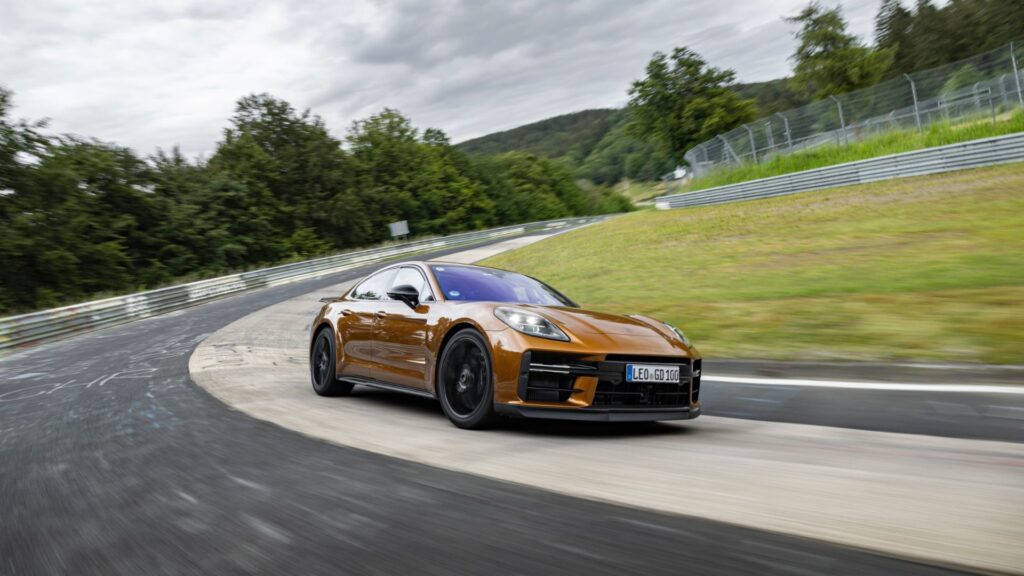
Pre-production Panamera broke previous record by 5.64 seconds, but the 911 GT2 RS still holds the 6-min crown.
Right before its launch, the new Panamera flagship demonstrated its capabilities on the Nürburgring Nordschleife. Under the guidance of Porsche test driver Lars Kern, a pre-production V8 hybrid version of this high-performance sedan completed the track 5.64 seconds quicker than the previous generation’s equivalent.
According to CarScoops, Porsche asserts that the Panamera, a four-door grand tourer, is the “fastest luxury car available with either a combustion or hybrid powertrain,” as the 911 GTS Hybrid (classified as a two-door grand tourer) ran it in 7:16.934 minutes.
The Panamera, despite having active suspension, carbon aero kit, and an adaptive four-way rear spoiler, is still a four-door saloon, so of course it’s in a different class comparatively speaking. Yet, there is a reason for the comparison, as you’ll see later on.

Porsche’s Gas Engines Still Hold the Crown
Kern, who has been the driver for the last two Nurburgring runs, previously set class records in 2016 and 2020 with the Panamera–the latter seeing a time of 7:29.81 minutes in the Panamera Turbo S.
“This is a very long track. This is even more of a challenge for a large and heavy car,” said Kern. “If we have mastered it here, we can go anywhere else, and it will work.”
Interestingly, the Porsche 911 GT2 RS still holds the record for fastest stock grand touring car around the ring at 6:43:300 in 2021 (though the Porsche 911 GT3 RS tried its damnedest to do so in 2022). Obviously, lower numbers look better, which is likely the reason the automaker compared the 911 GTS Hybrid with the 991.2 911 GT3’s time, which set a 7:12.7 lap back in 2017, instead of the 2022 Porsche 911 992 Carrera 4 GTS, which ran a 7:25.632.

Why the Panamera Hybrid’s Time Matters So Much
Which brings me to my point. Sure, 5.6 seconds is an impressive gain over the Turbo S (has an internal combustion engine) but it’s still not as impressive as the GT2 RS putting the Huracan Performante to shame. So why is this time so important?
It’s because while Porsche is on to something with its vision for the likes of the 911 and Panamera, it loosely highlights why electric vehicles, even pure EVs like the Rimac Nevera and Porsche Taycan, still have a way to go–at least when it comes to the high-performance sector. No matter how you slice it, raw combustion is still a major component in this Nurburgring feat.
So until AI advances battery tech significantly, not even pure EV vehicles (with all that instant torque) can best the robustness of a well-built ICE–even if that engine does use assistive electrical components.
The next logical step in advancing drivetrain/powertrain performance, at this time, is not a full adoption of EV, but intelligent hybridization.
Photos: Porsche
Join the Rennlist forums!

You must be logged in to post a comment.