


Anybody here fitted Cup car suspension to their turbo???

Thread Starter
|
Registered User
Joined: Oct 2008
Posts: 1,696
From: Portland Oregon
Rep Power: 188


Originally Posted by pwdrhound
I've set up a lot of suspensions on these cars and my guess is that the rears will be way too short even with the aluminum spacer you are using. A quick calculation tells me you'd need a spacer about 3" thick to get you where you need. The very limited shock travel /droop may present a handling issue with soft springs and a heavy car. You do not want to run out of travel in the rear as that will present dangerous mid corner snap oversteer. (always make sure you end up with more droop in the rear than the front!). Hope I'm wrong and it all works out without issues. Good luck...
As for the length difference, the H&R coils have a ton of droop. Something like 5" in the rear. However they are quite soft. And i intend to lower another ~1" rear and front. So then the question is, does shock length directly effect droop at a 1:1 ratio? Because the other factor we face is angular effects and the fact that the shock attaches ~5" inboard from the hubs and ~3" inboard from the control(pivot point). I definitely agree that thicker spacers are likely to be needed.
Now another question is, what are we calling an acceptable amount of suspension droop as a rule? Does the answer vary based on spring rate?

Registered User
Joined: Jul 2010
Posts: 4,848
Rep Power: 457
The amount of required droop is a function of spring rates, weight of the car, etc.. The softer the springs, the more droop (and suspension travel) you want. For obvious reasons, you must have more droop in the rear than in the front. The reverse of that would be dangerous. This is why you see such a large amount of droop in the rear of the H&Rs for example. Most people don't give droop any thought (most are frankly clueless of it's effects on suspension performance) but it's something you must pay attention to. For example, by simply raising the spring perches too much on the rear shocks to get more ride height, you will operating the shock outside of it's design range and reducing droop by default. Reduce it too much and you will have handling issues. You never ever want to allow your inside rear shock to run out of droop mid turn where the inside rear tire would loose contact with the ground. The result would be snap oversteer. With a heavy car, soft springs, and limited shock travel, this is doubly important. That's why suspension travel and droop is important and must not be overlooked. There is a lot more to it that just being able to bolt the suspension on the car. Ask your shop about suspension droop and it's importance and effects on performance. If you get the deer in the headlight look, I'd probably look for another shop.
Last edited by pwdrhound; Sep 15, 2016 at 11:34 AM.
Registered User

Joined: Mar 2009
Posts: 886
From: In my garage
Rep Power: 123
My 6.1 Cup shocks by Bilstein have a total length of 360 mm, measured from the end of the piston body (where it narrows and threads start) to the middle of heim joint at bottom. The body (without heim joint) is 220 mm and the piston 120mm. GT3's measurements (what I got elsewhere) are 430 / 230 / 170. So the max available piston travel (without bump stop) is 120mm (Cup) vs 170mm (GT3).
With spacer one can compensate the total length difference between OEM and Cup damper. It can also be used for crude rake/ride height adjustment and the finetune with coilovers. That's because it's between top of the damper and chassis. At front this can be done with sliding damper's body up or down in upright...
My spacers are 50mm, but I also have RSR'd subframes (drops chassis about F6 / R20 mm).
Yes, my main springs are F120 / R160 N/mm. Could be more, but IMO going up to Cup springs with street tires is not wise. Slicks that Cups ride on are much thicker/higher and act as springs themselves.
160 N/mm = 16 kg will compress the spring 1 mm. 1010 kg at rear will compress two springs 31mm each. Plus the helper that has compressed length of 32 mm and we have a total compression of 63 mm. Compression under load available: 57 mm (minus bump stop...must be used!). The springs I use have total length of 225 mm and 117 mm free travel, plus the bump stop, so the damper will not bottom. Any case bottoming (full compression) would require 3G vertical acceleration. Even then I have few mm more of droop than bump. Anyway I haven't noticed any snap oversteer yet, maybe I do not drive fast enough?
With spacer one can compensate the total length difference between OEM and Cup damper. It can also be used for crude rake/ride height adjustment and the finetune with coilovers. That's because it's between top of the damper and chassis. At front this can be done with sliding damper's body up or down in upright...
My spacers are 50mm, but I also have RSR'd subframes (drops chassis about F6 / R20 mm).
Yes, my main springs are F120 / R160 N/mm. Could be more, but IMO going up to Cup springs with street tires is not wise. Slicks that Cups ride on are much thicker/higher and act as springs themselves.
160 N/mm = 16 kg will compress the spring 1 mm. 1010 kg at rear will compress two springs 31mm each. Plus the helper that has compressed length of 32 mm and we have a total compression of 63 mm. Compression under load available: 57 mm (minus bump stop...must be used!). The springs I use have total length of 225 mm and 117 mm free travel, plus the bump stop, so the damper will not bottom. Any case bottoming (full compression) would require 3G vertical acceleration. Even then I have few mm more of droop than bump. Anyway I haven't noticed any snap oversteer yet, maybe I do not drive fast enough?
Thread Starter
|
Registered User
Joined: Oct 2008
Posts: 1,696
From: Portland Oregon
Rep Power: 188
Originally Posted by pete95zhn
My 6.1 Cup shocks by Bilstein have a total length of 360 mm, measured from the end of the piston body (where it narrows and threads start) to the middle of heim joint at bottom. The body (without heim joint) is 220 mm and the piston 120mm. GT3's measurements (what I got elsewhere) are 430 / 230 / 170. So the max available piston travel (without bump stop) is 120mm (Cup) vs 170mm (GT3).
With spacer one can compensate the total length difference between OEM and Cup damper. It can also be used for crude rake/ride height adjustment and the finetune with coilovers. That's because it's between top of the damper and chassis. At front this can be done with sliding damper's body up or down in upright...
My spacers are 50mm, but I also have RSR'd subframes (drops chassis about F6 / R20 mm).
Yes, my main springs are F120 / R160 N/mm. Could be more, but IMO going up to Cup springs with street tires is not wise. Slicks that Cups ride on are much thicker/higher and act as springs themselves.
160 N/mm = 16 kg will compress the spring 1 mm. 1010 kg at rear will compress two springs 31mm each. Plus the helper that has compressed length of 32 mm and we have a total compression of 63 mm. Compression under load available: 57 mm (minus bump stop...must be used!). The springs I use have total length of 225 mm and 117 mm free travel, plus the bump stop, so the damper will not bottom. Any case bottoming (full compression) would require 3G vertical acceleration. Even then I have few mm more of droop than bump. Anyway I haven't noticed any snap oversteer yet, maybe I do not drive fast enough?
With spacer one can compensate the total length difference between OEM and Cup damper. It can also be used for crude rake/ride height adjustment and the finetune with coilovers. That's because it's between top of the damper and chassis. At front this can be done with sliding damper's body up or down in upright...
My spacers are 50mm, but I also have RSR'd subframes (drops chassis about F6 / R20 mm).
Yes, my main springs are F120 / R160 N/mm. Could be more, but IMO going up to Cup springs with street tires is not wise. Slicks that Cups ride on are much thicker/higher and act as springs themselves.
160 N/mm = 16 kg will compress the spring 1 mm. 1010 kg at rear will compress two springs 31mm each. Plus the helper that has compressed length of 32 mm and we have a total compression of 63 mm. Compression under load available: 57 mm (minus bump stop...must be used!). The springs I use have total length of 225 mm and 117 mm free travel, plus the bump stop, so the damper will not bottom. Any case bottoming (full compression) would require 3G vertical acceleration. Even then I have few mm more of droop than bump. Anyway I haven't noticed any snap oversteer yet, maybe I do not drive fast enough?
Do you have pics of your car on a lift or jacks in the rear? And on the ground for comparison?
What ride height from fenders?
Also, which bump stop are you running?
Registered User
Joined: Mar 2009
Posts: 886
From: In my garage
Rep Power: 123
No problem. 
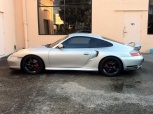
Just on ground, from last Time Trial three weeks ago, see below. NB and set to 6.1 GT3 ride height, measured from subframe points.
I'll measure tomorrow.
Way too difficult to remember...I did not document it...had several ones on the shop's table and chose ones that looked best and fitted inside the dust cap.
PS: That fugly Beemer behind is definetely not mine. It was used to tow a 991 GT3 on premises. The owner is cooling down after 40 years of racing. Is fastest of us all. 2.7 secs (on a 3 km track) faster than me. The guy that that came second was 1.1 sec slower than him, with his new GT4. Last year with 6.1 GT3 he was slower than me.
I'll measure tomorrow.
Way too difficult to remember...I did not document it...had several ones on the shop's table and chose ones that looked best and fitted inside the dust cap.
PS: That fugly Beemer behind is definetely not mine. It was used to tow a 991 GT3 on premises. The owner is cooling down after 40 years of racing. Is fastest of us all. 2.7 secs (on a 3 km track) faster than me. The guy that that came second was 1.1 sec slower than him, with his new GT4. Last year with 6.1 GT3 he was slower than me.
Last edited by pete95zhn; Sep 15, 2016 at 02:29 PM.
Registered User
Joined: Jul 2010
Posts: 4,848
Rep Power: 457
My 6.1 Cup shocks by Bilstein have a total length of 360 mm, measured from the end of the piston body (where it narrows and threads start) to the middle of heim joint at bottom. The body (without heim joint) is 220 mm and the piston 120mm. GT3's measurements (what I got elsewhere) are 430 / 230 / 170. So the max available piston travel (without bump stop) is 120mm (Cup) vs 170mm (GT3).
With spacer one can compensate the total length difference between OEM and Cup damper. It can also be used for crude rake/ride height adjustment and the finetune with coilovers. That's because it's between top of the damper and chassis. At front this can be done with sliding damper's body up or down in upright...
My spacers are 50mm, but I also have RSR'd subframes (drops chassis about F6 / R20 mm).
Yes, my main springs are F120 / R160 N/mm. Could be more, but IMO going up to Cup springs with street tires is not wise. Slicks that Cups ride on are much thicker/higher and act as springs themselves.
160 N/mm = 16 kg will compress the spring 1 mm. 1010 kg at rear will compress two springs 31mm each. Plus the helper that has compressed length of 32 mm and we have a total compression of 63 mm. Compression under load available: 57 mm (minus bump stop...must be used!). The springs I use have total length of 225 mm and 117 mm free travel, plus the bump stop, so the damper will not bottom. Any case bottoming (full compression) would require 3G vertical acceleration. Even then I have few mm more of droop than bump. Anyway I haven't noticed any snap oversteer yet, maybe I do not drive fast enough?
With spacer one can compensate the total length difference between OEM and Cup damper. It can also be used for crude rake/ride height adjustment and the finetune with coilovers. That's because it's between top of the damper and chassis. At front this can be done with sliding damper's body up or down in upright...
My spacers are 50mm, but I also have RSR'd subframes (drops chassis about F6 / R20 mm).
Yes, my main springs are F120 / R160 N/mm. Could be more, but IMO going up to Cup springs with street tires is not wise. Slicks that Cups ride on are much thicker/higher and act as springs themselves.
160 N/mm = 16 kg will compress the spring 1 mm. 1010 kg at rear will compress two springs 31mm each. Plus the helper that has compressed length of 32 mm and we have a total compression of 63 mm. Compression under load available: 57 mm (minus bump stop...must be used!). The springs I use have total length of 225 mm and 117 mm free travel, plus the bump stop, so the damper will not bottom. Any case bottoming (full compression) would require 3G vertical acceleration. Even then I have few mm more of droop than bump. Anyway I haven't noticed any snap oversteer yet, maybe I do not drive fast enough?
My point was, people don't pay any attention to the amount of suspension droop. You don't need to with an off the shelf suspension as they are designed with the correct amount of travel and a specified ride height. When running shocks with limited travel not designed for a particular application, it's easy to adjust the perches too high (to compensate for ride height) and then run out of droop without realizing it. The end result is a nasty tendency to snap oversteer when the car is highly loaded mid turn and the rear inside tire looses contact with the ground. Handling at the limit would be downright dangerous. Thankfully droop is easy to measure. Sounds like you've carefully measured everything out to make sure that's not the case. My JRZ Pros have 1.5" of droop in the front and 2.25" in the rear. If it was the reverse of that, handling would be ugly at the limit.
Pete, could you post the amount of droop you have front and rear? Easy to measure on a flat surface off of the fender. Just measure the difference in fender gap between the car sitting static and then 4 wheels off the ground. All 4 wheels must be at full droop so that the sway bars don't play a factor.
FYI, I've run just about every permutation of spring rates and find the car fastest and most composed on cup rates. I've run 450/600, 600/800, 700/800, 1000/1100, 1100/1200 and finally 1400/1500. I found 1100/1200 to be a great dual purpose street/track set up. The fastest laps were set on 1400/1500 however. Everything is sharper and more reactive and easier to control at the limit. Obviously it all depends on how aggressive one drives the car. I've discussed this with JRZ and the harmonics of a tire don't come into play until you get to rates of 1800+ lbs. At that point triples or quads are a must. I would not run Cup rates with street tires but they work extremely well with R compounds or slicks if you push the car at 9/10+. What various spring rates have you run on your car that to brought you to the conclusion that Cup rates would not work? Have you actually run them? What type and size tires are you running?
Last edited by pwdrhound; Sep 15, 2016 at 08:47 PM.
Thread Starter
|
Registered User
Joined: Oct 2008
Posts: 1,696
From: Portland Oregon
Rep Power: 188
[quote=pwdrhound]I think your measurements are spot on Pete, 50mm spacer with 20mm shorter RS subframes. That translates to 70mm spacer with TT subframes. That's pretty much dead on what I said earlier when I mentioned that the spacer should be roughly 3" (76mm). /quote]
The subframes have zero relationship to the droop of the suspension or spacers. The distance between the upper shock mount mounting point(body) and the rear spindle does not change based on subframe. The shorter subframe just corrects geometry of the control arms at the lower ride height. In fact changing the subframe should not in any circumstances change ride height. Now the spindle is another story in some cases.
The subframes have zero relationship to the droop of the suspension or spacers. The distance between the upper shock mount mounting point(body) and the rear spindle does not change based on subframe. The shorter subframe just corrects geometry of the control arms at the lower ride height. In fact changing the subframe should not in any circumstances change ride height. Now the spindle is another story in some cases.
Registered User
Joined: Jul 2010
Posts: 4,848
Rep Power: 457
[QUOTE=VAGscum;4561428]
You're right. My bad. I was thinking the measurement of ride height with respect to the factory measurement point which is taken with respect to the subframe. That will change but not the actual ride height.
Originally Posted by pwdrhound
I think your measurements are spot on Pete, 50mm spacer with 20mm shorter RS subframes. That translates to 70mm spacer with TT subframes. That's pretty much dead on what I said earlier when I mentioned that the spacer should be roughly 3" (76mm). /quote]
The subframes have zero relationship to the droop of the suspension or spacers. The distance between the upper shock mount mounting point(body) and the rear spindle does not change based on subframe. The shorter subframe just corrects geometry of the control arms at the lower ride height. In fact changing the subframe should not in any circumstances change ride height. Now the spindle is another story in some cases.
The subframes have zero relationship to the droop of the suspension or spacers. The distance between the upper shock mount mounting point(body) and the rear spindle does not change based on subframe. The shorter subframe just corrects geometry of the control arms at the lower ride height. In fact changing the subframe should not in any circumstances change ride height. Now the spindle is another story in some cases.
Thread Starter
|
Registered User
Joined: Oct 2008
Posts: 1,696
From: Portland Oregon
Rep Power: 188
Originally Posted by pwdrhound
You're right. My bad. I was thinking the measurement of ride height with respect to the factory measurement point which is taken with respect to the subframe. That will change but not the actual ride height.
Registered User
Joined: Jul 2010
Posts: 4,848
Rep Power: 457
No worries. I like these posts where we get deep into the nitty gritty. Very informative. I was also not considering the subframe measure points for ride height. So if ride height in relation to wheel well remains constant and you switch to the RS subframe the actual subframe measured ride height would actually be raised, no? Seeing the RS subframe mounts closer to the car's upper strut mount point. For my application I am keeping the stock turbo subframe and switching solid bushings. This raises my subframe ~8mm.

Thread
Thread Starter
Forum
Replies
Last Post
PelicanParts.com
964 Turbo
0
Aug 18, 2015 03:56 PM
PelicanParts.com
993 Turbo Vendor Classifieds
0
Aug 18, 2015 03:55 PM
PelicanParts.com
991 Turbo Vendor Classifieds
0
Aug 18, 2015 03:47 PM
PelicanParts.com
996 Turbo Vendor Classifieds
0
Aug 18, 2015 03:43 PM

