


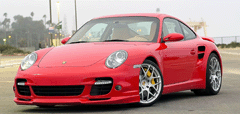
Pics & Review of My Bilstein PSS10 Lowered Red Turbo


Thread Starter
|
Registered User
Joined: Dec 2006
Posts: 3,116
From: Palos Verdes
Rep Power: 256


Thanks Mike. So did you tell them or did West End and BBI independently of each other decide to set your car with toe-out?
If so, that's very interesting. We would then have 3 premier tuning houses in Southern Cal. agreeing on the one alteration to the stock setting, which is slight toe out to provide better rotation/throttle controlled oversteer. I also notice that it makes the steering response much quicker. Sharper and more responsive, and more like that of the GT2.
(I once again must remind fellow sports car fans that with stiffer coilover and alignment changes of front neg camber and slight toe-out, the Turbo is transformed into something much closer to GT2's behavior. Night and day more fun and aggressive. My next experiment: cup tires! Review to come when it stops raining here in Southern Cal.)
BTW, minor correction to above: 1 degree = 60 minutes (not second). 1 minute of course = 60 seconds.
Also, btw the table I have above has some mislabeling itself, minute is one apostrophe, not 2, that's second. If I don't make any sense at all, I understand.
 I posted the conversion table/formula because sometimes toe setting is given in inches/mm, and you need that to convert angle to distance.
If so, that's very interesting. We would then have 3 premier tuning houses in Southern Cal. agreeing on the one alteration to the stock setting, which is slight toe out to provide better rotation/throttle controlled oversteer. I also notice that it makes the steering response much quicker. Sharper and more responsive, and more like that of the GT2.
(I once again must remind fellow sports car fans that with stiffer coilover and alignment changes of front neg camber and slight toe-out, the Turbo is transformed into something much closer to GT2's behavior. Night and day more fun and aggressive. My next experiment: cup tires! Review to come when it stops raining here in Southern Cal.)
BTW, minor correction to above: 1 degree = 60 minutes (not second). 1 minute of course = 60 seconds.
Also, btw the table I have above has some mislabeling itself, minute is one apostrophe, not 2, that's second. If I don't make any sense at all, I understand.
I posted the conversion table/formula because sometimes toe setting is given in inches/mm, and you need that to convert angle to distance.Last edited by cannga; Feb 17, 2009 at 11:19 AM.
Registered User
Joined: Feb 2009
Posts: 463
From: London, UK
Rep Power: 66
Hey Cannga!!
So how does this compare to my settings?
Stock:

(I am not sure about that stock Turbo front camber setting though. Would make more sense to me if it were negative not positive).
Winter:

Summer:

So how does this compare to my settings?
Stock:
(I am not sure about that stock Turbo front camber setting though. Would make more sense to me if it were negative not positive).
Winter:

Summer:

Last edited by Alex_997TT; Feb 17, 2009 at 11:34 AM.
Registered User
Joined: Feb 2009
Posts: 463
From: London, UK
Rep Power: 66
By the way, I think I might dial out even more camber for next winter. The car is not gripping in a straight line below 7 deg C right now.
Chris apparently worked some magic with Nick S's 700bhp car last week for straight line grip and stability, so I will consult with Chris shortly on this.
Nick was doing a Purely Porsche magazine piece with some other modified Turbos and so he needed a good drag-strip setup for the organized track meet. Will be interesting to see how he got on.
Chris apparently worked some magic with Nick S's 700bhp car last week for straight line grip and stability, so I will consult with Chris shortly on this.
Nick was doing a Purely Porsche magazine piece with some other modified Turbos and so he needed a good drag-strip setup for the organized track meet. Will be interesting to see how he got on.
Last edited by Alex_997TT; Feb 17, 2009 at 11:36 AM.
Thread Starter
|
Registered User
Joined: Dec 2006
Posts: 3,116
From: Palos Verdes
Rep Power: 256
Hey Alex, and thanks for the table. Yes excessive front camber could cause problem with front tire grip and loss of traction while on a straightline. In your case, I don't think the camber is excessive per se, but in combination with the increase power that your car has and the low temp, maybe it is?
Now that I think about it, I do find it odd that an AWD car with traction control would lose grip. Why wouldn't traction control intervene and brake the wheel losing grip? Strange, isn't it?
As mentioned on the rennteam thread, I've found it important that tire is set to ZERO on the TPMS differential reading obtained by the steering column stalk, especially on a Bilstein car. I also asked this question on the other thread that I don't know if you notice:
https://www.6speedonline.com/forums/...eply&p=2264497
Excessive camber will also reduce the available straight-line grip required for rapid acceleration and hard stops.
Now that I think about it, I do find it odd that an AWD car with traction control would lose grip. Why wouldn't traction control intervene and brake the wheel losing grip? Strange, isn't it?
As mentioned on the rennteam thread, I've found it important that tire is set to ZERO on the TPMS differential reading obtained by the steering column stalk, especially on a Bilstein car. I also asked this question on the other thread that I don't know if you notice:
https://www.6speedonline.com/forums/...eply&p=2264497
Excessive camber will also reduce the available straight-line grip required for rapid acceleration and hard stops.
By the way, I think I might dial out even more camber for next winter. The car is not gripping in a straight line below 7 deg C right now.
Chris apparently worked some magic with Nick S's 700bhp car last week for straight line grip and stability, so I will consult with Chris shortly on this.
Nick was doing a Purely Porsche magazine piece with some other modified Turbos and so he needed a good drag-strip setup for the organized track meet. Will be interesting to see how he got on.
Chris apparently worked some magic with Nick S's 700bhp car last week for straight line grip and stability, so I will consult with Chris shortly on this.
Nick was doing a Purely Porsche magazine piece with some other modified Turbos and so he needed a good drag-strip setup for the organized track meet. Will be interesting to see how he got on.
Registered User
Joined: Feb 2009
Posts: 463
From: London, UK
Rep Power: 66
I spoke with Chris again and he gave me Nick's setup and said even at 0 deg C and 700bhp his car was now glued to the road under acceleration.
Nick has more neg camber on the Front but almost full neg toe. On the back he has less neg camber and again more neg toe.
I am going to grow my table with everyones settings next to each other I think. Should make it easier to compare...
Nick has more neg camber on the Front but almost full neg toe. On the back he has less neg camber and again more neg toe.
I am going to grow my table with everyones settings next to each other I think. Should make it easier to compare...
Thread Starter
|
Registered User
Joined: Dec 2006
Posts: 3,116
From: Palos Verdes
Rep Power: 256

All you need to know about springs -- just kidding, only some basic amateur level info here; any expert feel free to correct or add as needed.
First the picture: left is Bilstein coilover, right is the TechArt spring. Both are for the rear and come from eclou's excellent thread on Bilstein installation. BTW, this thread was (is?) for a long time the first thing that comes up when you google something like "Porsche Bilstein PSS10".
Note that the TechArt spring is progressive: You could tell by the variable distances between the coils. A progressive spring has two rates, an initial one which is soft, and a final one which is stiffer. This allows a soft and more comfortable rate at first and then a change to a second rate that is stiffer.
I don't want to make this too complicated so I'll stop here but actually there is a further differentiation into step linear spring versus progressive spring. If interested you could read about it here: http://www.tuninglinx.com/html/suspension-springs.html
The Bilstein has 2 stacked springs, a main spring and a second, smaller one. The main spring is linear -- one rate only. The main spring of the Bilstein is of "standard" size and therefore allows you to switch and experiment with different springs and rates easily; replacement springs don't have to be Bilstein. It's a controversial topic, but linear springs are more likely to be found in track applications; google "linear progressive spring" to find out more.
The second spring of the Bisltein is called the Helper Spring. It is fully compressed once installed and therefore does not contribute to the spring rate. The spring rate of the 2 stacked springs is in effect that of the main linear spring.
So if the Helper Spring is fully compressed, why do we need it at all? It's there to hold the main spring in place (its seat) during full extension of the coilover -- think airborne as an extreme example. This prevents the spring from making noise when you're having fun (er yes I think airborne = having fun ).
What does this all mean in real life terms? If you were to compare the responses of progressive TechArt to linear Bilstein, it's very possible that the TechArt will take street obstacles a little softer/better. The disadvantage of the TechArt is that it would lean/squat/dive more than the Bilstein for the same reason, and that its response is non-linear, which could be good or bad depending on whom you are talking to.
Thread Starter
|
Registered User
Joined: Dec 2006
Posts: 3,116
From: Palos Verdes
Rep Power: 256
More spring info than you'd ever want  : The second spring in a 2 stacked springs setup could be "helper" as discussed above, or "tender." The term depends on the function of the spring.
Tender Spring: If the second spring is NOT fully compressed with static load, it is no longer called Helper Spring. It's now a Tender Spring and this stacked springs setup is now much different. A tender spring is actually much stiffer than a helper spring and by definition is not in total bind (fully compressed) like the helper spring at static load when car is not moving.
How is the setup different? It now has 2 effective spring rates, an initial rate, and a second rate. If the main spring rate is a, and the second spring rate is b, then:
Intial rate = b x (a/a + b) (someone checks the math for me )
)
Final rate = a
If you are thinking wait a minute, isn't this just like a progressive spring? Bingo. To make matters more interesting, I have even read that the tender spring could itself be either linear or progressive.
BTW, all after-market coilovers for the Turbo that I've seen have similar configuration to the Bilstein: stacked springs. In the Bilstein, the second spring is a Helper; whether it is Tender or Helper in these other setups, I don't know. I remember reading JIC Cross has a spring rate of 900+ in the rear (extremely high) and keep wondering if it is in fact a Main + Tender setup.
: The second spring in a 2 stacked springs setup could be "helper" as discussed above, or "tender." The term depends on the function of the spring. Tender Spring: If the second spring is NOT fully compressed with static load, it is no longer called Helper Spring. It's now a Tender Spring and this stacked springs setup is now much different. A tender spring is actually much stiffer than a helper spring and by definition is not in total bind (fully compressed) like the helper spring at static load when car is not moving.
How is the setup different? It now has 2 effective spring rates, an initial rate, and a second rate. If the main spring rate is a, and the second spring rate is b, then:
Intial rate = b x (a/a + b) (someone checks the math for me
)Final rate = a
If you are thinking wait a minute, isn't this just like a progressive spring? Bingo. To make matters more interesting, I have even read that the tender spring could itself be either linear or progressive.
BTW, all after-market coilovers for the Turbo that I've seen have similar configuration to the Bilstein: stacked springs. In the Bilstein, the second spring is a Helper; whether it is Tender or Helper in these other setups, I don't know. I remember reading JIC Cross has a spring rate of 900+ in the rear (extremely high) and keep wondering if it is in fact a Main + Tender setup.
Last edited by cannga; Mar 16, 2009 at 08:40 PM.
Thread Starter
|
Registered User
Joined: Dec 2006
Posts: 3,116
From: Palos Verdes
Rep Power: 256
The alignment changes in my Turbo are geared largely, almost singularly, towards reducing understeer. Following is a nice discussion why cars understeer or oversteer: http://www.autozine.org/technical_sc...handling_4.htm . The concept of slip angle is explained and emphasized.
(Found on the net:If you see the tree before you hit it it's called understeer; if you only hear and feel the tree it's oversteer. ) Anyway, here's part of the article:
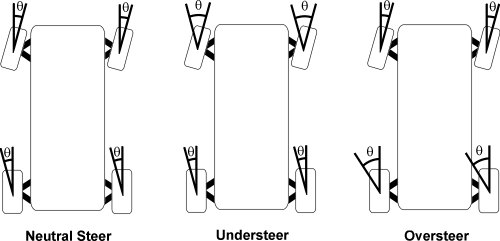
Neutral / Understeer / Oversteer
 Note : the car is turning left
(Found on the net:If you see the tree before you hit it it's called understeer; if you only hear and feel the tree it's oversteer.
) Anyway, here's part of the article:Neutral / Understeer / Oversteer
- We often hear these 3 terms in car magazines. I think few people would argue if I say they are the most important elements in the study of handling. What is understeer ? Basically, if you turn the steering wheel and find the car steers less than you expect, the car is understeering. This is not because your subjective judgement goes wrong, in fact any car must have some degree of non-neutral steering due to the weight distribution, suspension design, tyre used, lateral acceleration and road conditions. Further more, a car could understeer in this corner and then oversteer in that corner. The whole picture is very complicated, so I'll spend more paragraphs to discuss this topic.
What do we need ?
It seems that neutral steer must be more desirable than understeer and oversteer, but in fact it is not. In fact, when running in straight line, we want a little bit understeer to make the car stable. When the car is subjected to side force, probably due to cross wind or the road's irregularities, understeer could resist the force and avoid the car to be steered automatically, therefore the driver need not to correct the steering frequently.
When the car is entering a corner, we also need a light understeer to provide the stability while the driver is easing off the brakes and building up cornering force. In mid corner, we need neutral steer. In the exit phase, a slight oversteer will be welcomed as it helps tightening the path. However, the degree of oversteer must be progressive and easily controllable by applying and easing throttle. We call this "Power Oversteer". Without power oversteer, we have to ease the throttle (thus loss time) or the car will run out of the corner.
However, I must make clear that what I say "slight understeer / oversteer" is usually deemed to be "near neutral steer" by most car magazines. This is because in reality there are too many cars running on severe understeer thus they used to them. In other words, if a car magazine said the Porsche 996 has mild understeer, it probably equals to "medium understeer" in our sense.
Basic Concept : Slip Angle
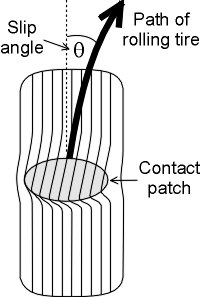
Before going on our study, we must understand the concept of slip angle first. When a car enters a corner, all the tyres are turned with respect to the ground. Due to the elasticity of the pneumatic tyre, the tread in the contact patch will resist the turning action because there is friction generated between the rubber and the road surface. As a result, the treads on the contact patch will be distorted, whose direction always lags behind the direction of the wheel ( See figure in below ). We call the angular difference between the treads and the wheel's direction as Slip Angle.
Note : the car is turning left- In which direction the wheel is running ? It is the direction of the tread, not the direciton of the wheel. I am not saying the tread has any ability to force the wheel to travel in its direction. On the contrary, the tread is only a sign showing how an arbitrary point on the tyre surface travels. If the arbitrary point travels in that direction, so does the wheel which is the summation of thousands of those points. Now you must think the existence of slip angle must reduce the car's steering angle thus leads to understeer. In fact, it is not so if everything else are perfect. Because both the front and rear tyres have more or less the same slip angles, they counter each other thus the resulting steering angle remains unaltered.
However, if the front and rear wheels have different slip angles, then we get understeer and oversteer :- Understeer : Front Slip Angle > Rear Slip Angle
- Oversteer : Front Slip Angle < Rear Slip Angle
Neutral steer : Front Slip Angle = Rear Slip Angle
Registered User
Joined: Sep 2007
Posts: 774
From: Ohio
Rep Power: 57
Beautiful Turbo! Love the G. red, the interior (same as mine), wheels, suspension, but I have to say that I like the stock lip better then the TA piece...I don't know why...maybe its just a little more simple. Great ride none the less! Congrats