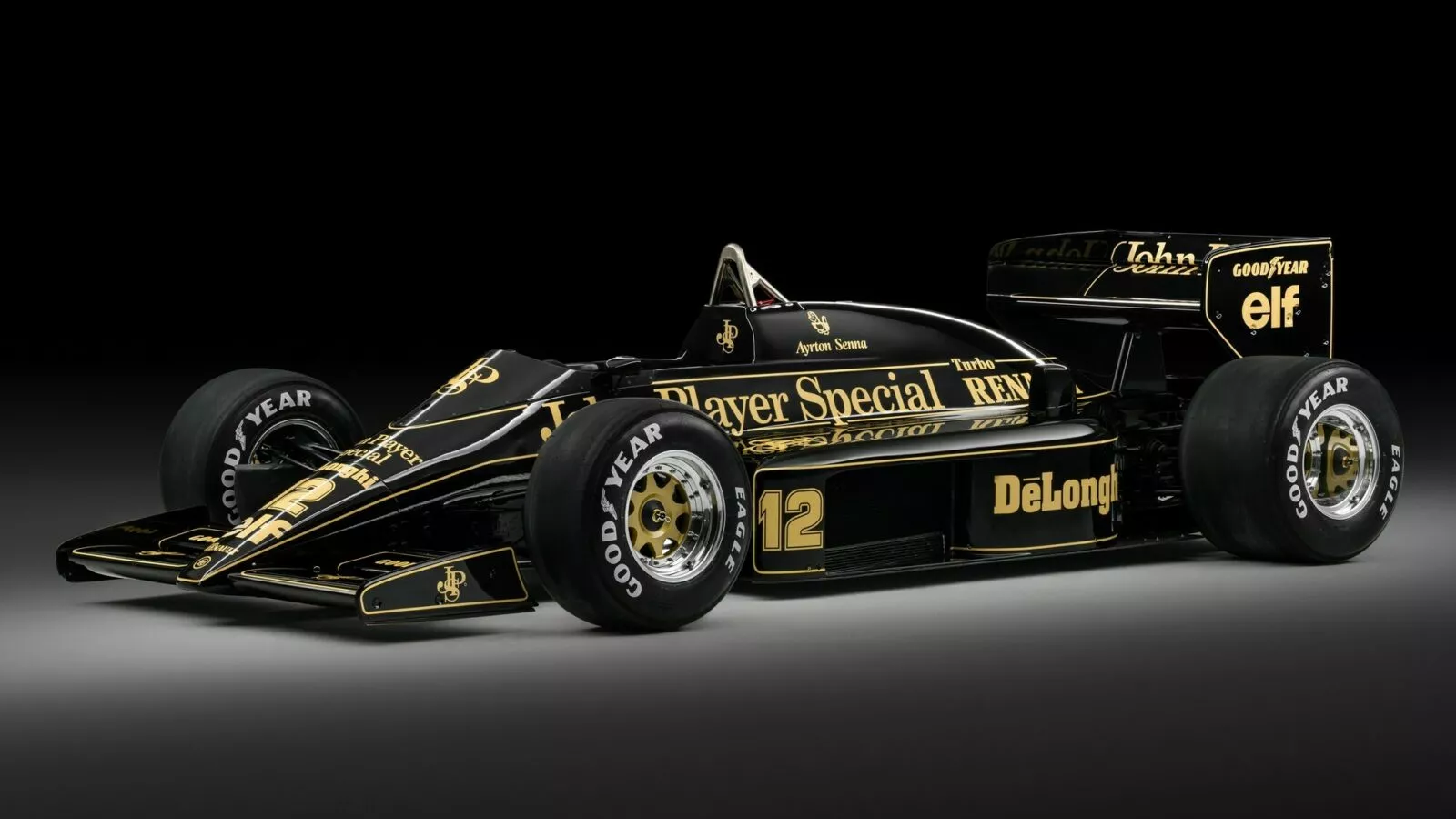
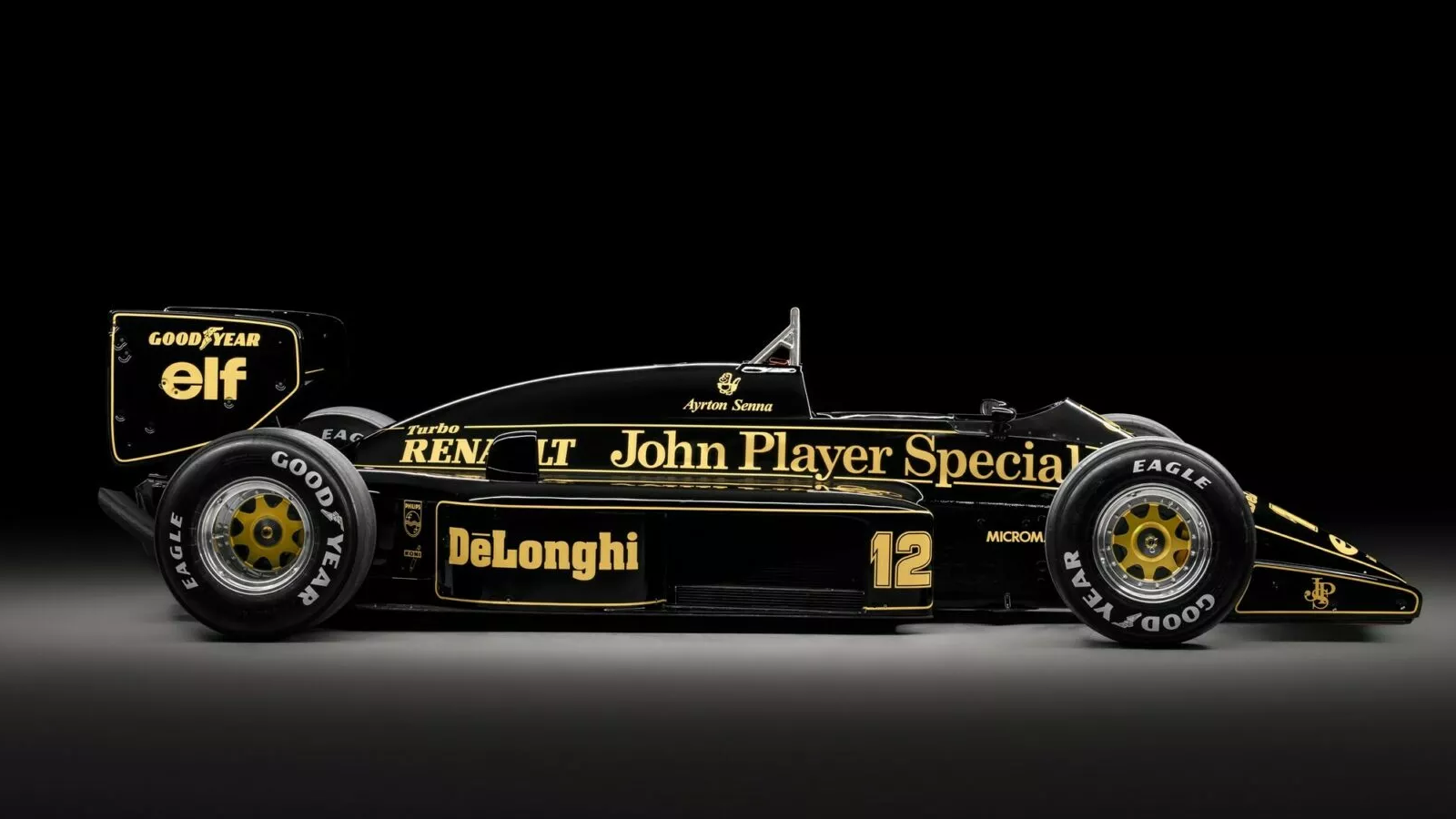
Chassis 98T-3, driven to two victories and five poles in 1986, could become the most valuable Lotus ever sold.
Turbo Icon
A fully operational 1986 Lotus 98T once raced by Ayrton Senna is set to cross the auction block, with estimates that could place it among the most expensive Lotus cars ever sold. The car, chassis 98T-3, represents the high-water mark of Formula 1’s turbocharged era, an era defined by staggering power outputs, minimal electronic oversight, and drivers required to manage both.
Source: RM Sotheby's
Black and Gold Era
Built for the 1986 Formula One World Championship, the 98T wore the unmistakable black-and-gold John Player Special livery that has become inseparable from Lotus’ 1980s identity. Visually, it remains one of the defining shapes of mid-1980s F1, low, angular, and aggressive, with towering rear wing endplates and tightly packaged sidepods designed around its turbocharged powerplant.
Senna's Sophomore Campaign
Senna was in his second season with Lotus in 1986, and while he is most often associated with his later success at McLaren, his Lotus years cemented his reputation as a qualifying master and wet-weather virtuoso. He finished on the podium in every full F1 season he competed in, and 1986 showcased his ability to wring performance from a car that could be brutally unforgiving.
1,200 Horsepower Qualifying Runs
At the heart of the 98T was Renault’s 1.5-liter EF15B turbocharged V6. In race trim, the engine produced roughly 900 horsepower, already an extraordinary figure for a car weighing just over 500 kilograms. But qualifying was another matter entirely.
Unlimited Boost
With no effective power restrictions in place, teams increased boost pressure dramatically for single-lap runs. In this configuration, the 98T’s output approached 1,200 horsepower. Turbochargers were reportedly pushed so hard they were expected to survive only a lap or two. Lotus even prepared different gearbox components specifically to withstand the additional stress during qualifying sessions. The engine revved to approximately 12,500 rpm, sending all of its force to the rear wheels through a manual gearbox, no traction control, no hybrid assistance, just mechanical grip and driver input.
Senna’s Most Successful Lotus
Chassis 98T-3 was driven exclusively by Senna during the first half of the 1986 season. In that span, he secured five pole positions, two victories, and three additional podium finishes with this very car. His wins came in Spain and the United States, during a season-long battle against rivals including Nigel Mansell, Alain Prost, and Nelson Piquet.
Qualifying Beast
Those statistics make 98T-3 the most successful Lotus chassis Senna drove during his three-year tenure with the team. At a time when qualifying pace could define a weekend, Senna’s ability to control immense turbo boost pressures over a single lap became one of his defining traits.
Preserved and Restored
Unlike many former Formula 1 cars that have been stripped of their original engines or converted into static display pieces, this example retains its original Renault V6. It remains fully operational.
The car was purchased directly from Lotus in 1988 and has since passed through several respected motorsport collections. It has been in its current ownership since 2016 and recently underwent a detailed restoration by Lanzante, a firm known for preparing significant competition machinery. The restoration was described as comprehensive, with the car prepared for potential track use rather than static exhibition.
A Turbo-Era Benchmark
The auction, handled by RM Sotheby's, is expected to see bids in the region of £7–9 million, with some projections placing the upper estimate closer to $12 million. If achieved, that figure would place it among the most valuable Lotus competition cars ever sold.
A Balance Of Trail And Street
Beyond its monetary value, the 98T-3 represents a specific moment in Formula 1 history, when engineering excess met minimal regulation, and drivers like Senna balanced throttle, boost, and bravery on every lap. Few surviving machines combine that level of performance, documented race success, and intact mechanical authenticity. For collectors, it is a rare opportunity. For historians, it is a preserved fragment of Formula 1’s most extreme technical chapter.