


Flat tires/options

Registered User
Joined: May 2010
Posts: 2,806
From: Dallas
Rep Power: 176


ChuckJ


Moderator

Joined: May 2004
Posts: 4,962
From: South Bend, IN
Rep Power: 241
While I can't find fault with most of what is in that post, I think the quoted paragraph needs some supporting documentation. i.e. - some actual examples of how the N rated variant of a tire differs from the generic version. Show me how the N rated version grips and stops better than the generic on a Porsche car. Show me the additional performance to support the additional cost.
My main question about this is why an N rated tire gets the same 'model' name as the non N rated version? Why have a P Zero or PS3 with an N rating if they are substantially different? Why not just call them Porsche Tires or something less confusing?
Sorry, I still need to be convinced of the differences. Coming from the company that really knows how to squeeze profit from anything, can you blame me for being suspicious?
My main question about this is why an N rated tire gets the same 'model' name as the non N rated version? Why have a P Zero or PS3 with an N rating if they are substantially different? Why not just call them Porsche Tires or something less confusing?
Sorry, I still need to be convinced of the differences. Coming from the company that really knows how to squeeze profit from anything, can you blame me for being suspicious?
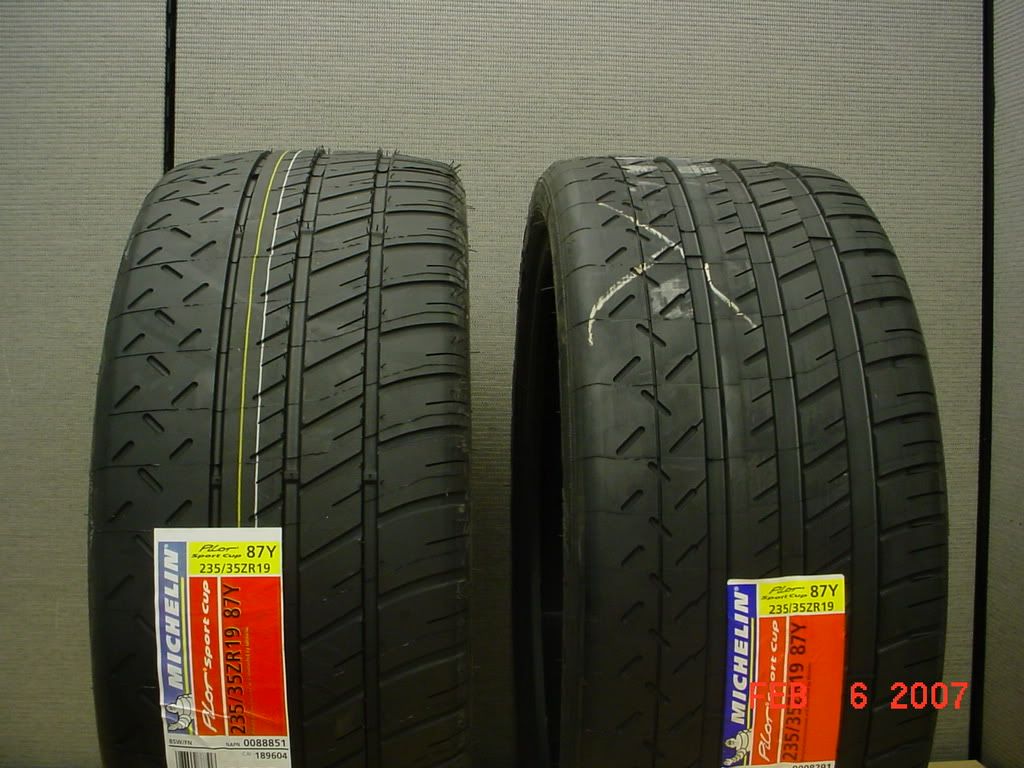
You can clearly see the two tread designs are different, but there could also be (and likely is but they won't tell us) tread compound changes from one side of the tire to the other as well.
The Michelin engineer I spoke with summed it up best:
Assuming you have N rated tires up front. If you have a proper N rated matching tire out back, it's going to give you far more feedback and the grip will be more progressive than if you had a non - N rated tire. One combo will let you drive them to 100% of their ability, and one won't.
Is it OK to mix N rated with non N rated? Not if you expect to get 100% of the tire's performance out of it. Will it hurt the car to run non N-Spec tires. No. People ask me all the time if you can tell the difference between the OEM and replacement version and my answer is the same: If you drive the car to 50% of its cabibility, probably not. But if you drive the car at the level it was designed to perform, there is a difference in N rated tires. The truth of the matter is that most people who have the cars don't see anywhere near the car's limits, especially outside of track gates. It's also why folks who see Autobahn driving are much more likely to buy the recommended tires!
Porsche isn't the only one playing a crucial role in the OE tire's production by the way. Mercedes, BMW, GM, and Dodge all do it for other select models.
__________________
damon@tirerack.com
877-522-8473 ext. 4643
574-287-2345 ext. 4643
**Don't forget to add my name to online orders!**
Or use this link:
http://www.tirerack.com/a.jsp?a=BH1&url=index.jsp
damon@tirerack.com
877-522-8473 ext. 4643
574-287-2345 ext. 4643
**Don't forget to add my name to online orders!**
Or use this link:
http://www.tirerack.com/a.jsp?a=BH1&url=index.jsp

Registered User
Joined: Nov 2008
Posts: 387
From: NYC Metro
Rep Power: 49
Thanks Damon. That is helpful and I appreciate someone who knows tires chiming in.
I'm not looking to understand the differences in how N rated tires are constructed, but I would like to understand how their performance exceeds that of the non N rated versions. It would be great if it could be quantified in a test. Would make for a good magazine article.
Any thoughts on the supply chain issues that Porsche has been having with N rated tires for the 991 in Europe? Are we seeing the same issue here in the US?
I'm not looking to understand the differences in how N rated tires are constructed, but I would like to understand how their performance exceeds that of the non N rated versions. It would be great if it could be quantified in a test. Would make for a good magazine article.
Any thoughts on the supply chain issues that Porsche has been having with N rated tires for the 991 in Europe? Are we seeing the same issue here in the US?

Registered User
Joined: Jul 2005
Posts: 529
From: Home of the Lakers
Rep Power: 0
Thanks Damon. That is helpful and I appreciate someone who knows tires chiming in.
I'm not looking to understand the differences in how N rated tires are constructed, but I would like to understand how their performance exceeds that of the non N rated versions. It would be great if it could be quantified in a test. Would make for a good magazine article.
Any thoughts on the supply chain issues that Porsche has been having with N rated tires for the 991 in Europe? Are we seeing the same issue here in the US?
I'm not looking to understand the differences in how N rated tires are constructed, but I would like to understand how their performance exceeds that of the non N rated versions. It would be great if it could be quantified in a test. Would make for a good magazine article.
Any thoughts on the supply chain issues that Porsche has been having with N rated tires for the 991 in Europe? Are we seeing the same issue here in the US?

Registered User
Joined: Oct 2007
Posts: 233
From: Connecticut
Rep Power: 30
There is no good answer. I carry a plug kit (pull out the nail/screw and push in rubber string to plug the tire). Illegal for tire shops to use today, new law is that tires must be patched from the inside. However, I'd rather plug the tire than have any tire shop try to dismount a tire from a very expensive Porsche wheel. Then limp home and fix it right at the dealer (who won't patch internally either). The Porsche repair kit sometimes works but not always. Like I said, no good answer - I've had three flats in the last five years.

Registered User
Joined: May 2009
Posts: 107
From: San Diego, CA
Rep Power: 22
I had two flats in the rear tires of my 997GT2, one on each side, at different times. Both times on long-distance trips. Both times I noticed the flat the next morning in the parking lot. The first time the leak was slow enough that I was able to drive the car for about 200 miles to Lake Tahoe, my next destination. I always carry a handpump. I stopped every hour to pump up the tire and kept watching the TPM while driving. I called ahead to the Porsche dealer in Reno. The next day I drove to Reno and had the tire changed.
The second time was in Zion National Park. For that one I needed to use the tire sealant goop since the tire had a rather large screw embedded in the tread. I called the Porsche dealer in Las Vegas for a new tire. The sealant worked well while puttering around the park and to Bryce. Three days later I drove to Las Vegas on my way home to San Diego. All was fine until I had covered a few miles on I15 at too high a speed. I kept up with traffic and should have heeded the recommendation of not exceeding 55 mph. At about 75 the srew came out and the tire deflated in seconds. No drama, the car was rocksolid. I took an exit about 1/8 of a mile ahead, stopped and called Porsche Roadside Assistance. They sent out a truck in a very short time with a low-bed trailer and a competent operator. Porsche in Las Vegas replaced the tire and we were on our way.
In both cases it took the dealer one day to get the tire from the warehouse.
The second time was in Zion National Park. For that one I needed to use the tire sealant goop since the tire had a rather large screw embedded in the tread. I called the Porsche dealer in Las Vegas for a new tire. The sealant worked well while puttering around the park and to Bryce. Three days later I drove to Las Vegas on my way home to San Diego. All was fine until I had covered a few miles on I15 at too high a speed. I kept up with traffic and should have heeded the recommendation of not exceeding 55 mph. At about 75 the srew came out and the tire deflated in seconds. No drama, the car was rocksolid. I took an exit about 1/8 of a mile ahead, stopped and called Porsche Roadside Assistance. They sent out a truck in a very short time with a low-bed trailer and a competent operator. Porsche in Las Vegas replaced the tire and we were on our way.
In both cases it took the dealer one day to get the tire from the warehouse.

Registered User
Joined: Jun 2009
Posts: 1,277
From: ATL
Rep Power: 72
Sidewall damage in remote location: think several hours stuck roadside - several hours ride to dealer in tow truck - overnight in hotel - lucky if you are back on the road in 24 hours. On the weekend? You are f'd - impromptu vacation...on foot. But thank goodness you have RA or it would be $500-$1000 of towing charges to add insult to injury.
Is this sort of adventure something the car was not really meant for? I suppose so.
Is this sort of adventure something the car was not really meant for? I suppose so.
Registered User
Joined: May 2009
Posts: 107
From: San Diego, CA
Rep Power: 22
I agree, a flat in the boonies that can't be temporarily fixed with either the sealant or a fixit-kit using a plug (I always carry one in the car but have never used it -- not sure how successful I'd be if I had to use it) can be real pain. On the other hand, if I carried a spare there wouldn't be enough luggage space to go on a trip to the boonies in the first place. So, for me, it's been a choice between taking the car on trips to remote places -- mostly for the fun of driving -- with the risk of getting stranded with a bad tire or not taking the trips at all. I've come down on the side of taking the trips without a spare. Have been lucky in more than 20 years of doing this of never getting seriously stranded.
A space-saver spare is no answer. Where do you put the full-size wheel with its flat after you've mounted the space saver on the car? If you are full up with luggage you'd have to leave the wheel or your passenger by the roadside. I first realized this problem in the '80s when taking a Testarossa on long trips with my wife. It had a space-saver spare, but in case of a flat the regular wheel wouldn't have fit anywhere but the passenger seat. I would have had to leave either the wheel or my wife by the roadside. Conclusion: I took the risk of going without the spare and filling the space it took up in the trunk with additional luggage, making my wife happy. Have been doing this ever since with my performance cars.
A space-saver spare is no answer. Where do you put the full-size wheel with its flat after you've mounted the space saver on the car? If you are full up with luggage you'd have to leave the wheel or your passenger by the roadside. I first realized this problem in the '80s when taking a Testarossa on long trips with my wife. It had a space-saver spare, but in case of a flat the regular wheel wouldn't have fit anywhere but the passenger seat. I would have had to leave either the wheel or my wife by the roadside. Conclusion: I took the risk of going without the spare and filling the space it took up in the trunk with additional luggage, making my wife happy. Have been doing this ever since with my performance cars.
Registered User
Joined: Nov 2008
Posts: 387
From: NYC Metro
Rep Power: 49
Sidewall damage in remote location: think several hours stuck roadside - several hours ride to dealer in tow truck - overnight in hotel - lucky if you are back on the road in 24 hours. On the weekend? You are f'd - impromptu vacation...on foot. But thank goodness you have RA or it would be $500-$1000 of towing charges to add insult to injury.
Is this sort of adventure something the car was not really meant for? I suppose so.
Is this sort of adventure something the car was not really meant for? I suppose so.



Registered User
Joined: Feb 2012
Posts: 1,479
From: New Jersey
Rep Power: 102
My dealer told me that Porsche does not believe in run flats.

Registered User
Joined: Feb 2012
Posts: 46
From: Canada
Rep Power: 16
Is this problem with performance cars only? I had a merc before this and never thought of these things. took long trips and thank God no issues in the last 5 years. had a spare though but never used it. Is it the same probability of a flat with the porsche or higher?

Registered User
Joined: Feb 2010
Posts: 148
From: Dallas TX
Rep Power: 27
What would you like to change in order to have a spare tire? A bigger car? Smaller, narrower wheels and tires maybe? How about give up the structural integrity of the front-end crumple zone? You could always raise the car's ride height and mount it underneath. Or you could change the gasoline tank to two gallons. You could change to run-flat tires and get a lot of road noise and rough ride and instability at high speeds. Or you could completely redesign the looks and put a "lump" somewhere that holds a spare. Come up with a modification that withstands the criticism of the other people on this forum.
If you are worried about a flat tire, take a spare when you feel most insecure and give up something else you intended to take, like a passenger or luggage. Or play the odds like most people successfully do. But if you put your complaints on the internet, expect to find plenty of anecdotes where someone had bad luck. And if you are really paranoid, find a way to carry two spares in case one is not enough. Or three. Or four.
If you are worried about a flat tire, take a spare when you feel most insecure and give up something else you intended to take, like a passenger or luggage. Or play the odds like most people successfully do. But if you put your complaints on the internet, expect to find plenty of anecdotes where someone had bad luck. And if you are really paranoid, find a way to carry two spares in case one is not enough. Or three. Or four.