


Differences between different years for the 996TTs?


Registered User

Joined: Oct 2006
Posts: 2,040
From: Seattle
Rep Power: 130


01's had no glovebox, early 01's had heavy solid wheels and bumperettes (warts) on the front. 01's also have been rumorder to be lighter. Nothing bad about the early models IMO
Do a SEARCH and you should find plenty of posts on this subject.
Do a SEARCH and you should find plenty of posts on this subject.
Registered User
Joined: Jan 2006
Posts: 3,272
From: California
Rep Power: 161
Launched at the Frankfurt Motor Show in October 1999, the new 911 Turbo boasted twin blowers and full-time four-wheel drive, much like its predecessors. It featured a number of important developments from normally aspirated 911's, ride-height being set 10mm lower on mildly re-rated springs and dampers. Thicker anti-roll bars were fitted all round whilst track got substantially widened, partly by way of new 18-inch alloy wheels that measured 8 and 11-inches across front / rear respectively
Perhaps the most significant arrival was ceramic composite brake discs which were an optional extra, Porsche becoming the first manufacturer to incorporate these onto a full production road car. As standard, Turbo's came equipped with the same 330mm cross-drilled and ventilated steel discs fitted to the MkI GT3 plus identical four-piston aluminum monobloc calipers. Also included was the Porsche Stability Management (PSM) fitted to all four-wheel drive 911's. Engine-wise, the new car incorporated a turbocharged version of the GT1-derived 3.6-litre unit that in normally-aspirated trim had also powered the GT3. It shared the block, pistons, head castings, smaller valves, unique combustion chamber shape and the camshaft's chain drive. The big difference was a pair of KKK K64 turbochargers which instantly gave a massive hike in output. Peak power leapt from 360bhp (in the GT3) to 420bhp at 6000rpm, this being developed 1200rpm lower than in the normally-aspirated model. Compression was dropped from 11.7 to 9.4:1 and Bosch Motronic ME 7.8 engine management custom mapped for the new characteristics. A six-speed transmission was derived from the 993 Turbo, however, for the first time on a forced induction 911, Porsche's latest model was also available with dual-format Tiptronic S as a no-cost option. This gearbox offered drivers the choice of either fully automatic five-speed operation or sequential shifting via steering wheel-mounted actuators.
Visually the Turbo featured a number of aesthetic tweaks not seen on the standard 911, the most obvious having been its widened bodywork, re-shaped light clusters and a trio of gaping air intakes carved out from the nose. Those at either side of the front apron fed cool air to the brakes whilst the large central intake was for the front-mounted radiator. Ugly intercooler ducts were positioned slightly ahead of the rear wheel arches, each of the four fenders being flared to accommodate those bigger wheels and tires. Also at the front was a matt black chin spoiler, the rear valance being heavily ventilated at each corner to maximize engine and brake cooling.
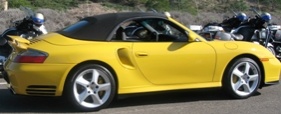
As usual, the Turbo came with its own unique rear wing, this time a fixed ducktail with an electronically adjustable element that extended into the airflow at speeds above 70mph. Weighing in at 1540kg, the 911 Turbo's top speed of 190mph and 0-60 time of just 4.2 seconds put it firmly in the territory of Europe's most lavishly engineered super cars. Deliveries began in May 2000, only a Coupe initially being offered. Options included sports seats, adjustable suspension, carbon and aluminum insert packs, a sunroof, heated memory seats, crested headrests, ruffled leather, sat-nav and Xenon headlights. From September 2001 (for the 2002 model year), customers could also order their new 911 Turbo with an X50 power upgrade. This comprised tweaking the turbochargers for more boost, installing larger intercoolers, re-mapped engine management and a reworked exhaust. The transmission was also reinforced to cope. X50 had to be specified prior to build and was not available as a conversion for existing cars. With 444bhp on tap at 5700rpm, it bridged the gap between the standard Turbo and GT2, 0-60 dropping by a tenth to 4.1 seconds, top speed rising to 193mph. At the same time, an Aero Kit came on stream offering a body-colored deep front spoiler and split-level rear aerofoil. A year later it was the turn of an open-top 911 Turbo to hit the market, the Cabriolet being launched at Frankfurt's Motor Show.
With reinforced sills and B-pillars, it weighed 70kg more than the Coupe, but this did little to affect performance. Top speed was reputed to have been an identical 190mph whilst 0-60 required 4.3 seconds, just a tenth more than the fixed-head. In September 2004, the standard Turbo and associated X50 upgrade were dropped, Porsche introducing the Turbo S for the final year of production. These last-of-the-line derivatives came with the X50 upgrade as standard along with Porsche's Carbon Ceramic Brakes (previously an expensive option). Cabriolet's were also delivered with an aluminum hardtop. Production ended in mid 2005 to make way for the 997 Turbo.
Perhaps the most significant arrival was ceramic composite brake discs which were an optional extra, Porsche becoming the first manufacturer to incorporate these onto a full production road car. As standard, Turbo's came equipped with the same 330mm cross-drilled and ventilated steel discs fitted to the MkI GT3 plus identical four-piston aluminum monobloc calipers. Also included was the Porsche Stability Management (PSM) fitted to all four-wheel drive 911's. Engine-wise, the new car incorporated a turbocharged version of the GT1-derived 3.6-litre unit that in normally-aspirated trim had also powered the GT3. It shared the block, pistons, head castings, smaller valves, unique combustion chamber shape and the camshaft's chain drive. The big difference was a pair of KKK K64 turbochargers which instantly gave a massive hike in output. Peak power leapt from 360bhp (in the GT3) to 420bhp at 6000rpm, this being developed 1200rpm lower than in the normally-aspirated model. Compression was dropped from 11.7 to 9.4:1 and Bosch Motronic ME 7.8 engine management custom mapped for the new characteristics. A six-speed transmission was derived from the 993 Turbo, however, for the first time on a forced induction 911, Porsche's latest model was also available with dual-format Tiptronic S as a no-cost option. This gearbox offered drivers the choice of either fully automatic five-speed operation or sequential shifting via steering wheel-mounted actuators.
Visually the Turbo featured a number of aesthetic tweaks not seen on the standard 911, the most obvious having been its widened bodywork, re-shaped light clusters and a trio of gaping air intakes carved out from the nose. Those at either side of the front apron fed cool air to the brakes whilst the large central intake was for the front-mounted radiator. Ugly intercooler ducts were positioned slightly ahead of the rear wheel arches, each of the four fenders being flared to accommodate those bigger wheels and tires. Also at the front was a matt black chin spoiler, the rear valance being heavily ventilated at each corner to maximize engine and brake cooling.
As usual, the Turbo came with its own unique rear wing, this time a fixed ducktail with an electronically adjustable element that extended into the airflow at speeds above 70mph. Weighing in at 1540kg, the 911 Turbo's top speed of 190mph and 0-60 time of just 4.2 seconds put it firmly in the territory of Europe's most lavishly engineered super cars. Deliveries began in May 2000, only a Coupe initially being offered. Options included sports seats, adjustable suspension, carbon and aluminum insert packs, a sunroof, heated memory seats, crested headrests, ruffled leather, sat-nav and Xenon headlights. From September 2001 (for the 2002 model year), customers could also order their new 911 Turbo with an X50 power upgrade. This comprised tweaking the turbochargers for more boost, installing larger intercoolers, re-mapped engine management and a reworked exhaust. The transmission was also reinforced to cope. X50 had to be specified prior to build and was not available as a conversion for existing cars. With 444bhp on tap at 5700rpm, it bridged the gap between the standard Turbo and GT2, 0-60 dropping by a tenth to 4.1 seconds, top speed rising to 193mph. At the same time, an Aero Kit came on stream offering a body-colored deep front spoiler and split-level rear aerofoil. A year later it was the turn of an open-top 911 Turbo to hit the market, the Cabriolet being launched at Frankfurt's Motor Show.
With reinforced sills and B-pillars, it weighed 70kg more than the Coupe, but this did little to affect performance. Top speed was reputed to have been an identical 190mph whilst 0-60 required 4.3 seconds, just a tenth more than the fixed-head. In September 2004, the standard Turbo and associated X50 upgrade were dropped, Porsche introducing the Turbo S for the final year of production. These last-of-the-line derivatives came with the X50 upgrade as standard along with Porsche's Carbon Ceramic Brakes (previously an expensive option). Cabriolet's were also delivered with an aluminum hardtop. Production ended in mid 2005 to make way for the 997 Turbo.

Thread
Thread Starter
Forum
Replies
Last Post
MrNurse
Boxster / Cayman
8
Sep 10, 2015 09:44 AM
