


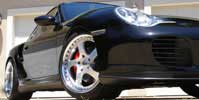
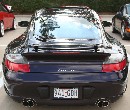
My new 997TT w/Twin 30R's...



Thread Starter
|
Former Vendor
Joined: Jul 2007
Posts: 876
From: Gates Mills, Ohio
Rep Power: 0


Car is currently under final stages of 93 octane pump gas tuning as well as the TB issue in 6th gear. Other than that, the project is complete and an overwhelming success as it has exceeded all my expectations from a bolt on package! 


Former Vendor
Joined: May 2007
Posts: 78
From: Oberlin, Ohio
Rep Power: 0
Hello everyone... it's been a while. It's snowing up here in Ohio so we've been working away in the shop on things that we've wanted to do all season but just didn't have time to work on. This is generally when we get caught up in a lot of R&D... taking what we learned throughout the season and applying it.
At any rate... as far as David's Sledgehammer project... we've been working on some new stuff to optimize our pumpgas performance on the car. I've already dyno'd over 700whp on 93 octane... but we've been working on control strategies to see if we can get more while keeping everything reliable... while tolerating the inconsistencies of true "pump gas". We could easily apply water injection or other means... but I'm more interested in "put the gas in and go" without having to add additional systems, octane boosters, or mixing fuels.
I can't believe how many people ask me if we've been into the engine yet... but we just haven't had to. Even after beating on it at the mile, the car drove up into the trailer the same way it drove off. We haven't so much as changed the oil in the car since before Texas... lol.
As soon as I have some firm numbers that will represent what we will permanently run the car at, I'll try to pop in and make a post. We've got a lot of stuff we're working on... so it's keeping us busy!
Thanks for reading.
At any rate... as far as David's Sledgehammer project... we've been working on some new stuff to optimize our pumpgas performance on the car. I've already dyno'd over 700whp on 93 octane... but we've been working on control strategies to see if we can get more while keeping everything reliable... while tolerating the inconsistencies of true "pump gas". We could easily apply water injection or other means... but I'm more interested in "put the gas in and go" without having to add additional systems, octane boosters, or mixing fuels.
I can't believe how many people ask me if we've been into the engine yet... but we just haven't had to. Even after beating on it at the mile, the car drove up into the trailer the same way it drove off. We haven't so much as changed the oil in the car since before Texas... lol.
As soon as I have some firm numbers that will represent what we will permanently run the car at, I'll try to pop in and make a post. We've got a lot of stuff we're working on... so it's keeping us busy!
Thanks for reading.

Registered User

Joined: Aug 2003
Posts: 3,787
From: Edmonton, Alberta
Rep Power: 209
Looking forward to hearing more about your 997TT Project.
Any time frame for initiation of the Switzer Performance Innovation 996TT Project?
Mike<!-- google_ad_section_end -->
Any time frame for initiation of the Switzer Performance Innovation 996TT Project?
Mike<!-- google_ad_section_end -->

Registered User
Joined: Jan 2009
Posts: 93
From: Tx
Rep Power: 26
Think about it this way, Speed:
You have a fire hose and a garden hose. The fire hose is giving you 100 gpm at 5 psi. The garden hose is giving you 5 gpm at 5 psi. Both are flowing water at the same psi, but a LOT more water is coming from the fire hose.
Now, convert the water to air, and then think of that is terms of density. The more density you have in a combustion chamber, the greater chance you have of inducing detonation.
Now, take a car like the Viper, who's huge 505 cubic inch displacement allows power in the 900 rwhp range using only 93 octane fuel with a TT setup. Why? Because the more displacement you have, the less external air required to make the same power as an engine with a smaller displacement would require. The less air, the less density, the less chance of detonation. To make 900 rwhp on a 3.6 Liter (219 cubic inches)...we have to run lots of boost and high octane fuel.
You have a fire hose and a garden hose. The fire hose is giving you 100 gpm at 5 psi. The garden hose is giving you 5 gpm at 5 psi. Both are flowing water at the same psi, but a LOT more water is coming from the fire hose.
Now, convert the water to air, and then think of that is terms of density. The more density you have in a combustion chamber, the greater chance you have of inducing detonation.
Now, take a car like the Viper, who's huge 505 cubic inch displacement allows power in the 900 rwhp range using only 93 octane fuel with a TT setup. Why? Because the more displacement you have, the less external air required to make the same power as an engine with a smaller displacement would require. The less air, the less density, the less chance of detonation. To make 900 rwhp on a 3.6 Liter (219 cubic inches)...we have to run lots of boost and high octane fuel.
The fire hose is a good analogy, but only if the hose represents the motor's size, not the turbochargers.
It takes a fixed amount of air to pressurize a given diplacement to a fixed pressure regardless of the size of the air hose. Unless you do something to change the motors VE, the motors will flow very simlar amounts of air between two very differnt turbochargers provided both compressors are within their choke flow amounts. Their may be slight power differences due to compressor efficiency, but nothing major.
A gt30 car and gt35r car will make similar power on low boost levels, as wil a k24/18g and k24/20g.

Member

Joined: Apr 2005
Posts: 1,932
From: The Woodlands, TX
Rep Power: 107
...Unless you do something to change the motors VE, the motors will flow very simlar amounts of air between two very differnt turbochargers provided both compressors are within their choke flow amounts. Their may be slight power differences due to compressor efficiency, but nothing major.
A gt30 car and gt35r car will make similar power on low boost levels, as wil a k24/18g and k24/20g.
A gt30 car and gt35r car will make similar power on low boost levels, as wil a k24/18g and k24/20g.
Last edited by roadsterdoc; Feb 1, 2009 at 07:06 AM.

Registered User
Joined: Feb 2007
Posts: 43
Rep Power: 21
This is not correct. Turbocharger size will indeed significantly effect "air flow" (CFM) at a given boost level with no other engine changes. Compressor size affects air density which is directly proportional to power (or temperature which is indirectly proportional to power). At 15psi (1 bar) the CFM and power output varies greatly between K16, K24, K24/18G, GT28, GT30,GT35 turbos at any given rpm.
I have a question, I have K24/26 turbos that load 1.25 Bar at max boost, would I gain alot to change them to K24/18G if I don change anything else (keep the original intercoolers). I have just below 600hp at the crank now.
//Jonas
Registered User
Joined: Jan 2009
Posts: 93
From: Tx
Rep Power: 26
This is not correct. Turbocharger size will indeed significantly effect "air flow" (CFM) at a given boost level with no other engine changes. Compressor size affects air density which is directly proportional to power (or temperature which is indirectly proportional to power). At 15psi (1 bar) the CFM and power output varies greatly between K16, K24, K24/18G, GT28, GT30,GT35 turbos at any given rpm.
As long as the outgoing compressor can support the airflow needed, then you will not see any big gains unless you change the engine's volumetric efficiency. What wil happen is the larger compressor does not have to be spun as fast to reach the same amount of "pressure" in the intake tract, and more exhasut gas will be bypassed by the wastegates. This will lower the intake to exhaust pr a little, which is a small boost in VE, but it will not equate to a huge difference at lower boostr levels. When you step up to a larger hotside, you start to see the big gains.
The k24/18g and the k24/20g are the perfect example of this. You only see the big gains at higher boost levels when on race gas when the 18g wheel is starting lose the ability to keep up with the airflow demands, and the decresed intake to exhasut pressure ratio delta is more signifigant. At .8 bar, all you would notice would be the slight increase in lag. At 1.4-1.5 bar the difference is about 50whp.
Just look at the idea of a compressor map. If you were to draw a horizonatal line across it at any point you would see there is a wide range of airflow at any possible pressure ratio. How much air is that compressor going to flow then? The volume of air is determined by the motors VE, rpm and displacement. None of those factors is changed by swapping compressor wheels alone, save for the small change casued by diffence in the amount of exhaust bypassed discussed earlier.
Last edited by nanokpsi; Feb 2, 2009 at 09:00 AM.



Registered User

Joined: Sep 2007
Posts: 2,063
From: California
Rep Power: 118
Very interesting read, any one like to add more to this ?
Forget about a turbochargers flow rating for a moment, and realize that "boost" is essentially backpressure in the intake tract. It is really just a measure of how much air is not going into the motor.
As long as the outgoing compressor can support the airflow needed, then you will not see any big gains unless you change the engine's volumetric efficiency. What wil happen is the larger compressor does not have to be spun as fast to reach the same amount of "pressure" in the intake tract, and more exhasut gas will be bypassed by the wastegates. This will lower the intake to exhaust pr a little, which is a small boost in VE, but it will not equate to a huge difference at lower boostr levels. When you step up to a larger hotside, you start to see the big gains.
The k24/18g and the k24/20g are the perfect example of this. You only see the big gains at higher boost levels when on race gas when the 18g wheel is starting lose the ability to keep up with the airflow demands, and the decresed intake to exhasut pressure ratio delta is more signifigant. At .8 bar, all you would notice would be the slight increase in lag. At 1.4-1.5 bar the difference is about 50whp.
Just look at the idea of a compressor map. If you were to draw a horizonatal line across it at any point you would see there is a wide range of airflow at any possible pressure ratio. How much air is that compressor going to flow then? The volume of air is determined by the motors VE, rpm and displacement. None of those factors is changed by swapping compressor wheels alone, save for the small change casued by diffence in the amount of exhaust bypassed discussed earlier.
As long as the outgoing compressor can support the airflow needed, then you will not see any big gains unless you change the engine's volumetric efficiency. What wil happen is the larger compressor does not have to be spun as fast to reach the same amount of "pressure" in the intake tract, and more exhasut gas will be bypassed by the wastegates. This will lower the intake to exhaust pr a little, which is a small boost in VE, but it will not equate to a huge difference at lower boostr levels. When you step up to a larger hotside, you start to see the big gains.
The k24/18g and the k24/20g are the perfect example of this. You only see the big gains at higher boost levels when on race gas when the 18g wheel is starting lose the ability to keep up with the airflow demands, and the decresed intake to exhasut pressure ratio delta is more signifigant. At .8 bar, all you would notice would be the slight increase in lag. At 1.4-1.5 bar the difference is about 50whp.
Just look at the idea of a compressor map. If you were to draw a horizonatal line across it at any point you would see there is a wide range of airflow at any possible pressure ratio. How much air is that compressor going to flow then? The volume of air is determined by the motors VE, rpm and displacement. None of those factors is changed by swapping compressor wheels alone, save for the small change casued by diffence in the amount of exhaust bypassed discussed earlier.
Member
Joined: Apr 2005
Posts: 1,932
From: The Woodlands, TX
Rep Power: 107
Forget about a turbochargers flow rating for a moment, and realize that "boost" is essentially backpressure in the intake tract. It is really just a measure of how much air is not going into the motor.
As long as the outgoing compressor can support the airflow needed, then you will not see any big gains unless you change the engine's volumetric efficiency. What wil happen is the larger compressor does not have to be spun as fast to reach the same amount of "pressure" in the intake tract, and more exhasut gas will be bypassed by the wastegates. This will lower the intake to exhaust pr a little, which is a small boost in VE, but it will not equate to a huge difference at lower boostr levels. When you step up to a larger hotside, you start to see the big gains.
The k24/18g and the k24/20g are the perfect example of this. You only see the big gains at higher boost levels when on race gas when the 18g wheel is starting lose the ability to keep up with the airflow demands, and the decresed intake to exhasut pressure ratio delta is more signifigant. At .8 bar, all you would notice would be the slight increase in lag. At 1.4-1.5 bar the difference is about 50whp.
Just look at the idea of a compressor map. If you were to draw a horizonatal line across it at any point you would see there is a wide range of airflow at any possible pressure ratio. How much air is that compressor going to flow then? The volume of air is determined by the motors VE, rpm and displacement. None of those factors is changed by swapping compressor wheels alone, save for the small change casued by diffence in the amount of exhaust bypassed discussed earlier.
As long as the outgoing compressor can support the airflow needed, then you will not see any big gains unless you change the engine's volumetric efficiency. What wil happen is the larger compressor does not have to be spun as fast to reach the same amount of "pressure" in the intake tract, and more exhasut gas will be bypassed by the wastegates. This will lower the intake to exhaust pr a little, which is a small boost in VE, but it will not equate to a huge difference at lower boostr levels. When you step up to a larger hotside, you start to see the big gains.
The k24/18g and the k24/20g are the perfect example of this. You only see the big gains at higher boost levels when on race gas when the 18g wheel is starting lose the ability to keep up with the airflow demands, and the decresed intake to exhasut pressure ratio delta is more signifigant. At .8 bar, all you would notice would be the slight increase in lag. At 1.4-1.5 bar the difference is about 50whp.
Just look at the idea of a compressor map. If you were to draw a horizonatal line across it at any point you would see there is a wide range of airflow at any possible pressure ratio. How much air is that compressor going to flow then? The volume of air is determined by the motors VE, rpm and displacement. None of those factors is changed by swapping compressor wheels alone, save for the small change casued by diffence in the amount of exhaust bypassed discussed earlier.
One major problem is how you may define small and large. I think this is where I get hung up in your posts. A 50hp gain is considered large in the automotive field (it would be considered small in the locomotive or jet engine fields). By making no other changes other than compressor size, lets say going from a K16 to a K16/24 hybrid, a 50hp gain is easily achieved. That would be considered a big gain. Going from a straight K24 to a K24/18G hybrid (about a 10mm larger compressor wheel), 100hp is gained. That is very big.
Peace. I'm out.
Registered User
Joined: Jan 2009
Posts: 93
From: Tx
Rep Power: 26
I do not mean to sound disrespectful, but there are so many issues that need addressing your post that I do not know if it is worthwhile for me to go through them all. You have your opinion and it differs from what has been demonstrated many times.
One major problem is how you may define small and large. I think this is where I get hung up in your posts. A 50hp gain is considered large in the automotive field (it would be considered small in the locomotive or jet engine fields). By making no other changes other than compressor size, lets say going from a K16 to a K16/24 hybrid, a 50hp gain is easily achieved. That would be considered a big gain. Going from a straight K24 to a K24/18G hybrid (about a 10mm larger compressor wheel), 100hp is gained. That is very big.
Peace. I'm out.
One major problem is how you may define small and large. I think this is where I get hung up in your posts. A 50hp gain is considered large in the automotive field (it would be considered small in the locomotive or jet engine fields). By making no other changes other than compressor size, lets say going from a K16 to a K16/24 hybrid, a 50hp gain is easily achieved. That would be considered a big gain. Going from a straight K24 to a K24/18G hybrid (about a 10mm larger compressor wheel), 100hp is gained. That is very big.
Peace. I'm out.
The "large" gain (the 50hp I mentioned) is at higher boost levels, when the smaller compressors are closer to their limits, and thus have to be overspun to produce the airflow. This overspinning is brought about by the wastegates bypassing less exhaust, as the energy is needed to spin the comprssors even faster. When more exhasut enters the turbine housing, the backpressure subsequently rises, which makes the intake to exhasut pressure move to a more unfavorable area, which hurts VE. This causes the compressors to flow less air even if they are capable of maintaining the same psi in the intake tract.
These comparisons and typically only true when just changing the compressor wheel. Depending on the case, sometimes also changing the turbine wheel doesn't mean huge gains at lower psi levels. Swapping to a bigger hotside almost always does yield large gains at most boost levels.
Just look at your k24 to k2418g example. You say the swap is worth 100hp. Fine. Run both systems at .8 bar and see what your gain is. I am willing to bet that it is not 100hp now is it
 Now, push them at higher boost levels and you start to see bigger increases. This post is the explanation for those gains. They are not due to just changing the wheel, or else the gains would be everywhere, as I am sure the 18g wheels still have a higher choke flow than the k24 compressor even at modest boost levels.
Last edited by nanokpsi; Feb 3, 2009 at 07:47 AM.
Registered User
Joined: Sep 2006
Posts: 100
From: Vancouver, BC
Rep Power: 24

Just read this entire thread. STANDING OVATION to Tym and David.
There's not a shadow of a doubt that I will be getting a 997TT as the aftermarket performance bar has been raised so, so rapidly.
VanBoost
There's not a shadow of a doubt that I will be getting a 997TT as the aftermarket performance bar has been raised so, so rapidly.
VanBoost
Thread Starter
|
Former Vendor
Joined: Jul 2007
Posts: 876
From: Gates Mills, Ohio
Rep Power: 0
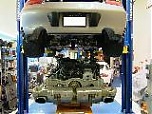
After finishing my 997 GT2 project this month, we have had numerous inquiries from people regarding higher hp cars with engine builds. Rather than just guessing at which components were adequate and which components were inadequate, we have decided to put Sledgehammer back on the dyno to find out where the limitations of the stock motor was. In addition, there has been much debate on how much power the stock rods can actually handle. There are still people who believe you need rods after 700 crank hp. So we started dyno testing again today, and i think many people will be amazed at just how good the 997 turbo motor is right from the factory. We have some preliminary data which i will post shortly.