


Spotless Water Deionization System Promotion




This is the process I used from my Buddy Brandt.......
OK, just a quick run down of the whole process... All measurements are by volume, not by weight.
Pic of most everything used.
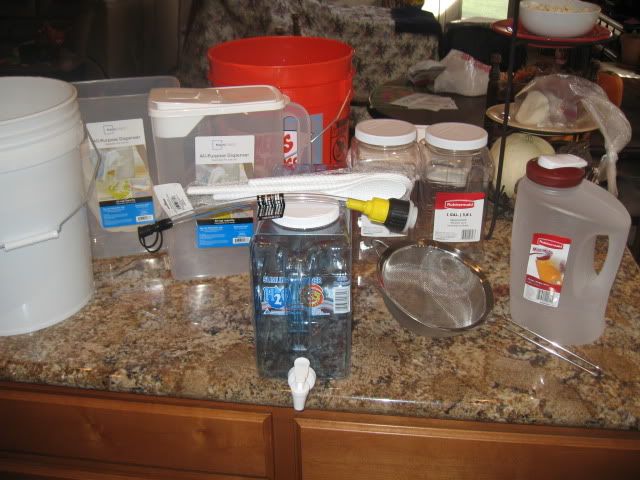
Put about three gallons of cold tap water in the white five gallon bucket. Put about five gallons of DI water into the orange five gallon bucket.
1. mix 15 oz of lye into 55 oz of cold *DI* (or Distilled) water. As shown.
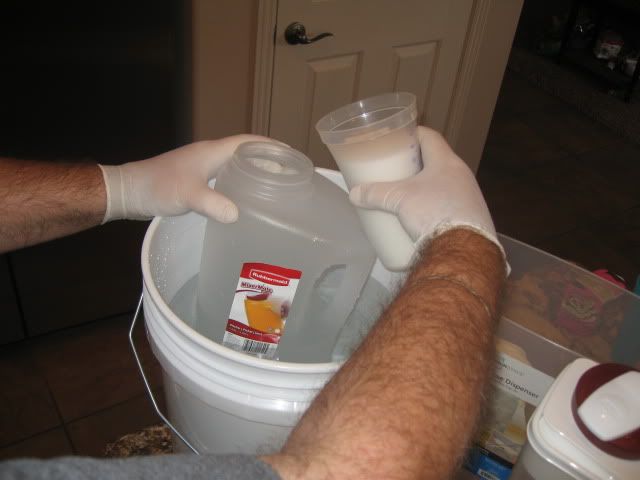
Put an airtight lid on it, and shake it. It'll get hot fast. Carefully release the excess pressure, and let the container cool off in the five gallon bucket of cool water. Every few minutes, shake it again. Do this until it no longer gets hot when shaken. Takes about five times.
Now that you have your lye solution ready, you're ready to soak all the resin in it. Dump a bunch of resin into your container. I used the ones already shown, but here's another pic of it. This is after dumping a bunch of DI resin into the container, then adding the lye solution to it. Notice that the fluid gap is between the two layers of resin. That's what you want. If the fluid gap is on top of the resin, then you don't have enough lye solution. Add more lye solution until the gap separates the two media types.
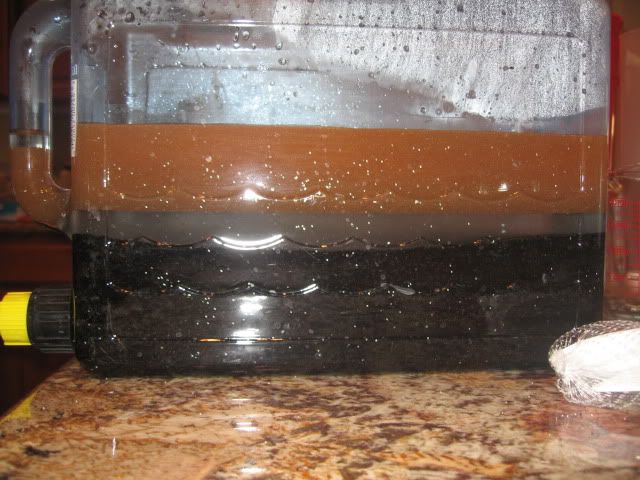
Now you have to separate the two resin types. The Anion resin is floating on the top of the lye solution, and is getting recharged *by* the lye solution. The Cation resin (dark purple) has sunk to the bottom, and is now completely spent. I used the yellow transmission filling valve to drain the Cation resin off of the bottom of the tank. I poured it into a strainer, then ran a gallon of DI water through it to rinse as much of the lye off of it as possible. The Cation resin is going to take an acid bath, so removing as much lye (by rinsing it with DI water first) is very helpful to keep from neutralizing too much of the acid.
I then placed the rinsed cation resin into one of the large plastic cereal containers and added a 1:1 muriatic acid I Water solution to it until it was completely covered in the acid bath. Stir it well, several times over the next thirty minutes.
Now drain the Anion resin (use a strainer) and rinse it thoroughly with DI water, straining as much water out as you can. Place it in a new ziploc bag. Do the same thing with the Cation resin. You're done.
Now if you want to try your luck at separate filters, some guys have had some success. But supposedly (and even though it's more work), mixing equal parts of anion/cation resin is better. I'm not very happy with how much water I got out of my resin, and I'm slightly concerned that there's enough lye/acid in each corresponding resin to negatively effect mixing them together, but I'm going to give it a shot today and see what happens.
Keeping them separate in different cartridges would certainly make the whole resin recharge thing go much easier. Guess I'll have to find out which one should go first if you keep them separate instead of doing a mixed-bed cartridge.
Edit: The 55 oz of water and 15 oz of lye wasn't enough to recharge an entire CRSpotless full of resin. It'll do about 3/4's of it. You'll still need to do a smaller batch. My smaller batch was 22 oz of water and 6 oz of lye. On the acid side, just mix it one to one with DI water, and add it to the resin until the resin is completely submerged by the acid bath. Next time, I'll just do a 77 oz of water to 21 oz of lye solution and do it all in one batch.
OK, just a quick run down of the whole process... All measurements are by volume, not by weight.
Pic of most everything used.
Put about three gallons of cold tap water in the white five gallon bucket. Put about five gallons of DI water into the orange five gallon bucket.
1. mix 15 oz of lye into 55 oz of cold *DI* (or Distilled) water. As shown.
Put an airtight lid on it, and shake it. It'll get hot fast. Carefully release the excess pressure, and let the container cool off in the five gallon bucket of cool water. Every few minutes, shake it again. Do this until it no longer gets hot when shaken. Takes about five times.
Now that you have your lye solution ready, you're ready to soak all the resin in it. Dump a bunch of resin into your container. I used the ones already shown, but here's another pic of it. This is after dumping a bunch of DI resin into the container, then adding the lye solution to it. Notice that the fluid gap is between the two layers of resin. That's what you want. If the fluid gap is on top of the resin, then you don't have enough lye solution. Add more lye solution until the gap separates the two media types.
Now you have to separate the two resin types. The Anion resin is floating on the top of the lye solution, and is getting recharged *by* the lye solution. The Cation resin (dark purple) has sunk to the bottom, and is now completely spent. I used the yellow transmission filling valve to drain the Cation resin off of the bottom of the tank. I poured it into a strainer, then ran a gallon of DI water through it to rinse as much of the lye off of it as possible. The Cation resin is going to take an acid bath, so removing as much lye (by rinsing it with DI water first) is very helpful to keep from neutralizing too much of the acid.
I then placed the rinsed cation resin into one of the large plastic cereal containers and added a 1:1 muriatic acid
I Water solution to it until it was completely covered in the acid bath. Stir it well, several times over the next thirty minutes.Now drain the Anion resin (use a strainer) and rinse it thoroughly with DI water, straining as much water out as you can. Place it in a new ziploc bag. Do the same thing with the Cation resin. You're done.
Now if you want to try your luck at separate filters, some guys have had some success. But supposedly (and even though it's more work), mixing equal parts of anion/cation resin is better. I'm not very happy with how much water I got out of my resin, and I'm slightly concerned that there's enough lye/acid in each corresponding resin to negatively effect mixing them together, but I'm going to give it a shot today and see what happens.
Keeping them separate in different cartridges would certainly make the whole resin recharge thing go much easier. Guess I'll have to find out which one should go first if you keep them separate instead of doing a mixed-bed cartridge.
Edit: The 55 oz of water and 15 oz of lye wasn't enough to recharge an entire CRSpotless full of resin. It'll do about 3/4's of it. You'll still need to do a smaller batch. My smaller batch was 22 oz of water and 6 oz of lye. On the acid side, just mix it one to one with DI water, and add it to the resin until the resin is completely submerged by the acid bath. Next time, I'll just do a 77 oz of water to 21 oz of lye solution and do it all in one batch.


We've met our GB quota and every order placed qualifies for the special pricing. And some of you need the Boss's permission to spend the $$$....I think Valentine's Day is around the corner Drop her a hint.
Drop her a hint.

Registered User
Joined: Jan 2010
Posts: 81
From: Logan Utah
Rep Power: 20

It takes about an hour and 2$ worth of products to do a refill, so like I stated if you have more money than time............
I have two batches for refills so this process is easy. I think I have also found a place to buy 1cubic ft of media for about 90$, with shipping its about 130$.
Moe, How cheap can you get 1 cubic foot for?
Cheers,
GREG
I have two batches for refills so this process is easy. I think I have also found a place to buy 1cubic ft of media for about 90$, with shipping its about 130$.
Moe, How cheap can you get 1 cubic foot for?
Cheers,
GREG
It takes about an hour and 2$ worth of products to do a refill, so like I stated if you have more money than time............
I have two batches for refills so this process is easy. I think I have also found a place to buy 1cubic ft of media for about 90$, with shipping its about 130$.
Moe, How cheap can you get 1 cubic foot for?
Cheers,
GREG
I have two batches for refills so this process is easy. I think I have also found a place to buy 1cubic ft of media for about 90$, with shipping its about 130$.
Moe, How cheap can you get 1 cubic foot for?
Cheers,
GREG

Premium Sponsor

Joined: Jan 2010
Posts: 63
From: Southern California
Rep Power: 19
With a process like that I would easily make my college Chemistry teacher proud. Whether it is simple, cost effective, or not, the discovery of the process alone is pretty cool.
__________________
6speed Members use Promo Code 6speed to receive 10% off entire order

6speed Members use Promo Code 6speed to receive 10% off entire order
Last day folks to take advantage of this offer. We've had a great response to the GB and thanks again for everyone's support 
Registered User
Joined: Jan 2010
Posts: 81
From: Logan Utah
Rep Power: 20
I've been doing some research and am close to finding some companies that will recharge the resin for you. I'll attempt to keep you posted.
This resin is used by pro window washers, they buy in larger volumes than we do and you can search them for good deals on resins.
Cheers,
GREG
This resin is used by pro window washers, they buy in larger volumes than we do and you can search them for good deals on resins.
Cheers,
GREG

Thread
Thread Starter
Forum
Replies
Last Post
LiquidElephant
Automobiles For Sale
3
Aug 27, 2015 06:17 PM
PelicanParts.com
BMW Vendor Classifieds
0
Aug 25, 2015 03:55 PM
