


Review of the f430


Thread Starter
|
Registered User
Joined: Jul 2003
Posts: 387
From: La Jolla
Rep Power: 45


Review of the f430
Clearly the writer is not much of a Ferrari fan.
The Sunday Times - Driving
October 03, 2004
First drive: Andrew Frankel drives the Ferrari F430
Almost perfect
I’m not expecting sympathy, but testing a new Ferrari is just about the hardest thing you can do in this job. They fly you to Italy, fill you with pasta, overwhelm you with enthusiasm and then give you a brief session in the car on the road and a yet shorter one on the track.
It is startlingly easy to be overwhelmed by the experience, bamboozled by the volume of raw information to be digested and therefore become inclined to give the car a more comfortable ride than it otherwise might deserve.
And why would it matter? The truth is, Ferrari could produce a car with the dynamics of a wheelie bin, and so long as it bore the badge and looked the part, it would sell. I believe many Ferrari owners neither know nor care whether their cars are good or not: what they want most is to be seen driving a Ferrari.
Happily this attitude has yet to surface in Ferrari’s famed Maranello headquarters. Contrary to the barroom banter, not all Ferraris are great cars and its most recent, the 612 Scaglietti, is unattractive, overpriced and a little disappointing. The new F430 marks a reassuring return to form, however.
Its job is to replace the 360 Modena, a generally overrated car that nevertheless became Ferrari’s strongest seller. Though the F430 uses the 360 as its basis and retains the old car’s wheelbase, steering and suspension, it is 70% new. And being such a step forward it deserves to be thought of as a new rather than evolved machine.
At its heart lies a 4.3 litre V8 motor, a fresh addition to Ferrari but already found in various Maseratis. Once Ferrari has finished tinkering with it, however, just its block and cylinder heads remain unchanged. Every moving part is new, which explains how its power has been raised from Maserati’s 400bhp to Ferrari’s 483bhp.
To put this output into context, in 1987 when Ferrari launched the legendary F40 it was the world’s fastest and most powerful car. Those lucky enough to be invited to own one spoke of performance almost beyond imagining. It had 478bhp. Moreover, the F430 is now Ferrari’s cheapest model.
But the greater significance of the F430 is that it is the first Ferrari to make credible the link between its road and racing cars. Jean Todt, the long-time boss of the Ferrari Formula One team is now also managing director of Ferrari’s road car division, and it does not take much more than a suggestion that the link between road and track is just carefully crafted marketing patter to set him off.
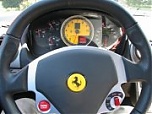
“Lessons we have learnt in Formula One have helped develop our F1-shift gearbox, carbon-ceramic brakes, the electronic differential, the aerodynamics under the car, the switch on the steering wheel to change settings of the car . . .†Todt could probably have continued but felt he had made his point.
So what kind of car does this make the F430? Not a racing car, for sure. Its ride is stiff and its engine suitably loud, but for all its searing performance — this is a vehicle that hits 60mph in under 4sec — it’s not intimidating.
I always suspected psychopathic tendencies lay behind the 360’s smiling face, yet minutes into my drive in the F430 I was confident to turn the steering wheel switch to its “race†setting, all but disabling its stability systems, and give it the boot.
It’s not perfect — the steering is a shade too light, the nose a smidge too eager to run wide of a corner and the tail rather too keen to play fast and loose on the race track — but I’m not sure I want a Ferrari to be easy. I want a challenge, but one where getting it wrong means a red face, not a new car. This is exactly what the F430 provides.
Knowing the F430 gets such fundamentals right makes forgiving its many other faults, such as its offset driving position, atypically messy cabin and awkward rear styling somewhat easier.
The only thing that still gnaws away at me is the nagging suspicion that I’d be just as quick and have at least as much fun in a new Porsche Carrera S, which is near enough £50,000 less than the F430 will cost when it arrives next spring.
What matters more is that I’d go anywhere in a F430 rather than its deadliest rival, Lamborghini’s impressive but antiseptic Gallardo. And rest assured, for sheer sense of occasion the Ferrari blows Porsche and Lamborghini clean off the field.
I’d hoped the F430 would join the Dino 246GT, the 365GTB/4 Daytona and F40 among the greatest of all Ferraris, but it’s not quite there. I’d rate it towards the top of the second division, alongside the 308GTB, the F50 and F355, an exceptional performance by any standards other than the marque’s own.
And of course its success is guaranteed. Though these words are among the very first to be written by a journalist who has driven the car, the waiting list is already over a year and I’d say it deserves to be. Anyone coming out of a 360 Modena into an F430 is not just buying its replacement, they’re buying a car transformed beyond comparison for the better. I just hope they notice.
--------------------
If you want passion, excitability and sensory overload, drive a Ferrari.
The Sunday Times - Driving
October 03, 2004
First drive: Andrew Frankel drives the Ferrari F430
Almost perfect
I’m not expecting sympathy, but testing a new Ferrari is just about the hardest thing you can do in this job. They fly you to Italy, fill you with pasta, overwhelm you with enthusiasm and then give you a brief session in the car on the road and a yet shorter one on the track.
It is startlingly easy to be overwhelmed by the experience, bamboozled by the volume of raw information to be digested and therefore become inclined to give the car a more comfortable ride than it otherwise might deserve.
And why would it matter? The truth is, Ferrari could produce a car with the dynamics of a wheelie bin, and so long as it bore the badge and looked the part, it would sell. I believe many Ferrari owners neither know nor care whether their cars are good or not: what they want most is to be seen driving a Ferrari.
Happily this attitude has yet to surface in Ferrari’s famed Maranello headquarters. Contrary to the barroom banter, not all Ferraris are great cars and its most recent, the 612 Scaglietti, is unattractive, overpriced and a little disappointing. The new F430 marks a reassuring return to form, however.
Its job is to replace the 360 Modena, a generally overrated car that nevertheless became Ferrari’s strongest seller. Though the F430 uses the 360 as its basis and retains the old car’s wheelbase, steering and suspension, it is 70% new. And being such a step forward it deserves to be thought of as a new rather than evolved machine.
At its heart lies a 4.3 litre V8 motor, a fresh addition to Ferrari but already found in various Maseratis. Once Ferrari has finished tinkering with it, however, just its block and cylinder heads remain unchanged. Every moving part is new, which explains how its power has been raised from Maserati’s 400bhp to Ferrari’s 483bhp.
To put this output into context, in 1987 when Ferrari launched the legendary F40 it was the world’s fastest and most powerful car. Those lucky enough to be invited to own one spoke of performance almost beyond imagining. It had 478bhp. Moreover, the F430 is now Ferrari’s cheapest model.
But the greater significance of the F430 is that it is the first Ferrari to make credible the link between its road and racing cars. Jean Todt, the long-time boss of the Ferrari Formula One team is now also managing director of Ferrari’s road car division, and it does not take much more than a suggestion that the link between road and track is just carefully crafted marketing patter to set him off.
“Lessons we have learnt in Formula One have helped develop our F1-shift gearbox, carbon-ceramic brakes, the electronic differential, the aerodynamics under the car, the switch on the steering wheel to change settings of the car . . .†Todt could probably have continued but felt he had made his point.
So what kind of car does this make the F430? Not a racing car, for sure. Its ride is stiff and its engine suitably loud, but for all its searing performance — this is a vehicle that hits 60mph in under 4sec — it’s not intimidating.
I always suspected psychopathic tendencies lay behind the 360’s smiling face, yet minutes into my drive in the F430 I was confident to turn the steering wheel switch to its “race†setting, all but disabling its stability systems, and give it the boot.
It’s not perfect — the steering is a shade too light, the nose a smidge too eager to run wide of a corner and the tail rather too keen to play fast and loose on the race track — but I’m not sure I want a Ferrari to be easy. I want a challenge, but one where getting it wrong means a red face, not a new car. This is exactly what the F430 provides.
Knowing the F430 gets such fundamentals right makes forgiving its many other faults, such as its offset driving position, atypically messy cabin and awkward rear styling somewhat easier.
The only thing that still gnaws away at me is the nagging suspicion that I’d be just as quick and have at least as much fun in a new Porsche Carrera S, which is near enough £50,000 less than the F430 will cost when it arrives next spring.
What matters more is that I’d go anywhere in a F430 rather than its deadliest rival, Lamborghini’s impressive but antiseptic Gallardo. And rest assured, for sheer sense of occasion the Ferrari blows Porsche and Lamborghini clean off the field.
I’d hoped the F430 would join the Dino 246GT, the 365GTB/4 Daytona and F40 among the greatest of all Ferraris, but it’s not quite there. I’d rate it towards the top of the second division, alongside the 308GTB, the F50 and F355, an exceptional performance by any standards other than the marque’s own.
And of course its success is guaranteed. Though these words are among the very first to be written by a journalist who has driven the car, the waiting list is already over a year and I’d say it deserves to be. Anyone coming out of a 360 Modena into an F430 is not just buying its replacement, they’re buying a car transformed beyond comparison for the better. I just hope they notice.
--------------------
If you want passion, excitability and sensory overload, drive a Ferrari.
Registered User
Joined: Sep 2004
Posts: 282
From: Los Altos Hills, CA
Rep Power: 0
Yeah, I thought this was a really weak article. He criticises the 430 for understeer and oversteer in the same sentence! And the comment that he would be "just as quick and have at least as much fun" in a Carrera S tells me all I need to know about this guy.
Gary
Gary


Thread
Thread Starter
Forum
Replies
Last Post
pasd181
991 Turbo
12
Oct 6, 2015 04:11 AM

