


Tint On GT3 (Photosync)


Thread Starter
|
Registered User
Joined: Jan 2009
Posts: 111
From: Dallas
Rep Power: 23

Tint On GT3 (Photosync)
I will most likely be putting photosync tint on my GT3 this week or next so I wanted to hear everyones opinions on what % I should get. The car will be tracked a few times a year so I won't be doing anything too dark. Right now I am leaning towards 35% but might end up with 45% depending upon the shade.
I will post pictures for everyone if I end up doing this. I will be going to Speedshield, which is located just outside of Dallas. They quoted me $600 for everything but the windshield, does that sound right?
FYI here's some info on this tint: prestige-films.com/auto_photosync.shtml
Thanks in advance for your help!
I will post pictures for everyone if I end up doing this. I will be going to Speedshield, which is located just outside of Dallas. They quoted me $600 for everything but the windshield, does that sound right?
FYI here's some info on this tint: prestige-films.com/auto_photosync.shtml
Thanks in advance for your help!
Basic Sponsor


Joined: Feb 2009
Posts: 2,451
From: California
Rep Power: 176

You are getting an exceptional product. More info below:
Hi all. We just wanted to share our experience and test results for PhotoSync. We used a highly sophisticated equipment to conduct our own test between PhotoSync and Crystalline. This machine is capable of reproducing the solar spectrum and can calculate a solar product performance with respect to 3 important global standards:
1. EN410 (2011)
2. ISO9050 (2003)
3. NFRC 300 (2010) - this is the most important one for us window tinters because it is a USA standard
*this equipment is patented and a very accurate measuring tool we use.
Many films on the market boast high IR rejection #s, but they usually take their highest performing #s. Typically, the easiest performance #s to gain is in the short IR between 900-1000nm. This represents a very small portion of the IR spectrum, which ranges from 780-2500. In general, these other window tints perform not as well in the higher ranges. BTU meters typically run in the range from 900-1000, so it is not representative of its true performance. On the IR scale, the range between 1100-1600 is the spot that is critical to heat transmission. With this unit, it can measure two different values:
900-1000
780-1700+
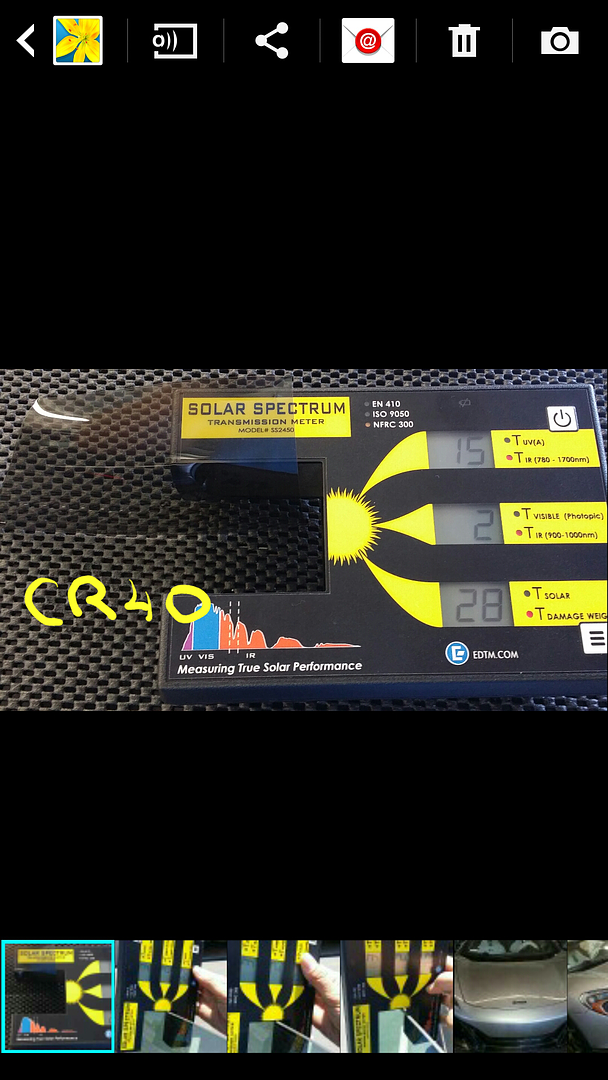
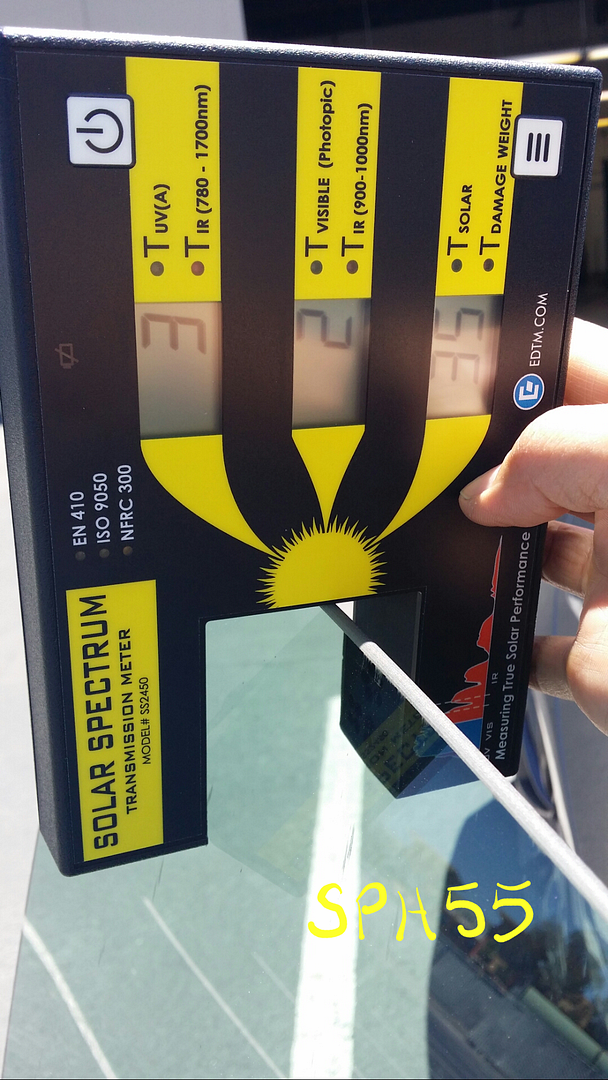
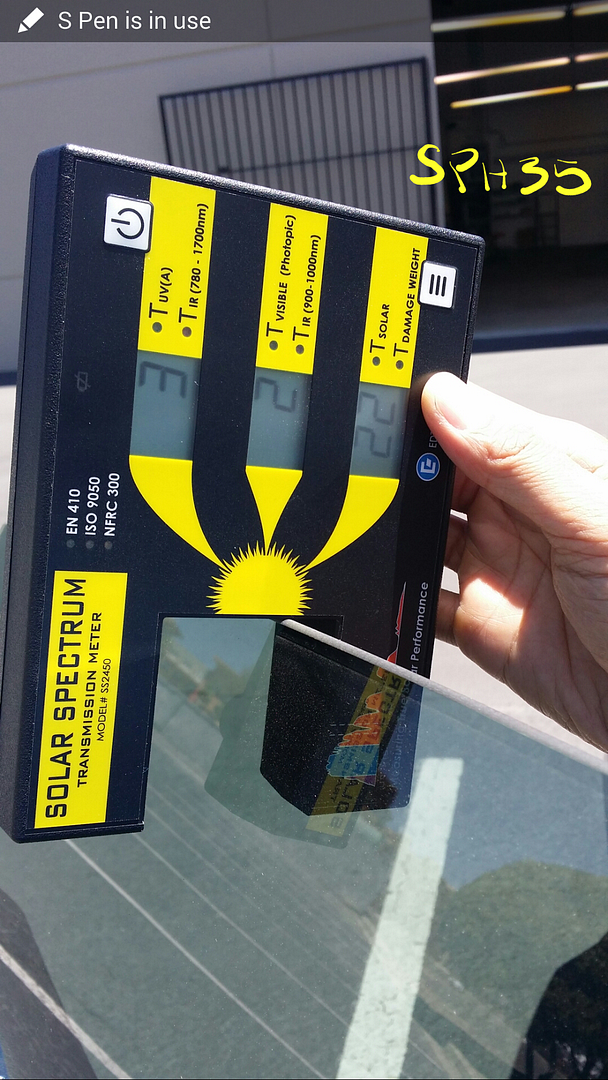
We just installed window film to this Tesla Model S with 55 on the front two and 35 on all of the back windows. As you can see SPH55 blocks out 98% of IR (allowing 2% to transmit through) on the 900-1000 scale. With the higher spectral range 780-1700, it comes through with 97% IR rejection (allowing 3% to transmit through). Simplified results:
SPH55
900-1000nm 98% IR Rejection
780-1700nm 97% IR Rejection
SPH35
900-1000nm 98% IR Rejection
780-1700nm 97% IR Rejection
**quite consistent results and only 1% variance in the higher nanometer range
Crystalline 40
900-1000nm 97% IR Rejection
780-1700nm 85% IR Rejection
**as you can see the performance drops when you are looking at the higher IR range.
Before actually conducting our own test, we were a little perplexed as to why the TSER is so different between PhotoSync and Crystalline even though their IR numbers are close. Now it is clear. It is because on Crystalline, their performance drops when you reach the higher nm of the IR Spectrum whereas PhotoSync is highly consistent with high IRR (infrared rejection)
Hi all. We just wanted to share our experience and test results for PhotoSync. We used a highly sophisticated equipment to conduct our own test between PhotoSync and Crystalline. This machine is capable of reproducing the solar spectrum and can calculate a solar product performance with respect to 3 important global standards:
1. EN410 (2011)
2. ISO9050 (2003)
3. NFRC 300 (2010) - this is the most important one for us window tinters because it is a USA standard
*this equipment is patented and a very accurate measuring tool we use.
Many films on the market boast high IR rejection #s, but they usually take their highest performing #s. Typically, the easiest performance #s to gain is in the short IR between 900-1000nm. This represents a very small portion of the IR spectrum, which ranges from 780-2500. In general, these other window tints perform not as well in the higher ranges. BTU meters typically run in the range from 900-1000, so it is not representative of its true performance. On the IR scale, the range between 1100-1600 is the spot that is critical to heat transmission. With this unit, it can measure two different values:
900-1000
780-1700+
We just installed window film to this Tesla Model S with 55 on the front two and 35 on all of the back windows. As you can see SPH55 blocks out 98% of IR (allowing 2% to transmit through) on the 900-1000 scale. With the higher spectral range 780-1700, it comes through with 97% IR rejection (allowing 3% to transmit through). Simplified results:
SPH55
900-1000nm 98% IR Rejection
780-1700nm 97% IR Rejection
SPH35
900-1000nm 98% IR Rejection
780-1700nm 97% IR Rejection
**quite consistent results and only 1% variance in the higher nanometer range
Crystalline 40
900-1000nm 97% IR Rejection
780-1700nm 85% IR Rejection
**as you can see the performance drops when you are looking at the higher IR range.
Before actually conducting our own test, we were a little perplexed as to why the TSER is so different between PhotoSync and Crystalline even though their IR numbers are close. Now it is clear. It is because on Crystalline, their performance drops when you reach the higher nm of the IR Spectrum whereas PhotoSync is highly consistent with high IRR (infrared rejection)


__________________
Premier Protective Films
ClearGuard Alpha PPF, Spectra PhotoSync Nano IR & CeraLuxe IRD Tint, Coatings
www.premiermobilegroup.com
Sharing our Passion on Youtube: https://urlgeni.us/youtube/Premier
Facebook: https://urlgeni.us/facebook/Premier
42630 Christy St, Fremont, CA. 510-623-1308 sales@premiermobilegroup.com
Premier Protective Films
ClearGuard Alpha PPF, Spectra PhotoSync Nano IR & CeraLuxe IRD Tint, Coatings
www.premiermobilegroup.com
Sharing our Passion on Youtube: https://urlgeni.us/youtube/Premier
Facebook: https://urlgeni.us/facebook/Premier
42630 Christy St, Fremont, CA. 510-623-1308 sales@premiermobilegroup.com

Thread Starter
|
Registered User
Joined: Jan 2009
Posts: 111
From: Dallas
Rep Power: 23
Flew to CA before I got around to dropping by the tint shop. I will swing by the week I get back (early Aug). I am eager to see what the tint looks like in person. I like black tint as opposed to the metallic or off-black colored tints I see offered at most shops.
Basic Sponsor
Joined: Feb 2009
Posts: 2,451
From: California
Rep Power: 176
Here is a simple test we conducted to confirm that Spectra PhotoSync's high heat rejecting capacity does not come from using metals. With window film, it is important to choose a non-metallic tint as they will affect your electronic signals.
__________________
Premier Protective Films
ClearGuard Alpha PPF, Spectra PhotoSync Nano IR & CeraLuxe IRD Tint, Coatings
www.premiermobilegroup.com
Sharing our Passion on Youtube: https://urlgeni.us/youtube/Premier
Facebook: https://urlgeni.us/facebook/Premier
42630 Christy St, Fremont, CA. 510-623-1308 sales@premiermobilegroup.com
Premier Protective Films
ClearGuard Alpha PPF, Spectra PhotoSync Nano IR & CeraLuxe IRD Tint, Coatings
www.premiermobilegroup.com
Sharing our Passion on Youtube: https://urlgeni.us/youtube/Premier
Facebook: https://urlgeni.us/facebook/Premier
42630 Christy St, Fremont, CA. 510-623-1308 sales@premiermobilegroup.com
Last edited by Premier Films; Oct 20, 2014 at 06:31 PM.
Basic Sponsor
Joined: Feb 2009
Posts: 2,451
From: California
Rep Power: 176
We are now carrying a new ceramic line, CeraLuxe Quantum Ceramic, made by Prestige Film Technologies - same company that manufactures Spectra PhotoSync. Performance is ahead of all ceramic tints on the market and also above ALL 3M tints, this is one spectacular film. It also does not affect radio or e-signals and does not have a reflective look. Luxury window film producing high heat rejection without compromise. On the pricing end, it does cost about 20%-25% less than Spectra PhotoSync!
Comes in the following shades: 73%, 45%, 33%, and 20% (By comparison PhotoSync comes in the following shades: 75%, 65%, 55%, 45%, 35%)
Here is our BTU (british thermal unit) video test of CeraLuxe Quantum Ceramic compared to others:
CeraLuxe labeled as "CLX"
On this BTU meter test, we put 3 different films to test against CeraLuxe 73% - which is rated at 53% Total Solar Energy Rejection + an IRR (infrared rejection) rating of 88%. In the line up of other films, we used a 3% metallic limo tint, 35% hybrid nano-carbon film, and a 50% popular ceramic. The results for CLX are impressive.
Comes in the following shades: 73%, 45%, 33%, and 20% (By comparison PhotoSync comes in the following shades: 75%, 65%, 55%, 45%, 35%)
Here is our BTU (british thermal unit) video test of CeraLuxe Quantum Ceramic compared to others:
CeraLuxe labeled as "CLX"
On this BTU meter test, we put 3 different films to test against CeraLuxe 73% - which is rated at 53% Total Solar Energy Rejection + an IRR (infrared rejection) rating of 88%. In the line up of other films, we used a 3% metallic limo tint, 35% hybrid nano-carbon film, and a 50% popular ceramic. The results for CLX are impressive.
__________________
Premier Protective Films
ClearGuard Alpha PPF, Spectra PhotoSync Nano IR & CeraLuxe IRD Tint, Coatings
www.premiermobilegroup.com
Sharing our Passion on Youtube: https://urlgeni.us/youtube/Premier
Facebook: https://urlgeni.us/facebook/Premier
42630 Christy St, Fremont, CA. 510-623-1308 sales@premiermobilegroup.com
Premier Protective Films
ClearGuard Alpha PPF, Spectra PhotoSync Nano IR & CeraLuxe IRD Tint, Coatings
www.premiermobilegroup.com
Sharing our Passion on Youtube: https://urlgeni.us/youtube/Premier
Facebook: https://urlgeni.us/facebook/Premier
42630 Christy St, Fremont, CA. 510-623-1308 sales@premiermobilegroup.com

Thread
Thread Starter
Forum
Replies
Last Post
ModBargains
Ferrari Vendor Classifieds
1
Oct 13, 2015 03:47 PM
Wheel Experts
991
0
Sep 2, 2015 09:04 AM
Wheel Experts
Wheels/Tires
0
Sep 2, 2015 09:02 AM