


DIY pressure/boost leak test rig w/pics



This photo may help. Its taken looking up into the engine compartment after the engine and trans have been removed. You can see the intake pipe coming in at the upper left, splitting, and then winding around to go to the compressor intakes. Never mind the soot - I had an exhaust leak.
I can't see how this thing is accessible with the engine in place, but maybe somebody else can.
Jon
I can't see how this thing is accessible with the engine in place, but maybe somebody else can.
Jon

Registered User
Joined: Sep 2009
Posts: 834
From: somewhere out there
Rep Power: 65


needs some help, as will need to do this test in next few days...
- To test the TB and injectors, plug one end of the Y and push air into the other.
- To test the rest of the system, for non-fenderwell set ups, pump air into the turbo inlet (3.5inch plenum post MAF). This is equivelant to plugging one inlet at the turbo and pressurizing the other but allows ICs to be tested as well.
- do i have the above correct?
- what's the maximum of pressure that should be used? I see 25lbs mentioned, I was thinking 1.4bar just above my car's intended max boost. Guy that works at porsche dealer told me 0.5bar is enough.
- Should the system be pressurized to X psi/bar, at which point, if the pressure holds, is confirmed diagnosis that the system is air tight?
- or should we expect the system to leak (from various places), and thus regulated air at Xpsi/bar is required? Then simply listen for leaks and use soapy water at connections?

Registered User
Joined: Jul 2009
Posts: 62
From: Canada
Rep Power: 19
I was refer to this awesome thread by jpflip.
I've now built my Home Depot PVC plug with pressure gauge and tire inflater.
Now I need an air compressor. How big a unit do I need? I think the inexpensive small ones won't work. Maybe a 5 Gallon one? 10 Gallon?
I've now built my Home Depot PVC plug with pressure gauge and tire inflater.
Now I need an air compressor. How big a unit do I need? I think the inexpensive small ones won't work. Maybe a 5 Gallon one? 10 Gallon?

Registered User

Joined: Mar 2008
Posts: 2,807
From: Montreal Canada
Rep Power: 268
Even a smaller one can do the job because you need to pressurized only about to 14 pounds. (1.0 bar....). If you put too much pressure it will come out of the oil filling cap. Of course if you buy a bigger compressor it will be useful for other jobs.... And also bigger tank , the compressor will not start all the time and you will be able to track the leak more easily without that noise....
Registered User
Joined: Jul 2009
Posts: 62
From: Canada
Rep Power: 19
Thanks again JP.
I think your comment "you will be able to track the leak more easily without that noise...." is key. I've got a relative lending me and hauling a 50-gal unit over as I speak...
You said 1.0Bar and 14psi. Others have said 20 to 25 psi in this thread. Any comments on the differing opinions? Others are welcome to comment too.
I have a 1.0 bar flash and the issue I'm trying to track down is a "perceived" lessening of power at max boost compared to what I remember it as before an engine-out service. I still see 0.9 and 1.0 bar being hit but it gets there a little slower than what I remember and maybe not as high (I think I saw occasional spikes to 1.1 before and now I never see that). So I'm thinking a boost leak only at the highest end (engine runs smooth at all rpm; no issues except what I "think" is less maximum power than before).
I think your comment "you will be able to track the leak more easily without that noise...." is key. I've got a relative lending me and hauling a 50-gal unit over as I speak...
You said 1.0Bar and 14psi. Others have said 20 to 25 psi in this thread. Any comments on the differing opinions? Others are welcome to comment too.
I have a 1.0 bar flash and the issue I'm trying to track down is a "perceived" lessening of power at max boost compared to what I remember it as before an engine-out service. I still see 0.9 and 1.0 bar being hit but it gets there a little slower than what I remember and maybe not as high (I think I saw occasional spikes to 1.1 before and now I never see that). So I'm thinking a boost leak only at the highest end (engine runs smooth at all rpm; no issues except what I "think" is less maximum power than before).

Thread Starter
|
Registered User
Joined: Jun 2007
Posts: 935
From: USA
Rep Power: 91
i have tested several 996tt systems i use a bostitch 2hp 6 gal 3.4 cfm compressor and test mostly protomotive systems to 28 psi with it
tim
ps i bought this compressor at costco its a pancake style cost about $150
tim
ps i bought this compressor at costco its a pancake style cost about $150

Registered User
Joined: Mar 2008
Posts: 2,807
From: Montreal Canada
Rep Power: 268
Thanks again JP.
I think your comment "you will be able to track the leak more easily without that noise...." is key. I've got a relative lending me and hauling a 50-gal unit over as I speak...
You said 1.0Bar and 14psi. Others have said 20 to 25 psi in this thread. Any comments on the differing opinions? Others are welcome to comment too.
I have a 1.0 bar flash and the issue I'm trying to track down is a "perceived" lessening of power at max boost compared to what I remember it as before an engine-out service. I still see 0.9 and 1.0 bar being hit but it gets there a little slower than what I remember and maybe not as high (I think I saw occasional spikes to 1.1 before and now I never see that). So I'm thinking a boost leak only at the highest end (engine runs smooth at all rpm; no issues except what I "think" is less maximum power than before).
I think your comment "you will be able to track the leak more easily without that noise...." is key. I've got a relative lending me and hauling a 50-gal unit over as I speak...
You said 1.0Bar and 14psi. Others have said 20 to 25 psi in this thread. Any comments on the differing opinions? Others are welcome to comment too.
I have a 1.0 bar flash and the issue I'm trying to track down is a "perceived" lessening of power at max boost compared to what I remember it as before an engine-out service. I still see 0.9 and 1.0 bar being hit but it gets there a little slower than what I remember and maybe not as high (I think I saw occasional spikes to 1.1 before and now I never see that). So I'm thinking a boost leak only at the highest end (engine runs smooth at all rpm; no issues except what I "think" is less maximum power than before).
lowering the engine : https://www.6speedonline.com/forums/...-engine-2.html

Registered User
Joined: Jul 2009
Posts: 547
From: Tampa Bay, fl
Rep Power: 41
I have same problem. When I tested at 25psi, air leaked a lot via oil cap. Its noise was loud and should cover any small leak I might have. It was pretty doable at 15-18psi. How do your guy do at 25psi?

Registered User
Joined: Jul 2008
Posts: 6,453
From: CT
Rep Power: 439
What if your leak doesn't leak at 15psi but leaks at 20 psi and you have a 1.4+ bar tune? You should test to at least 25psi.

Registered User
Joined: Nov 2009
Posts: 1,364
From: houston, TX
Rep Power: 96
my intake is made of reinforced silicon like the one in the picture...we are worried its collasping on top of the engine...
The car boosts 0.53 and holds flat if you keep accelerating, it does not move up or down at all...
We pressure tested car and found a leak with the oem lower boost hose on driver side...the agency hose was too short so we use the oem one. They are working on fixing this now...but that this alone is causing the problem...
The car boosts 0.53 and holds flat if you keep accelerating, it does not move up or down at all...
We pressure tested car and found a leak with the oem lower boost hose on driver side...the agency hose was too short so we use the oem one. They are working on fixing this now...but that this alone is causing the problem...
Registered User
Joined: Apr 2008
Posts: 285
From: Alta Loma, CA
Rep Power: 35
Here's my rig:
I used this cap from Home Depot:
http://www.homedepot.com/Plumbing/h_...atalogId=10053
drilled a 1/2" hole, screwed in my fitting with teflon tape and backed it with a nut
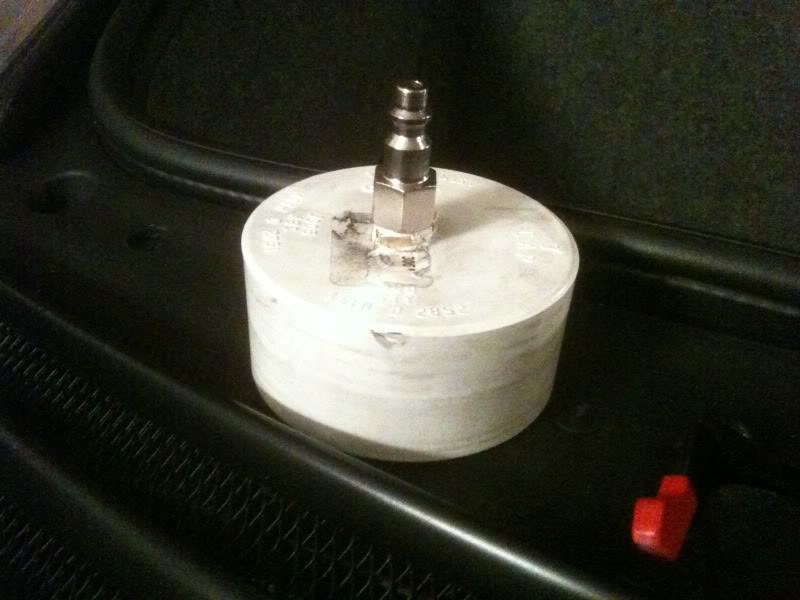
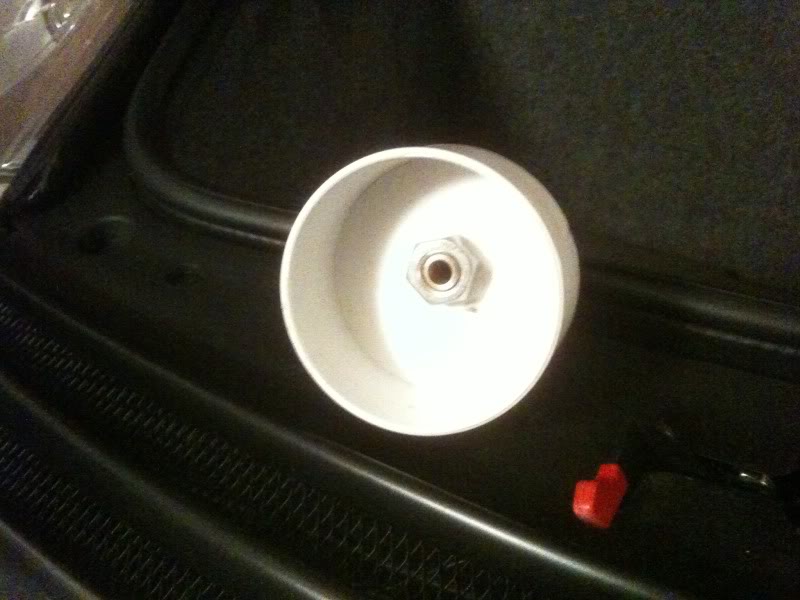
It worked great!!
I used this cap from Home Depot:
http://www.homedepot.com/Plumbing/h_...atalogId=10053
drilled a 1/2" hole, screwed in my fitting with teflon tape and backed it with a nut
It worked great!!

Registered User
Joined: Jun 2010
Posts: 528
From: Bakersfield, CA
Rep Power: 53
back from the past....
when setting the air attachment in place, are you guys just drilling a hole, putting the fitting in and epoxy sealing it?
or are you tapping a thread into it, and screwing in the attachment?
i saw one person that had a nut on the inside of the attachment, and also used threading tape, but i havent seen anyone actually state that you tap threads into the plastic piece...?
when setting the air attachment in place, are you guys just drilling a hole, putting the fitting in and epoxy sealing it?
or are you tapping a thread into it, and screwing in the attachment?
i saw one person that had a nut on the inside of the attachment, and also used threading tape, but i havent seen anyone actually state that you tap threads into the plastic piece...?