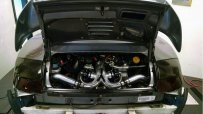
997 GT2 Expansion tank on 996 engine.
Subscribe


This is a worthwhile upgrade on a built or better flowing motor.It takes some work(and some 997 parts) to make everything fit as if oem but will definetely be worth the effort.We (Evoms)installed this 2 years ago in preparation for the March 09 Texas mile.The 996 manifold is an older design which dates back to the 993(reason for the block off plate)and was much improved upon in the 997.Not sure it would be worth much on a stock or mild bolt on setup but at the very least will get rid of the "step" in the hp graph.
Quote:
Originally Posted by joetwint
This is a worthwhile upgrade on a built or better flowing motor.It takes some work(and some 997 parts) to make everything fit as if oem but will definetely be worth the effort.We (Evoms)installed this 2 years ago in preparation for the March 09 Texas mile.The 996 manifold is an older design which dates back to the 993(reason for the block off plate)and was much improved upon in the 997.Not sure it would be worth much on a stock or mild bolt on setup but at the very least will get rid of the "step" in the hp graph.
so what kind of gain did you guys see?


Quote:
Joe,Originally Posted by joetwint
This is a worthwhile upgrade on a built or better flowing motor.It takes some work(and some 997 parts) to make everything fit as if oem but will definetely be worth the effort.We (Evoms)installed this 2 years ago in preparation for the March 09 Texas mile.The 996 manifold is an older design which dates back to the 993(reason for the block off plate)and was much improved upon in the 997.Not sure it would be worth much on a stock or mild bolt on setup but at the very least will get rid of the "step" in the hp graph.
I thought I recalled you starting with this idea, but did you ever test it with your motor? I recall you making a switch to the new WC plenum soon after you showed pics of this type of set up. At the time I assumed the 997tt tanks had restrictions (limits) that would not be compatible for your build.
Yes,we made the 231 pass at the mile with the 997 intake as it was installed and tested on the motor in early 09 but was run with the gt3 heads.it wasn't until after the March 09 mile that we switched to cnc ported turbo heads (which outflowed the GT3s by 15%) that we switched to the WC plenum.
Quote:
thanks for the info Joe, was it 997tt intake or 997gt2?Originally Posted by joetwint
Yes,we made the 231 pass at the mile with the 997 intake as it was installed and tested on the motor in early 09 but was run with the gt3 heads.it wasn't until after the March 09 mile that we switched to cnc ported turbo heads (which outflowed the GT3s by 15%) that we switched to the WC plenum.
did you ever get any dyno number with the difference between 996tt intake manifold and the 997?
Quote:
Joe,Originally Posted by joetwint
Yes,we made the 231 pass at the mile with the 997 intake as it was installed and tested on the motor in early 09 but was run with the gt3 heads.it wasn't until after the March 09 mile that we switched to cnc ported turbo heads (which outflowed the GT3s by 15%) that we switched to the WC plenum.
I follow you with the port. What size valves (diameter) did your build utilize on the intake and exhaust?
I have no way to relate to 15% more. Do you know what flow was achieved on the intake and exhaust ports at what lifts. If so, was it tested on the flow bench at 25 or 29 psi? The reason I ask is we went to slightly ported GT3 heads and obtained opposite results. I would like if possible to the compare the obtained flow at the same lift of our prep'ed GT3 heads with your prep'ed 996tt heads.
Quote:
did you ever get any dyno number with the difference between 996tt intake manifold and the 997?
it was a 997 tt intake.....on my setup at the time i believe it was worth about 35 hpOriginally Posted by OS Inspector
thanks for the info Joe, was it 997tt intake or 997gt2?did you ever get any dyno number with the difference between 996tt intake manifold and the 997?
Quote:
I follow you with the port. What size valves (diameter) did your build utilize on the intake and exhaust?
I have no way to relate to 15% more. Do you know what flow was achieved on the intake and exhaust ports at what lifts. If so, was it tested on the flow bench at 25 or 29 psi? The reason I ask is we went to slightly ported GT3 heads and obtained opposite results. I would like if possible to the compare the obtained flow at the same lift of our prep'ed GT3 heads with your prep'ed 996tt heads.
Same valve size as the GT3 on both intake and exhaust,the flow was picked up on the shape and contour of the ports.The flow numbers were done by Evoms as i don't have them in front of me and wouldn't want to misinform although it was a 15% gain this was compared to a off the shelf GT3 head (not a ported or world cup head)which was on the car prior.All we did to the GT3 heads was shortren the valve stems,modify the cam towers and machine the oil galleys to work in conjunction with the 996tt variocam.Originally Posted by cjv
Joe,I follow you with the port. What size valves (diameter) did your build utilize on the intake and exhaust?
I have no way to relate to 15% more. Do you know what flow was achieved on the intake and exhaust ports at what lifts. If so, was it tested on the flow bench at 25 or 29 psi? The reason I ask is we went to slightly ported GT3 heads and obtained opposite results. I would like if possible to the compare the obtained flow at the same lift of our prep'ed GT3 heads with your prep'ed 996tt heads.
Quote:
It gets a little confusing with the GT3 parts. Originally Posted by joetwint
Same valve size as the GT3 on both intake and exhaust,the flow was picked up on the shape and contour of the ports.The flow numbers were done by Evoms as i don't have them in front of me and wouldn't want to misinform although it was a 15% gain this was compared to a off the shelf GT3 head (not a ported or world cup head)which was on the car prior.All we did to the GT3 heads was shortren the valve stems,modify the cam towers and machine the oil galleys to work in conjunction with the 996tt variocam.
 You would think that between the GT3 Street, Cup and RSR that parts may be the same. Nope .... different cams, lifter size and configeration, towers, valve stem length, intake and exhaust valve diameters, etc. What a nightmare.
Quote:
Joe, That design is older then 993! Here is one in aluminum that I welded to the stock intake manifold. I had it separate during a race and did not want that to happen again.Originally Posted by joetwint
This is a worthwhile upgrade on a built or better flowing motor.It takes some work(and some 997 parts) to make everything fit as if oem but will definetely be worth the effort.We (Evoms)installed this 2 years ago in preparation for the March 09 Texas mile.The 996 manifold is an older design which dates back to the 993(reason for the block off plate)and was much improved upon in the 997.Not sure it would be worth much on a stock or mild bolt on setup but at the very least will get rid of the "step" in the hp graph.
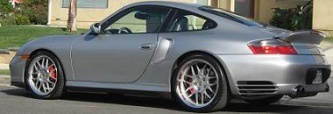
This is very interesting article. Thanks for posting and the discussion in general. 
The factory claims that the expansion intake manifold has a cooling effect as the air expands prior to flowing into the cylinder.
The factory claims that the expansion intake manifold has a cooling effect as the air expands prior to flowing into the cylinder.
Interesting stuff. Thanks for the pics and I'll be interested to see what you find out about this. Reps to you.

Not for CA. However, seems tuners *can* turn this off; you'll have to ask your tuner if they can.
Tricky little buggers those Germans. Seems they do an o2 sensor verification when the system is activated to look for a fuel mixture change. I've not been able to determine if it's in the first or secondary o2 sensor. Anyone know?
The motor and system is easy to fool with resistors (I think 330 ohm for the VSV (vacuum switching valve) I'm sure it has a different German name.) I can't tell if the DME determines a motor draw past the relay or not in the wiring diagrams. I'm pretty sure the only verification comes from the oxygen sensor readings.
I'll do some more research on it, hopefully this weekend. My laptop blue screens every time I try to use the Durametric on it, so I have to chase down another machine or spend some time with drivers to try and get it going.
I'll be finishing my 3.5" splitter (and updating that thread) this weekend and building a splitter this weekend for the GT2 tanks. Mill work is done on the flanges and I have to go pick them up.
However, seems tuners *can* turn this off; you'll have to ask your tuner if they can. Tricky little buggers those Germans. Seems they do an o2 sensor verification when the system is activated to look for a fuel mixture change. I've not been able to determine if it's in the first or secondary o2 sensor. Anyone know?
The motor and system is easy to fool with resistors (I think 330 ohm for the VSV (vacuum switching valve) I'm sure it has a different German name.) I can't tell if the DME determines a motor draw past the relay or not in the wiring diagrams. I'm pretty sure the only verification comes from the oxygen sensor readings.
I'll do some more research on it, hopefully this weekend. My laptop blue screens every time I try to use the Durametric on it, so I have to chase down another machine or spend some time with drivers to try and get it going.
I'll be finishing my 3.5" splitter (and updating that thread) this weekend and building a splitter this weekend for the GT2 tanks. Mill work is done on the flanges and I have to go pick them up.
Brad, Its the rear o2's. That's also how the ECU checks to see if the cat's are doing there job with the addition of adding fuel.. That's why the simulators don't work either on these cars.. They can be flashed out but then no OBD2 plug in inspection can be done on your car.