


IMPORTANT - Thinking of Fitting Wider tyres? - Read This First

Thread Starter
|
Registered User

Joined: Jul 2008
Posts: 1,751
From: Warwickshire, England
Rep Power: 141


 IMPORTANT - Thinking of Fitting Wider tyres? - Read This First
Just recently I've noticed quite a few questions being asked about tyres, and whether wider tyres will give improved handling
Having searched the forum there doesn't seem to be much information on tyres, and the information that is on here is a little misleading at best
Since tyres are an important, and sometimes overlooked subject, I thought I'd set the record straight, and maybe get a few people thinking along the way
Well, I guess that's enough of an intro.....now, let's get onto the good stuff.........
Contact Patch
It seems many people think by fitting wider tyres their cars handling will improve as their car now has a larger 'footprint'
Well, contrary to this popular belief, a wider tyre does not give you a larger footprint
Dont believe me? Well then, let's have a look shall we?
The contact area (or footprint) of a tyre is calculated by dividing the wheel's load by its air pressure
If the load is in 'Lbs', and the tyre pressure in 'Psi', the area will be 'inches squared'
For Example
A stock 996 Turbo weighs about 3,480lbs
If we assume the car has a 60/40 Rear/Front weight distribution, there would be a load of 1,044lbs on each rear wheel
(3,480lbs x 0.6 / 2 = 1,044lbs)
If the tyre pressure was 30psi, we would get a contact patch of 34.8 square inches (1044lb/30psi)
Remember, the contact area is calculated by dividing the wheels load by its air pressure
If the tyre pressure was 40 psi, the contact area would be 26.1 square inches, and if the pressure was 20 psi, the contact area would be 52.2 square inches
Notice how the contact patch decreases as the tyres air pressure increases
This is due to the tyre 'sitting up' as it becomes over inflated. If you've ever seen tread wear on an over inflated tyre you'll know what I mean
As the tyre pressure is decreased, the contact area increases
Note, this isn't strictly true, as after a certain point the tyre will deform from being under inflated
So then, now we know what dictates a tyres contact patch (the load on the wheel and the tyre pressure) what happens if we fit wider tyres?
Well, quite a few things will happen....but we won't get a larger contact area
The wider tyre will give us a wider contact patch, but, it will reduce in length, as the following picture, provided by Steve Jarvis demonstrates
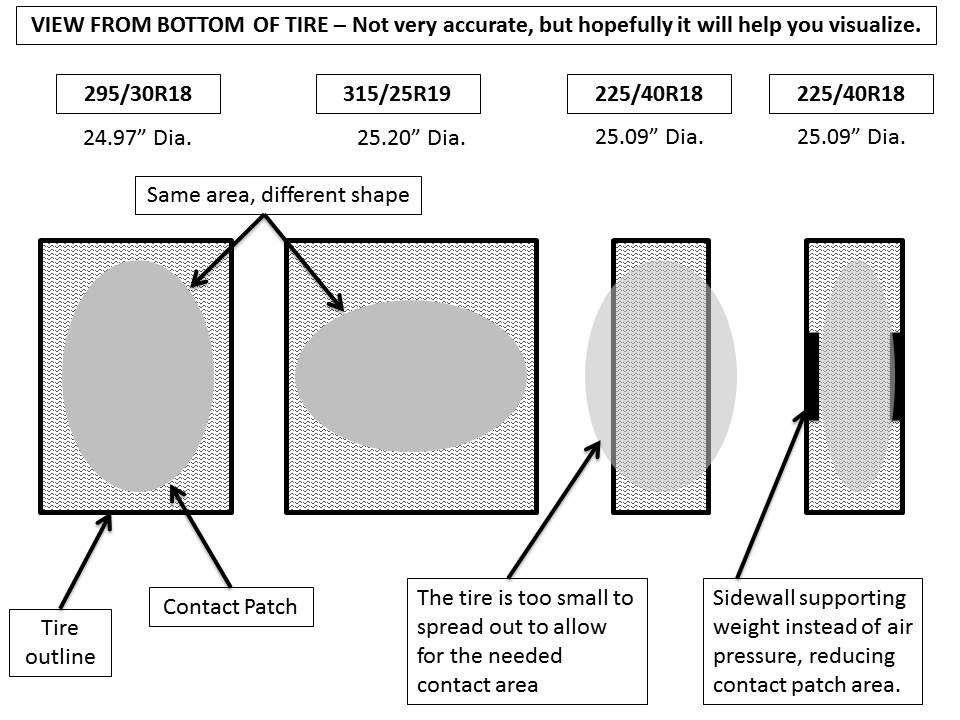
So if you fit wider tyres and keep the air pressure the same, the contact patch will have the same area, but will be a different shape
It will be wider, but shorter
Well then, if this is true, why does the 996 Turbo come width wide tyres to begin with? Why not just fit cheap narrow tyres if they've got the same size footprint? And, if they've all got the same footprint, does that mean they've all got the same levels of grip too?
Let's investigate........
Slip Angle
During cornering, tyres create a sideways force - a 'Slip Angle' - as can be seen in the following video
http://www.youtube.com/watch?v=W8UiE7yvO_M
'Slip Angle' is where the tyre gets pulled sideways by the road surface. The wheel is pointing in one direction, but the tyre is actually pointing in a slightly different direction. There's a twisting motion due to the friction between the tyre and the road surface.
The difference between these two directions is the Slip Angle
At the front of the contact patch the angle is quite small, but as you move along the contact patch the angle increases
Eventually, the sideways force becomes greater than the tyres grip on the road, the car begins to drift and you now have a 'Slide Angle'
The longer the contact patch is, the more gradually the car will begin to drift .......it's going, going, going, going, still going, about to go, gone
But, when the contact area is shortened, by fitting wider wheels, the drift happens much quicker.......going, gone!!
A wider tyre will give a higher overall level of grip when compared to a narrow tyre. This is because there isn't as much difference between the front and back of the contact patch. And the reason there isn't as much difference is because the contact area isn't as long
narrow tyre = longer contact area, less lateral grip, slower break away, gradual tyre deformation
wider tyre = shorter contact area, more lateral grip, faster break away, quick tyre deformation
The other vital thing we need to know?..........
Heat
Think of it like this
Right now your car is sitting perfectly still. Part of your tyre is in contact with the ground and is therefore flat
The area of that patch is, length multiplied by width
A narrower tyre has a longer contact patch, and that's a problem
In order to get the narrow tyres longer contact patch onto the ground its sidewall is going to have to deform quite a bit. When the car is in motion the tyres sidewall is all the time flattening and curving again as the wheel rotates
This constant bending causes the tyre to heat up
Since the narrower tyre has a longer contact patch it needs to deform more than a shorter contact patch would
This greater amount of flexing results in more heat being created
Whilst we need heat in our tyres in order for them to operate at their full potential, too much heat is a bad thing
A narrow tyre will have a greater percentage of its tread in contact with the ground at any time when compared to a wider tyre
Remember, this is because the narrow tyre will have a longer contact patch
Since more of the tyre is in contact with the ground at any one time, it has less time to cool before it comes into contact with the ground and it's tread and sidewall deform again
In order to combat the additional heat that's being generated, tyre manufacturers will make narrower tyres out of harder compounds
These harder compounds have a lower coefficient of friction, and therefore have less grip, especially when cold
Summary
A wider tyre will have a lower slip angle, a softer compound, a higher friction coefficient, will bend and deform less, and will have more time per revolution to cool itself
This is why a wider tyre will, in most cases, result in better performance
Having searched the forum there doesn't seem to be much information on tyres, and the information that is on here is a little misleading at best
Since tyres are an important, and sometimes overlooked subject, I thought I'd set the record straight, and maybe get a few people thinking along the way
Well, I guess that's enough of an intro.....now, let's get onto the good stuff.........
Contact Patch
It seems many people think by fitting wider tyres their cars handling will improve as their car now has a larger 'footprint'
Well, contrary to this popular belief, a wider tyre does not give you a larger footprint
Dont believe me? Well then, let's have a look shall we?
The contact area (or footprint) of a tyre is calculated by dividing the wheel's load by its air pressure
If the load is in 'Lbs', and the tyre pressure in 'Psi', the area will be 'inches squared'
For Example
A stock 996 Turbo weighs about 3,480lbs
If we assume the car has a 60/40 Rear/Front weight distribution, there would be a load of 1,044lbs on each rear wheel
(3,480lbs x 0.6 / 2 = 1,044lbs)
If the tyre pressure was 30psi, we would get a contact patch of 34.8 square inches (1044lb/30psi)
Remember, the contact area is calculated by dividing the wheels load by its air pressure
If the tyre pressure was 40 psi, the contact area would be 26.1 square inches, and if the pressure was 20 psi, the contact area would be 52.2 square inches
Notice how the contact patch decreases as the tyres air pressure increases
This is due to the tyre 'sitting up' as it becomes over inflated. If you've ever seen tread wear on an over inflated tyre you'll know what I mean
As the tyre pressure is decreased, the contact area increases
Note, this isn't strictly true, as after a certain point the tyre will deform from being under inflated
So then, now we know what dictates a tyres contact patch (the load on the wheel and the tyre pressure) what happens if we fit wider tyres?
Well, quite a few things will happen....but we won't get a larger contact area
The wider tyre will give us a wider contact patch, but, it will reduce in length, as the following picture, provided by Steve Jarvis demonstrates
So if you fit wider tyres and keep the air pressure the same, the contact patch will have the same area, but will be a different shape
It will be wider, but shorter
Well then, if this is true, why does the 996 Turbo come width wide tyres to begin with? Why not just fit cheap narrow tyres if they've got the same size footprint? And, if they've all got the same footprint, does that mean they've all got the same levels of grip too?
Let's investigate........
Slip Angle
During cornering, tyres create a sideways force - a 'Slip Angle' - as can be seen in the following video
http://www.youtube.com/watch?v=W8UiE7yvO_M
'Slip Angle' is where the tyre gets pulled sideways by the road surface. The wheel is pointing in one direction, but the tyre is actually pointing in a slightly different direction. There's a twisting motion due to the friction between the tyre and the road surface.
The difference between these two directions is the Slip Angle
At the front of the contact patch the angle is quite small, but as you move along the contact patch the angle increases
Eventually, the sideways force becomes greater than the tyres grip on the road, the car begins to drift and you now have a 'Slide Angle'
The longer the contact patch is, the more gradually the car will begin to drift .......it's going, going, going, going, still going, about to go, gone
But, when the contact area is shortened, by fitting wider wheels, the drift happens much quicker.......going, gone!!
A wider tyre will give a higher overall level of grip when compared to a narrow tyre. This is because there isn't as much difference between the front and back of the contact patch. And the reason there isn't as much difference is because the contact area isn't as long
narrow tyre = longer contact area, less lateral grip, slower break away, gradual tyre deformation
wider tyre = shorter contact area, more lateral grip, faster break away, quick tyre deformation
The other vital thing we need to know?..........
Heat
Think of it like this
Right now your car is sitting perfectly still. Part of your tyre is in contact with the ground and is therefore flat
The area of that patch is, length multiplied by width
A narrower tyre has a longer contact patch, and that's a problem
In order to get the narrow tyres longer contact patch onto the ground its sidewall is going to have to deform quite a bit. When the car is in motion the tyres sidewall is all the time flattening and curving again as the wheel rotates
This constant bending causes the tyre to heat up
Since the narrower tyre has a longer contact patch it needs to deform more than a shorter contact patch would
This greater amount of flexing results in more heat being created
Whilst we need heat in our tyres in order for them to operate at their full potential, too much heat is a bad thing
A narrow tyre will have a greater percentage of its tread in contact with the ground at any time when compared to a wider tyre
Remember, this is because the narrow tyre will have a longer contact patch
Since more of the tyre is in contact with the ground at any one time, it has less time to cool before it comes into contact with the ground and it's tread and sidewall deform again
In order to combat the additional heat that's being generated, tyre manufacturers will make narrower tyres out of harder compounds
These harder compounds have a lower coefficient of friction, and therefore have less grip, especially when cold
Summary
A wider tyre will have a lower slip angle, a softer compound, a higher friction coefficient, will bend and deform less, and will have more time per revolution to cool itself
This is why a wider tyre will, in most cases, result in better performance
Last edited by ant_8u; Apr 26, 2011 at 09:11 PM.




Registered User
Joined: Aug 2003
Posts: 1,439
Rep Power: 87
I disagree with the assumption that tire contact patch area is purely a function
of weight * pressure. The tire carcass is not the infinitely flexible bladder of
physics 101. It is somewhere between that, and a solid block, especially with
some of today's stiff tire constructions. As such, irrespective load, a wider tire
will deliver a larger contact patch.
of weight * pressure. The tire carcass is not the infinitely flexible bladder of
physics 101. It is somewhere between that, and a solid block, especially with
some of today's stiff tire constructions. As such, irrespective load, a wider tire
will deliver a larger contact patch.
Registered User
Joined: Mar 2010
Posts: 1,241
From: Truckee
Rep Power: 82
I disagree with the assumption that tire contact patch area is purely a function
of weight * pressure. The tire carcass is not the infinitely flexible bladder of
physics 101. It is somewhere between that, and a solid block, especially with
some of today's stiff tire constructions. As such, irrespective load, a wider tire
will deliver a larger contact patch.
of weight * pressure. The tire carcass is not the infinitely flexible bladder of
physics 101. It is somewhere between that, and a solid block, especially with
some of today's stiff tire constructions. As such, irrespective load, a wider tire
will deliver a larger contact patch.
Registered User

Joined: Feb 2011
Posts: 1,075
From: Lewisville, NC
Rep Power: 110
What really drives me crazy is all the people that make a comment like:
"I'm getting ready to add a tune and upgraded turbos, I need wider tires so it will hook"
Wider tires are in general better, but don't expect them to significantly increase your straight line traction.
Later, Steve
"I'm getting ready to add a tune and upgraded turbos, I need wider tires so it will hook"
Wider tires are in general better, but don't expect them to significantly increase your straight line traction.
Later, Steve
Registered User
Joined: Mar 2011
Posts: 88
From: Los Angeles, CA
Rep Power: 29
Stock (18") Tire sizes
Awesome write up, Thanks!
What is the largest tires that can be used on the stock 18" wheels keeping the F&R diameters consistent to ensure a safe AWD driveline and NO adversities?
Currently using the 225/40/18 & 295/30/18 Michelin PS (ZR).
Thanks!
What is the largest tires that can be used on the stock 18" wheels keeping the F&R diameters consistent to ensure a safe AWD driveline and NO adversities?
Currently using the 225/40/18 & 295/30/18 Michelin PS (ZR).
Thanks!
Trending Topics

Registered User
Joined: Jul 2006
Posts: 8,930
From: ga
Rep Power: 552
I disagree with the assumption that tire contact patch area is purely a function
of weight * pressure. The tire carcass is not the infinitely flexible bladder of
physics 101. It is somewhere between that, and a solid block, especially with
some of today's stiff tire constructions. As such, irrespective load, a wider tire
will deliver a larger contact patch.
of weight * pressure. The tire carcass is not the infinitely flexible bladder of
physics 101. It is somewhere between that, and a solid block, especially with
some of today's stiff tire constructions. As such, irrespective load, a wider tire
will deliver a larger contact patch.
Agree!! There was an actual article on a test done on some tires, I don't feel like looking it up, but it proved what you are saying. It is somewhere in between. But I do also agree with the OP in that people get entirely the wrong impression about putting the biggest tires they can fit on the car. They may feel more traction, probably more as a result of that much taller and wider tire being also much heavier too and unsprung weight being harder to move, but it's not the contact patch they are feeling.
Good points here.
Registered User
Joined: Jul 2006
Posts: 8,930
From: ga
Rep Power: 552
Depends on the tire. You should always look at the specific manufacturer size ratings before getting a tire. I think some people have put 335's on the stock 18' rears. But if not, then certainly 315's. And those usually match up with a 235/245 tire for the front. But you have to check to make sure.

Registered User
Joined: Sep 2009
Posts: 64
From: Virginia Beach
Rep Power: 19
Wider Tires?
Very impressive information. Also, I have heard that running tires sizes which were specified for the car is the most efficient. Like the 997 Carrera S has 295/30 on the rear and the 4S has 305/30 on the rear. Of course, the 305 will fit the Carrera S but it is not the most efficient based on the car configuration.
Thread Starter
|
Registered User
Joined: Jul 2008
Posts: 1,751
From: Warwickshire, England
Rep Power: 141
I disagree with the assumption that tire contact patch area is purely a function
of weight * pressure. The tire carcass is not the infinitely flexible bladder of
physics 101. It is somewhere between that, and a solid block, especially with
some of today's stiff tire constructions. As such, irrespective load, a wider tire
will deliver a larger contact patch.
of weight * pressure. The tire carcass is not the infinitely flexible bladder of
physics 101. It is somewhere between that, and a solid block, especially with
some of today's stiff tire constructions. As such, irrespective load, a wider tire
will deliver a larger contact patch.
Yes I do agree with you, there's more to it than just load and pressure, but that starts to get beyond the realms of this thread
Really, we're only just scratching the surface of the subject here
You are correct in what you say about sidewalls playing a part - think about run flat tyres for instance
If you were to fit run flats to your car and then deflate them, the load would be the same, but what would the contact patch be?
Would the contact patch become 1,044lbs/0psi?

Remember though, the tyre could never be entirely empty, It would still have air in it, but it would be at atmospheric pressure
There are always extreme cases which will alter things, but for the purposes of this thread I think 'load/pressure' is a good starting point on which to build
Registered User
Joined: Feb 2011
Posts: 1,075
From: Lewisville, NC
Rep Power: 110
ant_8u,
That brings up something I haven't though about.
Would the actual contact area be calculated using the base psi (ie 35psi) or the base plus atmosphere (ie 35psi + 14.7psi = 47.7psi)?
Later, Steve
That brings up something I haven't though about.
Would the actual contact area be calculated using the base psi (ie 35psi) or the base plus atmosphere (ie 35psi + 14.7psi = 47.7psi)?
Later, Steve
Thread Starter
|
Registered User
Joined: Jul 2008
Posts: 1,751
From: Warwickshire, England
Rep Power: 141
Don't include atmospheric pressure
When calculating a tyres contact patch the pressure used is the differential between the pressure inside the tyre, and the pressure outside of it
We don't include atmospheric pressure as it is present both inside and outside the tyre, therefore cancelling itself out
A tyre which is inflated to 30psi for instance would actually contain 44.7psi (30psi + 14.7psi atmospheric) But, it would also have 14.7psi pushing against the outer walls of the tyre
Registered User
Joined: Mar 2008
Posts: 642
From: Kansas
Rep Power: 79
This was a nice presentation. My complements.
However, tire contact size and shape are highly affected by load and pressure are HIGHLY variable and this is complex science.
Read this:
http://www.performancesimulations.co...on-tires-1.htm
Avon tires did a comprehensive test and actually measured the contact patch in a HIGHLY CONTROLLED scientific experiment.
The results are varied, but in general, wide tires DO have a larger contact patch.
Mike
However, tire contact size and shape are highly affected by load and pressure are HIGHLY variable and this is complex science.
Read this:
http://www.performancesimulations.co...on-tires-1.htm
Avon tires did a comprehensive test and actually measured the contact patch in a HIGHLY CONTROLLED scientific experiment.
The results are varied, but in general, wide tires DO have a larger contact patch.
Mike
Don't include atmospheric pressure
When calculating a tyres contact patch the pressure used is the differential between the pressure inside the tyre, and the pressure outside of it
We don't include atmospheric pressure as it is present both inside and outside the tyre, therefore cancelling itself out
A tyre which is inflated to 30psi for instance would actually contain 44.7psi (30psi + 14.7psi atmospheric) But, it would also have 14.7psi pushing against the outer walls of the tyre
When calculating a tyres contact patch the pressure used is the differential between the pressure inside the tyre, and the pressure outside of it
We don't include atmospheric pressure as it is present both inside and outside the tyre, therefore cancelling itself out
A tyre which is inflated to 30psi for instance would actually contain 44.7psi (30psi + 14.7psi atmospheric) But, it would also have 14.7psi pushing against the outer walls of the tyre