


Comprehensive AWE Dyno Day Results, Experimental KPV Intake & Major Clutch Slippage!!


Thread Starter
|
Registered User
Joined: Jul 2003
Posts: 4,343
From: New Jersey
Rep Power: 199

Comprehensive AWE Dyno Day Results, Experimental KPV Intake and Majo Clutch Slippage!
After our morning breakfast, coffee, OJ and chat at Panera Bread, we high tailed it down to AWE for some dyno fun. Our little caravan consisted of me, Ron (Vipertestarossa), Bill (BCS996TT), Chris (Rockitman), Dave (Dave) and Mark (MarkL). We arrived at AWE at about 9:30am and were cordially welcomed.
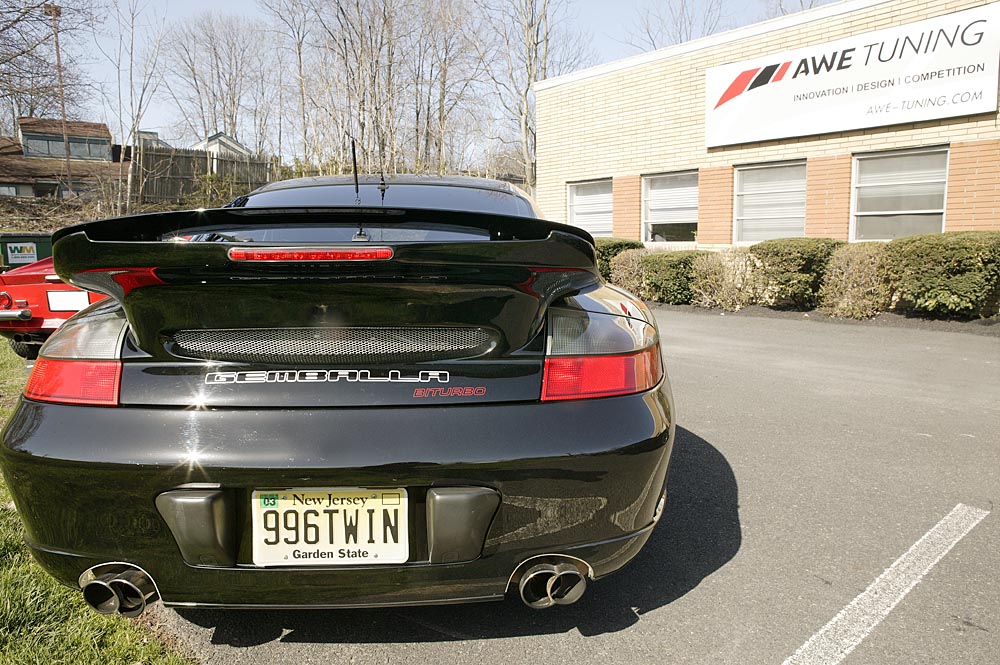
Before I continue, I want to express my personal thanks to Todd, Mike and Tom and Brian at AWE for hosting this event, providing refreshments and being all-around nice guys.
The following dyno sessions were performed on a Mustang four wheel drive dynamometer. All comparisons were also done on the same machine, albeit at different times of the year. All values are peak readings. Now, onto the good stuff……
Rockitman
Since his last dyno session last year, Chris added a Europipe exhaust and BMC air filter to his GT3.
Last year’s Stock Setup:
348 rear wheel horsepower
262 foot pounds rear wheel torque
This dyno session with the Europipe exhaust and BMC filter:
373 rear wheel horsepower
282 foot pounds rear wheel torque
Congratulations Chris!! 25 hp and 20 ft-lbs of torque increases!!!!!! That is even better than Europipe’s claims!
BCS996TT
Since Bill’s last dyno, wherein he used the canned Upsolute program and stock K16 turbos, he has changed turbos and has changed to an upgraded Upsolute program.
Last year’s Setup:
437 four wheel horsepower
??? foot pounds four wheel torque
This dyno session with the listed changes:
496 four wheel horsepower
490 foot pounds four wheel torque
During my exploration into modifications of the intake system (see my results below for more information), I discovered a potential modification to the stock airbox that could equate to possible power improvement. This “potential†performance modification entails the removal of the airflow converter insert. I came up with that name, but it tells the story. As Todd (AWE owner) explained to us (thank you Todd!), the insert is used to convert potentially turbulent airflow coming from the airbox’s odd shape and configuration to a more laminar flow in preparation for its path across the mass air flow sensor. The following photo shows the stock airbox and the location of this insert.
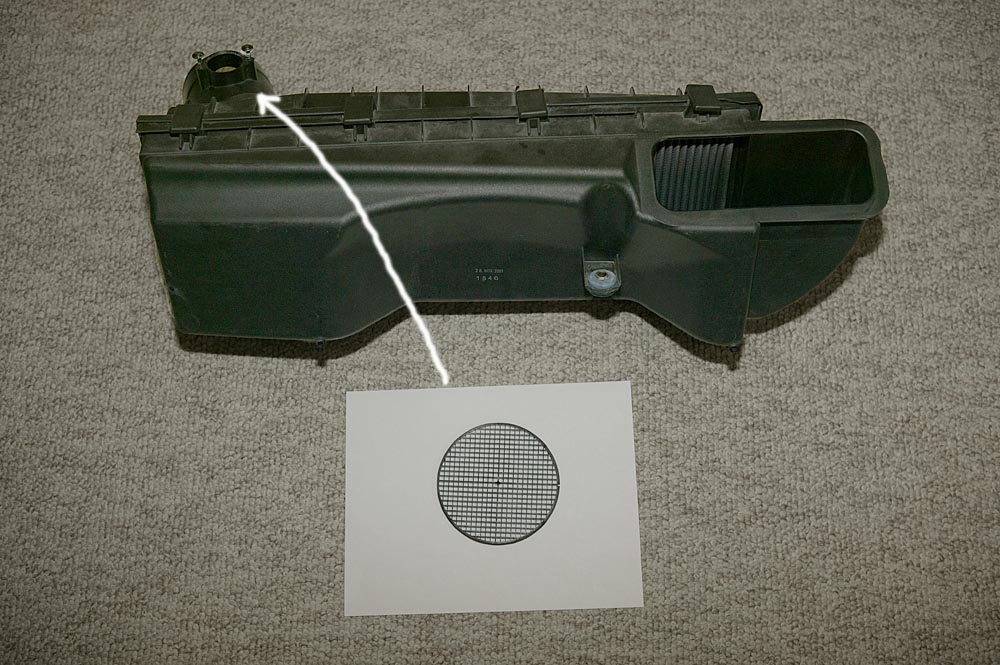
Although the purpose, as described by Todd, is to smoothen the airflow, there is no denying its blocking effect. It is a partially solid object in the airflow path. I calculated the area reduction of this insert and it amounts to 8.34%. So, the big question was whether the removal of this insert, and its 8+% blocking effect, would increase or decrease power.
We decided to try an A>B comparison on Bill’s car. So, immediately following his normal two runs, Ron, Bill and I jumped into action and removed the box, opened it up and removed the insert. We then ran two more dyno tests.
With the insert removed, we obtained the following results:
493 four wheel horsepower
XXX foot pounds four wheel torque
So, it looks like the insert really doesn’t add horsepower with the stock airbox in place.
Congratulations Bill!! Those are some excellent increases!! And remember, keep that laptop tethered to the car!!!
KPV
During my last dyno session, I had K24 turbos, Stainless Steel headers, GIAC Stage 4 programming, K&N air filter and Europipe Stage 2 Loud exhaust. This setup yielded the following results:
505 four wheel horsepower
486 foot pounds four wheel torque
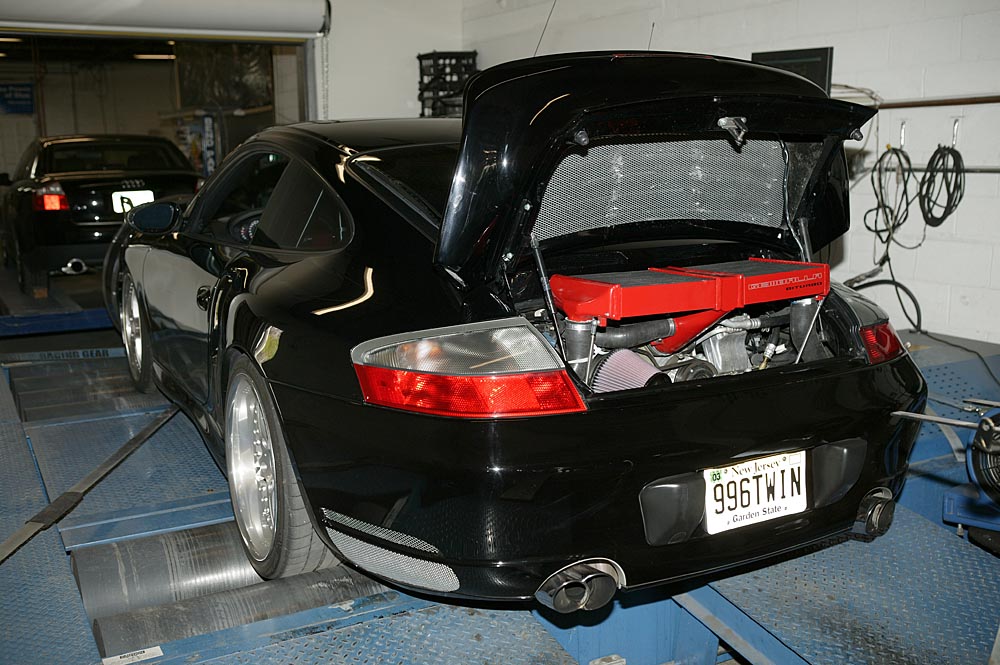
Since my last dyno, I added the Gemballa third intercooler, the GIAC Stage 4 Race program and my experimental intake. I ran Sunoco GT100, 100 octane fuel, for this dyno test and had the program set to race fuel mode. The third intercooler is self explanatory and clearly visible in the photos, but the intake is not.
The intake is shown below. I was interested in the EVO intake but it simply will not work with my 3rd intercooler. So, as the saying goes, necessity is the mother of invention!


This dyno session with these latest changes yielded:
507 four wheel horsepower
506 foot pounds four wheel torque
Before I continue, I want to express my personal thanks to Todd, Mike and Tom and Brian at AWE for hosting this event, providing refreshments and being all-around nice guys.
The following dyno sessions were performed on a Mustang four wheel drive dynamometer. All comparisons were also done on the same machine, albeit at different times of the year. All values are peak readings. Now, onto the good stuff……
Rockitman
Since his last dyno session last year, Chris added a Europipe exhaust and BMC air filter to his GT3.
Last year’s Stock Setup:
348 rear wheel horsepower
262 foot pounds rear wheel torque
This dyno session with the Europipe exhaust and BMC filter:
373 rear wheel horsepower
282 foot pounds rear wheel torque
Congratulations Chris!! 25 hp and 20 ft-lbs of torque increases!!!!!! That is even better than Europipe’s claims!
BCS996TT
Since Bill’s last dyno, wherein he used the canned Upsolute program and stock K16 turbos, he has changed turbos and has changed to an upgraded Upsolute program.
Last year’s Setup:
437 four wheel horsepower
??? foot pounds four wheel torque
This dyno session with the listed changes:
496 four wheel horsepower
490 foot pounds four wheel torque
During my exploration into modifications of the intake system (see my results below for more information), I discovered a potential modification to the stock airbox that could equate to possible power improvement. This “potential†performance modification entails the removal of the airflow converter insert. I came up with that name, but it tells the story. As Todd (AWE owner) explained to us (thank you Todd!), the insert is used to convert potentially turbulent airflow coming from the airbox’s odd shape and configuration to a more laminar flow in preparation for its path across the mass air flow sensor. The following photo shows the stock airbox and the location of this insert.
Although the purpose, as described by Todd, is to smoothen the airflow, there is no denying its blocking effect. It is a partially solid object in the airflow path. I calculated the area reduction of this insert and it amounts to 8.34%. So, the big question was whether the removal of this insert, and its 8+% blocking effect, would increase or decrease power.
We decided to try an A>B comparison on Bill’s car. So, immediately following his normal two runs, Ron, Bill and I jumped into action and removed the box, opened it up and removed the insert. We then ran two more dyno tests.
With the insert removed, we obtained the following results:
493 four wheel horsepower
XXX foot pounds four wheel torque
So, it looks like the insert really doesn’t add horsepower with the stock airbox in place.
Congratulations Bill!! Those are some excellent increases!! And remember, keep that laptop tethered to the car!!!
KPV
During my last dyno session, I had K24 turbos, Stainless Steel headers, GIAC Stage 4 programming, K&N air filter and Europipe Stage 2 Loud exhaust. This setup yielded the following results:
505 four wheel horsepower
486 foot pounds four wheel torque
Since my last dyno, I added the Gemballa third intercooler, the GIAC Stage 4 Race program and my experimental intake. I ran Sunoco GT100, 100 octane fuel, for this dyno test and had the program set to race fuel mode. The third intercooler is self explanatory and clearly visible in the photos, but the intake is not.
The intake is shown below. I was interested in the EVO intake but it simply will not work with my 3rd intercooler. So, as the saying goes, necessity is the mother of invention!
This dyno session with these latest changes yielded:
507 four wheel horsepower
506 foot pounds four wheel torque
Last edited by KPV; Apr 25, 2005 at 11:24 AM.
Thread Starter
|
Registered User
Joined: Jul 2003
Posts: 4,343
From: New Jersey
Rep Power: 199
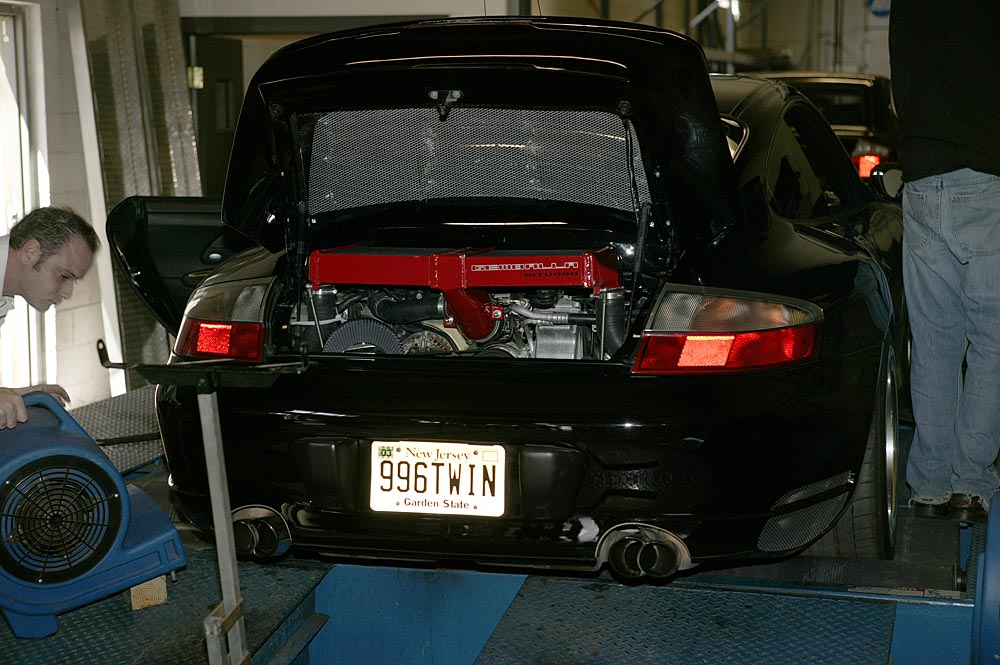
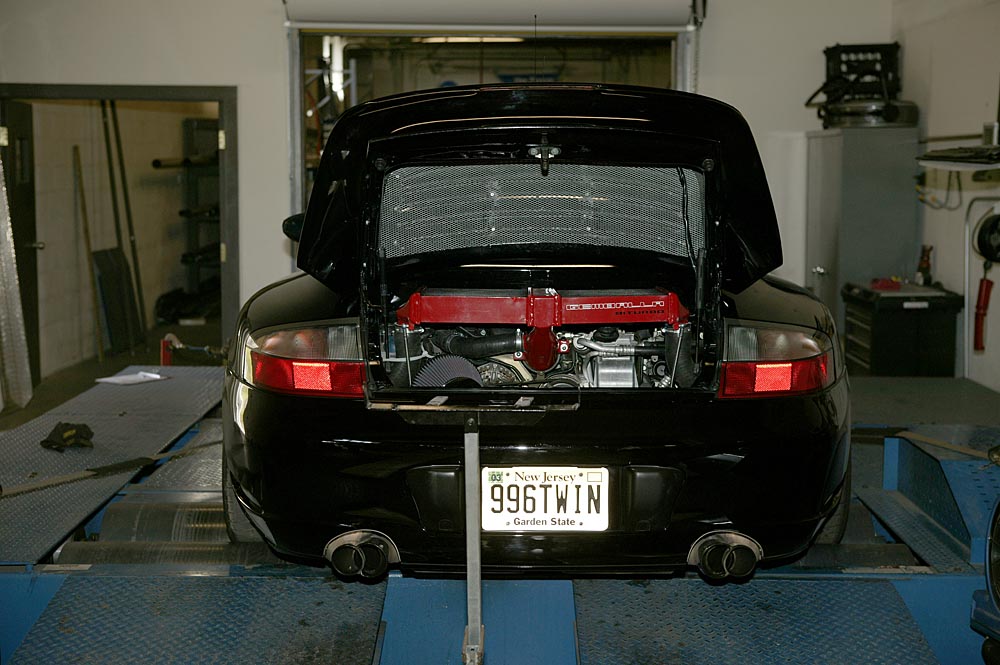
OK, so, anti-climatic.

So what gives??? I suspected the 3rd intercooler may actually reduce my power slightly due to the increased friction the air must undergo on its way to the throttle body, but I thought the GIAC Stage 4R program and the KPV intake would surely yield better results. Yes, I am disappointed. Does anyone know exactly what hp and tq increases I am supposed to expect running the Stage 4R program?
The intake incorporates a velocity stack and, since it uses a cone filter, drawing air from around its circumference, I wouldn’t expect turbulent airflow across the MAF and hence the elimination of the insert screen mentioned earlier shouldn’t have an adverse impact.
I really think the Stage 4R programming may not be performing correctly. I would appreciate input. The torque went up appreciably though. I realized a 20 foot pound peak torque increase.
Hmmmmmmm. Please post your thoughts regarding this matter.
Vipertestarossa (aka: Ron “Big Dog†Brown)
This was Ron’s first dyno session with his yellow beast. He has his car loaded up with the goodies. His performance list includes GIAC Stage 4GTR programming, 104 octane race fuel, Garrett turbos, BMC air filter, airbox insert removed, ceramic coated headers, Cargraphic exhaust and EVO heavy duty intake hoses.
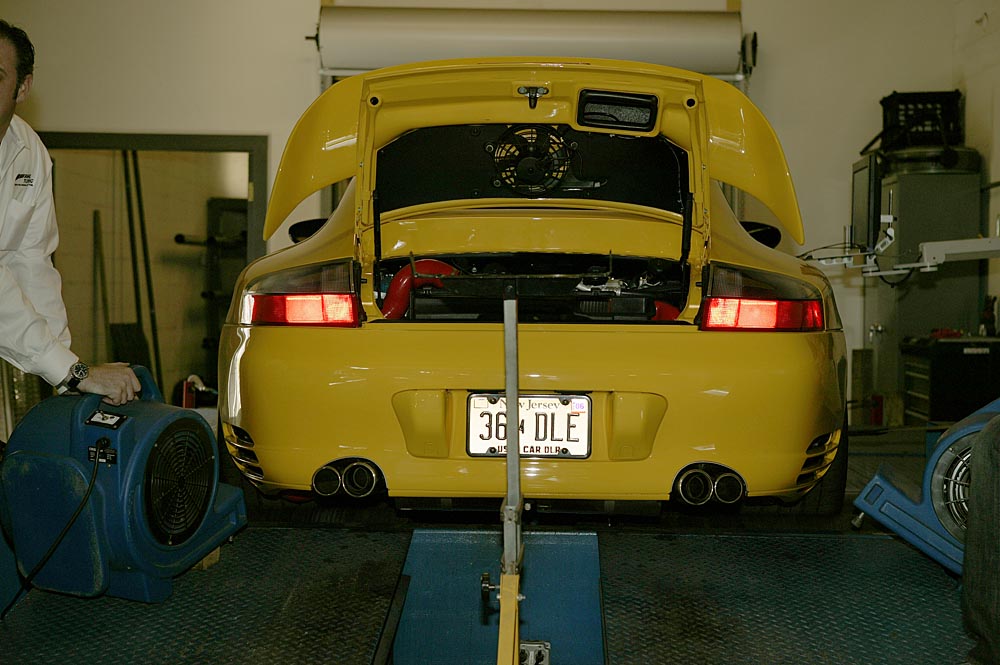
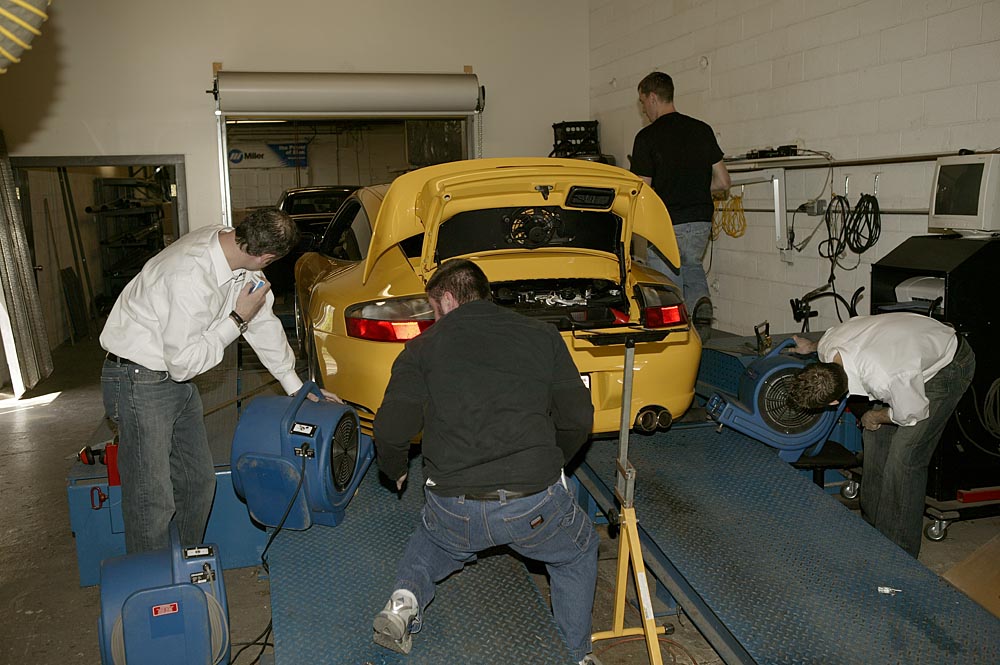
Unfortunately, Ron’s first dyno run suffered massive clutch slip. We first thought it was wheel spin, but the tell-tale smell of clutch lining straightened out any doubts. Brian (AWE’s dyno expert) ran up and down through the gears to try to reseat the clutch disc and/or de-glaze the surfaces and then they performed the test again. Remember, this is the stock clutch and pressure plate. Two tests were done that yielded satisfactory, yet not extraordinary results…….
550 four wheel horsepower
529 foot pounds four wheel torque
Ron, marginally happy after the two tests…
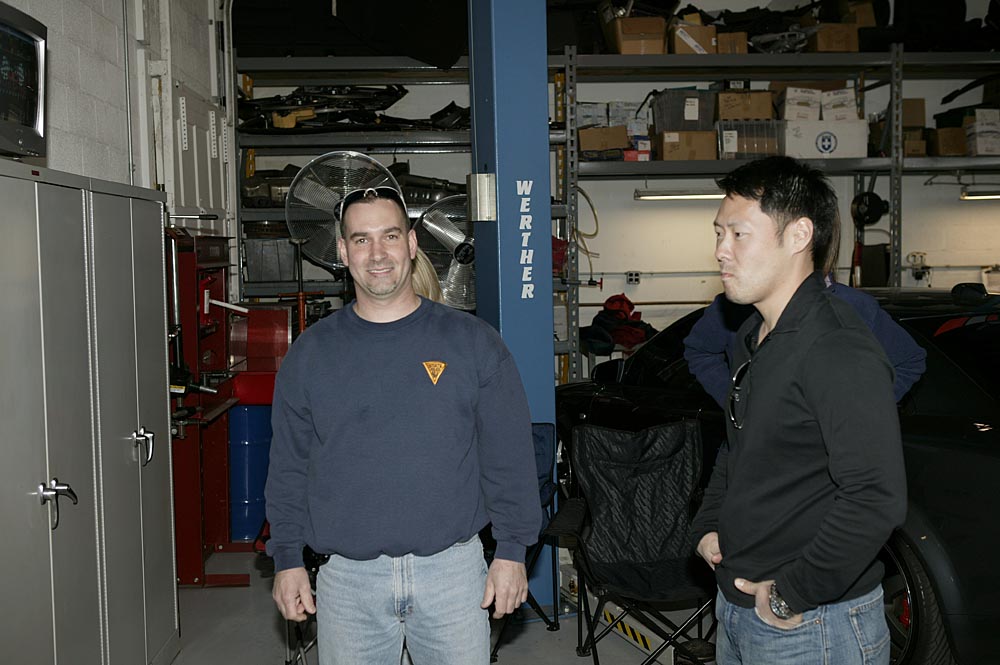
I am not sure what the horsepower and torque output should be for theGIAC Stage 4GTR kit. In addition, the mere fact that the car’s clutch slipped on the first attempt means to me that the car’s clutch may have undergone some unknown degree of slippage during the two “successful†pulls.
As I understand it, Ron will be installing an upgraded clutch and then re-dyno-ing the car. Good luck to you buddy and congratulations on the best run of the day!!
Last edited by KPV; Apr 18, 2005 at 02:34 PM.

Registered User
Joined: Dec 2003
Posts: 105
From: NY
Rep Power: 27
Ken,
It was nice to finally meet you... Your ongoing efforts to improve the already great 996TT are truly exemplary. I look forward to any future events in the NE area....
I've attached my dyno sheet in the other thread, but I'll add it here as well for those that are interested.....
Upgrades to the car are listed in my sig at the bottom.
Big two thumbs up for the guys at AWE!! Definitely a class act in their industry....
Btw, I have vids of all dyno pulls including Ron's "Majo clutch slippage," if anyone would like to see...
It was nice to finally meet you... Your ongoing efforts to improve the already great 996TT are truly exemplary. I look forward to any future events in the NE area....
I've attached my dyno sheet in the other thread, but I'll add it here as well for those that are interested.....
Upgrades to the car are listed in my sig at the bottom.
Big two thumbs up for the guys at AWE!! Definitely a class act in their industry....
Btw, I have vids of all dyno pulls including Ron's "Majo clutch slippage," if anyone would like to see...
Registered User
Joined: Jul 2003
Posts: 2,741
From: So Bay, LA
Rep Power: 142

Ken, Honestly, I think the oversized intercooler and the airfilter is causing a pressure drop. Also the air filter is enclosed under the large interccooler and is sucking in hot ambient engine air.
I think you would yield much better numbers by removing the oversized IC and putting the stock box back on.
I think you would yield much better numbers by removing the oversized IC and putting the stock box back on.
Thread Starter
|
Registered User
Joined: Jul 2003
Posts: 4,343
From: New Jersey
Rep Power: 199
Mark,
It was a pleasure meeting you. If you want me to include you in future emails to our group, please PM me your email info.
Oak,
It is great to hear from you. I haven't seen you around in awhile. Thanks for the insight. I know there may be a pressure drop across the Gemballa IC, but the shorter, swifter, presumably less turbulent intake + Stage 4R programming should have counteracted that INHO. Hmmmm.
Regarding the hotter engine bay air, the lid is up during the dyno run and a fan was blowing the engine bay. During driving, air enters the engine compartment from 3 locations, the decklid and the 2 forward facing "snouts" at the left and right sides of the wing. The decklid air goes down through the Gemballa IC whereas the snouts' air comes in under the IC. All of this air is vented out the long back vent as you can see in the first picture.
It was a pleasure meeting you. If you want me to include you in future emails to our group, please PM me your email info.
Oak,
It is great to hear from you. I haven't seen you around in awhile. Thanks for the insight. I know there may be a pressure drop across the Gemballa IC, but the shorter, swifter, presumably less turbulent intake + Stage 4R programming should have counteracted that INHO. Hmmmm.
Regarding the hotter engine bay air, the lid is up during the dyno run and a fan was blowing the engine bay. During driving, air enters the engine compartment from 3 locations, the decklid and the 2 forward facing "snouts" at the left and right sides of the wing. The decklid air goes down through the Gemballa IC whereas the snouts' air comes in under the IC. All of this air is vented out the long back vent as you can see in the first picture.

Registered User

Joined: Jul 2003
Posts: 1,332
From: Here
Rep Power: 76
well... I guess this calls for another dyno day...
ME..race gas with a couple of other goodies... ron new clutch, and ken with stock airbox....
However....you boys need to figure out what happened with the race programs as they didnt yield the expected power...
Ron was short 60HP and Ken 40HP.
Next time, dyno in both modes and compare.
ME..race gas with a couple of other goodies... ron new clutch, and ken with stock airbox....
However....you boys need to figure out what happened with the race programs as they didnt yield the expected power...
Ron was short 60HP and Ken 40HP.
Next time, dyno in both modes and compare.
Registered User
Joined: Feb 2004
Posts: 1,857
From: Wayne, NJ
Rep Power: 99
I must say the KPV fabricated intake was beautifully executed
makes me proud to be such good friends with Ken!
makes me proud to be such good friends with Ken!
Trending Topics

Registered User
Joined: Feb 2004
Posts: 1,857
From: Wayne, NJ
Rep Power: 99
Originally posted by BCS996TT
well... I guess this calls for another dyno day...
ME..race gas with a couple of other goodies... ron new clutch, and ken with stock airbox....
However....you boys need to figure out what happened with the race programs as they didnt yield the expected power...
Ron was short 60HP and Ken 40HP.
Next time, dyno in both modes and compare.
well... I guess this calls for another dyno day...
ME..race gas with a couple of other goodies... ron new clutch, and ken with stock airbox....
However....you boys need to figure out what happened with the race programs as they didnt yield the expected power...
Ron was short 60HP and Ken 40HP.
Next time, dyno in both modes and compare.
absolutely Bill, there will be another dyno day
Registered User
Joined: Jul 2003
Posts: 2,741
From: So Bay, LA
Rep Power: 142
Thanks Ken, I haven't been into posting as much. Good to see you still have your modding bug.
From what I can see from your set up, it seems that all the hot air would become trapped. Unless you have an opening under air box. I think the way your set up is designed it is creating a high air pressure ie a vacuum in a sense to trap hot air. The only way to relieve this vacuum (hot air) is though the intake.
Also, it sure seem like there are many right angles for the air flow for the large IC, I doubt the "less turbulent" air filter will even have an effect over all the right angles.
Your numbers would be even less in real road conditions if your deck lid was closed.
I think you would regain some of your numbers if the changes were made. I also noticed that even if you were to put back the stock air box it would not work correctly due to the shape of the deck lid. Maybe you could modify the EVO box to work? I think it maybe possible by fabricating an intake extension to the bottom of the IC and sealed with weather strip, like the earlier 79-86 930 which had a seal around the large IC on the top side.
Make sense?
From what I can see from your set up, it seems that all the hot air would become trapped. Unless you have an opening under air box. I think the way your set up is designed it is creating a high air pressure ie a vacuum in a sense to trap hot air. The only way to relieve this vacuum (hot air) is though the intake.
Also, it sure seem like there are many right angles for the air flow for the large IC, I doubt the "less turbulent" air filter will even have an effect over all the right angles.
Your numbers would be even less in real road conditions if your deck lid was closed.
I think you would regain some of your numbers if the changes were made. I also noticed that even if you were to put back the stock air box it would not work correctly due to the shape of the deck lid. Maybe you could modify the EVO box to work? I think it maybe possible by fabricating an intake extension to the bottom of the IC and sealed with weather strip, like the earlier 79-86 930 which had a seal around the large IC on the top side.
Make sense?
Thread Starter
|
Registered User
Joined: Jul 2003
Posts: 4,343
From: New Jersey
Rep Power: 199
Oak,
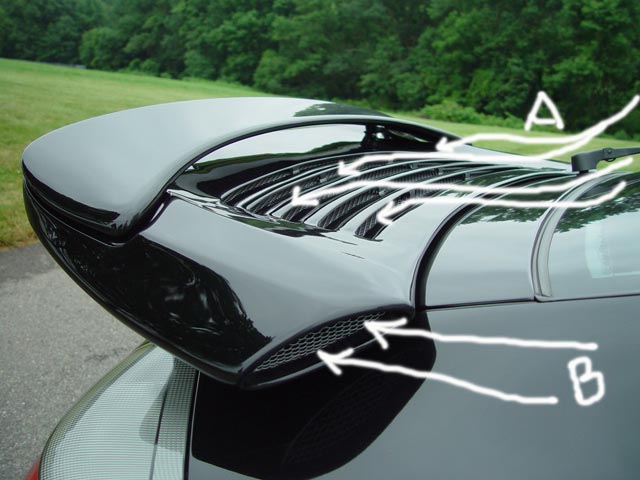
Following are three pictures.
The first picture shows the air inlets in the wing. Some of the air coming down the rear window enters the deck louvers and flows through the Gemballa IC (Marked “Aâ€). The snouts on either side pick up air as they have direct frontal exposure (Marked “Bâ€.
The second picture shows the air exit in the wing. All of the “collected†air is distributed to the intake, through this exit and down under the car around the engine in an unknown proportion.
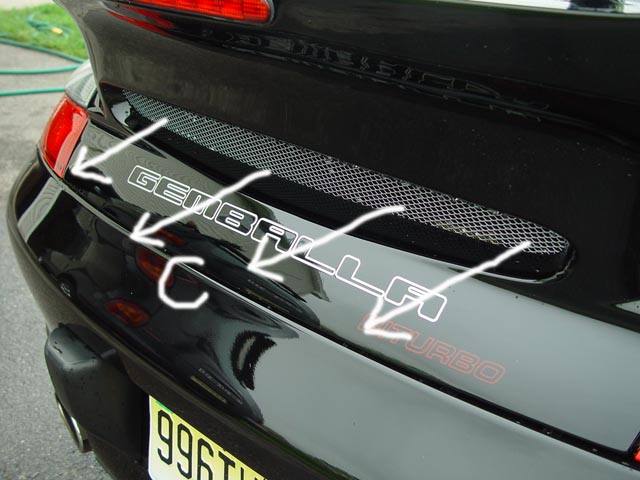
The third picture shows the engine bay interior. The “B†air comes in below the IC as the wing snouts channel air there as shown. The “A†air is deposited under the IC after going through it. So effectively there is some “mix†going on. As said before, this air is distributed to the intake, through the wing’s rear exit and down under the car around the engine in an unknown proportion.
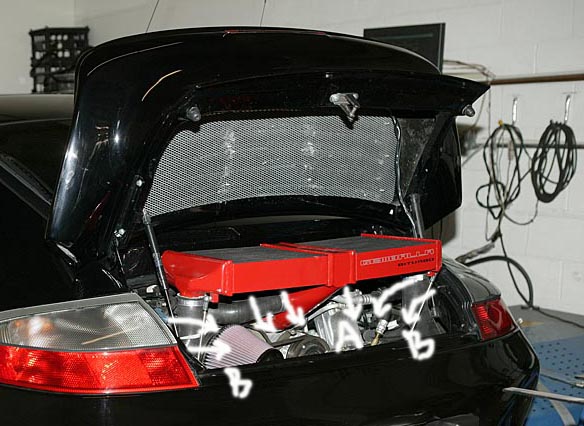
I truly believe that the forward facing snouts “B†take in enough cold air to keep the area “relatively†cool below the IC. I actually thought about piping from the filter directly to the snouts to gain cold ram air. The problem is that their total area is slightly less than the stock airbox’s opening. The snouts total 13 square inches whereas the stock airbox opening is 17 square inches. Now, this may be moot as the snouts are most likely pressurized at speed, so even though they are slightly less cross sectional area, they are under pressure.
Hmmmm……..
Following are three pictures.
The first picture shows the air inlets in the wing. Some of the air coming down the rear window enters the deck louvers and flows through the Gemballa IC (Marked “Aâ€). The snouts on either side pick up air as they have direct frontal exposure (Marked “Bâ€.
The second picture shows the air exit in the wing. All of the “collected†air is distributed to the intake, through this exit and down under the car around the engine in an unknown proportion.
The third picture shows the engine bay interior. The “B†air comes in below the IC as the wing snouts channel air there as shown. The “A†air is deposited under the IC after going through it. So effectively there is some “mix†going on. As said before, this air is distributed to the intake, through the wing’s rear exit and down under the car around the engine in an unknown proportion.
I truly believe that the forward facing snouts “B†take in enough cold air to keep the area “relatively†cool below the IC. I actually thought about piping from the filter directly to the snouts to gain cold ram air. The problem is that their total area is slightly less than the stock airbox’s opening. The snouts total 13 square inches whereas the stock airbox opening is 17 square inches. Now, this may be moot as the snouts are most likely pressurized at speed, so even though they are slightly less cross sectional area, they are under pressure.
Hmmmm……..
Last edited by KPV; Apr 18, 2005 at 04:11 PM.
Registered User
Joined: Jul 2003
Posts: 2,741
From: So Bay, LA
Rep Power: 142
Ken, Thanks for the pics, I understand the mechanics of what you are showing. But if you have ever seen the air flow directly behind where the vent is behind the deck lid there is usually a vortex right in that spot where a vacuum is created. I believe this will limit the "fresh" air flowing through. This vacuum can create a negative air pressure, making it harder for the engine to get a ram air effect at speed. As opposed to a high pressure area and inducing a ram effect.
I'm no expert, just some personal observations and theories.
I'm no expert, just some personal observations and theories.

Registered User
Joined: Aug 2003
Posts: 3,095
From: Chicago
Rep Power: 146
Ken:
You have a OBD reader. So do I. Let's be engineers and collect some freakin data. I'll collect intake and ambient temps. You do the same. If your intake temps are the same or higher, the third IC set-up is hurting you. Sound good?
Great write-up by the way. It sure makes the EVO intake look good.
You have a OBD reader. So do I. Let's be engineers and collect some freakin data. I'll collect intake and ambient temps. You do the same. If your intake temps are the same or higher, the third IC set-up is hurting you. Sound good?
Great write-up by the way. It sure makes the EVO intake look good.