


Chad's Reference to Knife Edging the crank...


Thread Starter
|
Registered User
Joined: Jul 2003
Posts: 3,670
Rep Power: 189


Chad's Reference to Knife Edging the crank...
Some of you may have noticed Chad's reference to the to knife edging the crank and wondered what it meant. In stead of clouding or hijacking Chad's thread I thought I would post it here. This is a motor I am doing as we speak. This crank has been crossed drilled and knife edged. What that means is the crank has had the counter weights ground down to a knife's edge to slice through the air of the case and oil. By creating a knife edge the resistances less which means friction is less and the crank can turn over faster and easier than say it's counter partner. By cross drilling you are increasing the oil capacity to the bearings. Under very high RPMs the oil pressure has to overcome the centrifugal force and pump now hot thinning oil to the surface to properly lubricate the bearing. By adding a second hole strategically placed this ensures that at high RPMs the bearing is not starved for oil. Balance the whole assembly, add a few coatings and you have one of the best crank setups as possible.
Just thought some would like to see and know the difference.


Just thought some would like to see and know the difference.



Registered User
Joined: Sep 2003
Posts: 4,823
From: DFW, TX
Rep Power: 272
Originally posted by msindi
Is this a 996TT motor?? How much would such a process cost? what are the power gains or any other gains from this process?
Is this a 996TT motor?? How much would such a process cost? what are the power gains or any other gains from this process?
 J/K
J/KEvan
Thread Starter
|
Registered User
Joined: Jul 2003
Posts: 3,670
Rep Power: 189
This is not a 996TT motor, but the lower end looks almost identical other than a few small changes. The cranks look identical with small journals though. The cost can be all over over the map depending on what the total job will consist off. Typically cross drilling is not an issue until you run 8K RPM. The HP gains are more those of efficiency and hard to measure. Balancing and coatings are also hard to measure results. What you end up with is a very smooth and fast revving motor able to sustain high RPM without starving the bearings for oil. The cross drilling is a double fold issue because your valve train will not cope in stock mode as high as the benefits of cross drilling. The knife edging and balance though do have daily benefits and make for a nice motor. All the work we did to this crank ran about 800.00.
Thread Starter
|
Registered User
Joined: Jul 2003
Posts: 3,670
Rep Power: 189
LMAO....Nah that is about 20 hours of work to get down their. Our motors have a ton of stuff to pull off. The cams are rather tricky, not any worse than say a standard 911. The tools alone cost me 2500.00
Registered User
Joined: Jul 2003
Posts: 251
From: San Diego
Rep Power: 44
Great pictures - question...
Very clear pictures and I can imagine the effect on rotational resistance being improved - but I'm wondering what effect the knife edge machining has on the torsional resonance of the crank ?
From my F1 days the design of a crank which didn't fly apart due to some torsional harmonic resonance or other was a very exact science with some closely guarded trade secrets - that's V10's for you at 17,000 + rpm
I've attached a photo for your amusement - have a guess what sort of engine used to get 10 of these babies !
From my F1 days the design of a crank which didn't fly apart due to some torsional harmonic resonance or other was a very exact science with some closely guarded trade secrets - that's V10's for you at 17,000 + rpm
I've attached a photo for your amusement - have a guess what sort of engine used to get 10 of these babies !
Trending Topics
Thread Starter
|
Registered User
Joined: Jul 2003
Posts: 3,670
Rep Power: 189
Wow, I can only guess what that was out of.
We have these things balanced as an assembly past 10K when we do them to ensure that harmonics is not an issue. So far that has not been an issue.
We have these things balanced as an assembly past 10K when we do them to ensure that harmonics is not an issue. So far that has not been an issue.
Registered User
Joined: Jul 2003
Posts: 251
From: San Diego
Rep Power: 44
Glad you can appreciate the pic's
Not many people can - in fact you're one of a very few who gets what this piston is all about - as for the alloy it's made of, that's another story....
More clues tomorrow ;-)
More clues tomorrow ;-)


Registered User

Joined: Aug 2003
Posts: 910
From: TX, USA
Rep Power: 59
This is interesting, I thought knife edging only involved the leading edge of the counterweights, not the outer edge.
The piston has a single extremely narrow single compression ring. It appears to be over a 4" bore very short stroke engine. The wrist pin is right against the oil ring so it must be a long connecting rod super high RPM engine. I wonder if the long distance between the compression ring and the top of the piston ring indicates a turbocharged engine (CART)? I would think a turbo'ed motor would have 2 compression rings(?) It also looks like a design for the largest possible valve sizes. Maybe from a F1 about 5 years ago?
The piston has a single extremely narrow single compression ring. It appears to be over a 4" bore very short stroke engine. The wrist pin is right against the oil ring so it must be a long connecting rod super high RPM engine. I wonder if the long distance between the compression ring and the top of the piston ring indicates a turbocharged engine (CART)? I would think a turbo'ed motor would have 2 compression rings(?) It also looks like a design for the largest possible valve sizes. Maybe from a F1 about 5 years ago?
Last edited by ebaker; Oct 19, 2003 at 09:53 PM.

Registered User
Joined: Jul 2003
Posts: 251
From: San Diego
Rep Power: 44
We have a winner...
ebaker - congrats. You are correct F1 from 96 season, so actually over 7 years ago. Non turbo of course and from a very hi revving engine - better not say which make ;-) But it's not a Judd.
Clearly you know your engines - I'll have to dig out something a little more obscure next time...
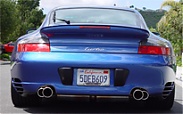
For Accomplice / Kevin - here's a picture of my TT - if you'd like anymore, let me know.
Clearly you know your engines - I'll have to dig out something a little more obscure next time...
For Accomplice / Kevin - here's a picture of my TT - if you'd like anymore, let me know.