


Break In Period on a Built Motor


Moderator


Joined: Jul 2003
Posts: 22,235
Rep Power: 1227


A Picture's Worth A Thousand Words:
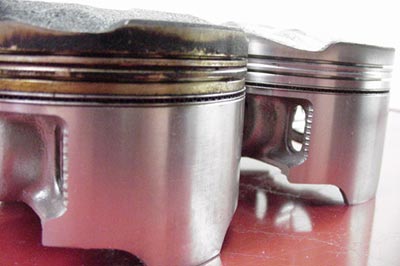
The piston on the right was broken in as
per MotoMan's instructions.
After a full season of hard racing:
- Perfect Ring Seal ...
- No Scuffing ...
- Lots of Trophies !!!
These Honda F3 pistons show
the difference.
Although these pistons came out of engines which were raced for a full season, they weren't set-up with any special clearances or other preparation.
These engines were never worked on prior to being raced. They were totally stock as built by Honda.
The only difference was the break in method they used...
The one on the right was broken in as per MotoMan's instructions.
The one on the left was broken in exactly according to the owner's manual. The resulting leaky rings have allowed pressure to "blow by" down into the crankcase on acceleration, and oil to "suck-up" into the combustion chamber on deceleration.
Needless to say, this bike was slow !!
It's up to you:
The loss in power from an easy break-in and the resulting poor ring seal can be
anywhere from 2% - 10% !!
In other words:
The gain in power from using this break-in method can be anywhere from 2% - 10% !!
The piston on the right was broken in as
per MotoMan's instructions.
After a full season of hard racing:
- Perfect Ring Seal ...
- No Scuffing ...
- Lots of Trophies !!!
These Honda F3 pistons show
the difference.
Although these pistons came out of engines which were raced for a full season, they weren't set-up with any special clearances or other preparation.
These engines were never worked on prior to being raced. They were totally stock as built by Honda.
The only difference was the break in method they used...
The one on the right was broken in as per MotoMan's instructions.
The one on the left was broken in exactly according to the owner's manual. The resulting leaky rings have allowed pressure to "blow by" down into the crankcase on acceleration, and oil to "suck-up" into the combustion chamber on deceleration.
Needless to say, this bike was slow !!
It's up to you:
The loss in power from an easy break-in and the resulting poor ring seal can be
anywhere from 2% - 10% !!
In other words:
The gain in power from using this break-in method can be anywhere from 2% - 10% !!
Moderator
Joined: Jul 2003
Posts: 22,235
Rep Power: 1227
Update -
Some have felt that the piston which was broken in hard in the above photo is too clean to be true !!
"That piston is impossible, there must be some trick going on."
So, here I present: "The Impossible Piston Museum"
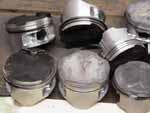
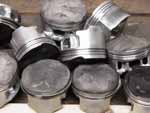
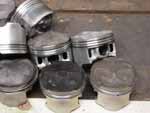
Here are 14 pistons from 14 different bikes, with several manufacturers represented. Some are from streetbikes and some from racebikes.
 .
.
.
<<It looks like there are more than 14 pistons, because the area in the 3 photos overlap.
It's 3 segments of a panorama photo to give you multiple views of this extraordinarily rare collection.
The pistons have been stacked for display purposes only, they aren't going back into engines. Always be super careful when handling pistons, as the aluminum is soft and very easily dented, causing combustion leakage, and friction ... neither of which is good for power.
As in any museum, some of the specimens are better examples than others, but the point is that none have any leakage past the top ring, because they were all broken in by the method described here !
The only impossible thing about these pistons ... is that it's impossible to achieve this result with an easy break-in.
Some have felt that the piston which was broken in hard in the above photo is too clean to be true !!
"That piston is impossible, there must be some trick going on."
So, here I present: "The Impossible Piston Museum"
Here are 14 pistons from 14 different bikes, with several manufacturers represented. Some are from streetbikes and some from racebikes.
All of the engines had the correct jetting, the reason some have black carbon deposits is because they were run on "pump gas", which burns dark regardless of the jetting. Whereas the lighter ones were run on oxygenated race fuel, which gives a very light tan to gray color. (Many of the black-carboned pistons were from racebikes.)
Disclaimer:
Absolutely no photo altering or physical cleaning of the pistons is allowed in the museum !!
We run a legit exhibit, and all the artifacts on display are 100% genuine.
Note:
The controversial piston in the above picture is the last one in the middle row,
and it's indicated by the arrows.
You can take a closer look by clicking on the photos to see the full sized versions:
Absolutely no photo altering or physical cleaning of the pistons is allowed in the museum !!
We run a legit exhibit, and all the artifacts on display are 100% genuine.
Note:
The controversial piston in the above picture is the last one in the middle row,
and it's indicated by the arrows.
You can take a closer look by clicking on the photos to see the full sized versions:
..
<<It looks like there are more than 14 pistons, because the area in the 3 photos overlap.
It's 3 segments of a panorama photo to give you multiple views of this extraordinarily rare collection.
The pistons have been stacked for display purposes only, they aren't going back into engines. Always be super careful when handling pistons, as the aluminum is soft and very easily dented, causing combustion leakage, and friction ... neither of which is good for power.
As in any museum, some of the specimens are better examples than others, but the point is that none have any leakage past the top ring, because they were all broken in by the method described here !
The only impossible thing about these pistons ... is that it's impossible to achieve this result with an easy break-in.

Registered User
Joined: Apr 2004
Posts: 921
From: Phoenix, AZ
Rep Power: 72
I have always broken my engines in by running them hard. Every single one has ran strong and has never has any issues. At the Porsche factory each car is ran hard before shipping. People that baby their cars for 1000+ miles are risking not having their rings seat correctly. Everybody has their own take on this subject so there is mine.

Registered User
Joined: Jul 2003
Posts: 2,803
From: Missing in action
Rep Power: 214
Originally Posted by jags911tt
Thanks guys this is what I needed to know.
Now any input on cams and porting the heads on a gt700 car
Now any input on cams and porting the heads on a gt700 car
I know a bit more about heads. The easiest route is to simply port and polish your heads. Frankly, this is probably more than sufficient if you are going to retain the GT28 turbos. You can also increase the size of your valves. This is more involved, costly and time consuming. Scott and JoeTwin kept OEM valve sizes with GT30s are they are doing great. I went with larger valves.
Craig
Moderator
Joined: Jul 2003
Posts: 22,235
Rep Power: 1227
Viewer Questions:
Q: If break- in happens so quickly, why do you recommend using petroleum break- in oil for 1500 miles ??A: Because while about 80% of the ring sealing takes place in the first hour of running the engine,
the last 20% of the process takes a longer time. Street riding isn't a controlled environment, so most of the mileage may
not be in "ring loading mode". Synthetic oil is so slippery that it actually "arrests" the break in process before the rings can seal completely. I've had a few customers who switched to synthetic oil too soon, and the rings never sealed properly no matter how hard they rode. Taking a new engine apart to re - ring it is the last thing anyone wants to do, so I recommend a lot
of mileage before switching to synthetic. It's really a "better safe than sorry" situation.Q: My bike comes with synthetic oil from the factory, what should I do ??
A: I recommend changing the factory installed synthetic oil back to petroleum for the break-in period.
Q: What about the main and rod bearings, don't they break - in ??A:Actually, the operation of plain bearings doesn't involve metal to metal contact !! The shiny spots on used
bearings are caused from their contact with the crankshaft journals during start up after the engine has been sitting a while,
and the excess oil has drained off. This is the main reason for not revving up the engine when it's first started.
The subject of plain bearings is one of the most mysterious aspects of engines, and will be covered in a future issue
of Power News. In it, I'll reveal more information that fully explains the non-contact phenomenon.
Q: Why change the oil at 20 miles ?? Doesn't the oil pick up
screen catch the aluminum bits ???A:It's true that the screen stops the big pieces, but many areas of the engine aren't within the oil filtration system. The oil that is splashed around will circulate metal debris to the lubricated bearing surfaces. For example, transmission gears and their ball bearings are unprotected by the filtration system, and even the cam chain makes a perfect "conveyer belt" to
bring metal debris up into the cylinder head !!
A close examination of a new engine will reveal lots of aluminum deposits on steel parts. This aluminum coats and tightens
up the clearances of the parts, which creates a loss of power. Most of the time I spend "blueprinting"
an engine is actually inspecting every part and "de-aluminizing" them !!I prefer to remove the oil pan and clean the aluminum bits out of a new engine out that way, but a $20 oil change
is an easy and inexpensive way to flush the initial particles that come loose in the first miles.
Q: What about motorcycle V.S. car oils ???
A: This is a topic all by itself !! It will be covered in a future issue of Power News.
Q:Will this break - in method cause my engine to wear out faster ???
A: No, in fact,a poor ring seal will allow an increase in the by products of combustion to contaminate the oil.
Acid contamination and oil consumption are the 2 reliability problems which are the result of an
"owner's manual" or "magazine tech article" style easy break-in.
By following the instructions on this page, you'll find that your oil is cleaner and the engine will rev quicker.
Plus, you'll have much better torque and power across the power range from the vastly improved ring seal.
Reliability and Power are 100% connected !!
Q: If break- in happens so quickly, why do you recommend using petroleum break- in oil for 1500 miles ??A: Because while about 80% of the ring sealing takes place in the first hour of running the engine,
the last 20% of the process takes a longer time. Street riding isn't a controlled environment, so most of the mileage may
not be in "ring loading mode". Synthetic oil is so slippery that it actually "arrests" the break in process before the rings can seal completely. I've had a few customers who switched to synthetic oil too soon, and the rings never sealed properly no matter how hard they rode. Taking a new engine apart to re - ring it is the last thing anyone wants to do, so I recommend a lot
of mileage before switching to synthetic. It's really a "better safe than sorry" situation.Q: My bike comes with synthetic oil from the factory, what should I do ??
A: I recommend changing the factory installed synthetic oil back to petroleum for the break-in period.
Q: What about the main and rod bearings, don't they break - in ??A:Actually, the operation of plain bearings doesn't involve metal to metal contact !! The shiny spots on used
bearings are caused from their contact with the crankshaft journals during start up after the engine has been sitting a while,
and the excess oil has drained off. This is the main reason for not revving up the engine when it's first started.
The subject of plain bearings is one of the most mysterious aspects of engines, and will be covered in a future issue
of Power News. In it, I'll reveal more information that fully explains the non-contact phenomenon.
Q: Why change the oil at 20 miles ?? Doesn't the oil pick up
screen catch the aluminum bits ???A:It's true that the screen stops the big pieces, but many areas of the engine aren't within the oil filtration system. The oil that is splashed around will circulate metal debris to the lubricated bearing surfaces. For example, transmission gears and their ball bearings are unprotected by the filtration system, and even the cam chain makes a perfect "conveyer belt" to
bring metal debris up into the cylinder head !!
A close examination of a new engine will reveal lots of aluminum deposits on steel parts. This aluminum coats and tightens
up the clearances of the parts, which creates a loss of power. Most of the time I spend "blueprinting"
an engine is actually inspecting every part and "de-aluminizing" them !!I prefer to remove the oil pan and clean the aluminum bits out of a new engine out that way, but a $20 oil change
is an easy and inexpensive way to flush the initial particles that come loose in the first miles.
Q: What about motorcycle V.S. car oils ???
A: This is a topic all by itself !! It will be covered in a future issue of Power News.
Q:Will this break - in method cause my engine to wear out faster ???
A: No, in fact,a poor ring seal will allow an increase in the by products of combustion to contaminate the oil.
Acid contamination and oil consumption are the 2 reliability problems which are the result of an
"owner's manual" or "magazine tech article" style easy break-in.
By following the instructions on this page, you'll find that your oil is cleaner and the engine will rev quicker.
Plus, you'll have much better torque and power across the power range from the vastly improved ring seal.
Reliability and Power are 100% connected !!

Thread Starter
|
Registered User
Joined: Jul 2005
Posts: 3,771
From: Seattle WA
Rep Power: 225
Originally Posted by Craig
I don't know much about cams. I have GT3 exhaust cams and stock intake cams. Scott, Mark, Chad and Knighton are the knowledgeable guys about intake cams. That being said, it appears to me based upon Scott's and Mark's dynos, as confirmed during recent telephone discussions, that the primary benefits of intake cams are achieved above 7000 rpms. Therefore, if you are going to do intake cams, you should probably increase your rev limiter (and build everything else accordingly).
I know a bit more about heads. The easiest route is to simply port and polish your heads. Frankly, this is probably more than sufficient if you are going to retain the GT28 turbos. You can also increase the size of your valves. This is more involved, costly and time consuming. Scott and JoeTwin kept OEM valve sizes with GT30s are they are doing great. I went with larger valves.
Craig
I know a bit more about heads. The easiest route is to simply port and polish your heads. Frankly, this is probably more than sufficient if you are going to retain the GT28 turbos. You can also increase the size of your valves. This is more involved, costly and time consuming. Scott and JoeTwin kept OEM valve sizes with GT30s are they are doing great. I went with larger valves.
Craig
What about the evo Sport Camshafts
Registered User
Joined: Jul 2003
Posts: 2,803
From: Missing in action
Rep Power: 214
Originally Posted by jags911tt
Thanks Craig. I am not looking to increase the rev limiter. I think I will stick to porting and polishing the heads.
What about the evo Sport Camshafts
What about the evo Sport Camshafts
Craig
Moderator
Joined: Jul 2003
Posts: 22,235
Rep Power: 1227
Originally Posted by jags911tt
Thanks guys this is what I needed to know.
Now any input on cams and porting the heads on a gt700 car
Now any input on cams and porting the heads on a gt700 car
As for the exhaust cams I can only guess they are GT3 exhaust cams. Why? They are using the same stock lifters and no one knows the exact metal make up of the Porsche cams. Without this information metal incompatibly (between tappets and cam) is a real issue. Protomotive and the cam maker they used will find out very soon. I have spoken with Todd on this and he has some very good preventative ideas to deal with this.
As for markski's cams. I sold Protomotive a set of my cams and cam housings which are currently being used on his car. These are GT3 based parts (cams, cam housings/tappets) which other than the GT3 exhaust cams will not fit on a 996tt motor.
I give you my take on the heads in a bit ........... I'm tired of writing for now.
Last edited by cjv; May 18, 2007 at 09:43 PM.




Registered User
Joined: Feb 2005
Posts: 4,660
Rep Power: 254
Originally Posted by vincentdds
Jags
Don't forget to do oil and filter change right after the break in. This will remove traces of metal from new engine parts from the oil.
Don't forget to do oil and filter change right after the break in. This will remove traces of metal from new engine parts from the oil.

Moderator
Joined: Jul 2003
Posts: 22,235
Rep Power: 1227
Originally Posted by jags911tt
As it states above - is there a break in period?
Also please give me input on head work and cam's
Jag
Also please give me input on head work and cam's
Jag
With that in mind the cams, heads, turbo's and displacement must be blueprinted. Remember no cam is a silver bullet for the entire rpm range. It doesn't do any good to have big heads and a small cam. Or small heads and big turbo's, etc. One cam will come on in lower rpm's and peak out around 7500 max. Another will come on in the mid rpm's and peak out around 8500. It also helps if your cams are designed for a turbo vs a NA motor.
The blueprinter must match the head flow with the turbo's. Bigger ports/valves allow for more power at lower boost levels. Smallers turbo's operate at lower redline and produce more torque at lower rpm's. The response is quicker and earlier. Given the displacement is equal. Add more displacement and this changes in favor of the larger turbo's.
Another part that is recently being looked at as these motor's make more power ............. the parts between the throttle body and the heads. The current stock and aftermarket splitters are simply not enough after a certain point. In addition, I don't believe any current piping from air filters located in the area where the stock air filter is located and snaked to the turbo's can provide sufficient air for GT30R and larger turbo's. Such turbo's should have air taken from within 12" of the turbo intake. In addition the size of the tubing required for these turbo's just doesn't have enough room when snaked between the motor and chassis.
Last edited by cjv; May 18, 2007 at 10:39 PM.
Thread Starter
|
Registered User
Joined: Jul 2005
Posts: 3,771
From: Seattle WA
Rep Power: 225
Originally Posted by vincentdds
Jags
Don't forget to do oil and filter change right after the break in. This will remove traces of metal from new engine parts from the oil.
Don't forget to do oil and filter change right after the break in. This will remove traces of metal from new engine parts from the oil.
Thanks Vince.
Thread Starter
|
Registered User
Joined: Jul 2005
Posts: 3,771
From: Seattle WA
Rep Power: 225
Originally Posted by andyk79
Jags, I take it you are going to build up your motor? What have the guys been up to of late. Have you guys gone on any crazy drives?