


Headers


Registered User

Joined: Aug 2005
Posts: 1,477
From: Melbourne Beach, Fl
Rep Power: 117


Originally Posted by cjv
9eleven,
Your first sentence is very accurate with the exception of the word "probably." Headers by themselves do not add power. Remember, only additional fuel with the correct oxygen volumn makes power. All the other components only facilitate the air and fuel. Ported OME headers are not a very real restriction unless you climb above 650 hp. Let me explain. The other headers will actually slightly hinder power/torque under 500 hp. There can be a gradule increase in power from 500 to 650, but as I said before, most drivers wouldn't really feel the increase unless you were on a track and were measuring the tenths of a second gained duringa lap.
Headers really should a benefit when coupled with large turbo's. I' speaking about turbo's that do not utilize internal waste gates because these waste gates are not conducive with big power. They take up room. In addition they cannot move the volumn of gasses that external one can. The external WG's are simple bigger. Remember, the weak link theory. Well, these big turbo's require big everything else. Not going into engine internals, you need a larger fresh air supply. The route of the existing filter to turbo is simply too restrictive to supply the volume of air required for these turbo's. That is why the distance is shortened and tubes enlarged to about 100 mm. They usually locate these cone filters in the rear fenders. Then you need larger tubes IC's and piping to the Y pipe and then larger throttle body and MAF. A MAF rated for a minimum of 1000 hp is preferable.
I have not covered everthing, but you get the idea. I can tell you from experience, there is no way the ported headers will even come close after 850 hp and it is a slow losing battle for them after 650.
You mention Ruff, Ruff does well with their set up, but remember, Ruff isn't making 800-1000 hp motors. I can remember about six years ago when Ruff was making more hp and especially more torque than everyone else. I can also remember discovering that their secret was the larger tube from the filter to the turbo. My how things have progressed. I see this whole arguement as arguing about nothing. A 650/700 hp car might be 15/20 hp less without a good set of turbo's. In addition, overall this car is far more conducive with the street. Do you know the longevity difference between a 650 hp motor compared to a 800 and then a 1000 hp motor. The big motors are great for a short period of time. But I will guarantee you that a big motor will not last 20,000 miles til rebuild unless the owner is babying it. I believe it would even be less with the spring pressures I see these motors running at. Remember a 450 hp race motor is good for 30-50 race hours. How many race hours do you think a 700, 800, 1000 or 1200 hp motor will last. That is unless you drive it like a little old lady the majority of the time.
This whole arguement is about apples and oranges.
Your first sentence is very accurate with the exception of the word "probably." Headers by themselves do not add power. Remember, only additional fuel with the correct oxygen volumn makes power. All the other components only facilitate the air and fuel. Ported OME headers are not a very real restriction unless you climb above 650 hp. Let me explain. The other headers will actually slightly hinder power/torque under 500 hp. There can be a gradule increase in power from 500 to 650, but as I said before, most drivers wouldn't really feel the increase unless you were on a track and were measuring the tenths of a second gained duringa lap.
Headers really should a benefit when coupled with large turbo's. I' speaking about turbo's that do not utilize internal waste gates because these waste gates are not conducive with big power. They take up room. In addition they cannot move the volumn of gasses that external one can. The external WG's are simple bigger. Remember, the weak link theory. Well, these big turbo's require big everything else. Not going into engine internals, you need a larger fresh air supply. The route of the existing filter to turbo is simply too restrictive to supply the volume of air required for these turbo's. That is why the distance is shortened and tubes enlarged to about 100 mm. They usually locate these cone filters in the rear fenders. Then you need larger tubes IC's and piping to the Y pipe and then larger throttle body and MAF. A MAF rated for a minimum of 1000 hp is preferable.
I have not covered everthing, but you get the idea. I can tell you from experience, there is no way the ported headers will even come close after 850 hp and it is a slow losing battle for them after 650.
You mention Ruff, Ruff does well with their set up, but remember, Ruff isn't making 800-1000 hp motors. I can remember about six years ago when Ruff was making more hp and especially more torque than everyone else. I can also remember discovering that their secret was the larger tube from the filter to the turbo. My how things have progressed. I see this whole arguement as arguing about nothing. A 650/700 hp car might be 15/20 hp less without a good set of turbo's. In addition, overall this car is far more conducive with the street. Do you know the longevity difference between a 650 hp motor compared to a 800 and then a 1000 hp motor. The big motors are great for a short period of time. But I will guarantee you that a big motor will not last 20,000 miles til rebuild unless the owner is babying it. I believe it would even be less with the spring pressures I see these motors running at. Remember a 450 hp race motor is good for 30-50 race hours. How many race hours do you think a 700, 800, 1000 or 1200 hp motor will last. That is unless you drive it like a little old lady the majority of the time.
This whole arguement is about apples and oranges.
http://9ff.de/en/products/details.ph...d=4&relID=2274
http://translate.google.com/translat...lr%3D%26sa%3DG
The 9ff is a compromise motor. They use bigger KKK's with internal wastegates. Their power ratings are at the flywheel. The AR or their turbo is high and lends to top speed only. The car would not be extremely impressive in the quarter or tracks like LS or Infineron. They really could be getting into the KA, Protomotive, EVOMS, PD and a couple others power ranges with headers incorporating external waste gates. The Manthey on the other hand is at the top of the range with their 700 hp.
I'll guarantee that you will never get these companies to attend a shootout with the above American companies. We have already tried. They have too much to lose. Be my guest and try.
 This side of the Atlantic has been awaiting the chance but there will never be a contest if they won't participate.
Last edited by cjv; Aug 4, 2007 at 01:21 PM.
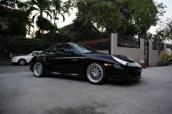
I am looking at a maximum of 600 Hp. I have sumed it up as follows:
1. New Header - If you are looking for +650 hp. Better spool up and soundsbetter.
2. Port headers - For better spool up and less than 650 hp.
3. Stock headers - OK for up to 650hp. Saves $1800 - 2000
Does this about sum it up. Maybe I may port to get better spool up / response. Still sitting on the fence about this.
1. New Header - If you are looking for +650 hp. Better spool up and soundsbetter.
2. Port headers - For better spool up and less than 650 hp.
3. Stock headers - OK for up to 650hp. Saves $1800 - 2000
Does this about sum it up. Maybe I may port to get better spool up / response. Still sitting on the fence about this.

Registered User
Joined: Dec 2003
Posts: 3,597
From: Texas
Rep Power: 205
Originally Posted by cjv
9eleven,
Your first sentence is very accurate with the exception of the word "probably." Headers by themselves do not add power. Remember, only additional fuel with the correct oxygen volumn makes power. All the other components only facilitate the air and fuel. Ported OME headers are not a very real restriction unless you climb above 650 hp. Let me explain. The other headers will actually slightly hinder power/torque under 500 hp. There can be a gradule increase in power from 500 to 650, but as I said before, most drivers wouldn't really feel the increase unless you were on a track and were measuring the tenths of a second gained duringa lap.
Headers really should a benefit when coupled with large turbo's. I' speaking about turbo's that do not utilize internal waste gates because these waste gates are not conducive with big power. They take up room. In addition they cannot move the volumn of gasses that external one can. The external WG's are simple bigger. Remember, the weak link theory. Well, these big turbo's require big everything else. Not going into engine internals, you need a larger fresh air supply. The route of the existing filter to turbo is simply too restrictive to supply the volume of air required for these turbo's. That is why the distance is shortened and tubes enlarged to about 100 mm. They usually locate these cone filters in the rear fenders. Then you need larger tubes IC's and piping to the Y pipe and then larger throttle body and MAF. A MAF rated for a minimum of 1000 hp is preferable.
I have not covered everthing, but you get the idea. I can tell you from experience, there is no way the ported headers will even come close after 850 hp and it is a slow losing battle for them after 650.
You mention Ruff, Ruff does well with their set up, but remember, Ruff isn't making 800-1000 hp motors. I can remember about six years ago when Ruff was making more hp and especially more torque than everyone else. I can also remember discovering that their secret was the larger tube from the filter to the turbo. My how things have progressed. I see this whole arguement as arguing about nothing. A 650/700 hp car might be 15/20 hp less without a good set of turbo's. In addition, overall this car is far more conducive with the street. Do you know the longevity difference between a 650 hp motor compared to a 800 and then a 1000 hp motor. The big motors are great for a short period of time. But I will guarantee you that a big motor will not last 20,000 miles til rebuild unless the owner is babying it. I believe it would even be less with the spring pressures I see these motors running at. Remember a 450 hp race motor is good for 30-50 race hours. How many race hours do you think a 700, 800, 1000 or 1200 hp motor will last. That is unless you drive it like a little old lady the majority of the time.
This whole arguement is about apples and oranges.
Your first sentence is very accurate with the exception of the word "probably." Headers by themselves do not add power. Remember, only additional fuel with the correct oxygen volumn makes power. All the other components only facilitate the air and fuel. Ported OME headers are not a very real restriction unless you climb above 650 hp. Let me explain. The other headers will actually slightly hinder power/torque under 500 hp. There can be a gradule increase in power from 500 to 650, but as I said before, most drivers wouldn't really feel the increase unless you were on a track and were measuring the tenths of a second gained duringa lap.
Headers really should a benefit when coupled with large turbo's. I' speaking about turbo's that do not utilize internal waste gates because these waste gates are not conducive with big power. They take up room. In addition they cannot move the volumn of gasses that external one can. The external WG's are simple bigger. Remember, the weak link theory. Well, these big turbo's require big everything else. Not going into engine internals, you need a larger fresh air supply. The route of the existing filter to turbo is simply too restrictive to supply the volume of air required for these turbo's. That is why the distance is shortened and tubes enlarged to about 100 mm. They usually locate these cone filters in the rear fenders. Then you need larger tubes IC's and piping to the Y pipe and then larger throttle body and MAF. A MAF rated for a minimum of 1000 hp is preferable.
I have not covered everthing, but you get the idea. I can tell you from experience, there is no way the ported headers will even come close after 850 hp and it is a slow losing battle for them after 650.
You mention Ruff, Ruff does well with their set up, but remember, Ruff isn't making 800-1000 hp motors. I can remember about six years ago when Ruff was making more hp and especially more torque than everyone else. I can also remember discovering that their secret was the larger tube from the filter to the turbo. My how things have progressed. I see this whole arguement as arguing about nothing. A 650/700 hp car might be 15/20 hp less without a good set of turbo's. In addition, overall this car is far more conducive with the street. Do you know the longevity difference between a 650 hp motor compared to a 800 and then a 1000 hp motor. The big motors are great for a short period of time. But I will guarantee you that a big motor will not last 20,000 miles til rebuild unless the owner is babying it. I believe it would even be less with the spring pressures I see these motors running at. Remember a 450 hp race motor is good for 30-50 race hours. How many race hours do you think a 700, 800, 1000 or 1200 hp motor will last. That is unless you drive it like a little old lady the majority of the time.
This whole arguement is about apples and oranges.
as any Turbo engine builder/tuner will tell you in all frank honesty : "the best exhaust system for a TURBO is no exhaust" which translates to on a Turbocharged engine the goal is to eliminate backpressure as much as possible.

Moderator


Joined: Jul 2003
Posts: 22,235
Rep Power: 1227
Originally Posted by robmd99
what about this statement from rennlist
as any Turbo engine builder/tuner will tell you in all frank honesty : "the best exhaust system for a TURBO is no exhaust" which translates to on a Turbocharged engine the goal is to eliminate backpressure as much as possible.
as any Turbo engine builder/tuner will tell you in all frank honesty : "the best exhaust system for a TURBO is no exhaust" which translates to on a Turbocharged engine the goal is to eliminate backpressure as much as possible.
I do not believe that to be true. Take my motor for instance, the tuners/engine builders can't agree on a turbo much less the exhaust and I have some of the best involved. There is distinct science involved, and unless you design and blueprint every part of the motor you are only guessing. Heck, just ask your tuner or engine builder to provide you with paper work to prove to you the exact designed rpm of the engine they just built. In in most cases you will obtain the same information regarding the tube diameter, thickness, length, collector design, etc. as they will provide for the designed rpm.

I would suggest, as a start you purchase some of A. Graham Bell's books regarding turbo motors and modern engine tuning. They will provide you with a basis for understanding what is involved. I don't suggest these readings in jest or disrespect. If you read Graham's book, you will learn what valve train distortion is, how it relates to the exhaust and how it robs power. Believe me, that is just a start. If no exhaust was best, all the race teams would have nothing after the turbo. With street noise restrictions, a whole new science enters the equation.
Last edited by cjv; Aug 8, 2007 at 08:48 AM.

Thread
Thread Starter
Forum
Replies
Last Post
Studio RSR
BMW Vendor Classifieds
4
Nov 10, 2015 07:07 PM
gadgetman
Automotive Parts & Accessories For Sale/Wanted
5
Sep 21, 2015 06:55 AM
vividracing
991 Turbo
0
Sep 3, 2015 04:56 PM
shifter_
Automotive Parts & Accessories For Sale/Wanted
0
Sep 2, 2015 03:33 PM


