


These new Michelins feel funny ??


Thread Starter
|
Registered User
Joined: Jan 2006
Posts: 5,710
From: MPLS, MN USA
Rep Power: 466


 These new Michelins feel funny ??
I just changed out my old Continental ContiSportContacts for the
Michelin Pilot (PS2's).
The Michelin's feel like I am riding on baloons compared to the Continentals.
The rears seem to flex and squirm, WTF??
Tonight I am going to try higher air pressure, 40+ lbs all around.
Any thoughts??
Michelin Pilot (PS2's).
The Michelin's feel like I am riding on baloons compared to the Continentals.
The rears seem to flex and squirm, WTF??
Tonight I am going to try higher air pressure, 40+ lbs all around.
Any thoughts??
Registered User

Joined: Sep 2006
Posts: 3,028
From: Houston
Rep Power: 201
It takes some time for the mold release compound to wear off the tread of a new tire. On the 997tt rear pressures are 39psi for a light load car. The PS2's have alot more stick than the CSC's.

40psi on 19's or even 18's is alot. I have run both Pirelli and Michelin PS2 on my 18" volks and 19" iforged. The Michelin were designed to stretch alittle bit to help on turning in for cornering. I run mine usually at around 34/36 or 36/38. Check them once they are hot definitely. Also your alignment could be an issue. Just a thought.
Registered User
Joined: Feb 2005
Posts: 639
From: Kelowna, BC, Canada
Rep Power: 89
That's normal Marty mind did exactly the same thing when new...once you have cooked them a few times and put some miles on them they will become very predictable and set into corners.
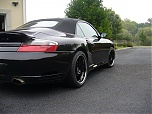
Looks like you are having a blast with your "Protomotive Beast"
Cheers,
Ben
Looks like you are having a blast with your "Protomotive Beast"
Cheers,
Ben

Registered User
Joined: Jul 2006
Posts: 8,930
From: ga
Rep Power: 552
Originally Posted by eclou
It takes some time for the mold release compound to wear off the tread of a new tire. On the 997tt rear pressures are 39psi for a light load car. The PS2's have alot more stick than the CSC's.
Exactly, I had a similar experience with the MPSC's my first time out on them (was on track). I was very dissapointed, the second session, they came to life. This was track driving and it took me a 4 laps hard driving session to get the release compound off, I'd imagine it would take some considerable street driving to get the compound off.
Trending Topics
Registered User
Joined: Jul 2007
Posts: 482
From: ohio
Rep Power: 39
Tires are comprised of many layers of rubber, steel
and fabric. Due to these different components,
your new tires require a “break-in” period to
ensure that they deliver their normal ride quality
and maximum performance.
As tires are cured, a “release
lubricant” is applied
to prevent them from sticking in their mold. Some
of the lubricant stays on the surface of your
tires, reducing traction until it is worn away. Five
hundred miles of easy acceleration, cornering and
braking will allow the mold release lubricant to
wear off, allowing the other tire components to
begin working together.
It is also important to note that your old tires probably
had very little tread depth remaining when you felt
it was time to replace
them. As any autocrosser or
racer who has tread rubber shaved off of his tires
will tell you, “low tread depth tires respond quicker.”
Don’t be surprised if your new tires are a little slower
to respond (even if you use the exact same tire as
before). Their new, full depth brings with it a little
more tread squirm until they wear down.
and fabric. Due to these different components,
your new tires require a “break-in” period to
ensure that they deliver their normal ride quality
and maximum performance.
As tires are cured, a “release
lubricant” is applied
to prevent them from sticking in their mold. Some
of the lubricant stays on the surface of your
tires, reducing traction until it is worn away. Five
hundred miles of easy acceleration, cornering and
braking will allow the mold release lubricant to
wear off, allowing the other tire components to
begin working together.
It is also important to note that your old tires probably
had very little tread depth remaining when you felt
it was time to replace
them. As any autocrosser or
racer who has tread rubber shaved off of his tires
will tell you, “low tread depth tires respond quicker.”
Don’t be surprised if your new tires are a little slower
to respond (even if you use the exact same tire as
before). Their new, full depth brings with it a little
more tread squirm until they wear down.
NOTE: Be careful whenever you explore the
capabilities of your new tires. Remember that
every tire requires a break-in period for optimum
performance.
Above is from Tirerack, I also run 34/36 on the street.
Breaking In Your Tirescapabilities of your new tires. Remember that
every tire requires a break-in period for optimum
performance.
Above is from Tirerack, I also run 34/36 on the street.
Registered User
Joined: Apr 2007
Posts: 62
From: NJ
Rep Power: 22
I think OEM recommended pressure is 36/42, when cold. Anyone know why Porsche would recommend presures that high in the rear? Does anyone out there actually drive with tires at that level for rear tires? Thanks for any guidance/understanding here.





Registered User
Joined: Oct 2004
Posts: 75
From: Plymouth, MN
Rep Power: 25
Originally Posted by WOODTSTER
Thanks guys, the grip is getting better and the sidewalls are soft
compared to Conti's (which can be good or bad).
MK
compared to Conti's (which can be good or bad).
MK
I was on my way, but ended up @ the GF's house  You going to be out next week?
Thread Starter
|
Registered User
Joined: Jan 2006
Posts: 5,710
From: MPLS, MN USA
Rep Power: 466
Mr. Zinc,
Yes, Bryant and I made quite a splash with the local
V-8 powered guys (and a few Suby's, Neons, Motorcycles, etc). I will be out in a couple weeks again.
MK
Yes, Bryant and I made quite a splash with the local
V-8 powered guys (and a few Suby's, Neons, Motorcycles, etc). I will be out in a couple weeks again.
MK