


Bilstein Damptronics ride height impact

Thread Starter
|
Registered User
Joined: Feb 2009
Posts: 463
From: London, UK
Rep Power: 66


Bilstein Damptronics ride height impact
Okay so I finally got a reply from my suspension guru over why my Bilstein B16 Damptronic kit ride quality varied so much when I changed my ride height (note I have the suspension kit listed in my signature => set to -15mm front and back)
I hope that explains things a little Cannga et al...
<link rel="File-List" href="file:///C:%5CUsers%5CAlex%5CAppData%5CLocal%5CTemp%5Cmsoht ml1%5C04%5Cclip_filelist.xml"><!--[if gte mso 9]><xml> <w:WordDocument> <w:View>Normal</w:View> <w:Zoom>0</w:Zoom> <w:PunctuationKerning/> <w:ValidateAgainstSchemas/> <w:SaveIfXMLInvalid>false</w:SaveIfXMLInvalid> <w:IgnoreMixedContent>false</w:IgnoreMixedContent> <w:AlwaysShowPlaceholderText>false</w:AlwaysShowPlaceholderText> <w:Compatibility> <w:BreakWrappedTables/> <w:SnapToGridInCell/> <w:WrapTextWithPunct/> <w:UseAsianBreakRules/> <w ontGrowAutofit/> </w:Compatibility> <w:BrowserLevel>MicrosoftInternetExplorer4</w:BrowserLevel> </w:WordDocument> </xml><![endif]--><!--[if gte mso 9]><xml> <w:LatentStyles DefLockedState="false" LatentStyleCount="156"> </w:LatentStyles> </xml><![endif]--><style> <!-- /* Style Definitions */ p.MsoNormal, li.MsoNormal, div.MsoNormal {mso-style-parent:""; margin:0cm; margin-bottom:.0001pt; mso-pagination:widow-orphan; font-size:12.0pt; font-family:"Times New Roman"; mso-fareast-font-family:"Times New Roman";} @page Section1 {size:595.3pt 841.9pt; margin:72.0pt 90.0pt 72.0pt 90.0pt; mso-header-margin:35.4pt; mso-footer-margin:35.4pt; mso-paper-source:0;} div.Section1 {page:Section1;} --> </style><!--[if gte mso 10]> <style> /* Style Definitions */ table.MsoNormalTable {mso-style-name:"Table Normal"; mso-tstyle-rowband-size:0; mso-tstyle-colband-size:0; mso-style-noshow:yes; mso-style-parent:""; mso-padding-alt:0cm 5.4pt 0cm 5.4pt; mso-para-margin:0cm; mso-para-margin-bottom:.0001pt; mso-pagination:widow-orphan; font-size:10.0pt; font-family:"Times New Roman"; mso-ansi-language:#0400; mso-fareast-language:#0400; mso-bidi-language:#0400;} </style> <![endif]--> They are monotube dampers with a nitrogen gas charge. A second free floating piston separates a nitrogen chamber from the oil in the main cavity of the damper into which a second 'valved' piston moves. <o>
</o> Firstly the volume of oil on the compression side of the damper is less for a damper with lower ride height, so there is a physical difference. The lower volume may impact on the damper performance as the worked volume is less. So for example gets hotter quicker (small object gets and lose heat quicker). Other properties are also affected, heat also affects the principle of cavitation especially over a smaller swept volume. <o>
</o> Secondly, but most importantly the nitrogen charge acts like a pre-load to the spring (effectively) increasing the amount of initial force to move the damper. The nitrogen charge in some monotube dampers is set at 300psi / 20bar! When you compress a damper on the bench the piston is pushed out by the pressure of the internal spring (if any) and nitrogen charge (gas reaction force), essentially a gas spring opposing the movement of the gas/oil piston. If you reduce the ride height, you are pre-loading the nitrogen charge therefore increasing the preload.<o>
</o> All the above assumes that you are not already at the end of the piston travel where you come across the internal bump stops/springs, which is not the case with your ride heights. So to get a slight improvement in damper comfort you extend the damper (raise the ride height) which reduces the amount of preload and thus the amount of force to get the piston moving!<o>
</o> Oh and finally, the spring rate in the Bilsteins was selected along with the damper rate for your ride and comfort. Then some bright spark removes the little rubber (springy) bushings in the arms! (gmg rear arms intended for race). When Bilstein were testing they most certainly used a stock car and bushings. The bushing spring removed, you have softer rate springs than intended and a harsher damper rate to boot!
ontGrowAutofit/> </w:Compatibility> <w:BrowserLevel>MicrosoftInternetExplorer4</w:BrowserLevel> </w:WordDocument> </xml><![endif]--><!--[if gte mso 9]><xml> <w:LatentStyles DefLockedState="false" LatentStyleCount="156"> </w:LatentStyles> </xml><![endif]--><style> <!-- /* Style Definitions */ p.MsoNormal, li.MsoNormal, div.MsoNormal {mso-style-parent:""; margin:0cm; margin-bottom:.0001pt; mso-pagination:widow-orphan; font-size:12.0pt; font-family:"Times New Roman"; mso-fareast-font-family:"Times New Roman";} @page Section1 {size:595.3pt 841.9pt; margin:72.0pt 90.0pt 72.0pt 90.0pt; mso-header-margin:35.4pt; mso-footer-margin:35.4pt; mso-paper-source:0;} div.Section1 {page:Section1;} --> </style><!--[if gte mso 10]> <style> /* Style Definitions */ table.MsoNormalTable {mso-style-name:"Table Normal"; mso-tstyle-rowband-size:0; mso-tstyle-colband-size:0; mso-style-noshow:yes; mso-style-parent:""; mso-padding-alt:0cm 5.4pt 0cm 5.4pt; mso-para-margin:0cm; mso-para-margin-bottom:.0001pt; mso-pagination:widow-orphan; font-size:10.0pt; font-family:"Times New Roman"; mso-ansi-language:#0400; mso-fareast-language:#0400; mso-bidi-language:#0400;} </style> <![endif]--> They are monotube dampers with a nitrogen gas charge. A second free floating piston separates a nitrogen chamber from the oil in the main cavity of the damper into which a second 'valved' piston moves. <o></o> Firstly the volume of oil on the compression side of the damper is less for a damper with lower ride height, so there is a physical difference. The lower volume may impact on the damper performance as the worked volume is less. So for example gets hotter quicker (small object gets and lose heat quicker). Other properties are also affected, heat also affects the principle of cavitation especially over a smaller swept volume. <o>
</o> Secondly, but most importantly the nitrogen charge acts like a pre-load to the spring (effectively) increasing the amount of initial force to move the damper. The nitrogen charge in some monotube dampers is set at 300psi / 20bar! When you compress a damper on the bench the piston is pushed out by the pressure of the internal spring (if any) and nitrogen charge (gas reaction force), essentially a gas spring opposing the movement of the gas/oil piston. If you reduce the ride height, you are pre-loading the nitrogen charge therefore increasing the preload.<o>
</o> All the above assumes that you are not already at the end of the piston travel where you come across the internal bump stops/springs, which is not the case with your ride heights. So to get a slight improvement in damper comfort you extend the damper (raise the ride height) which reduces the amount of preload and thus the amount of force to get the piston moving!<o>
</o> Oh and finally, the spring rate in the Bilsteins was selected along with the damper rate for your ride and comfort. Then some bright spark removes the little rubber (springy) bushings in the arms! (gmg rear arms intended for race). When Bilstein were testing they most certainly used a stock car and bushings. The bushing spring removed, you have softer rate springs than intended and a harsher damper rate to boot!
Registered User
Joined: Dec 2006
Posts: 3,116
From: Palos Verdes
Rep Power: 256
Hi Alex, first please send your tuner my "thanks" for taking the time to explain. His knowledge is impressive and I did learn from his post, and my own further "web research" LOL & questioning.
I assume this thread is in response to your observation about your car, "I cannot tell you how nasty even -20mm was on public roads even going 20 mph," and my comment that maybe something is wrong, because that is entirely within Bilstein spec of 10-30mm front, 5-25mm rear, and it contradicts what Bilstein told me, other tuners' observations, and numerous past postings from owners.
I have this diagram from Bilstein that will make my answer easier to understand. If we are to follow the diagram, then we know two things:
1. At steady state, as you lower the car, the volume of the oil side decreases. Your tuner states the same in his "statement 1."
2. At steady state, as you lower the car, the volume of the gas chamber does NOT decrease. This is because one, we just stated in 1 above, the oil side decreases in volume already, therefore allows the gas chamber's volume to stay same. Why would it stay same? The coilover has a floating dividing piston that specifically serves to maintain constant pressure. This is specifically mentioned in the diagram.
3. Your tuner's statement 2, is in fact contradicted by his statement 1. As you lower the car, if the oil chamber volume decreases as per statement 1, then why wouldn't the gas chamber maintain its volume and pressure? The preloading by the nitrogen charge does not go up because of the floating dividing piston. That condition might be understandable on first generation damper; I doubt very much the latest Bilstein design would overlook this.
The condition described by your tuner is correct, if the coilover is towards the extremes its recommended spec, but we are talking about 20mm here, entirely and comfortably within specs. I find it impossible to have the condition you described unless something else is wrong with the system. (My own car has been lowered to 22mm or so in the past, and I found it soft as a marshmallow still.)
I have more to comment regarding heat issue, and the 20 bar nitrogen chamber.
>>>>>>>>>>>>>>>>>>>>>>>>>>>>>>>>>>>>>>>
http://www.bilsteinus.com/tech.php

I assume this thread is in response to your observation about your car, "I cannot tell you how nasty even -20mm was on public roads even going 20 mph," and my comment that maybe something is wrong, because that is entirely within Bilstein spec of 10-30mm front, 5-25mm rear, and it contradicts what Bilstein told me, other tuners' observations, and numerous past postings from owners.
I have this diagram from Bilstein that will make my answer easier to understand. If we are to follow the diagram, then we know two things:
1. At steady state, as you lower the car, the volume of the oil side decreases. Your tuner states the same in his "statement 1."
2. At steady state, as you lower the car, the volume of the gas chamber does NOT decrease. This is because one, we just stated in 1 above, the oil side decreases in volume already, therefore allows the gas chamber's volume to stay same. Why would it stay same? The coilover has a floating dividing piston that specifically serves to maintain constant pressure. This is specifically mentioned in the diagram.
3. Your tuner's statement 2, is in fact contradicted by his statement 1. As you lower the car, if the oil chamber volume decreases as per statement 1, then why wouldn't the gas chamber maintain its volume and pressure? The preloading by the nitrogen charge does not go up because of the floating dividing piston. That condition might be understandable on first generation damper; I doubt very much the latest Bilstein design would overlook this.
The condition described by your tuner is correct, if the coilover is towards the extremes its recommended spec, but we are talking about 20mm here, entirely and comfortably within specs. I find it impossible to have the condition you described unless something else is wrong with the system. (My own car has been lowered to 22mm or so in the past, and I found it soft as a marshmallow still.)
I have more to comment regarding heat issue, and the 20 bar nitrogen chamber.
>>>>>>>>>>>>>>>>>>>>>>>>>>>>>>>>>>>>>>>
http://www.bilsteinus.com/tech.php
Statement 1: Firstly the volume of oil on the compression side of the damper is less for a damper with lower ride height, so there is a physical difference. The lower volume may impact on the damper performance as the worked volume is less. So for example gets hotter quicker (small object gets and lose heat quicker). Other properties are also affected, heat also affects the principle of cavitation especially over a smaller swept volume. <O>
</O>Statement 2: Secondly, but most importantly the nitrogen charge acts like a pre-load to the spring (effectively) increasing the amount of initial force to move the damper. The nitrogen charge in some monotube dampers is set at 300psi / 20bar! When you compress a damper on the bench the piston is pushed out by the pressure of the internal spring (if any) and nitrogen charge (gas reaction force), essentially a gas spring opposing the movement of the gas/oil piston. If you reduce the ride height, you are pre-loading the nitrogen charge therefore increasing the preload.<O>
</O>Statement 2: Secondly, but most importantly the nitrogen charge acts like a pre-load to the spring (effectively) increasing the amount of initial force to move the damper. The nitrogen charge in some monotube dampers is set at 300psi / 20bar! When you compress a damper on the bench the piston is pushed out by the pressure of the internal spring (if any) and nitrogen charge (gas reaction force), essentially a gas spring opposing the movement of the gas/oil piston. If you reduce the ride height, you are pre-loading the nitrogen charge therefore increasing the preload.<O>
Last edited by cannga; Mar 23, 2010 at 12:24 PM.
Registered User

Joined: Dec 2007
Posts: 1,671
From: Athens
Rep Power: 135
At my previous 996TT pss10 was installed...i lowered the car to bilsteins spec front and rear...When driving the car had terrible feel over bumps and potholes...like there was no suspension...And in reality...there wasnt...the car was operating at bump stops...piston travel was only 5,5cm from full out to full in (front axle) and so when the car was lowered the car was already sitting on bumpstops...
I had to open the shocks and reengineer the way bilstein designed them...After internal modification I managed to enlarge piston travel to 8cm...So when the car was sitting on wheels it had 4 cm for the shocks to compress Vs 1,5cm before...
I plan to install a better suspension to my new 997TT...but i do not want to have the same troubles again...My conclusions about pss10 on 996TT are that it is not engineered for lowering...what is the case in 997TT?Has anybody install it on 997TT and lower the car to GT2 specs to see what happens?Bilstein states a limit for 35mm front lowering...i wonder if this is applicable...
I had to open the shocks and reengineer the way bilstein designed them...After internal modification I managed to enlarge piston travel to 8cm...So when the car was sitting on wheels it had 4 cm for the shocks to compress Vs 1,5cm before...
I plan to install a better suspension to my new 997TT...but i do not want to have the same troubles again...My conclusions about pss10 on 996TT are that it is not engineered for lowering...what is the case in 997TT?Has anybody install it on 997TT and lower the car to GT2 specs to see what happens?Bilstein states a limit for 35mm front lowering...i wonder if this is applicable...
Registered User
Joined: Dec 2006
Posts: 3,116
From: Palos Verdes
Rep Power: 256
^^^Yes. There is a well documented thread on 996 Turbo about this. That car was lowered a significant amount beyond spec and was hitting the internal bump stop. I'll try to find that thread later on, but I *know* it is way way beyond the 20mm Alex is talking about here.
BTW, for 997, GT2 is 110/147, Turbo is 132/153. So unlike 996 Turbo, 997 Turbo is closer to 997 GT2 and could be lowered to GT2 level and still be within spec. The 996 Turbo vs. GT2 info is also in that thread I mentioned above (anyone corrects me as needed, I could be wrong here).
BTW, for 997, GT2 is 110/147, Turbo is 132/153. So unlike 996 Turbo, 997 Turbo is closer to 997 GT2 and could be lowered to GT2 level and still be within spec. The 996 Turbo vs. GT2 info is also in that thread I mentioned above (anyone corrects me as needed, I could be wrong here).
Last edited by cannga; Mar 23, 2010 at 12:17 PM.
Registered User
Joined: Dec 2007
Posts: 1,671
From: Athens
Rep Power: 135
I see...the point is I want to lower my car and i am thinking of installing a set of springs or bilstein damptronics...and a set of sway bars...(at least rear)...Does bilstein suspension operate proper in lowering?or bumpstops will be hit again?

Registered User
Joined: Oct 2008
Posts: 2,321
From: Fastlane USA
Rep Power: 246
I'll be the first to admit that I know essentially nothing about shocks or suspension. So I did a quick looksie on wikipedia, where else, right? 
http://en.wikipedia.org/wiki/Shock_absorber
From their diagram, it appears that if you lower the car, both the oil and gas reservoirs decrease in volume thereby increasing overall pressure. To me, an overall increase in pressure as a starting point would result in a harsher ride. If my reasoning is wrong or am missing something here then please correct me. But this makes sense to me. I couldn't find anywhere on the Bilstein site that says ride comfort would be the same if lowered.
http://en.wikipedia.org/wiki/Shock_absorber
From their diagram, it appears that if you lower the car, both the oil and gas reservoirs decrease in volume thereby increasing overall pressure. To me, an overall increase in pressure as a starting point would result in a harsher ride. If my reasoning is wrong or am missing something here then please correct me. But this makes sense to me. I couldn't find anywhere on the Bilstein site that says ride comfort would be the same if lowered.
Last edited by TTdude; Mar 23, 2010 at 04:14 PM.
Registered User
Joined: Dec 2007
Posts: 1,671
From: Athens
Rep Power: 135
Trending Topics
Registered User
Joined: Dec 2006
Posts: 3,116
From: Palos Verdes
Rep Power: 256
 I don't have time to fact check with author but if what I am reading is right, the lowering is an eye-popping 45 mm!!!
The key is to stay in spec, I cannot emphasize this enough, 10-30 front, 5-25 rear, then you won't hit the bump stop, and bump/rebound dampening and spring operation will stay within specs.
>>>>>>>>>>>>>
https://www.6speedonline.com/forums/...pension-3.html
Please note this is a dicussion involving the 996 Turbo!! -- Can
The ride heights for the USA Turbo, ROW Turbo and GT2 are listed below
- USA Turbo
Front 148mm to 168mm (Means OEM height is 158 mm)
Rear 148mm to 168mm - ROW Turbo
Front 128mm to 148mm
Rear 138mm to 158mm - GT2
Front 108mm to 118mm
Rear 133mm to 143mm
Front 113mm
Rear 134mm
>>>>>>>>>>>>>>>>>>>>>>>
Last edited by cannga; Mar 24, 2010 at 11:29 PM.
Registered User
Joined: Dec 2006
Posts: 3,116
From: Palos Verdes
Rep Power: 256
No problem at all -- wikipedia could be a great source; I use it frequently (but supplement it with questions to Bilstein and tuners though). I too consider myself a novice always. But.. novice or not, the key though is to be open minded and to challenge the authority when the BS meter goes up , so yes... your observation is welcome.
If you look at my explanation above, you'll notice I use the word "steady state" a few times. This is what happens when you set the ride height. The viscous fluid escapes to the reservoir and that's why the fluid chamber gets smaller. The gas chamber stays the same. This is specifically mentioned so in the Bilstein diagram.
The diagram you show is a completely different situation (anyone corrects me as needed). It is showing what happens in a dynamic scenario, when the car is actually hitting street bumps or rolling in corners. In dynamic situations, of course, BOTH gas and fluid chambers are squeezed. This is the basic operating principle of a high pressure monotube coilover.
, so yes... your observation is welcome.If you look at my explanation above, you'll notice I use the word "steady state" a few times. This is what happens when you set the ride height. The viscous fluid escapes to the reservoir and that's why the fluid chamber gets smaller. The gas chamber stays the same. This is specifically mentioned so in the Bilstein diagram.
The diagram you show is a completely different situation (anyone corrects me as needed). It is showing what happens in a dynamic scenario, when the car is actually hitting street bumps or rolling in corners. In dynamic situations, of course, BOTH gas and fluid chambers are squeezed. This is the basic operating principle of a high pressure monotube coilover.
I'll be the first to admit that I know essentially nothing about shocks or suspension. So I did a quick looksie on wikipedia, where else, right?
http://en.wikipedia.org/wiki/Shock_absorber
From their diagram, it appears that if you lower the car, both the oil and gas reservoirs decrease in volume thereby increasing overall pressure. To me, an overall increase in pressure as a starting point would result in a harsher ride. If my reasoning is wrong or am missing something here then please correct me. But this makes sense to me. I couldn't find anywhere on the Bilstein site that says ride comfort would be the same if lowered.
http://en.wikipedia.org/wiki/Shock_absorber
From their diagram, it appears that if you lower the car, both the oil and gas reservoirs decrease in volume thereby increasing overall pressure. To me, an overall increase in pressure as a starting point would result in a harsher ride. If my reasoning is wrong or am missing something here then please correct me. But this makes sense to me. I couldn't find anywhere on the Bilstein site that says ride comfort would be the same if lowered.
Last edited by cannga; Mar 24, 2010 at 02:35 AM.
Thread Starter
|
Registered User
Joined: Feb 2009
Posts: 463
From: London, UK
Rep Power: 66
The ride heights for the USA Turbo, ROW Turbo and GT2 are listed below:
- USA Turbo
Front 148mm to 168mm (cp: Probably 158 mm spec???)
Rear 148mm to 168mm - ROW Turbo
Front 128mm to 148mm
Rear 138mm to 158mm - GT2
Front 108mm to 118mm
Rear 133mm to 143mm
Front 113mm
Rear 134mm
>>>>>>>>>>>>>>>>>>>>>>>
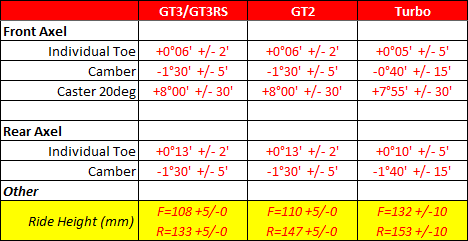
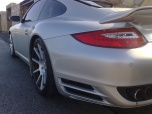
I am now -15mm front and back, so the rake is the same as stock, for my Turbo (F=117, R=138) - which I have named the "goldielocks zone" for my suspension configuration
Last edited by Alex_997TT; Mar 24, 2010 at 10:38 AM.
Registered User
Joined: Dec 2006
Posts: 3,116
From: Palos Verdes
Rep Power: 256
I was giving an example of how you would run into problem only if you lower the coilover out of spec. In that very well known thread, the lowering was an eye popping 158-113=45mm!! This is way beyond Bilstein spec. (I've not fact-checked yet, but that seems to be the case.)
Please understand, I'm not disputing what you find at all. Just know that if 20 mm causes extreme stiffness, it is an exception, not the norm as per numerous past reports from users and installers alike.
>>>>>>>>>>>>>
https://www.6speedonline.com/forums/...pension-3.html
Please note this is a dicussion involving the 996 Turbo!! -- Can
The ride heights for the USA Turbo, ROW Turbo and GT2 are listed below
Front 113mm
Rear 134mm
>>>>>>>>>>>>>>>>>>>>>>>
https://www.6speedonline.com/forums/...pension-3.html
Please note this is a dicussion involving the 996 Turbo!! -- Can
The ride heights for the USA Turbo, ROW Turbo and GT2 are listed below
- USA Turbo
Front 148mm to 168mm (Means OEM height is 158 mm)
Rear 148mm to 168mm - ROW Turbo
Front 128mm to 148mm
Rear 138mm to 158mm - GT2
Front 108mm to 118mm
Rear 133mm to 143mm
Front 113mm
Rear 134mm
>>>>>>>>>>>>>>>>>>>>>>>
Last edited by cannga; Mar 24, 2010 at 11:28 PM.
Registered User
Joined: Dec 2006
Posts: 3,116
From: Palos Verdes
Rep Power: 256
Chris and skandalis, to see ride height measurement how-to and other rather interesting  info on suspension tuning, click the Bilstein link in my signature and check out that first post.
Ride height measurement is easy to do and very important -- "measure your ride height and save the world" !!
(Credit to Alex & his tuner for providing stock numbers and incentive for me to create those posts.)
https://www.6speedonline.com/forums/...red-turbo.html
info on suspension tuning, click the Bilstein link in my signature and check out that first post. Ride height measurement is easy to do and very important -- "measure your ride height and save the world" !!
(Credit to Alex & his tuner for providing stock numbers and incentive for me to create those posts.)
https://www.6speedonline.com/forums/...red-turbo.html
Last edited by cannga; Mar 24, 2010 at 03:24 PM.