
"The truth about the 480 HP figure"

Registered User
Joined: Dec 2006
Posts: 3,116
From: Palos Verdes
Rep Power: 256


>>>>>>>>>>>>>>>>
you can see the following differences:
- measured power and torque come on significantly later than the factory shows
- shape of the curves are different; giac and ia curves are more similar
- factory curves are more linear than the curves measured by tuners
>>>>>>>>>>>>
Thanks for the very interesting post. I agree that the differences are significant. IF Porsche knowingly distorts the curves, this would be considered fraudulent advertising, no?
I wonder if Porsche keeps actual curves for each car built to back up this ad material (?) "diagram."
First we have some question with the automatic tt's ability to consistently achieve the advertised 3.4 sec 0-60 time, now this. Maybe Porsche's effort to "control" Volkswagen and compete w/ Toyota (Against Toyota? Talk about rude awakening .) are causing them to lose focus.
you can see the following differences:
- measured power and torque come on significantly later than the factory shows
- shape of the curves are different; giac and ia curves are more similar
- factory curves are more linear than the curves measured by tuners
>>>>>>>>>>>>
Thanks for the very interesting post. I agree that the differences are significant. IF Porsche knowingly distorts the curves, this would be considered fraudulent advertising, no?
I wonder if Porsche keeps actual curves for each car built to back up this ad material (?) "diagram."
First we have some question with the automatic tt's ability to consistently achieve the advertised 3.4 sec 0-60 time, now this. Maybe Porsche's effort to "control" Volkswagen and compete w/ Toyota (Against Toyota? Talk about rude awakening
.) are causing them to lose focus.
Originally Posted by golfguy
Jean
i guess i wasn't specific in my post but i was referring to the following differences between the charts comparing the measured dyno measures (lower lines in overboost mode without giac chip) and the factory plot. you can see the following differences:
- measured power and torque come on significantly later than the factory shows
- shape of the curves are different; giac and ia curves are more similar
- factory curves are more linear than the curves measured by tuners
i'm wondering why the differences are so dramatic and how one correlates dyno results? dyno testing definitely useful in comparing before and after results.
ps. my comments about lag are based on my not so accurate butt dyno comparing my 993tt to the 997tt. boost is available at lower rpms on the 993tt and the delivery seems to be more linear; that's why i feel some lag on the 997tt. clearly the 997tt is much faster that the 993tt. as i noted, the fabspeed exhaust eliminated most of the feeling of lag.
i guess i wasn't specific in my post but i was referring to the following differences between the charts comparing the measured dyno measures (lower lines in overboost mode without giac chip) and the factory plot. you can see the following differences:
- measured power and torque come on significantly later than the factory shows
- shape of the curves are different; giac and ia curves are more similar
- factory curves are more linear than the curves measured by tuners
i'm wondering why the differences are so dramatic and how one correlates dyno results? dyno testing definitely useful in comparing before and after results.
ps. my comments about lag are based on my not so accurate butt dyno comparing my 993tt to the 997tt. boost is available at lower rpms on the 993tt and the delivery seems to be more linear; that's why i feel some lag on the 997tt. clearly the 997tt is much faster that the 993tt. as i noted, the fabspeed exhaust eliminated most of the feeling of lag.

Registered User
Joined: Dec 2006
Posts: 3,116
From: Palos Verdes
Rep Power: 256
>>>>
Lastly, I don't know what chart Porsche is using for their figures, but I have yet to see a chart like that. I call marketing BS on this one
>>>>>>>>>>>.
Oops, just now realize Stephen has already pointed out the "fact."
Lastly, I don't know what chart Porsche is using for their figures, but I have yet to see a chart like that. I call marketing BS on this one
>>>>>>>>>>>.
Oops, just now realize Stephen has already pointed out the "fact."
Originally Posted by PorschePhd
LOL, I don't know what the "real" number is and honestly do not care. I sure as hell am not playing that game. What I can tell you is that the turbos are killed by the heat. Porsche had 25 faliures in Italy right before production hence the "sport" mode.
<o> </o>
</o>
When we actually started tuning we found all sorts of issues. Even Porsches original code was flawed. After we started changing and moving the programs around and testing it was clear that there was lots of room for improvement. The biggest plus INHO was the 120 C degree drop in EGT. Back pressure brought the powerband down and the knock level is gone up top where it was causing a dip.
Clearly the car was not ready for production. There have been 3-4 new releases in software since production. <o></o>
Lastly, I don't know what chart Porsche is using for their figures, but I have yet to see a chart like that. I call marketing BS on this one. I have dynoed a lot and not one shares a chart not similar to the factory and very close to mine.
<o></o>
Lastly, use the dynos for a baseline and the gain. Not a pissing match. I get so tired of this. I give the gains and that is it. A dyno is a tuning tool. <o></o>
<o>
</o>When we actually started tuning we found all sorts of issues. Even Porsches original code was flawed. After we started changing and moving the programs around and testing it was clear that there was lots of room for improvement. The biggest plus INHO was the 120 C degree drop in EGT. Back pressure brought the powerband down and the knock level is gone up top where it was causing a dip.
Clearly the car was not ready for production. There have been 3-4 new releases in software since production. <o>
</o>Lastly, I don't know what chart Porsche is using for their figures, but I have yet to see a chart like that. I call marketing BS on this one. I have dynoed a lot and not one shares a chart not similar to the factory and very close to mine.
<o>
</o>Lastly, use the dynos for a baseline and the gain. Not a pissing match. I get so tired of this. I give the gains and that is it. A dyno is a tuning tool. <o>
</o>
Registered User
Joined: Apr 2007
Posts: 24
From: Sydney
Rep Power: 0
Presumably the Porsche factory chart is measuring power and torque at the crank, whereas the other charts are measuring the same parameters at all four wheels. Therefore any comparison of the two is somewhat meaningless. Gotta be comparing apples with apples to make any sense IMHO.

Registered User
Joined: Jul 2003
Posts: 3,670
Rep Power: 189
Not necessarily. Load is load and the power curve of the motor is still similar. It can not be that far off. I can induce serious inertia on my dyno. You can load the car up and many gears. 1:1 is 1:1 and as long as the inertia is loaded in the appropriate RPM band you should still see similar results. I have dynoed hundreds of Porsche and I can’t say any of the others are this far out. Every other car has a “similar” curve.
Registered User
Joined: Jun 2004
Posts: 1,163
From: Earth
Rep Power: 92
I am on the move and have limited internet access.
I have read a few posts as a followup and I can only say that some of the comments really surprise me. But I will only give my opinion on a couple of things before I disappear.. A search will show much more on this topic.
Eclou, thanks for posting the compressor map, we can have lengthy discussions about those on a separate thread if you are interested I have dissecated a good 50 of those and might have some input that could be of interest. In fact, without knowing how much the 997 engine flows in ft/lbs, the compressor maps are useless. The VTGs go beyond their efficiency levels at 550BHP according to very reliable sources (couldn't be more reliable in fact) but feel free to disbelieve, no big deal, this means that any higher number will not hold on the road under load because the turbo is overheating and will cause immediate heat soak, therefore those numbers are nothing more than a nice dyno figure albeit without bad intentions. If you read my first post I clearly said that as long as these chassis dynos being posted show 610BHP, customers will have a hard time understanding it, so I do know that some tuners are showing those numbers on their websites, I am questioning their relevance when compared to Porsche factory numbers
A quartermile trap speed is a great peak HP indicator, however without much load, to be clearer, in 1-2nd gear you hardly see any load on your engine, in 3rd-4th and 5th on a drag strip your revs start at 4kRPM+, meaning load is also limited to a couple of seconds. Engine performance does not end there. Porsche numbers are more comparable to running in 5th gear starting at 2k RPMs up to 6K RPMs back to back 10 times or going up to top speed 2-3 times in a row. Useless? Maybe I agree, but that is how they can produce real reliable HP that will last the whole day on the track for instance without heat soaking. Different measuring standards, that's all.
Back to the topic.
If the discussion is turning into one of those "Porsche engineers don't know what they are doing and we have the best tuners in the world, Europeans are jealous" kind of childish debate, I should probably bow out. To be clear my tuner is American so let's park that and try to look at things from a different and mature angle.
If you want the answer as to why Porsche dyno charts will never look like your tuner's, read on.
First off you are comparing an engine dyno graph to a chassis dyno one, all the rest is senseless. But assuming they were both chassis dyno, whatis happening is very clear to the initiated.
Porsche puts much more load on their dynos than anyone else, simply because they need to deliver an engine that can withstand the toughest conditions to keep those crazy Germans going back and forth at 190mph on the autobhan and not go bankrupt with lawsuits. The engine power you are seeing is the one that will be reflected under any conditions on the road, and not only under a 10 second quartermile run. If one does not know the difference then some research is probably overdue.
Putting your turbo engine under much higher load on a dyno will increase substantially your torque early on in the game, it will trigger boost earlier on, boost is load related, not RPM related alone. Try that in 1st gear raising your RPMs slowly and check out your boost onset.
With the loaded Porsche dyno runs, torque will be on much earlier than a 6-7 second chassis dyno run, this does not need to be debated. Guess which torque curve you will be seeing when starting from 2k RPMS in 4th gear on the road?
The lightly loaded run will also produce higher peak numbers since you are not giving the engine time to heat soak. In summary, any Porsche engine dyno chart will show higher torque curve early on, and lower peak HP.
The reason why you see similar (or rather close) numbers on a stock turbo when you put it on a 6 second chassis dyno run, is because a Porsche engine will not show MORE HP on a chassis dyno, but the reverse is true, a tuned engine when put under load will show much lower peak numbers on an engine dyno, or simply a MAHA properly loaded dyno run. The higher the boost that tuned engine is using, the lower the peak numbers on a MAHA or other heavily loaded dyno, as a result of knock sensing and its resulting pull in timing and subsequently boost.
In case you are wondering how I know, I simply tested it with my engine at Manthey Racing in Germany on their MAHA dyno, session are of 30 seconds each for 30 minutes, your bumper can melt if you leave it on, and your brand new Sport Cup tires will blow up, so they install special wheels and tires... To hear it from a more reliable source than myself, US highly respected Porsche engine builder Kevin Matwichuk, experienced it first hand on a MAHA as well, drop him a line to find out more. Another good source is Todd Knighton from Protomotive who can reconfirm what I am saying.
This is load, like the factory sees it. My numbers were on average 20-30% higher in torque below 4k RPMS than my tuner's engine dyno, which in itself puts much more stress already than the typical 600RPM/sec chassis dyno.
I also get tired of these debates but when this is why customers buy package A vs package B, I like to give my opinion. The difference in the base line is inaccurately compared to Porsche factory, and as long as the customer is aware of that, everyone should be happy. Numbers are not faked, but they are certainly not Porsche standard (or DIN 70020 for that matter), but then again who cares? This is only a POV.
Sorry for the long post.
I have read a few posts as a followup and I can only say that some of the comments really surprise me. But I will only give my opinion on a couple of things before I disappear.. A search will show much more on this topic.
Eclou, thanks for posting the compressor map, we can have lengthy discussions about those on a separate thread if you are interested I have dissecated a good 50 of those and might have some input that could be of interest. In fact, without knowing how much the 997 engine flows in ft/lbs, the compressor maps are useless. The VTGs go beyond their efficiency levels at 550BHP according to very reliable sources (couldn't be more reliable in fact) but feel free to disbelieve, no big deal, this means that any higher number will not hold on the road under load because the turbo is overheating and will cause immediate heat soak, therefore those numbers are nothing more than a nice dyno figure albeit without bad intentions. If you read my first post I clearly said that as long as these chassis dynos being posted show 610BHP, customers will have a hard time understanding it, so I do know that some tuners are showing those numbers on their websites, I am questioning their relevance when compared to Porsche factory numbers
A quartermile trap speed is a great peak HP indicator, however without much load, to be clearer, in 1-2nd gear you hardly see any load on your engine, in 3rd-4th and 5th on a drag strip your revs start at 4kRPM+, meaning load is also limited to a couple of seconds. Engine performance does not end there. Porsche numbers are more comparable to running in 5th gear starting at 2k RPMs up to 6K RPMs back to back 10 times or going up to top speed 2-3 times in a row. Useless? Maybe I agree, but that is how they can produce real reliable HP that will last the whole day on the track for instance without heat soaking. Different measuring standards, that's all.
Back to the topic.
If the discussion is turning into one of those "Porsche engineers don't know what they are doing and we have the best tuners in the world, Europeans are jealous" kind of childish debate, I should probably bow out. To be clear my tuner is American so let's park that and try to look at things from a different and mature angle.
If you want the answer as to why Porsche dyno charts will never look like your tuner's, read on.
First off you are comparing an engine dyno graph to a chassis dyno one, all the rest is senseless. But assuming they were both chassis dyno, whatis happening is very clear to the initiated.
Porsche puts much more load on their dynos than anyone else, simply because they need to deliver an engine that can withstand the toughest conditions to keep those crazy Germans going back and forth at 190mph on the autobhan and not go bankrupt with lawsuits. The engine power you are seeing is the one that will be reflected under any conditions on the road, and not only under a 10 second quartermile run. If one does not know the difference then some research is probably overdue.
Putting your turbo engine under much higher load on a dyno will increase substantially your torque early on in the game, it will trigger boost earlier on, boost is load related, not RPM related alone. Try that in 1st gear raising your RPMs slowly and check out your boost onset.
With the loaded Porsche dyno runs, torque will be on much earlier than a 6-7 second chassis dyno run, this does not need to be debated. Guess which torque curve you will be seeing when starting from 2k RPMS in 4th gear on the road?
The lightly loaded run will also produce higher peak numbers since you are not giving the engine time to heat soak. In summary, any Porsche engine dyno chart will show higher torque curve early on, and lower peak HP.
The reason why you see similar (or rather close) numbers on a stock turbo when you put it on a 6 second chassis dyno run, is because a Porsche engine will not show MORE HP on a chassis dyno, but the reverse is true, a tuned engine when put under load will show much lower peak numbers on an engine dyno, or simply a MAHA properly loaded dyno run. The higher the boost that tuned engine is using, the lower the peak numbers on a MAHA or other heavily loaded dyno, as a result of knock sensing and its resulting pull in timing and subsequently boost.
In case you are wondering how I know, I simply tested it with my engine at Manthey Racing in Germany on their MAHA dyno, session are of 30 seconds each for 30 minutes, your bumper can melt if you leave it on, and your brand new Sport Cup tires will blow up, so they install special wheels and tires... To hear it from a more reliable source than myself, US highly respected Porsche engine builder Kevin Matwichuk, experienced it first hand on a MAHA as well, drop him a line to find out more. Another good source is Todd Knighton from Protomotive who can reconfirm what I am saying.
This is load, like the factory sees it. My numbers were on average 20-30% higher in torque below 4k RPMS than my tuner's engine dyno, which in itself puts much more stress already than the typical 600RPM/sec chassis dyno.
I also get tired of these debates but when this is why customers buy package A vs package B, I like to give my opinion. The difference in the base line is inaccurately compared to Porsche factory, and as long as the customer is aware of that, everyone should be happy. Numbers are not faked, but they are certainly not Porsche standard (or DIN 70020 for that matter), but then again who cares?
This is only a POV.Sorry for the long post.
Registered User
Joined: Jun 2004
Posts: 1,163
From: Earth
Rep Power: 92
Originally Posted by PorschePhd
Not necessarily. Load is load and the power curve of the motor is still similar. It can not be that far off.
Does anyone have any data of a MAHA vs. Dynojet (or Mustang) for the exact same "tuned" engine?
Registered User
Joined: Jul 2003
Posts: 3,670
Rep Power: 189
Originally Posted by Jean
Stephen, more like 20-30% difference in torque below peak boost level on a tuned engine is very substantial. The power curve is very different according to my data. I can post numbers when I am back if anyone is interested.
Does anyone have any data of a MAHA vs. Dynojet (or Mustang) for the exact same "tuned" engine?
Does anyone have any data of a MAHA vs. Dynojet (or Mustang) for the exact same "tuned" engine?
I do not have that data but I too would like to see it. As far as the difference I would love to see this as well. I guess I am ignorant when I am loading the car for 45 seconds how this is not sufficient load? Hell, the car sounds like it is going to blow, the headers burn the paint under the dyno and the car sits there like it has hit a wall and trying to overcome it. My boost levels are the same during this procedure as it is on the street. It is not my goal to start another huge debate rather I want to fully understand how the car/engine will load differently based on the dyno.
The other thing I would add is this: Have you spent time in a 997TT? If so can you honestly tell me that max TQ is being achieved as the factory dyo suggest? Full TQ is not going to happen without full boost, that we can agree on. Well I can assure you that 95% of us in the US are not getting these results. My car hardly would ever achieve full boost in that range as stock. (confirmed with mechanical gauge, not the light show the factory provides) In addition to that it NEVER would sustain overboost to the advertised marks. NEVER. Not cold, hot or other. Additionally there was a ton of knock count in the original dip per the PIWIS when I logged it. Now I do not know if this is a US<ST1
verses ROW software. I know there are some big difference in the EU2 and EU4 files. Most of the ROW are E4 files. E2 is almost no emissions what so ever.
Last edited by PorschePhd; Apr 24, 2007 at 03:26 PM.
Registered User
Joined: Jun 2004
Posts: 1,163
From: Earth
Rep Power: 92
Originally Posted by PorschePhd
I do not have that data but I too would like to see it. As far as the difference I would love to see this as well. I guess I am ignorant when I am loading the car for 45 seconds how this is not sufficient load? Hell, the car sounds like it is going to blow, the headers burn the paint under the dyno and the car sits there like it has hit a wall and trying to overcome it. My boost levels are the same during this procedure as it is on the street. It is not my goal to start another huge debate rather I want to fully understand how the car/engine will load differently based on the dyno.
The other thing I would add is this: Have you spent time in a 997TT? If so can you honestly tell me that max TQ is being achieved as the factory dyo suggest? Full TQ is not going to happen without full boost, that we can agree on. Well I can assure you that 95% of us in the US are not getting these results. My car hardly would ever achieve full boost in that range as stock. (confirmed with mechanical gauge, not the light show the factory provides) In addition to that it NEVER would sustain overboost to the advertised marks. NEVER. Not cold, hot or other. Additionally there was a ton of knock count in the original dip per the PIWIS when I logged it. Now I do not know if this is a US<ST1 verses ROW software. I know there are some big difference in the EU2 and EU4 files. Most of the ROW are E4 files. E2 is almost no emissions what so ever.
The other thing I would add is this: Have you spent time in a 997TT? If so can you honestly tell me that max TQ is being achieved as the factory dyo suggest? Full TQ is not going to happen without full boost, that we can agree on. Well I can assure you that 95% of us in the US are not getting these results. My car hardly would ever achieve full boost in that range as stock. (confirmed with mechanical gauge, not the light show the factory provides) In addition to that it NEVER would sustain overboost to the advertised marks. NEVER. Not cold, hot or other. Additionally there was a ton of knock count in the original dip per the PIWIS when I logged it. Now I do not know if this is a US<ST1
verses ROW software. I know there are some big difference in the EU2 and EU4 files. Most of the ROW are E4 files. E2 is almost no emissions what so ever. I really do not know what can be the difference in loading but it is there. Whether it is dyno related or methodology related I could not answer you honestly.
BUT, I have a much better and more reliable way to give you an exact dyno chart of your car on the road. Simply if you can send me a 4th. gear (or 5th or 6th) run from 2K RPM up until the rev limiter on an AX22 GPS datalogger. From there I can extract with some formulas the exact flywheel horsepower and torque on your stock engine. I have used it succesfully on other stock cars and results are scary accurate. If you would like to test the same on a tuned 997TT I can do that as well no problem. It needs to be an AX22 though, as the long G readings are very accurate. I think the findings will be interesting enough to justify getting one of those units from someone. Any other 997TT owners, stock or tuned, with an AX22 and willing to share such a file, please do (even anonymously).
As far as driving a 997TT, my experience is limited to renting one for 3 days and one full track day of instructing but never really looked closely at the boost gauge or I would probably not been here typing now, although some might like the thought
I just found a chart that I had posted on Rennlist in 2005 (yes, old topic
)that shows my numbers obtained on a MAHA vs the engine dyno at the low end (last two lines T04E).You can clearly see how the MAHA dyno numbers are substantially higher than my engine dyno run up to 4550RPMs as a result of higher load, then numbers drop at the top end for the same reason....and also the lower octane ratings obviously (see below). I believe this is very conclusive of what load impact can be on dyno charts.
The MAHA dyno numbers were done on a "detuned" engine running at 1 Bar (92 octane) vs. 1.14 Bar for the engine dyno run (103 octane), even with less favourable conditions, the MAHA showed earlier power delivery and higher torque, as a result of proper load. This is the latest generation MAHA and a state of the art facility, and the same dyno that is used by Porsche in addition to their engine dyno before cars are put in the market.
The idea that Porsche cheats on their published dyno charts is simply impossible as regulations are very strict in this respect, all of these have to be tested and approved by their local TUV under DIN 70020 standards.
Registered User
Joined: Jul 2003
Posts: 3,670
Rep Power: 189
Jean,
Sorry for the late response. I am still playing catch up. I do not have a AX22 but if someone wants to loan me one I wil be more than happy to provide some data.
I also can not see your charts.
Sorry for the late response. I am still playing catch up. I do not have a AX22 but if someone wants to loan me one I wil be more than happy to provide some data.
I also can not see your charts.
Registered User

Joined: Sep 2006
Posts: 3,028
From: Houston
Rep Power: 201
Jean,
1)The compressor map I displayed is not the 997TT VTG map. VTG maps have much broader efficiency islands that won't be easily confused for a fixed A/R turbine. As to the VTG going beyond it's "efficiency level" - what level is that? 80%, 72%, 60%? Is it going past the choke line?
2)MAHA dynos are used in the US as well. They are eddy current design chassis dynos. Mustang dyno's are also eddy current design. They both are absorbtion/brake style dynos with the ability to set a preload. MAHA's accuracy however, are from what I have read are software limited to 500hp. Mustang units are good to 1000hp. MAHA and Mustangs both can measure driveline losses. Several different Mustang eddy current loading dynos were used to measure the power gains in the 997TT. You are questioning the dyno plots but I don't think you realized these were not inertia-based dynos like the Dynojet which measures acceleration of a fixed weight drum - those I agree would lead to lead to overly optimistic output figures.
3)The AX22 is a GPS and accelerometer based data logger made by Race Technology in the UK
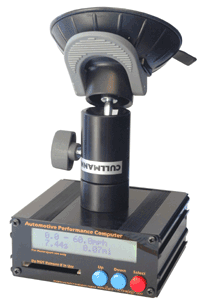
The Driftbox is a GPS and accelerometer based data logger made by Racelogic in the UK.Porsche uses the commercial sibling - the VBox - in its R&D.

The Driftbox is what was used by EVOMS to measure the power gains in the 997TT. Especially notable was the 6th gear acceleration times from 60-130 mph dropping from 12.8 to 8.1 seconds. I am pretty sure Todd at EVOMS would be willing share that Driftbox data with you. Also, one can calculate the flywheel HP from the 1/4 mile trapspeed and ET. Not sure how fat Todd is, but I estimated the car at 3600# and Todd at 200#.
4)comments on your own charts comparing your engine dyno vs the MAHA dyno:
A)92 octane fuel has more BTUs than 103 octane. It generates more heat. EGTs will be higher, and so will exhaust gas velocities. That can contribute to faster spool-up
B)Are we to assume your 1 bar and 1.14 bar runs were done after correcting the AFRs? If so, you realize that it is possible you simply have pushed the TO4E at 1.14(I don't know which trim you are using) from a more efficient island/zone to a less efficient zone.
C)A turbocharged motor under load spools up faster. Under load the exhaust gas temps are increasing, expanding faster, and spinning the turbine faster. Some tuners specifically keep the AFR lean on the lower rpms to help raise the EGT and diminish spool up times. Also, depending on the aromatics used in the 103 the AFR of your car running 103 may be significantly different than the same car running 92. Differing AFRs could contribute to better spool up
D)an AFR and EGT plot would really help to dissect the differences.
5)as to heat soak argument - running a car on a chassis dyno is far more prone to heat soak than any other environment - track, autobahn. Thus the Imagine/EVOMS/AWE dyno charts were done in a less than ideal environment. The cars on the dyno are relying more on radiation vs convection to dispel heat since they are not in a wind tunnel simulating 100+mph of airflow. In this aspect, I would contend that the power figures the tuners achieved may even be on the conservative side.
6)Porsche would not be in trouble with the TUV for publishing a 2-D dyno chart. Manufacturers have gotten into trouble for exaggerating max HP and TQ figures, not plots. DIN 70020 measurements are flywheel ratings, not loaded chassis ratings. This further cast a shadow of suspicion on the 2000 rpm max tq claim.
7)companies have been known to make false claims. Look at the whole A380 fiasco, at Enron, at Porsche's limited runs of 996GT2's and GT3's, CGT.
8)I think that there would be less impetus for tuners like Stephen, Todd(AWE), Todd(EVOMS), Todd(Protomotive) if the end consumers found that the car's tq characteristics were as advertised. I certainly would not have paid out almost $4k and potentially void my warranty. Being the cheap bastard I am, I thought the ECU prices were ridiculous compared to the prices I paid for custom chip tuning for my 951 track car ($225), my E36M3 track car ($500), and tow vehicle ($75). Now I consider it an absolute necessity for this platform.
1)The compressor map I displayed is not the 997TT VTG map. VTG maps have much broader efficiency islands that won't be easily confused for a fixed A/R turbine. As to the VTG going beyond it's "efficiency level" - what level is that? 80%, 72%, 60%? Is it going past the choke line?
2)MAHA dynos are used in the US as well. They are eddy current design chassis dynos. Mustang dyno's are also eddy current design. They both are absorbtion/brake style dynos with the ability to set a preload. MAHA's accuracy however, are from what I have read are software limited to 500hp. Mustang units are good to 1000hp. MAHA and Mustangs both can measure driveline losses. Several different Mustang eddy current loading dynos were used to measure the power gains in the 997TT. You are questioning the dyno plots but I don't think you realized these were not inertia-based dynos like the Dynojet which measures acceleration of a fixed weight drum - those I agree would lead to lead to overly optimistic output figures.
3)The AX22 is a GPS and accelerometer based data logger made by Race Technology in the UK
The Driftbox is a GPS and accelerometer based data logger made by Racelogic in the UK.Porsche uses the commercial sibling - the VBox - in its R&D.
The Driftbox is what was used by EVOMS to measure the power gains in the 997TT. Especially notable was the 6th gear acceleration times from 60-130 mph dropping from 12.8 to 8.1 seconds. I am pretty sure Todd at EVOMS would be willing share that Driftbox data with you. Also, one can calculate the flywheel HP from the 1/4 mile trapspeed and ET. Not sure how fat Todd is, but I estimated the car at 3600# and Todd at 200#.
4)comments on your own charts comparing your engine dyno vs the MAHA dyno:
A)92 octane fuel has more BTUs than 103 octane. It generates more heat. EGTs will be higher, and so will exhaust gas velocities. That can contribute to faster spool-up
B)Are we to assume your 1 bar and 1.14 bar runs were done after correcting the AFRs? If so, you realize that it is possible you simply have pushed the TO4E at 1.14(I don't know which trim you are using) from a more efficient island/zone to a less efficient zone.
C)A turbocharged motor under load spools up faster. Under load the exhaust gas temps are increasing, expanding faster, and spinning the turbine faster. Some tuners specifically keep the AFR lean on the lower rpms to help raise the EGT and diminish spool up times. Also, depending on the aromatics used in the 103 the AFR of your car running 103 may be significantly different than the same car running 92. Differing AFRs could contribute to better spool up
D)an AFR and EGT plot would really help to dissect the differences.
5)as to heat soak argument - running a car on a chassis dyno is far more prone to heat soak than any other environment - track, autobahn. Thus the Imagine/EVOMS/AWE dyno charts were done in a less than ideal environment. The cars on the dyno are relying more on radiation vs convection to dispel heat since they are not in a wind tunnel simulating 100+mph of airflow. In this aspect, I would contend that the power figures the tuners achieved may even be on the conservative side.
6)Porsche would not be in trouble with the TUV for publishing a 2-D dyno chart. Manufacturers have gotten into trouble for exaggerating max HP and TQ figures, not plots. DIN 70020 measurements are flywheel ratings, not loaded chassis ratings. This further cast a shadow of suspicion on the 2000 rpm max tq claim.
7)companies have been known to make false claims. Look at the whole A380 fiasco, at Enron, at Porsche's limited runs of 996GT2's and GT3's, CGT.
8)I think that there would be less impetus for tuners like Stephen, Todd(AWE), Todd(EVOMS), Todd(Protomotive) if the end consumers found that the car's tq characteristics were as advertised. I certainly would not have paid out almost $4k and potentially void my warranty. Being the cheap bastard I am, I thought the ECU prices were ridiculous compared to the prices I paid for custom chip tuning for my 951 track car ($225), my E36M3 track car ($500), and tow vehicle ($75). Now I consider it an absolute necessity for this platform.
Registered User
Joined: Jun 2004
Posts: 1,163
From: Earth
Rep Power: 92
Eclou
I am afraid you have gone a bit OT. I am sorry I will not spend the time to answer each of the observations. I think I have stated enough information to support what I said initially so that a reasonably objective mind can draw a conclusion.
I will stop there now and leave it to each one to think about it.
Interesting device that Driftbox, never heard of it before. I guess the only thing that Porsche engineers did well was to use a VBOX for their factory testing. I also find it interesting that EVOMS stock 997TT does 60-130mph in 12.1 almost slower than my stock 993 TT, all the tests that I have seen on stock 997TT put it in the 10s and some less, but those were German magazines and my datalogger is an AX22, so it does not count.
Sorry to hear you had to pay $4k to get what the factory failed to give you, I would have sold my 997TT on the spot and even sued Porsche if I had arrived at the same conclusions as you did, what a ripoff really.
Cheers now, I am going to keep looking for those 610HP VTG maps, I thought I finally got my hands on them on a public forum
I am afraid you have gone a bit OT. I am sorry I will not spend the time to answer each of the observations. I think I have stated enough information to support what I said initially so that a reasonably objective mind can draw a conclusion.
I will stop there now and leave it to each one to think about it.
Interesting device that Driftbox, never heard of it before. I guess the only thing that Porsche engineers did well was to use a VBOX for their factory testing. I also find it interesting that EVOMS stock 997TT does 60-130mph in 12.1 almost slower than my stock 993 TT, all the tests that I have seen on stock 997TT put it in the 10s and some less, but those were German magazines and my datalogger is an AX22, so it does not count.
Sorry to hear you had to pay $4k to get what the factory failed to give you, I would have sold my 997TT on the spot and even sued Porsche if I had arrived at the same conclusions as you did, what a ripoff really.
Cheers now, I am going to keep looking for those 610HP VTG maps, I thought I finally got my hands on them on a public forum
Registered User
Joined: Sep 2006
Posts: 3,028
From: Houston
Rep Power: 201
Jean,
You sardonically drip your post with inferences that the information I have posted is beneath your intellectual level. Honestly the modest quality of conjecture that you have presented led me to believe otherwise. Just because someone owns, drives or rents a high performance turbocharged car - I understand you have a very fast 993TT and are an accomplished driver - does not automatically impart them with any engineering prowess. I have tried to avoid condescencion. If you believe that I was intentionally doing so then I apologize. I was simply trying to emphasize some simple points which you appeared to have overlooked/ignored. Reading over your posts I cannot help but reiterate the several circular and quizzical arguments you have made supporting that very appearance-
You discounted the results of one eddy-current dyno (Mustang) while touting another (MAHA) as the gold standard. They operate on the same principles.
You discounted the results of one GPS/accelerometer logger (Driftbox) while touting another (AX22) as the gold standard. They operate on the same principles.
You claim that the MAHA dynos are more representative of true power than an engine dyno, that the MAHA output with loading show earlier boost/tq. Then you state that Porsche's engine dyno must be true or else the TUV would not approve them. Is one true and the other really, really true?
You put up a chart of your own engine dynos for comparison of engine dyno vs chassis dyno but there are the additional variables of octane and boost and probably AFR that are changed between the runs plots. With no less than 4 variables changed (dyno, boost, octane, AFR) can we really assume that the only influential variable is type of dyno?
Lastly to address the initial topic - you made an unsubstantiated assertion that the VTG turbo cannot produce over 550 hp, and the only proof you can come up with is the promise that "it is from a very reliable source." "Reliable" and "infallible" are not synonymous (you might ask your reliable source why they never solved the RMS issue in the 996's, why boxer cylinder sleeves like to dislodge, why PCCB - even Gen II - are failing). This is all despite the presentation of multiple measured loading dyno charts, videotaped 127 mph ET at 1100ft altitude, and GPS logged data which suggest otherwise. You also seem to conveniently have forgotten the discussion demonstrating the ability to accurately estimate HP from trap speed using the Hale and Andrew's formulas, which your reasonably objective mind accepted as valid last year. Call me a cynic but I find it impossible to draw the same conclusions as you have, despite your "scientific method".
You sardonically drip your post with inferences that the information I have posted is beneath your intellectual level. Honestly the modest quality of conjecture that you have presented led me to believe otherwise. Just because someone owns, drives or rents a high performance turbocharged car - I understand you have a very fast 993TT and are an accomplished driver - does not automatically impart them with any engineering prowess. I have tried to avoid condescencion. If you believe that I was intentionally doing so then I apologize. I was simply trying to emphasize some simple points which you appeared to have overlooked/ignored. Reading over your posts I cannot help but reiterate the several circular and quizzical arguments you have made supporting that very appearance-
You discounted the results of one eddy-current dyno (Mustang) while touting another (MAHA) as the gold standard. They operate on the same principles.
You discounted the results of one GPS/accelerometer logger (Driftbox) while touting another (AX22) as the gold standard. They operate on the same principles.
You claim that the MAHA dynos are more representative of true power than an engine dyno, that the MAHA output with loading show earlier boost/tq. Then you state that Porsche's engine dyno must be true or else the TUV would not approve them. Is one true and the other really, really true?
You put up a chart of your own engine dynos for comparison of engine dyno vs chassis dyno but there are the additional variables of octane and boost and probably AFR that are changed between the runs plots. With no less than 4 variables changed (dyno, boost, octane, AFR) can we really assume that the only influential variable is type of dyno?
Lastly to address the initial topic - you made an unsubstantiated assertion that the VTG turbo cannot produce over 550 hp, and the only proof you can come up with is the promise that "it is from a very reliable source." "Reliable" and "infallible" are not synonymous (you might ask your reliable source why they never solved the RMS issue in the 996's, why boxer cylinder sleeves like to dislodge, why PCCB - even Gen II - are failing). This is all despite the presentation of multiple measured loading dyno charts, videotaped 127 mph ET at 1100ft altitude, and GPS logged data which suggest otherwise. You also seem to conveniently have forgotten the discussion demonstrating the ability to accurately estimate HP from trap speed using the Hale and Andrew's formulas, which your reasonably objective mind accepted as valid last year. Call me a cynic but I find it impossible to draw the same conclusions as you have, despite your "scientific method".