


997 s barke pads change out


Registered User
Joined: Jun 2004
Posts: 26
From: Atlanta
Rep Power: 23

Brake info
Bob,
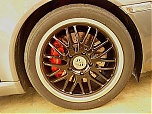
I just did this changing from stock to track pads and back again. The first time takes a little while in order to separate the vibration dampers from the backs of the pads where they are glued. After safely jacking the car and putting it on stands, the wheel is removed and you are looking at the outside edge of the Brembo caliper. Removing the old pads consists of removing the R clip, using a pin to drive out the pad retaining pin (toward the car), removing the spring, separate the calipers (caliper spreader vs. waterpump pliers), use a small thin putty knife to separate the old pad from the sensor, and cable tie the wear sensors out of the way.
As long as you don't reinstall the vibration dampers, you can do each wheel in about 5 minutes. Here are some links that I used to understand the basic concepts.
FWIW, here are some useful links that I collected before doing my pads yesterday. It really is as easy as everyone says, just be safe and use jackstands...
http://forums.rennlist.com/rennforum...996+jackstands
http://www.caymanclub.net/files/Changing_Brake_Pads.pdf
http://www.bombaydigital.com/boxster...s/change_pads/
http://www.heumann.com/bigred/index.html
http://www.youtube.com/watch?v=D_Mc2ZayRgg
Good luck!
I just did this changing from stock to track pads and back again. The first time takes a little while in order to separate the vibration dampers from the backs of the pads where they are glued. After safely jacking the car and putting it on stands, the wheel is removed and you are looking at the outside edge of the Brembo caliper. Removing the old pads consists of removing the R clip, using a pin to drive out the pad retaining pin (toward the car), removing the spring, separate the calipers (caliper spreader vs. waterpump pliers), use a small thin putty knife to separate the old pad from the sensor, and cable tie the wear sensors out of the way.
As long as you don't reinstall the vibration dampers, you can do each wheel in about 5 minutes. Here are some links that I used to understand the basic concepts.
FWIW, here are some useful links that I collected before doing my pads yesterday. It really is as easy as everyone says, just be safe and use jackstands...
http://forums.rennlist.com/rennforum...996+jackstands
http://www.caymanclub.net/files/Changing_Brake_Pads.pdf
http://www.bombaydigital.com/boxster...s/change_pads/
http://www.heumann.com/bigred/index.html
http://www.youtube.com/watch?v=D_Mc2ZayRgg
Good luck!


Registered User
Joined: Apr 2008
Posts: 128
From: Waxhaw, NC
Rep Power: 24
The track pads come in several different compound mixes as well.........some harder and some softer.
That's a start.........I am not the expert, but I will be using "track pads" when I change to "track tires and wheels".
Stay tuned for more input from the experts.

Registered User
Joined: Feb 2008
Posts: 193
From: Nevada City, CA
Rep Power: 26
What I learned about different pads
I am not an expert but here goes.
Street pads are good all round pads and can be used on the track.
Street pads do not have the aggressive initial bite (come on a little more slowly) of track pads – this is desirable on the street but as you get better on the track you will be trying to brake later and later in as you enter the turns, track pads give you an extra fraction of a second at WOT before you hit the brakes.
Track pads can work at higher temperatures and dissipate more heat in less time, better for repeated braking from higher speeds so you will not get brake fade as you spend more time at higher speeds on the track. They also work at higher temperatures than street pads which will start to fade at higher temps, HOWEVER, more aggressive pads do not work well (quite noticeable on the track in your warm up run) at low temps, they must be hot to work and can be dangerous on the street! So for repeated braking at high speeds track pads are better, on the street, street pads are better.
Track pads are harder than street pads and wear out a little more slowly. This depends on the pads, if you look at most pad manufacturers you will find they go from a “Street” grade to a very aggressive “Track/Race” grade, the more aggressive pads have higher initial grip, will not fade when hot, will last longer, but need to be hotter to work. More aggressive pads will wear your rotors out more quickly.
Tracks pads are harder to modulate, in other words they come on harder and quicker. So you need to be smoother with brake application and release to avoid unsettling the car.
Track pads are noisy, they will squeal under light braking (e.g., around town) and can be really loud, your significant other will probably complain!
Track pads are more expensive than street pads.
For an occasional DE street pads are fine, you will simply not be driving the cars hard enough to run into fade or wear problems on the track on your first few times out. For those of us who are truly afflicted a set of track pads is needed. At that point you need to have flushed your brakes with ATE as well!
I like PAGID pads for the track and have used both their blue and orange versions. So here are my recommendations:
For an occasional DE stick with street pads just make sure you have 60% of your pads left before a DE.
PAGID Blue “Sport” pads, a reasonable compromise nice initial bite, can make some noise under light braking. Good for more serious DE running and street. I used these for street and track in my Boxster.
PAGID Orange, nice track pads, they need to get a little hot, they can be very loud, not that good cold. Use on the track, avoid on the street, I have driven my cars to the track with PAGID orange, I just keep in mind that they will not get hot and stay hot on the street. Just stomp a little harder while driving to and from the track and swap them out when you get home.
I have done 2 DEs with my 997 with OEM pads, next time out it will be with PAGID orange.
As I said I am no expert, I don’t drive flat out on the track and work hard to be smooth. I am still very much in the learn mode with my car and will get some dedicated track wheels and tires next year. I tend to focus on one or two aspects of the track and driving each time I am out and I find that helps me a lot. So sometimes I work on the line & braking points (a good idea for your first few times out), other times I work on braking and shifting (I have the line pretty much down at Thunderhill), this time out I am going to start by braking a little early to give me some time to work on my heal toe shift! Anyway you get the idea.
Drive smooth and have fun on the track.
Street pads are good all round pads and can be used on the track.
Street pads do not have the aggressive initial bite (come on a little more slowly) of track pads – this is desirable on the street but as you get better on the track you will be trying to brake later and later in as you enter the turns, track pads give you an extra fraction of a second at WOT before you hit the brakes.
Track pads can work at higher temperatures and dissipate more heat in less time, better for repeated braking from higher speeds so you will not get brake fade as you spend more time at higher speeds on the track. They also work at higher temperatures than street pads which will start to fade at higher temps, HOWEVER, more aggressive pads do not work well (quite noticeable on the track in your warm up run) at low temps, they must be hot to work and can be dangerous on the street! So for repeated braking at high speeds track pads are better, on the street, street pads are better.
Track pads are harder than street pads and wear out a little more slowly. This depends on the pads, if you look at most pad manufacturers you will find they go from a “Street” grade to a very aggressive “Track/Race” grade, the more aggressive pads have higher initial grip, will not fade when hot, will last longer, but need to be hotter to work. More aggressive pads will wear your rotors out more quickly.
Tracks pads are harder to modulate, in other words they come on harder and quicker. So you need to be smoother with brake application and release to avoid unsettling the car.
Track pads are noisy, they will squeal under light braking (e.g., around town) and can be really loud, your significant other will probably complain!
Track pads are more expensive than street pads.
For an occasional DE street pads are fine, you will simply not be driving the cars hard enough to run into fade or wear problems on the track on your first few times out. For those of us who are truly afflicted a set of track pads is needed. At that point you need to have flushed your brakes with ATE as well!
I like PAGID pads for the track and have used both their blue and orange versions. So here are my recommendations:
For an occasional DE stick with street pads just make sure you have 60% of your pads left before a DE.
PAGID Blue “Sport” pads, a reasonable compromise nice initial bite, can make some noise under light braking. Good for more serious DE running and street. I used these for street and track in my Boxster.
PAGID Orange, nice track pads, they need to get a little hot, they can be very loud, not that good cold. Use on the track, avoid on the street, I have driven my cars to the track with PAGID orange, I just keep in mind that they will not get hot and stay hot on the street. Just stomp a little harder while driving to and from the track and swap them out when you get home.
I have done 2 DEs with my 997 with OEM pads, next time out it will be with PAGID orange.
As I said I am no expert, I don’t drive flat out on the track and work hard to be smooth. I am still very much in the learn mode with my car and will get some dedicated track wheels and tires next year. I tend to focus on one or two aspects of the track and driving each time I am out and I find that helps me a lot. So sometimes I work on the line & braking points (a good idea for your first few times out), other times I work on braking and shifting (I have the line pretty much down at Thunderhill), this time out I am going to start by braking a little early to give me some time to work on my heal toe shift! Anyway you get the idea.
Drive smooth and have fun on the track.



Thread
Thread Starter
Forum
Replies
Last Post
2lflat4
Automotive Parts & Accessories For Sale/Wanted
2
Nov 18, 2019 05:05 PM
