


997.2 burning oil?


Registered User
Joined: Jun 2008
Posts: 55
From: NorCal
Rep Power: 21

I got my 09 C2 in August of last year....
I just hit the 10k mi mark, and have probably put at least 5 quarts into the car. Every porsche mech that I speak with has told me that this is quite normal. There have been no signs of leaking/seepage, so I bet it is quite normal....

Registered User
Joined: Aug 2004
Posts: 2,134
From: Chicagoland
Rep Power: 123

The DFI engine is supposed to be "cleaner" but burns oil like crazy? I don't get it?
Anyway, does anybody else think the 0W-40 oil might contribute? I'm no mechanic or oil expert but doesn't 0W-40 have qualities similar to water until it warms up? Maybe a majority of oil is being burned just after start-up when it is thinest? I wonder if 5W-40 might work better? Should Porsche test my theory even if it is very weak?
Anyway, does anybody else think the 0W-40 oil might contribute? I'm no mechanic or oil expert but doesn't 0W-40 have qualities similar to water until it warms up? Maybe a majority of oil is being burned just after start-up when it is thinest? I wonder if 5W-40 might work better? Should Porsche test my theory even if it is very weak?
Oil is not the thinnest when it it cool.
Porsche just has no quality control and makes many crap engines. It's not anymore complex than that. Top it off with filling these loose engines with Mobil 0W40 and they invite oil burning.




Registered User
Joined: Jul 2006
Posts: 3,800
From: Tampa
Rep Power: 234
Yes it has goten a little better. I have a 2 day track event this weekend so I will report back and see how the oil burning does.

Registered User
Joined: Apr 2007
Posts: 480
From: OC, CA
Rep Power: 0

What did the dealer say about the soot on the exhaust tips.
Guys...STOP....09 (997.2S..3.8L) engines are vastly different than the 2005-08 (997.1S 3.8L) engine...OK?
When I 1st got my 2009 C2S in late September 08 I burned a quart of oil in around 700-800 miles. I burned another quart by 2500 miles and I burned .75 of a quart at 3000 miles.
I topped off at 3000 miles and now at 4100 miles I have burned a tad over 1/2 a quart. Oil burning is getting less and less. I did an oil and filter change at 2500 miles.
When you check your oil level in the new 2009 Carrera S be sure you are on a extremely flat surface like your garage floor. The gas station or Mall parking lot is not flat enough fore and aft or side to side and the level reading is extremely sensitive...EXTREMELY SENSITIVE...should I say this again?
Now, after you get home and check your oil and if reads it is at the lowest level, turn the car off and let it sit for 3-4 minutes. Then crank it back up and check the level again and it will show it is 1/2 full. Weird I know but this is something I have been trying to work with at the dealer level. The dealer noticed this too and people are over filling their new 2009 Carrera's!...not good. If I do not get a straight answer from my dealer by next week I will call PCNA.
Another issue that I have noticed with my 2009 Carrera S is a lot of black soot on the tail pipes...more than any other Porsche or other brand of car I have ever owned. My dealer is very concerned about this so I have an appointment at the dealer Monday morning to leave the car with them.
When I 1st got my 2009 C2S in late September 08 I burned a quart of oil in around 700-800 miles. I burned another quart by 2500 miles and I burned .75 of a quart at 3000 miles.
I topped off at 3000 miles and now at 4100 miles I have burned a tad over 1/2 a quart. Oil burning is getting less and less. I did an oil and filter change at 2500 miles.
When you check your oil level in the new 2009 Carrera S be sure you are on a extremely flat surface like your garage floor. The gas station or Mall parking lot is not flat enough fore and aft or side to side and the level reading is extremely sensitive...EXTREMELY SENSITIVE...should I say this again?
Now, after you get home and check your oil and if reads it is at the lowest level, turn the car off and let it sit for 3-4 minutes. Then crank it back up and check the level again and it will show it is 1/2 full. Weird I know but this is something I have been trying to work with at the dealer level. The dealer noticed this too and people are over filling their new 2009 Carrera's!...not good. If I do not get a straight answer from my dealer by next week I will call PCNA.
Another issue that I have noticed with my 2009 Carrera S is a lot of black soot on the tail pipes...more than any other Porsche or other brand of car I have ever owned. My dealer is very concerned about this so I have an appointment at the dealer Monday morning to leave the car with them.


Registered User
Joined: Apr 2008
Posts: 136
From: Seattle, WA
Rep Power: 24
These are characteristics of a DI engine.
Here is a German technical paper on general oil consumption during break-in. This engine was at full load for the entire test and still didn't stabilize until about 400 hours of use.
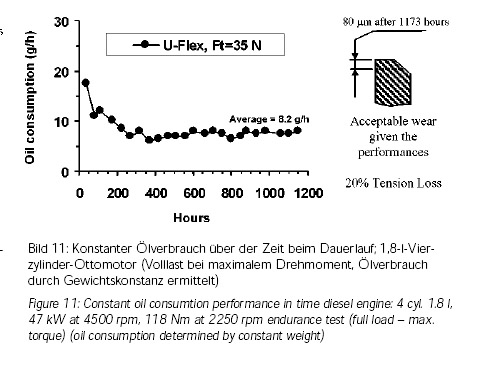
Different engine all together, but you can kind of get the idea.
DI engines do not come without fault. Perhaps some of you have read my write up already on these. These engines will have performance issues after some moderate use.
Here is the over simplified short version... the intake vales no longer are washed with fuel. They are super heated and dry. As most of the left over fuel and blowby oil is recycled from the cylinder chamber back through the intake, that residual oil and those particulates of fuel that were not burnt now are in direct contact with those hot/dry intake valve. Some of that bakes itself to the intake valves. Over time(from a few thousand miles to maybe 15,000[I am guessing since this DI engine is too new still]) the timing is pulled back to deal with the lack of smooth air flow via the intake valves.
Because it comes on so gradual over the 1000's of miles you won't feel this. But your car is getting slower and less fuel efficient.
That actually is the short version. The long version explains how I studied the recycling system that Porsche made and how internally the concept it's very similar to Audi's. And you may already have heard that the FSI(Audi's DI design) is plagued with this issue severely, especially the RS4 and R8. But I won't get into all of that.
This isn't to say that all the oil you are burning up is going on your intake valves. That's silly. That was just a side note. The oil burning goes back to the beginning of my post, normal burn in for a new engine(within reason). Some of your oil burning is NOT normal but will most likely taper off in the coming months. But this "missing" oil in your engine is on your tail pipe or getting layered up in your Cat. If you heated your tail-pipes up to 1000 degees for a while you'd see what your intake valves are looking like, baked on carbon and residual gasoline particulates that will only come off with an atomic bomb blast(or hours of cleaning).
One more thing. Once your oil consumption tapers off, I COMMAND you(ha) to send a sample of your oil to BlackStone or similar oil analytical labs for a review. Plenty of DI engines are also seeing critically high fuel dilution in the oil. And when your oil stops going down on the readout, it could mean it's still burning but being replaced with raw fuel instead. High fuel dilution in oil means the flash point of the oil decreases at a frightening degree. I'm seeing fuel dilution at 5-6% in some! That is 5-6% of your oil pan is gasoline mixed in the oil. That is serious trouble. 1-2% is "normal". High fuel dilution is an engine destroyer.
EDIT: I have absolutely no affiliation with BlackStone. I am just an Engineer outside the world of automotive.
Here is a German technical paper on general oil consumption during break-in. This engine was at full load for the entire test and still didn't stabilize until about 400 hours of use.
Different engine all together, but you can kind of get the idea.
DI engines do not come without fault. Perhaps some of you have read my write up already on these. These engines will have performance issues after some moderate use.
Here is the over simplified short version... the intake vales no longer are washed with fuel. They are super heated and dry. As most of the left over fuel and blowby oil is recycled from the cylinder chamber back through the intake, that residual oil and those particulates of fuel that were not burnt now are in direct contact with those hot/dry intake valve. Some of that bakes itself to the intake valves. Over time(from a few thousand miles to maybe 15,000[I am guessing since this DI engine is too new still]) the timing is pulled back to deal with the lack of smooth air flow via the intake valves.
Because it comes on so gradual over the 1000's of miles you won't feel this. But your car is getting slower and less fuel efficient.
That actually is the short version.
The long version explains how I studied the recycling system that Porsche made and how internally the concept it's very similar to Audi's. And you may already have heard that the FSI(Audi's DI design) is plagued with this issue severely, especially the RS4 and R8. But I won't get into all of that.This isn't to say that all the oil you are burning up is going on your intake valves. That's silly. That was just a side note. The oil burning goes back to the beginning of my post, normal burn in for a new engine(within reason). Some of your oil burning is NOT normal but will most likely taper off in the coming months. But this "missing" oil in your engine is on your tail pipe
or getting layered up in your Cat. If you heated your tail-pipes up to 1000 degees for a while you'd see what your intake valves are looking like, baked on carbon and residual gasoline particulates that will only come off with an atomic bomb blast(or hours of cleaning).One more thing. Once your oil consumption tapers off, I COMMAND you(ha) to send a sample of your oil to BlackStone or similar oil analytical labs for a review. Plenty of DI engines are also seeing critically high fuel dilution in the oil. And when your oil stops going down on the readout, it could mean it's still burning but being replaced with raw fuel instead. High fuel dilution in oil means the flash point of the oil decreases at a frightening degree. I'm seeing fuel dilution at 5-6% in some! That is 5-6% of your oil pan is gasoline mixed in the oil. That is serious trouble. 1-2% is "normal". High fuel dilution is an engine destroyer.
EDIT: I have absolutely no affiliation with BlackStone. I am just an Engineer outside the world of automotive.
Last edited by ragdoll; Aug 30, 2009 at 11:47 AM.
Registered User
Joined: May 2009
Posts: 235
From: Warm Spot
Rep Power: 34
Interesting and time will tell. To counter this Diesel's have always been direct injection and never had cooling of valves from fuel. I have been in numerous diesel engines, I used to farm, and never had build up on the valves.
Peter
Peter