


rubbed tire and track safety


Thread Starter
|
Registered User
Joined: Mar 2012
Posts: 110
From: Bay Area, CA
Rep Power: 19

rubbed tire and track safety
I have a upcoming track-day and I am looking to use a set of my old track tires. While pulling them out of the garage today, i noticed rub marks on one of the tires. Do you know if the tire is still safe to be used on the track?


Registered User
Joined: Jun 2008
Posts: 1,962
From: Colorado / L.A.
Rep Power: 116

While no one can tell you over the internet what condition your tires are in, from the photos I wouldn't drive them to the grocery store. The larger question would be why you would consider running tires that you know are the wrong size for your car. That is never safe.
Last edited by denversteve; Oct 30, 2012 at 09:47 PM.



Registered User
Joined: Mar 2010
Posts: 2,273
From: San Jose, CA
Rep Power: 193
Think about it...you're asking the question. Depending on your alignment (if mellow) they may be okay, provided they don't rub on your current set-up/vehicle. However, if the mfg date is over from a year ago or longer, they are done and you'd be better off on a fresher set of street tires.
IMHO
For me, they would go in the dumpster.
IMHO
For me, they would go in the dumpster.
Last edited by VID997; Oct 31, 2012 at 01:19 AM.
Thread Starter
|
Registered User
Joined: Mar 2012
Posts: 110
From: Bay Area, CA
Rep Power: 19
the rubbing issue has been resolved, it was due to too aggressive of a wheel offset. The tire is the correct 295/30-19 size. I am doing my trackday at Laguna Seca during the thanksgiving weekend.
VID997, can you elaborate on the importance of mfg date?
VID997, can you elaborate on the importance of mfg date?
Registered User
Joined: Mar 2010
Posts: 2,273
From: San Jose, CA
Rep Power: 193
Rubber degrades with exposure to sun (UV Rays) and oxygen. Over a very short period of time this can dry out the compound, thus making the tire/rubber hard, dried-out, and yielding a greasy feel on track. Nitrogen is used to fill commercial vehicles and race/track tires to help aid in rapid deterioration. It is also used to fill tires because its chemical compound is more stable within confined areas when heat is applied, meaning it doesn't expand like oxygen does.
I have been at events where fellow drivers have recently put on fresh rubber, so they thought, yet had tremendous understeer, and even spun off track. Struggling to maintain grip and confused because other driver's with the same vehicle and tires stuck like glue. When examining the manufacturing dates, the guys struggling had tires that were 2 years old or older compared to those without issues, which were manufactured within the same year, if not within the last few months of running.
Another major concern I have for your "track tires" are the shoulder cuts/scarring. With an aggressive alignment your outside shoulders may never make contact with the asphalt while street driving. However, when driving hard at the track that changes, and you can actually wear out the shoulders out before the inside if your car isn't set-up properly.
Most likely I have never come close to scrubbing in the outside shoulders while street driving. Although, while tracking I'm at the limit and have even corded the outside edge of Hoosiers R6's. The picture below illustrates a set of RE-11's run to their limit for the alignment at the time. (NOTE the triangle marker at the edge of the tire wear).
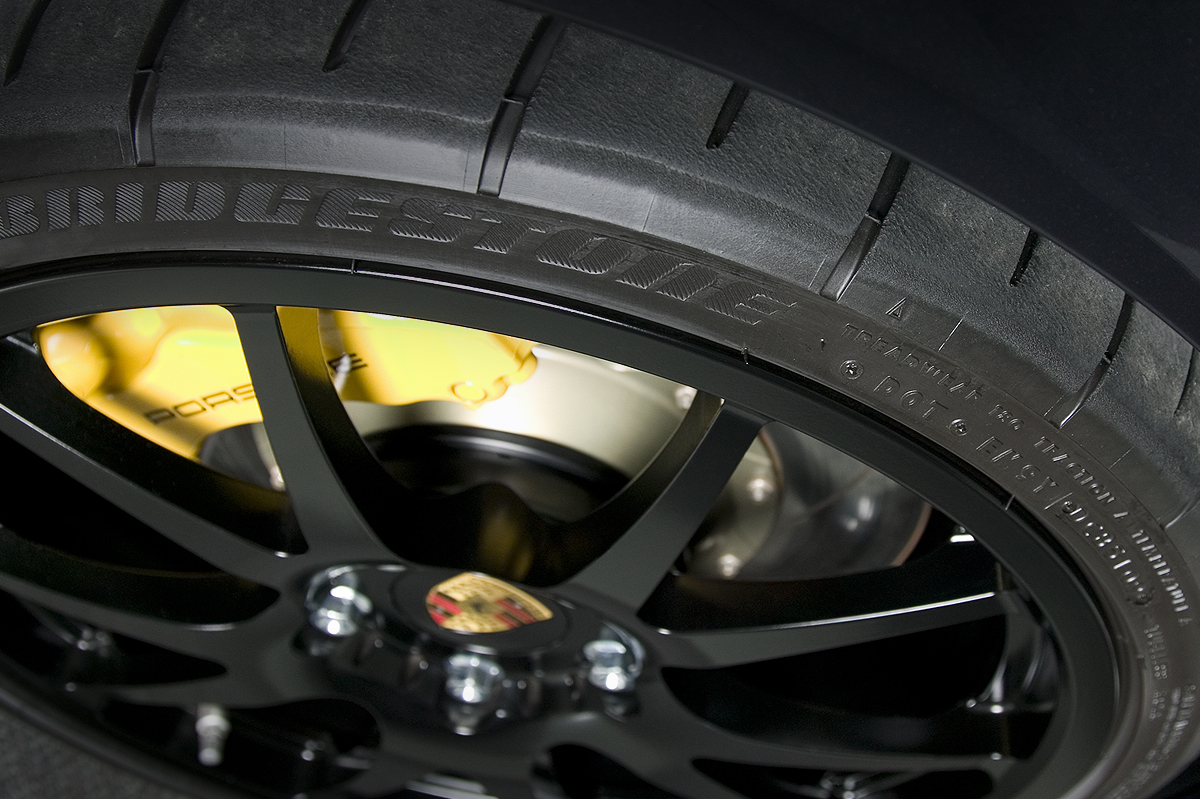
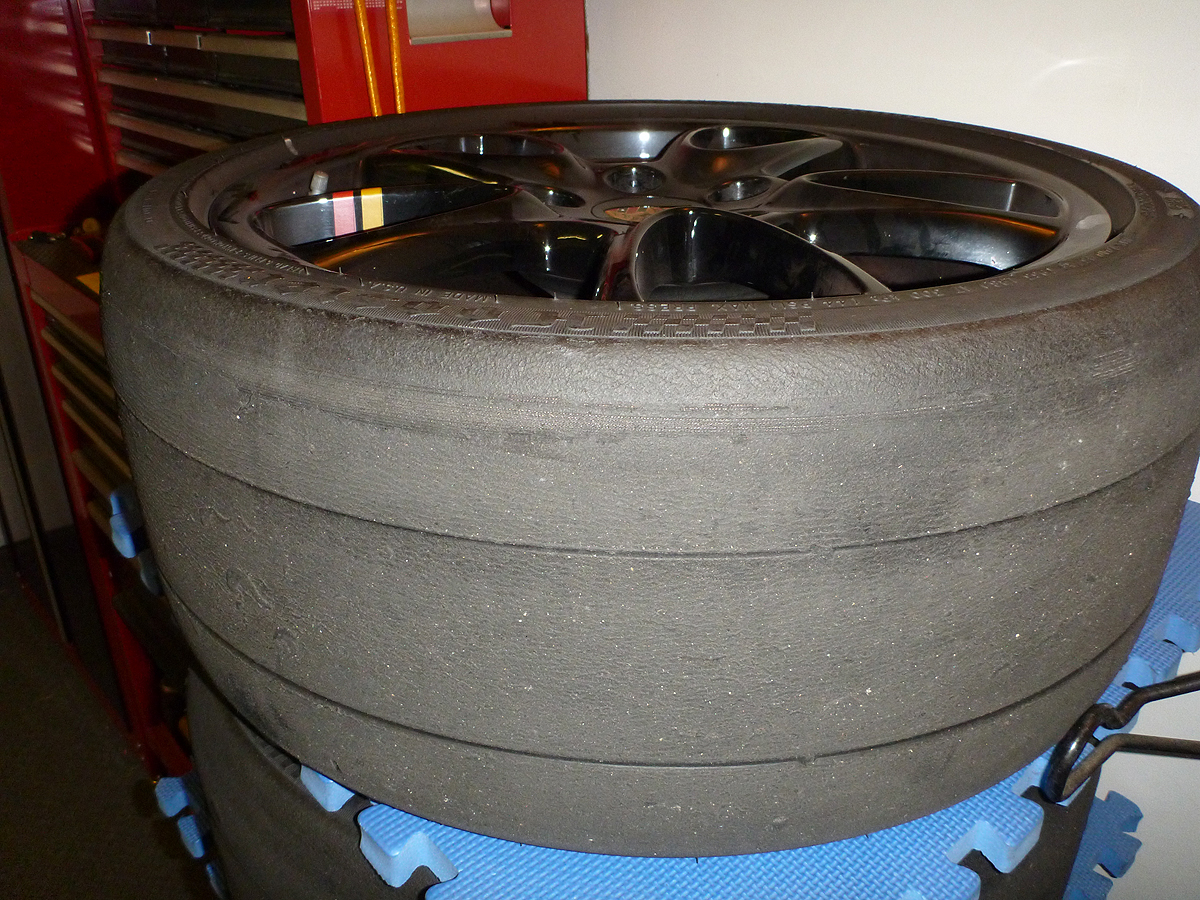
^^^ Corded R6's outside shoulder.
Use your own good judgement and apply safety to yourself and the others you are sharing the track with.
Don’t be "That Guy"
I have been at events where fellow drivers have recently put on fresh rubber, so they thought, yet had tremendous understeer, and even spun off track. Struggling to maintain grip and confused because other driver's with the same vehicle and tires stuck like glue. When examining the manufacturing dates, the guys struggling had tires that were 2 years old or older compared to those without issues, which were manufactured within the same year, if not within the last few months of running.
Another major concern I have for your "track tires" are the shoulder cuts/scarring. With an aggressive alignment your outside shoulders may never make contact with the asphalt while street driving. However, when driving hard at the track that changes, and you can actually wear out the shoulders out before the inside if your car isn't set-up properly.
Most likely I have never come close to scrubbing in the outside shoulders while street driving. Although, while tracking I'm at the limit and have even corded the outside edge of Hoosiers R6's. The picture below illustrates a set of RE-11's run to their limit for the alignment at the time. (NOTE the triangle marker at the edge of the tire wear).
^^^ Corded R6's outside shoulder.
Use your own good judgement and apply safety to yourself and the others you are sharing the track with.
Don’t be "That Guy"
Last edited by VID997; Oct 31, 2012 at 01:24 AM.
Trending Topics

Registered User
Joined: Jun 2009
Posts: 288
From: hayward, ca
Rep Power: 50
Tire manufacture date is good info also. Each tire has a date code in a slightly recessed area on the side wall. Dates are expressed by year and week: Example: 4511 would be the forty fifth week of 2011.

Registered User
Joined: Mar 2008
Posts: 642
From: Kansas
Rep Power: 79
Rubber degrades with exposure to sun (UV Rays) and oxygen. Over a very short period of time this can dry out the compound, thus making the tire/rubber hard, dried-out, and yielding a greasy feel on track. Nitrogen is used to fill commercial vehicles and race/track tires to help aid in rapid deterioration. It is also used to fill tires because its chemical compound is more stable within confined areas when heat is applied, meaning it doesn't expand like oxygen does.
I have been at events where fellow drivers have recently put on fresh rubber, so they thought, yet had tremendous understeer, and even spun off track. Struggling to maintain grip and confused because other driver's with the same vehicle and tires stuck like glue. When examining the manufacturing dates, the guys struggling had tires that were 2 years old or older compared to those without issues, which were manufactured within the same year, if not within the last few months of running.
Another major concern I have for your "track tires" are the shoulder cuts/scarring. With an aggressive alignment your outside shoulders may never make contact with the asphalt while street driving. However, when driving hard at the track that changes, and you can actually wear out the shoulders out before the inside if your car isn't set-up properly.
Most likely I have never come close to scrubbing in the outside shoulders while street driving. Although, while tracking I'm at the limit and have even corded the outside edge of Hoosiers R6's. The picture below illustrates a set of RE-11's run to their limit for the alignment at the time. (NOTE the triangle marker at the edge of the tire wear).
^^^ Corded R6's outside shoulder.
Use your own good judgement and apply safety to yourself and the others you are sharing the track with.
Don’t be "That Guy"
I have been at events where fellow drivers have recently put on fresh rubber, so they thought, yet had tremendous understeer, and even spun off track. Struggling to maintain grip and confused because other driver's with the same vehicle and tires stuck like glue. When examining the manufacturing dates, the guys struggling had tires that were 2 years old or older compared to those without issues, which were manufactured within the same year, if not within the last few months of running.
Another major concern I have for your "track tires" are the shoulder cuts/scarring. With an aggressive alignment your outside shoulders may never make contact with the asphalt while street driving. However, when driving hard at the track that changes, and you can actually wear out the shoulders out before the inside if your car isn't set-up properly.
Most likely I have never come close to scrubbing in the outside shoulders while street driving. Although, while tracking I'm at the limit and have even corded the outside edge of Hoosiers R6's. The picture below illustrates a set of RE-11's run to their limit for the alignment at the time. (NOTE the triangle marker at the edge of the tire wear).
^^^ Corded R6's outside shoulder.
Use your own good judgement and apply safety to yourself and the others you are sharing the track with.
Don’t be "That Guy"
Nitrogen is simply a dry gas. If you use DRY compressed air (already 78% Nitrogen), you will yield the same results.
In practice, it is nearly impossible to achieve a 100% Nitrogen fill. First, the commercial Nitrogen is only about 95-98% pure. Then you need a vacuum chamber to eliminate any "non-nitrogen gasses".
In the end, just use compressed air that has come from a system with a dryer. Works just as well.
My 2 cents

Thread
Thread Starter
Forum
Replies
Last Post
eclip5e
Automobiles For Sale
6
Jul 29, 2019 11:13 AM
horsepowerfarm
Automotive Parts & Accessories For Sale/Wanted
7
Sep 10, 2015 06:09 PM
