


Proper GT3RS Break-in



Registered User
Joined: Dec 2007
Posts: 5
From: Savannah
Rep Power: 0

I know I'm in the minority, but, I did the proper break-in with my RS. I track it regularly and didn't want to take any chances. I've also had zero issues with my RMS...maybe there is a connection...maybe not. In any case, I would be the one guy that had an engine problem and P can test to see how the engine has been reved.



Registered User
Joined: Sep 2003
Posts: 444
Rep Power: 41
Follow what is says in the owner's manual. That's the best advice as it's been reviewed by the people who design, build, test and litigate for the car. These high-revving close-tolerance engines need to be broken-in properly. I do that for all of my cars and they run beautifully for years.
Last edited by Bill S; Dec 27, 2007 at 12:04 PM.

Registered User
Joined: Jun 2006
Posts: 2,282
From: CT
Rep Power: 113
Follow what is says in the owner's manual. That's the best advice as it's been reviewed by the people who design, build, test and litigate for the car. These high-revving close-tolerance engines need to be broken-in properly. I do that for all of my cars and they run beautifully for years.
I think a proper break in period consists of revving higher in each gear, for example 2nd gear 3k RPM, 3rd gear 4k RPM. 5th Gear 5k, etc.
Thats what I read somewhere, I'll try to look for the site.
Registered User
Joined: Sep 2003
Posts: 444
Rep Power: 41
You need to realize that the manufacturers write that stuff in the owners manual for warranty/insurance reasons. I do not think that 4000 revs is sufficient for break in period especially for a car that revs 8000+.
I think a proper break in period consists of revving higher in each gear, for example 2nd gear 3k RPM, 3rd gear 4k RPM. 5th Gear 5k, etc.
Thats what I read somewhere, I'll try to look for the site.
I think a proper break in period consists of revving higher in each gear, for example 2nd gear 3k RPM, 3rd gear 4k RPM. 5th Gear 5k, etc.
Thats what I read somewhere, I'll try to look for the site.

Registered User
Joined: Jan 2007
Posts: 77
From: NJ
Rep Power: 27
Coincidence that another reply mentioned an M5 because I to have an M5 and I babied my motor as recommended. I now now and been told you got to let her rip and loosen that motor up. My car has dyno'ed consistently lower than others.
My GT3 I let it rip from the beginning. I did not do anything stupid but I sure rev'ed and shifted at 7000 to 7500 rpm. The car has dyno'ed strong for stock (363 rwhp) and after FVD headers, 384 rwhp.
These cars are meant to be run hard. I know of individuals who have tracked the GT3 with only 200miles.
A little example, you build a race motor and it goes out and you run it ***** out. Maybe not a valid consideration but close enough.
Loosen that baby up!
GT3Ranger
My GT3 I let it rip from the beginning. I did not do anything stupid but I sure rev'ed and shifted at 7000 to 7500 rpm. The car has dyno'ed strong for stock (363 rwhp) and after FVD headers, 384 rwhp.
These cars are meant to be run hard. I know of individuals who have tracked the GT3 with only 200miles.
A little example, you build a race motor and it goes out and you run it ***** out. Maybe not a valid consideration but close enough.
Loosen that baby up!
GT3Ranger
drove it below 6000rpms for 200 miles and then 8400rpms every day since
my car has 12000miles on it and dynoes 389 to the wheels
changed the oil after 1000miles and then every 2500miles
Last edited by 997gt3north; Dec 27, 2007 at 04:32 PM.
Registered User
Joined: Jun 2006
Posts: 2,282
From: CT
Rep Power: 113
Here is an motorcycle example, frankly I do not know if this holds true for Porsche cars.
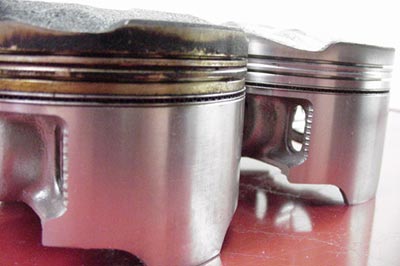
Although these pistons came out of engines which were raced for a full season, they weren't set-up with any special clearances or other preparation.
These engines were never worked on prior to being raced. They were totally stock as built by Honda.
The only difference was the break in method they used...
The one on the right was broken in as per instructions of tuner.
The one on the left was broken in exactly according to the owner's manual. The resulting leaky rings have allowed pressure to "blow by" down into the crankcase on acceleration, and oil to "suck-up" into the combustion chamber on deceleration.
Once again, not sure if this relates to Porsche vehicles.
Although these pistons came out of engines which were raced for a full season, they weren't set-up with any special clearances or other preparation.
These engines were never worked on prior to being raced. They were totally stock as built by Honda.
The only difference was the break in method they used...
The one on the right was broken in as per instructions of tuner.
The one on the left was broken in exactly according to the owner's manual. The resulting leaky rings have allowed pressure to "blow by" down into the crankcase on acceleration, and oil to "suck-up" into the combustion chamber on deceleration.
Once again, not sure if this relates to Porsche vehicles.

Registered User
Joined: Jul 2006
Posts: 2,901
From: Eating your Taquitos
Rep Power: 148

It applies to all piston engines. Specific to Porsche, the engines are run in at the factory through various cycles that do the majority of the ring seat.
Best thing you can do for the engine is flog the snot out if it right off the lot, and try to keep it in throttle or completely off throttle as much as possible for the first hundred miles or so.
Best thing you can do for the engine is flog the snot out if it right off the lot, and try to keep it in throttle or completely off throttle as much as possible for the first hundred miles or so.

Thread
Thread Starter
Forum
Replies
Last Post
adnanm3
Aston Martin
25
Oct 25, 2016 08:38 AM
Kai@ELITEMS
996 Turbo / GT2
1
Aug 6, 2016 09:50 AM
Kai@ELITEMS
997 Turbo / GT2
0
Oct 1, 2015 04:34 PM
Kai@ELITEMS
Bentley
0
Oct 1, 2015 04:33 PM
ModBargains.com
996 Turbo Vendor Classifieds
0
Oct 1, 2015 11:48 AM


