


Track Alignment


Thread Starter
|
Registered User
Joined: Oct 2008
Posts: 274
From: Montreal
Rep Power: 32

Track Alignment
I hope the subject is not too technical for the forum but it may be useful for others. If you track your car, could you share with me your preference in terms of wheels alignment. I had my car aligned twice since April and I can still see the tires used on the exterior side (pressures and temperatures checked). Here is my last setting (I track the car with 18" Pirelli D3 slicks):
FRONT Camber -2.5 degrees, Toe O degree (sway bar full soft)
REAR Camber -2.0 degrees, Toe-in 12 degrees (sway bar full hard)
To get this camber on the front, we had to turn the top plate of the suspension to get more room. I will change my rear sway bar for a GT2 one. Any idea on the adjustment I should use ?
I know that alignment is something personal to a certain degree depending of your driving style, but assuming you can push the car to its limits it shouldn't be that different, isn't it ?
FRONT Camber -2.5 degrees, Toe O degree (sway bar full soft)
REAR Camber -2.0 degrees, Toe-in 12 degrees (sway bar full hard)
To get this camber on the front, we had to turn the top plate of the suspension to get more room. I will change my rear sway bar for a GT2 one. Any idea on the adjustment I should use ?
I know that alignment is something personal to a certain degree depending of your driving style, but assuming you can push the car to its limits it shouldn't be that different, isn't it ?
Last edited by GT3Techno; May 31, 2009 at 09:40 AM.
Registered User
Joined: Jun 2008
Posts: 653
From: S. Florida
Rep Power: 49
I know that alignment is something personal to a certain degree depending of your driving style, but assuming you can push the car to its limits it shouldn't be that different, isn't it ?
 That's what I thought, but for me it is quit different from the "other" GT3's I run with.
I run -3.0 Camber front (Rotated struts) and rear, just a tiny bit toe out in the front. Sway bar front almost all stiff and rear all soft.
It felt faster with the car lose and it felt faster / better, but the Traqmate says a little push is faster
 .
.Maybe I just can't drive, (I still toss the car into the corner, coming out of a Mustang) and or run the tires (That I buy used to begin with) too long, the rears suffer a lot more, so maybe I am always loose because of the tires.
Registered User
Joined: Nov 2007
Posts: 246
From: Columbus Ohio
Rep Power: 42

I am not really sure I understand what you are asking in this post. Is the issue that you do not feel you are getting even tire wear? Do you think the handle is off. Your alignment numbers. are vary close to what is in the manual for Track set up. Its decent. I find that the gt3 with 19 inch rims needs less camber than the 996 3 for example the wider the tire the less camber generally. Also 18 inch diameter differs from19 on amount of camber needed.
To answer your question specific to you, You need to get a contact pyrometer , learn how to use it and take tire temps that will answer your camber and set up questions.
Regarding the sway bar settings. to make the car handle you want to use less rear sway bar. the way to do that is to use stiffer rear springs then you can go to a softer rear sway. Some guys have gone to the GT2 bar and put it in the middle, one back full stuff. Its an option, but if you are serious go with stiffer rear springs and run the OE sway at full soft.
By the way you don't have to Rotate the strut plates, they sell shims that allow you to get lots of negative camber.
To answer your question specific to you, You need to get a contact pyrometer , learn how to use it and take tire temps that will answer your camber and set up questions.
Regarding the sway bar settings. to make the car handle you want to use less rear sway bar. the way to do that is to use stiffer rear springs then you can go to a softer rear sway. Some guys have gone to the GT2 bar and put it in the middle, one back full stuff. Its an option, but if you are serious go with stiffer rear springs and run the OE sway at full soft.
By the way you don't have to Rotate the strut plates, they sell shims that allow you to get lots of negative camber.
Registered User
Joined: Jun 2006
Posts: 1,204
From: Belmont, CA
Rep Power: 71
imo, that is too little camber for running racing slicks. for reference, 997 cup cars run up to, or even greater than -4.0 degrees of camber, obviously driver and track dependent.
like toadinlaw said, to be really exact, a contact pyrometer is the best way to fine tune the amount of camber needed.
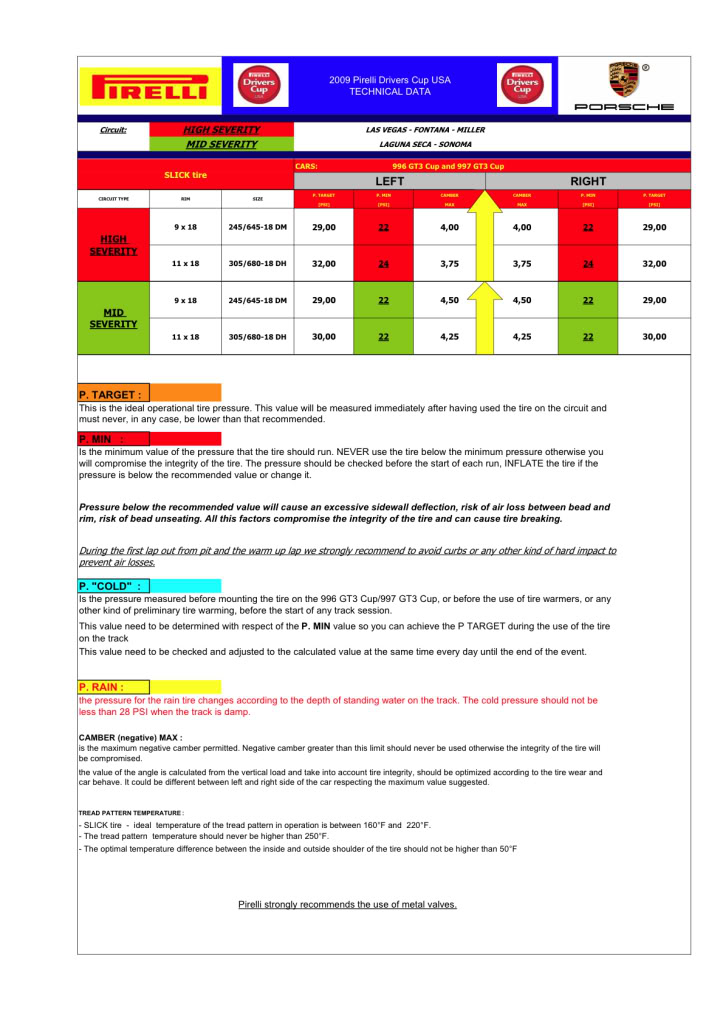
here is a setup sheet by pirelli on their P-zero slicks, can't be too far off from their D3s:
like toadinlaw said, to be really exact, a contact pyrometer is the best way to fine tune the amount of camber needed.
here is a setup sheet by pirelli on their P-zero slicks, can't be too far off from their D3s:
Registered User
Joined: Nov 2007
Posts: 246
From: Columbus Ohio
Rep Power: 42
[quote=Chasen1211;2406156]imo, that is too little camber for running racing slicks. for reference, 997 cup cars run up to, or even greater than -4.0 degrees of camber, obviously driver and track dependent.
like toadinlaw said, to be really exact, a contact pyrometer is the best way to fine tune the amount of camber needed.
here is a setup sheet by pirelli on their P-zero slicks, can't be too far off from their D3s:
[quote]
I agree 100 % on slicks, I missed that, but the pyrometer is the way to figure it out.
like toadinlaw said, to be really exact, a contact pyrometer is the best way to fine tune the amount of camber needed.
here is a setup sheet by pirelli on their P-zero slicks, can't be too far off from their D3s:
[quote]
I agree 100 % on slicks, I missed that, but the pyrometer is the way to figure it out.
Registered User
Joined: Jul 2006
Posts: 970
From: Brooklyn, NY
Rep Power: 65
Another thing to consider is track and driving style.
More turns, in one direction, less straights, always means more tire wear. Another thing to consider is if you are early apexing the turns you are entering too fast and brushing off speed with your tires.
Before messing with the alignment too much, just take your turn in a tick later, do a later apex and see if you are getting more even tire wear.
More turns, in one direction, less straights, always means more tire wear. Another thing to consider is if you are early apexing the turns you are entering too fast and brushing off speed with your tires.
Before messing with the alignment too much, just take your turn in a tick later, do a later apex and see if you are getting more even tire wear.
Trending Topics

Registered User
Joined: Nov 2007
Posts: 246
From: Columbus Ohio
Rep Power: 42
There is always lots of things to consider. That is what makes this fun, if you are talking about tire wear then you focus on camber by tire temp. even tire temps will yield even tire wear, if you can't take tire temps then judge camber by the tire wear,
I am not a big fan of tons of camber, only enough camber is needed to get even tire wear, you want as much rubber on the track and for braking as possible so wear dictates camber in my book.
if it turn in handling you want, a tick of pos. toe or zero toe up front will help that.
I am not a big fan of tons of camber, only enough camber is needed to get even tire wear, you want as much rubber on the track and for braking as possible so wear dictates camber in my book.
if it turn in handling you want, a tick of pos. toe or zero toe up front will help that.
Registered User
Joined: May 2009
Posts: 235
From: Warm Spot
Rep Power: 34
Got some Hoosier radial slicks for the GT2 and this is what hoosier says about tire temps.
250/650 18
305/645 18
HOOSIER
GT TIRE INFORMATION
CAMBER RECOMMENDATION
Temperatures measured at three different points on the tread are an excellent indicator deciding the best choice for camber adjustments on the vehicle. The ideal working temperature range is between 175° F (80° C) and 220° F (104° C) with an optimum inside to outside spread of 20° F (0° C) and with a maximum of 50° F (10°C). In a well-balanced chassis the front and rear tire temperatures should be within 25° F (15° C) with the exception of a rear engine Porsche where the rear tires may run 45° F (25° C) hotter. If these values are exceeded, we recommend the vehicles geometry be adjusted. A banked track significantly increases the stress on the tires inner shoulder. It is recommended to minimize the temperature spreads by lowered camber settings.
Tire temps are not even across the tread Hmmmm.
Peter
for the GT2 and this is what hoosier says about tire temps. 250/650 18
305/645 18
HOOSIER
GT TIRE INFORMATION
CAMBER RECOMMENDATION
Temperatures measured at three different points on the tread are an excellent indicator deciding the best choice for camber adjustments on the vehicle. The ideal working temperature range is between 175° F (80° C) and 220° F (104° C) with an optimum inside to outside spread of 20° F (0° C) and with a maximum of 50° F (10°C). In a well-balanced chassis the front and rear tire temperatures should be within 25° F (15° C) with the exception of a rear engine Porsche where the rear tires may run 45° F (25° C) hotter. If these values are exceeded, we recommend the vehicles geometry be adjusted. A banked track significantly increases the stress on the tires inner shoulder. It is recommended to minimize the temperature spreads by lowered camber settings.
Tire temps are not even across the tread Hmmmm.
Peter

Registered User

Joined: Jun 2008
Posts: 214
From: North Carolina
Rep Power: 26
I'd like to note as a side point that these cars are very sensitive to tires as far as street cars go. Coming from M3s, the 996/997 chassis is certainly more lively, and their characteristics change quite a bit depending on tires.

Registered User
Joined: May 2009
Posts: 69
From: Vancouver, BC
Rep Power: 24
Temperatures measured at three different points on the tread are an excellent indicator deciding the best choice for camber adjustments on the vehicle. The ideal working temperature range is between 175° F (80° C) and 220° F (104° C) with an optimum inside to outside spread of 20° F (0° C) and with a maximum of 50° F (10°C). In a well-balanced chassis the front and rear tire temperatures should be within 25° F (15° C) with the exception of a rear engine Porsche where the rear tires may run 45° F (25° C) hotter. If these values are exceeded, we recommend the vehicles geometry be adjusted. A banked track significantly increases the stress on the tires inner shoulder. It is recommended to minimize the temperature spreads by lowered camber settings.
Awaiting Email Confirmation
Joined: Feb 2004
Posts: 282
From: NJ
Rep Power: 0
alignment
Good discussion. It shows how dramatically different a particular car will respond depending on type and size of tires, sway bar settings, style of driving, corner balancing, and track driven. Even with all these factors, the trend is that the 997 GT3 wants more camber in front than rear, and that when you approach more than -2.5 in the rear the wear falls off a cliff.

Registered User
Joined: Oct 2008
Posts: 55
From: San Diego
Rep Power: 20
where did you get slicks with the old designation? pirelly does not market the compounds like that anymore. now they use soft med and hard. if tehy are that old throw them out.
oh you need 3-3.5 camber in front and a half degree less in the rear.
oh you need 3-3.5 camber in front and a half degree less in the rear.
Thread Starter
|
Registered User
Joined: Oct 2008
Posts: 274
From: Montreal
Rep Power: 32
Update: I check on Pirelli website and they are still using this designation in their current catalog of racing products. See attached file.
Thanks,
Last edited by GT3Techno; Jun 9, 2009 at 08:23 AM.