


Motortrend - 991 First drive


Thread Starter
|
Registered User
Joined: Jun 2008
Posts: 3,079
From: Germany
Rep Power: 228


Motortrend - 991 First drive
First Drive: 2012 Porsche 911 Carrera S
The One by Which All Others Are Measured

By Ron Kiino
Photos Courtesy of the Manufacturer, Julia LaPalme
Porsche has earned and embraced this bull's-eye status, and there is no 911 better suited to defend that position than the all-new, seventh-generation 991. Longer, lighter, quicker, roomier, and more fuel-efficient than its 997 predecessor, the 991 is an evolutionary masterpiece of speed, style, and technology.
" When we want to say just how quick a car is, or how well it handles, or how amazing its steering is, well, there's one reference we turn to."
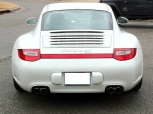
Let's start with the body. Now constructed of almost 50 percent aluminum, including the doors, wings, lids, and roof, the body is about 100 pounds lighter and around 20-percent stiffer, the latter due in part to key uses of ultra-high-strength steel. Further, the body managed to successfully diet while growing more than 2 inches in length (compared to the 997 GTS) and having a wheelbase stretched 4 inches. Next to the GTS, height for the Carrera S dips 0.2 inch and width shrinks 1.7 inches. The general appearance is still unmistakably 911, except sometimes from the rear, which can resemble the tail of an Aston Vantage or a BMW Z8. Unlike 911s of yesterday, the 991's tail doesn't slope sharply down towards the road; rather, it juts up a bit, as if imitating a duck.
As fundamental a shift as switching from air- to water-cooled engines in the 996, the lengthening of the wheelbase represents a new era for 911, one in which the dynamic proportions have been further enhanced. (Newton's still shaking his head, but his interest is surely piqued.) Overlap a profile drawing of the 991 over the 997, and the engines' placements reside in essentially the same spots; the major differences being the 991's rear axle has shifted 2.8 inches rearward from the driver's H-point and the front axle 1.2 inches forward. The result? Less weight over the rear, which equals better balance. We weighed a Carrera S and found its 3309 pounds were distributed 39 percent up front and 61 percent out back -- superior to the 997 GTS's 3396 pounds at 38/62.

suspension management, or continuous damping control, are optional.
To be that quick around the 'Ring you need power and torque, and the new S has more of both. Not a lot -- 15 horses and 15 pound-feet -- but total output of 400 horsepower and 325 pound-feet are enough to launch an S with the PDK dual-clutch auto from 0 to 60 mph in around 4.0 seconds. Porsche claims a time of 4.1 (4.3 with the seven-speed manual -- more on that world's first later), which is the same time we got for the heavier, 408-horsepower 997 GTS with PDK. So expect around 3.9 in the S with SportChrono and launch control. The S's 3.8-liter flat-six shares about 30 percent of its parts with the GTS' engine, but the other 70 percent is new, including a reworked intake manifold and multi-hole fuel injectors. Even the exhaust is freshly designed. The updated 3.8 pulls stronger, sounds racier (thanks in part to a "Sound Symposer" that directs engine noise into the cabin via an acoustic channel), revs higher (7800 rpm vs. 7300), and consumes less gas (Porsche claims a noteworthy 16-percent fuel-economy hike on the European cycle).
Routing all that go to the road is your choice of a seven-speed PDK auto or the first-ever seven-speed manual. The shift-it-yourself box, produced by ZF, delivers a nice, firm action with short throws and an oh-so-easy clutch, but rowing through that many gears isn't as intriguing as it may sound. It can be tedious. Seventh is for highway use only, but since a lot of drivers are frequent highway travelers, it won't exactly be an unused gear. Engage seventh -- it sits to the right of fifth -- and the engine goes docile, spinning at a hushed 2100 rpm at 70 mph. The engine is relaxed; you're relaxed. Then a truck right in front of you blows a tire and loses control, and you think, "I'm in seventh gear...where do I go from here? Six? Skip directly to fifth? Wait, am I already in fifth?" Getting used to a six-speed manual took long enough. Getting used to a seven-speed, created so 911 stick fans wouldn't have to pay any highway fuel-econ penalty, will take longer. Which leads me to the PDK.
" Quicker and smoother shifting -- yes, a great dual-clutch got even better -- the enhanced seven-speed PDK offers the best of both worlds. "
Quicker and smoother shifting -- yes, a great dual-clutch got even better -- the enhanced seven-speed PDK offers the best of both worlds. It provides the briskest acceleration, what with mind-dizzying launch control and race-quick shifts, and, thanks to a new "coasting" feature that disengages the trans from the engine during various off-throttle situations, improved fuel economy. There's also a selectable auto start/stop function, standard with both transmissions, that helps save gas.

Inside, the 991 is a handsome blend of 911 heritage and Panamera innovation. The trademark five-dial gauge cluster with a big, center-mounted tachometer still greets the driver, but one dial is now devoted to a multi-menu TFT display that relays everything from a g meter to tire pressures. A la the Panamera, the 991 sports a center console that is fully integrated into the dash, creating a richer, more modern ****pit. But dissimilar to its four-door sibling's, the 991's houses far fewer buttons, meaning the look is less intimidating and the driver interaction more efficient. With the wheelbase bump comes an extra inch of front legroom and about a quarter-inch more rear legroom. Opt for the $1490 power sunroof -- a painted piece of aluminum that spans almost the width of the roof -- and headroom is up a max of 0.6 inch. The two-person backseat remains a space for kids or luggage, while the $5010 821-watt Burmester sound system continues as the choice for audiophiles. One notable, welcome addition to the list of standard equipment: Porsche Communication Management, which includes navigation with touchscreen control and 3D mapping.
In 2012, Porsche expects the 991 to account for about 30 percent of all sales. Of course, the "base" $83,050 Carrera, with its 3.4-liter 350-horse flat-six and 19-inch wheels, will represent a big bite of that slice. To think it's any less impressive in its own right than the S would be foolish. Nevertheless, the S gets to carry the mantle as the one -- the greatest all-around 911 ever. At least until the Turbo, GTS, and GT3 arrive in the coming years. In the meantime, let the new 911 comparisons begin.

Last edited by catchmyshadow; Nov 13, 2011 at 07:51 AM.
Registered User
Joined: Feb 2011
Posts: 48
From: USA
Rep Power: 18
Excellent read, thanks!
I am so excited to see this car in person and drive it myself.
Not ready to trade mine in yet, as I feel like I just got it and haven't had enough time to get to know the car/fully enjoy it yet, but... wow the 991 seems amazing!
I am so excited to see this car in person and drive it myself.
Not ready to trade mine in yet, as I feel like I just got it and haven't had enough time to get to know the car/fully enjoy it yet, but... wow the 991 seems amazing!

Thread Starter
|
Registered User
Joined: Jun 2008
Posts: 3,079
From: Germany
Rep Power: 228
agreed, the journalists are a bit biased but the car seems like an amazing piece of engineering and a benchmark (again).
Porsche have outdone themselves once again, inside and out.
the fact that it is much easier to handle, not tricky, safer and less nervous than its predecessors will attract a lot more (even not so talented) customers.
yep, one of the best writeups so far.

Registered User
Joined: Apr 2007
Posts: 594
From: Taiwan
Rep Power: 47


Trending Topics

Registered User
Joined: Sep 2011
Posts: 143
From: Brisbane, Australia
Rep Power: 21
The interior looks similar to the 997 but that's not exactly a bad thing, it's gorgeous and so is the exterior. I do like the 997 taillights better though. Seems like mechanically though they've improved, it's great that they've made the car lighter even though it's bigger.

Thread
Thread Starter
Forum
Replies
Last Post
