When you click on links to various merchants on this site and make a purchase, this can result in this site earning a commission. Affiliate programs and affiliations include, but are not limited to, the eBay Partner Network.
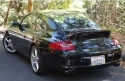
I have a 2003 996 Targa. I was rear-ended last year hard enough to knock the aftermarket stereo out of the dashboard. The external damage looked minor (see photos). It turned out that the internal "rails" that act as a frame were crushed inward an inch on the right and half an inch on the left. You can see that the right tailpipe extends more than the right one and that the rear panel has buckled a bit. It cost $12K to repair, which included removing and reinstalling the engine.
About 30k miles ago I had the LN Engineering IMS bearing installed. I only use Mobil 1 0W-40 and change the oil and filter at 2/3 the interval that Porsche recommends. At each oil change there has just been a little fuzz on the magnetic drain plug. I just changed my oil last weekend for the first time since getting hit. This time my drain plug was completely coated with flakes of metal in the 0.4 to 0.8 mm size range. I cut open my filter and saw more of the same.
Usually metal in a 996 engine is from the IMS bearing failing, but mine is now ceramic, so that shouldn't be it. Does anyone know how an accident might cause the metal flakes in the engine oil? Is there something like an engine dimension that I can measure to show that the accident caused engine damage. If it's from the accident, of course I'll have the other driver's insurance pay for it. I don't see coming up with $22K to have the engine rebuilt any time soon.
I'm not too hard on the engine for a Porsche. I only rev it about 4000 rpm after it's warmed up. Every day getting on the freeway I floor it and shift above 6000 rpm, but beyond that I keep it pretty tame and shoot for better gas mileage. I got to a few autocrosses each year, and I've never been on a track.
A rear end collision of sufficient violence to bend the sheet metal it did could have damaged the engine.
Was any of the rear sheet metal in contact with the engine? Were any of the engine's accessory drive hardware damaged? Any pulleys bent/twisted/damaged from contact with the metal behind the engine and between it an the rear bumper cover?
IMHO the shop should have noted the extent and severity of the damage and flagged the engine as needing tear down for inspection of any damage.
The problem is -- if I wanted to play the Devil's advocate here -- the problem is plenty of these engines manifest internal issues that result in metal swarf showing up without having suffered anything worse than just being used (and not even abused) so it would take some doing I think to show the engine's damage arose from the collision and not from just wear/tear.
Had the engine been removed and torn down immediately after the accident the inspection would have I'm sure been able to note what there was in the way of wear and where and spotted any damage that could have arisen from the forces from the impact.
It would help that the shop had seen other examples of these cars hit from behind and repaired them or at least had some experience in knowing when to declare the car a total loss due to high possibility the engine was damaged and required teardown and rebuilding to repair this damage were it found to exist.
Was any of the rear sheet metal in contact with the engine? Were any of the engine's accessory drive hardware damaged? Any pulleys bent/twisted/damaged from contact with the metal behind the engine and between it an the rear bumper cover?
There was no sheet metal contacting the engine that I could see. No pulleys rubbing. I drove it three hours home and it seemed fine.
I drove the car for 350 miles this week, then removed the magnetic drain plug to see if there were more flakes. Unfortunately there were. I wiped them off and took the photo below.
Well, the odds the accident did some engine damage goes down based on what you wrote.
But the continued presence of ferrous metal in the oil after not too many miles suggests something is not right in the engine.
You but you have already done what I would advised you to do and that is change the oil and filter, then run the engine some even drive the car some, and then remove the oil filter housing and examine the oil and the filter element and in this case the magnetic drain plug and based on what you find determines what you do next.
In this case based on what you see I'd advise you to consult with a trusted Porsche tech and ask his advice on how to proceed.
I would think any external damage from the collision, that caused internal damage, would be obvious during engine removal. Get it to a shop that knows these engines & have them remove the oil sump cover to inspect inside. Oil should be changed every 5,000 miles with something better than Mobil1.
@Macster: Who is your trusted Porsche tech in the SF Bay Area?
I have (had) several.
One trusted senior Porsche tech unfortunately left the dealer and went to another dealer, and a non Porsche dealer at that.
The 2nd one also left the dealer to take a job with an indy. I recently went to use him and found the job with the indy fell through and he was between jobs. He did the O2 sensors on my Turbo though -- at another shop where he was working -- and immediately after the job told me he was seriously considering taking a job with a Porsche dealer back east, so I do not know if he is still around.
While not as senior as the two techs I mentioned above, I have a lot of confidence in the shop lead tech at Porsche of Livermore, which is where I continue to have my Porsches serviced and repaired, well, except for the sensor job, which I just used this other tech just to touch base with I'm and catch up on what he had been up to since he left the dealer.
In case this tech is still around send me a private email and I'll put you in touch with him provided he's still in the area, of course.
On the other side of the bay, a bit closer to you than Livermore but not by much, I can recommend Pete at Rector Porsche in Burlingame. I haven't used him but I have talked to him several times -- once about a 996 engine he had apart fixing it from a failed IMSB -- and was really impressed with his knowledge and skill.
I have used Porsche of Santa Clara once or twice but not recently and not for any real serious engine work and I can't recommend anyone by name. You might stop in and ask the SM if you can speak with a senior tech and see if he could be of some help to you if you decided to bring the car in.
There is Jerry Woods Enterprises at 491 East McGlincy Lane in Campbell. You might stop in and speak with him and see if he can help you or recommend someone who can. While I have not ever met him, let alone have him work on my car, a co-worker had a 993 engine built by him and praised JW to the sky.
Well my local shop owner said "You're probably going to need a new engine. Just drive it." Others, including Jake Raby, said not to run it because it would just incur further damage and make the rebuild cost higher.
I thank Jake Raby for his many e-mail responses to my questions. As a PhD engineer, I really respect what he's doing: finding the M96/M97 failure modes and addressing them (which really was Porsche's job, but they dropped the ball on that one). In the end, shipping my car to Flat 6 for a few months or more (depending on their lead time) and spending $22K+ just wasn't possible for me right now, although I do believe that the result would be nearly bullet-proof. And I could have gone from 3.6 to 3.8 liters with new LNE Nickies cylinders for the same price.
I found a replacement rebuilt 996.2 X51 engine (more power and improved lubrication) at an engine builder in Illinois for $12K. I had my engine pulled by a different shop, in the San Jose, California area, who shipped my old engine in for the core for another $2K+. The engine builder opened up the engine and...surprise!...the LNE IMS bearing was quite wobbly. Apparently this shed some steel and caused wear of the crankshaft. Even though I caught the problem early, there was metal all over. I am told and have read online that many others with the LNE IMS bearings have had the exact same problem.
Now, you might ask, "How do steel flakes come from a ceramic bearing?" The answer is that it's not really a ceramic bearing; rather, it's a ceramic-coated steel bearing. And the ceramic wears off after a few tens of thousands of miles.
What finally convinced me to replace the original IMS bearing with the LNE bearing was the Porsche Club of America expert in Panorama magazine strongly recommending it. Now I feel really ripped off that I spent over $3K to have the LNE bearing installed, then another $14K to fix the damage apparently caused by the LNE bearing. I should have saved the $17K and done nothing. And I feel further cheated by LNE deciding a few months after I got my "IMS Retrofit TM" ball bearing that their ball bearing was really just a temporary solution--the permanent solution is the pressure-fed "IMS Solution TM".
I called LNE today and talked to one of their technical people. He wasn't very helpful. He said that there were a lot of things that could have gone wrong, like a loose timing chain, but not their IMS bearing. He also claimed that "It would have gone in the first few hundred miles" if it were going to go at all," which I don't buy.
My newly rebuilt engine will have roller bearings than ball bearings. This is a much better choice because the load is spread out far more, for a lower local stress where the rollers meet the races, resulting in less wear. That's why automobile wheel bearings are roller bearings. It uses splash lubrication of engine oil, just like the LNE ball bearing (the stock Porsche ball bearing is packed in grease, which sometimes gets washed away by oil leaks). I think that the IMS Solution will also be good, as it's a pressure-fed plain bearing like Porsche used on earlier generations of engines and really should have used in the M96 and M97 engines. Apparently there are only a few approved installers right now.
As a fellow 996 targa owner in San Jose, I feel your pain and hope this works out for you. I had a similar accident a year ago where a drunk driver hit the same panel, smashed in and the bill came close to 14k to repair.
Well my local shop owner said "You're probably going to need a new engine. Just drive it." Others, including Jake Raby, said not to run it because it would just incur further damage and make the rebuild cost higher.
I thank Jake Raby for his many e-mail responses to my questions. As a PhD engineer, I really respect what he's doing: finding the M96/M97 failure modes and addressing them (which really was Porsche's job, but they dropped the ball on that one). In the end, shipping my car to Flat 6 for a few months or more (depending on their lead time) and spending $22K+ just wasn't possible for me right now, although I do believe that the result would be nearly bullet-proof. And I could have gone from 3.6 to 3.8 liters with new LNE Nickies cylinders for the same price.
I found a replacement rebuilt 996.2 X51 engine (more power and improved lubrication) at an engine builder in Illinois for $12K. I had my engine pulled by a different shop, in the San Jose, California area, who shipped my old engine in for the core for another $2K+. The engine builder opened up the engine and...surprise!...the LNE IMS bearing was quite wobbly. Apparently this shed some steel and caused wear of the crankshaft. Even though I caught the problem early, there was metal all over. I am told and have read online that many others with the LNE IMS bearings have had the exact same problem.
Now, you might ask, "How do steel flakes come from a ceramic bearing?" The answer is that it's not really a ceramic bearing; rather, it's a ceramic-coated steel bearing. And the ceramic wears off after a few tens of thousands of miles.
What finally convinced me to replace the original IMS bearing with the LNE bearing was the Porsche Club of America expert in Panorama magazine strongly recommending it. Now I feel really ripped off that I spent over $3K to have the LNE bearing installed, then another $14K to fix the damage apparently caused by the LNE bearing. I should have saved the $17K and done nothing. And I feel further cheated by LNE deciding a few months after I got my "IMS Retrofit TM" ball bearing that their ball bearing was really just a temporary solution--the permanent solution is the pressure-fed "IMS Solution TM".
I called LNE today and talked to one of their technical people. He wasn't very helpful. He said that there were a lot of things that could have gone wrong, like a loose timing chain, but not their IMS bearing. He also claimed that "It would have gone in the first few hundred miles" if it were going to go at all," which I don't buy.
My newly rebuilt engine will have roller bearings than ball bearings. This is a much better choice because the load is spread out far more, for a lower local stress where the rollers meet the races, resulting in less wear. That's why automobile wheel bearings are roller bearings. It uses splash lubrication of engine oil, just like the LNE ball bearing (the stock Porsche ball bearing is packed in grease, which sometimes gets washed away by oil leaks). I think that the IMS Solution will also be good, as it's a pressure-fed plain bearing like Porsche used on earlier generations of engines and really should have used in the M96 and M97 engines. Apparently there are only a few approved installers right now.
DrMEMS, I am truly sorry to hear about your problems. But I thank you for sharing your experiences and thoughts. This is very informative.
A roller bearing in that application is not the best bearing. While wheel bearings -- at least in some cars -- are roller they are tapered/cone shaped to deal with side loads.
The IMS roller bearing won't be able to deal with side loads.
I couldn't agree more about the roller bearings being superior to the ball bearings. Can't comment about the side load talked about. But I would think that with roller/cylinder bearings if you have a catostrophic failure the roller bearings would still stay in place versus the ball bearing being shredded to pieces? I just know the next IMS update will be the cylinder/roller bearings for me.
Originally Posted by DrMEMS
Well my local shop owner said "You're probably going to need a new engine. Just drive it." Others, including Jake Raby, said not to run it because it would just incur further damage and make the rebuild cost higher.
I thank Jake Raby for his many e-mail responses to my questions. As a PhD engineer, I really respect what he's doing: finding the M96/M97 failure modes and addressing them (which really was Porsche's job, but they dropped the ball on that one). In the end, shipping my car to Flat 6 for a few months or more (depending on their lead time) and spending $22K+ just wasn't possible for me right now, although I do believe that the result would be nearly bullet-proof. And I could have gone from 3.6 to 3.8 liters with new LNE Nickies cylinders for the same price.
I found a replacement rebuilt 996.2 X51 engine (more power and improved lubrication) at an engine builder in Illinois for $12K. I had my engine pulled by a different shop, in the San Jose, California area, who shipped my old engine in for the core for another $2K+. The engine builder opened up the engine and...surprise!...the LNE IMS bearing was quite wobbly. Apparently this shed some steel and caused wear of the crankshaft. Even though I caught the problem early, there was metal all over. I am told and have read online that many others with the LNE IMS bearings have had the exact same problem.
Now, you might ask, "How do steel flakes come from a ceramic bearing?" The answer is that it's not really a ceramic bearing; rather, it's a ceramic-coated steel bearing. And the ceramic wears off after a few tens of thousands of miles.
What finally convinced me to replace the original IMS bearing with the LNE bearing was the Porsche Club of America expert in Panorama magazine strongly recommending it. Now I feel really ripped off that I spent over $3K to have the LNE bearing installed, then another $14K to fix the damage apparently caused by the LNE bearing. I should have saved the $17K and done nothing. And I feel further cheated by LNE deciding a few months after I got my "IMS Retrofit TM" ball bearing that their ball bearing was really just a temporary solution--the permanent solution is the pressure-fed "IMS Solution TM".
I called LNE today and talked to one of their technical people. He wasn't very helpful. He said that there were a lot of things that could have gone wrong, like a loose timing chain, but not their IMS bearing. He also claimed that "It would have gone in the first few hundred miles" if it were going to go at all," which I don't buy.
My newly rebuilt engine will have roller bearings than ball bearings. This is a much better choice because the load is spread out far more, for a lower local stress where the rollers meet the races, resulting in less wear. That's why automobile wheel bearings are roller bearings. It uses splash lubrication of engine oil, just like the LNE ball bearing (the stock Porsche ball bearing is packed in grease, which sometimes gets washed away by oil leaks). I think that the IMS Solution will also be good, as it's a pressure-fed plain bearing like Porsche used on earlier generations of engines and really should have used in the M96 and M97 engines. Apparently there are only a few approved installers right now.




 LN IMS Bearing Is Wobbly
 . Apparently this shed some steel and caused wear of the crankshaft. Even though I caught the problem early, there was metal all over. I am told and have read online that many others with the LNE IMS bearings have had the exact same problem.