


Talk to me about headers.


Registered User
Joined: Dec 2006
Posts: 3,116
From: Palos Verdes
Rep Power: 256


To OP -- see the thread that bbywu quoted above. Header is a complex component and requires matching with the rest of your setup, including your ECU tune. Some argue a re-tune of the ECU after adding header. I most definitely would not just grab randomly a FVD header, or any header for that matter, and add to your setup. Go with what your Protomotive tuner tells you (I am sure he's not going to use FVD header.). And NO, don't grab a header based on "look"!!! (Or sound.)
The header should NOT be the first component in your power upgrade. The most typically recommended path is exhaust, ECU, intercooler, and maybe header later on down the upgrade path.
A header shifts the power band (see below) and may not always be beneficial, depending on your driving style, engine power, etc.
>>>>>>>>>>>>>>>>>>>
http://en.wikipedia.org/wiki/Manifold_(automotive_engineering)
Great care must be used when selecting the length and diameter of the primary tubes. Tubes that are too large will cause the exhaust gas to expand and slow down, decreasing the scavenging effect. Tubes that are too small will create backpressure against which the engine must work to expel the exhaust gas from the chamber, reducing power and leaving exhaust in the chamber to dilute the incoming intake charge. Since engines produce more exhaust gas at higher speeds, the header(s) are tuned to a particular engine speed range according to the intended application. Typically, wide primary tubes offer the best gains in power and torque at higher engine speeds, while narrow tubes offer the best gains at lower speeds.
The header should NOT be the first component in your power upgrade. The most typically recommended path is exhaust, ECU, intercooler, and maybe header later on down the upgrade path.
A header shifts the power band (see below) and may not always be beneficial, depending on your driving style, engine power, etc.
>>>>>>>>>>>>>>>>>>>
http://en.wikipedia.org/wiki/Manifold_(automotive_engineering)
Great care must be used when selecting the length and diameter of the primary tubes. Tubes that are too large will cause the exhaust gas to expand and slow down, decreasing the scavenging effect. Tubes that are too small will create backpressure against which the engine must work to expel the exhaust gas from the chamber, reducing power and leaving exhaust in the chamber to dilute the incoming intake charge. Since engines produce more exhaust gas at higher speeds, the header(s) are tuned to a particular engine speed range according to the intended application. Typically, wide primary tubes offer the best gains in power and torque at higher engine speeds, while narrow tubes offer the best gains at lower speeds.
Last edited by cannga; Feb 28, 2010 at 08:53 AM.


With the regards to "stages of power", and since we don't have a "stage 1" package, you will not find significant gains under 650hp - the break line on where our packages include headers.
We can do them in polished or ceramic coat:


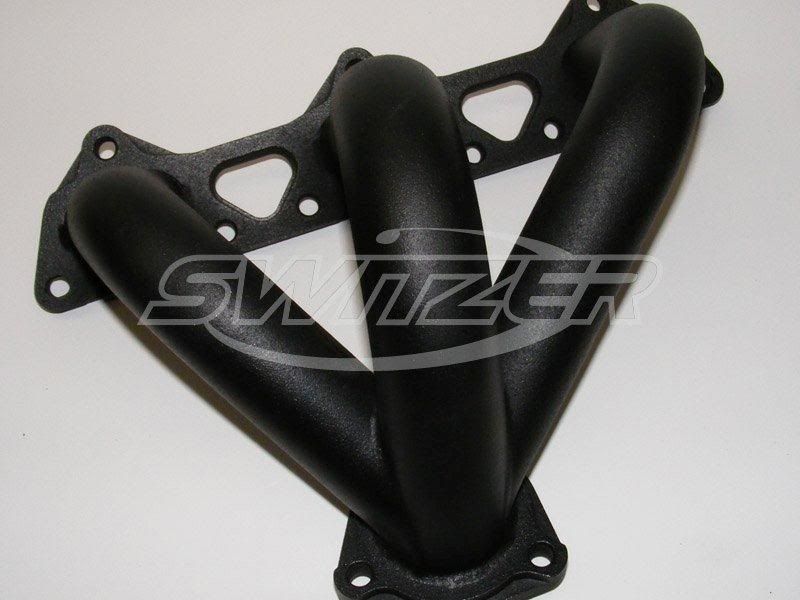
These are good for well over 1100hp, as well.
We can do them in polished or ceramic coat:
These are good for well over 1100hp, as well.

Registered User
Joined: Jun 2007
Posts: 778
From: Livermore>Fremont, CA
Rep Power: 204
It is all about the routing of the exhaust pulse through the manifold, think about it, equal length manifolds with allow the engine to be more efficient than a log style manifold.

Thread
Thread Starter
Forum
Replies
Last Post
sdg1871
991 Turbo
267
Dec 24, 2015 12:22 PM
C5tt
Automotive Parts & Accessories For Sale/Wanted
5
Oct 24, 2015 07:35 PM

