


Engine Limits vs Power -- Sharing Some Knowledge


Moderator


Joined: Jul 2003
Posts: 22,235
Rep Power: 1227


speed, I have a little time so here is a partial reply to your questions.
Actually, the Porsche motor does not have a block with bores. It is a split case with liners. The principle method of cooling is the liner oil squirters, unlike block motors. The crank is not offset. The two banks oppose each other at 180 degrees. This is one reason why these motors are very stable at certain rpm's and tend to tear themselves apart after certain rpm's.
The purpose for offsetting the wrist pin is to provide a straighter rod line at a certain important portion of the rod cycle. An additional benefit of this procedure allows for a slightly longer rod length which in conjunction with stroking the crank allows for a slower piston speed (piston/rod ratio).
No, the crank is not off set.
The banks are off set to opposite sides.
As stated above the purpose of the offset is to provide a straight line between the piston/rod at the point where liner pressure is the greatest.
We are able to make other advantageous adjustments, however, testing proved that without other adjustments power was gained. It was nt a great amount in the overall scheme of things. What is note worthy, in the grand scheme of things, this allowed for other modifications which provided power gains that were not previously attainable. I guess it can best be described as removing another weak link.
Our compression ratio is higher than 9:4-1 and our advance is far greater than advance being used by anyone we know. Here is a picture of our 105.7 mm pistons.
Look at the right side of the inside wrist pin bore. Now look at the left. The off set is between 2 and 4 mm, That is as much as I'm going to say. I hope you understand.

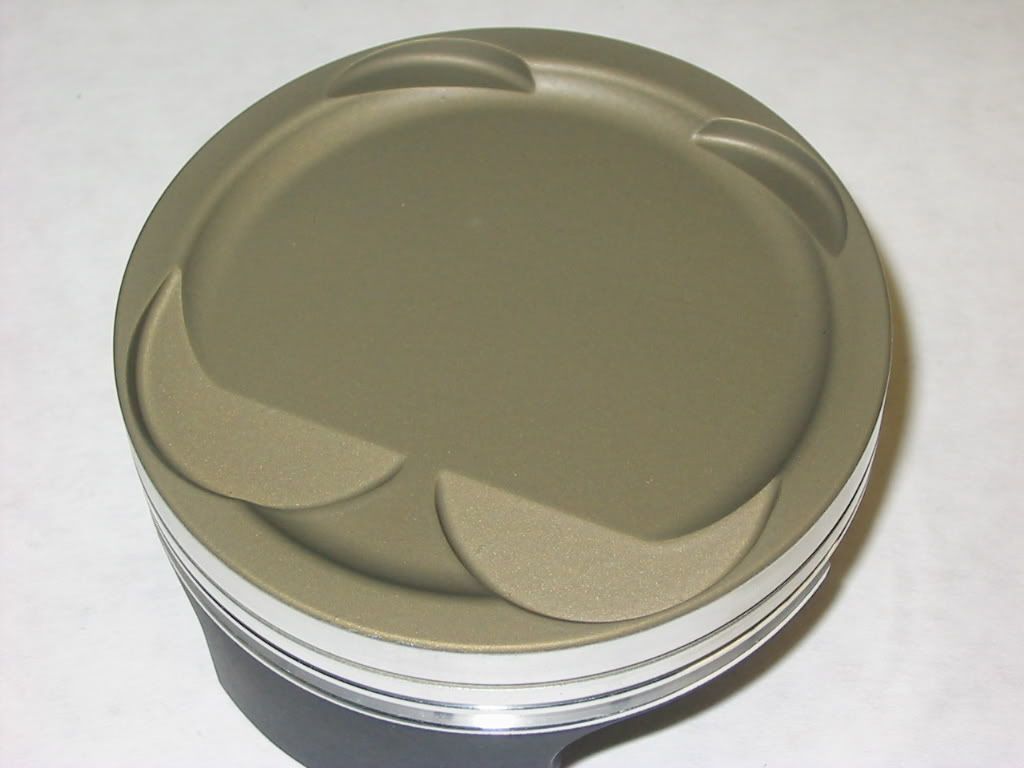
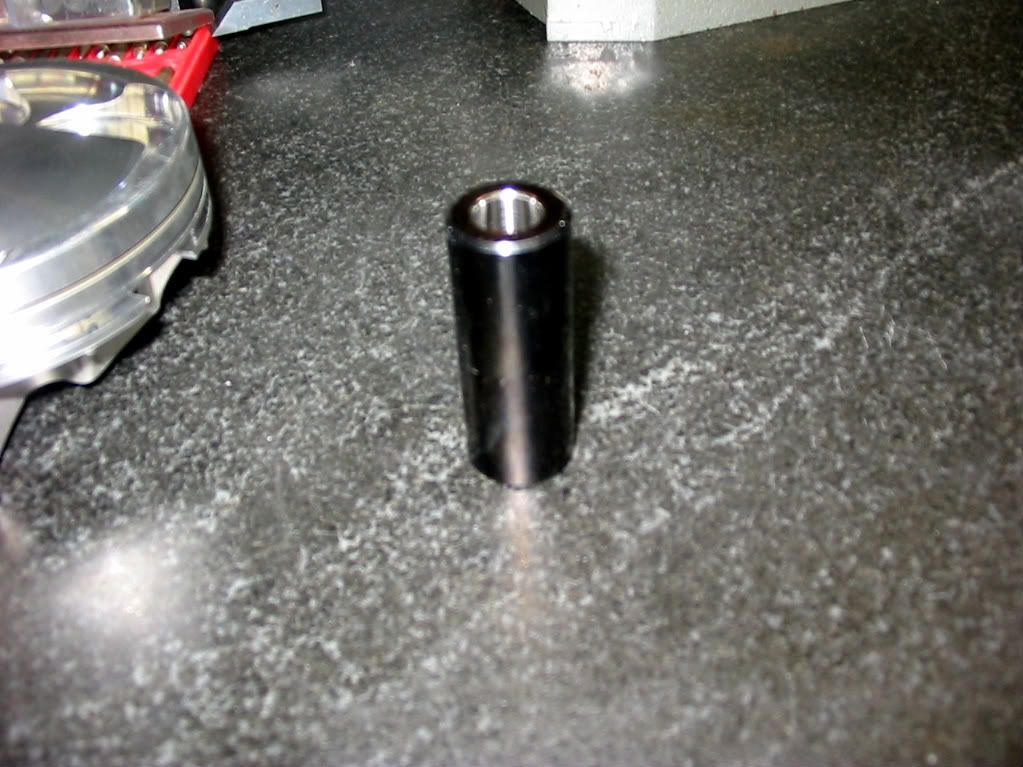
If the crank is not central in the block then that is true. However, I am not aware of the position of the crank in a porsche block at this stage to comment.
However, in fundamental principle the thrust face of the piston onto the liner is the better performing position. Relieving the thrust face by using an offset pin does make the engine run quieter and smoother....but to a lesser degree, but the smoothness is also dictated by other things as well such as tuning of the advance ignition curve, skirt/piston design etc. This is possibly where you may be achieving a degree of the "smoothness" you refer to.
You are saying the crank is offset in the Porsche block then?
Also, you are saying that you have one bank of pistons with the opposing sides/skirts (non thrust side that is) being positioned onto the liner in favor of the correct thrust side of the piston? That is not a very desirable situation at all. Running the pistons back the front (eg offsetting the position of the pin to the upper side off centre) will cause the non thrust side/skirt face to drag and slap back onto the liner after combustion on downstroke. That can/will crack the skirts. I wouldnt be doing that at all  .
.
.
As i said previously. The basic principle of running an offset (correct offset...not back the front that is) is to quiten the engine, and yes it will achieve a degree of smoothness in that process....true. But fundamentally a central pinned piston performs better as it places the correct thrust side of the piston against the liner in the right direction.
To be honest cjv and with all due respect i just cant see it but then again my core knowledge is not from being directly involved in piston design. Are you absolutely certain there were no other adjustments made in the tuning of the ecu, boost and so forth?
May i ask what your compression ratio and advance curve is?
Look at the right side of the inside wrist pin bore. Now look at the left. The off set is between 2 and 4 mm, That is as much as I'm going to say. I hope you understand.
Last edited by cjv; Apr 30, 2011 at 09:58 PM.

Banned
Joined: Feb 2010
Posts: 2,634
Rep Power: 249
speed, I have a little time so here is a partial reply to your questions.
Actually, the Porsche motor does not have a block with bores. It is a split case with liners. The principle method of cooling is the liner oil squirters, unlike block motors. The crank is not offset. The two banks oppose each other at 180 degrees. This is one reason why these motors are very stable at certain rpm's and tend to tear themselves apart after certain rpm's.
The purpose for offsetting the wrist pin is to provide a straighter rod line at a certain important portion of the rod cycle. An additional benefit of this procedure allows for a slightly longer rod length which in conjunction with stroking the crank allows for a slower piston speed (piston/rod ratio).
 . But it'd be good to hear the result, minimal as it may well be.
Here's a link of a porsche engine i found on the web for those members who wish to see how it works in action: http://www.hillmanimages.com/912/912_fig_130.html
No, the crank is not off set.
The banks are off set to opposite sides.
As stated above the purpose of the offset is to provide a straight line between the piston/rod at the point where liner pressure is the greatest.
We are able to make other advantageous adjustments, however, testing proved that without other adjustments power was gained. It was nt a great amount in the overall scheme of things. What is note worthy, in the grand scheme of things, this allowed for other modifications which provided power gains that were not previously attainable. I guess it can best be described as removing another weak link.
At the end of the day any gain, no matter how small it may well have been, is a gain
 . Cjv would you mind PMing how many hp you are talking?.
Our compression ratio is higher than 9:4-1 and our advance is far greater than advance being used by anyone we know. Here is a picture of our 105.7 mm pistons.
Look at the right side of the inside wrist pin bore. Now look at the left. The off set is between 2 and 4 mm, That is as much as I'm going to say. I hope you understand.
PS. I noticed by your photos these pistons appear ultra light in skirt design. Are they forged or cast? Also you mentioned oil squirters for the liners. Just to confrm, are these pistons gallery cooled in the crowns?
Last edited by speed21; May 1, 2011 at 07:39 AM.

Cjv I have no commercial interest in what you are doing so no need to worry. Thanks for the discussion though. 
PS. I noticed by your photos these pistons appear ultra light in skirt design. Are they forged or cast? Also you mentioned oil squirters for the liners. Just to confrm, are these pistons gallery cooled in the crowns?
PS. I noticed by your photos these pistons appear ultra light in skirt design. Are they forged or cast? Also you mentioned oil squirters for the liners. Just to confrm, are these pistons gallery cooled in the crowns?
Moderator
Joined: Jul 2003
Posts: 22,235
Rep Power: 1227
Chad,
I know from talking to Neil that your build was to include increasing the width of the engine. He told me that was scraped due to the longer chain not working out. He showed me the longer chains sometime ago and told me they were too long and that a new Link length would be required. Adding the link was too long and the tensioners etc would all have to be redesigned. But the idea was never forgotten. So you have some special Rods in your engine I'm told. He told me your Rod length and the stroke. I am not sure how this all works. I figure he made the Pistons without rings. Your Rods are as long as Porsche runs in the Cup engines with a far shorter stroke. And lighter. They must have no bolts and held together with tyraps.
I was there this week and I saw what he has been working on and off on for a couple of years.
Heres an update. I asked if I could let the world know this and got a smerk out of a normally straight faced person. So here goes.
It uses Porsche Heads and Valve Train, Liners and Liner Housings, the Oil pump is on the outside, and it has to be now called a V6 as its not flat. It's tiny. This has been in the works for a long time. This is something he wanted to do way back in the 962C IMSA days. I wish he would finish it but it gets second fiddle as the customer work has to come first.
I know from talking to Neil that your build was to include increasing the width of the engine. He told me that was scraped due to the longer chain not working out. He showed me the longer chains sometime ago and told me they were too long and that a new Link length would be required. Adding the link was too long and the tensioners etc would all have to be redesigned. But the idea was never forgotten. So you have some special Rods in your engine I'm told. He told me your Rod length and the stroke. I am not sure how this all works. I figure he made the Pistons without rings. Your Rods are as long as Porsche runs in the Cup engines with a far shorter stroke. And lighter. They must have no bolts and held together with tyraps.
I was there this week and I saw what he has been working on and off on for a couple of years.
Heres an update. I asked if I could let the world know this and got a smerk out of a normally straight faced person. So here goes.
It uses Porsche Heads and Valve Train, Liners and Liner Housings, the Oil pump is on the outside, and it has to be now called a V6 as its not flat. It's tiny. This has been in the works for a long time. This is something he wanted to do way back in the 962C IMSA days. I wish he would finish it but it gets second fiddle as the customer work has to come first.
This motor when finally revealed will put conventional Porsche thinking regarding power and response on it's ear.
Moderator
Joined: Jul 2003
Posts: 22,235
Rep Power: 1227
Cjv I have no commercial interest in what you are doing so no need to worry. Thanks for the discussion though.
PS. I noticed by your photos these pistons appear ultra light in skirt design. Are they forged or cast? Also you mentioned oil squirters for the liners. Just to confrm, are these pistons gallery cooled in the crowns?
PS. I noticed by your photos these pistons appear ultra light in skirt design. Are they forged or cast? Also you mentioned oil squirters for the liners. Just to confrm, are these pistons gallery cooled in the crowns?
Forged. Yes, there is cooling in the pistons. However, the oil liner squirters have nothing to do with the other system we utilize to remove heat from the pistons. I will post a picture later that will show stock versus 962 oil squirters. Below is what we went through to have the pistons and rods mocked up prior to building. The rods and pistons were CAD designed and then made up in some type of plastic to be assembled, checked (for space and tolerances)and verified. Everything was custom designed by Neil Harvey of Performance Developments to make the most of available space.


Last edited by cjv; May 1, 2011 at 11:04 AM.
Moderator
Joined: Jul 2003
Posts: 22,235
Rep Power: 1227
I requested Neil Harvey to comment on this thread as it relates to bent rods. Neil has decades of experience which includes Porsche Motorsports, F1 experience with a team that won two Championships and many years as the owner or Performance Developments. Neil is also responsible for many of the innovations and work on my project ............. Killer Angel.
I don't intend this to be a question and answer post as Neil was gratious enough to spend his time on this input. Please respect this. If you disagree, that is fine, it is your right.
Chad,
I'll answer the questions below.
I did read the whole thing about the Rods bending. Typically Rods bend under high Cylinder pressure caused by the Rod strength being less than the forces put upon them. Detonation causes huge spikes in Cylinder Pressure and can cause the Rods to bend, but often other signs are also present. Erosion of the Piston, broken Rings etc. The Rings break from the shock, and the Pistons fail due to shock waves and the excessive heat generated within the shock waves.
Rods spend most of their time at an angle to the Crank pin. The only times they are straight is at BDC and TDC. The greatest cylinder pressure occurs after TDC unless you have a huge amount of advanced timing that causes the fuel to ignite prematurely. That is so basic to understand. If the cylinder pressure was greater before TDC, the engine would stop turning and turn backwards. That is why often when the timing is so far advanced, the engine wants to turn backwards when cranked.
Rod strength can be calculated. It has to be, otherwise we would have no way of deciding upon what to use. It is easy when you go to a Rod manufacturer and ask for a set of rods to fit a certain engine. They will sell you a Rod based upon a design that works, but so often is over designed for the application. Remember in your case Chad, we had to design it to clear the Pump with the added stroke, include Pin oiling and supply the lightest Rod possible.
The cause of Rods bending under load is basically caused by the pressure rise in the Cylinder happening quicker than the Rod speed. Two things work against you here. Maximum Torque occurs at a lower engine speed and at the lower engine speed, the rod speed is lower. As engine speed increases the Torque drops due to friction, other rotating losses and the engines inability to pump air due to the event times getting smaller due to engine RPM's. Because the Rod cannot accelerate as quick as the pressure rise occurs, something has to give. I can tell you, if you could see inside your engine when this occurs, it's not the Rod bending that would scare you. It's the amount the Crankshaft flexes and how out of round the Rods Big end bore becomes. You remember we changed your bearings to help this. In reading and looking at the photos of the Pistons shown, I can tell you there are other signs that will be there that tell what and how it happened. Most probably the Rods bent because of what I have stated above. The shop said there were no signs of detonation and the Piston crowns seem to show this. However, there are things to look for that will show what was happening. I have no idea in this case as I do not have the parts to inspect. Liner wear, Liner surface changes, Ring wear, Piston shape, Bearing wear etc. All of these can show where and at what angle the maximum pressure occurred and working back from these signs can give good cause and failure analysis.
So in reading all of the written posts about the Rods bending, it's a subject that has many reasons. Since becoming involved in your project, I have often read what has been written. There are a lot of "experts" out there with a whole lot more "knowledge" than me it appears. When I'm made to feel dumb, I read and listen more than I speak.
To answer the questions about Piston Pins, I found this explaination in my files. It describes the reasons better than I can. Hope this helps.
Modern engine pistons are not mounted on their connecting rods exactly on center. They are offset radially, that is, perpendicular to their rotational axis. In other words, in a vertical, single-cylinder engine, the piston is offset toward the exhaust side of the cylinder. That is, the piston pin hole is bored off center toward the intake side, usually less than 1 millimeter. It is frequently stated with a sort of bored complacency that the purpose of this offset is to reduce piston slap. The truth is, while piston slap is reduced through piston pin offset, but that is not the purpose of the technology.
The piston engine has three major parts: crankshaft, connecting rod, and piston. Each has a different job to do. The reciprocating part -- the piston -- makes the crankshaft -- the rotating part, uhh, rotate. The connecting rod is simply the part in the middle. It translates the piston's recip motion into the crankshaft rotary motion. The neat thing is that in the process, it shares in the motion of both. That is, the connecting rod is both a reciprocating part and a rotational part, at the same time. (In fact, when balancing an engine, it is common to divide the connecting rod's weight in two, thus permitting half its weight to be calculated as recip and half as rotation.) The point is, the upper half of the connecting rod reciprocates with the piston, the lower half rotates with the crankshaft, and this is important to understanding the stresses on all three parts, but especially those on the connecting rod.
The piston and its half of the connecting rod stops twice per crankshaft revolution, even though the crankshaft continues to turn. This means the piston and top of the rod also start back up twice. This stopping and starting imposes stresses on all three of the parts, stresses that increase with crankshaft rpm. To reduce these loads, the piston is mounted to the connecting rod slightly offset. This causes the piston to reach top dead center at a different time than the connecting rod, effectively spreading the shock loading over a greater number of crankshaft degrees. In short, the real reason for piston pin offset is that it softens reciprocal loading, permitting lighter more power-efficient parts to be used, and the engines to be capable of higher rpm.
However, there is another phenomenon at work also, a kind of side benefit. Because the connecting rod spends most of its time in the engine at an angle, the piston engine has what is called minor and major thrust. Major thrust refers to the downward-stroking piston's force against the cylinder wall during combustion, due to the rod being angled in that direction. Minor thrust is the piston's thrust against the opposite cylinder wall during compression, because the rod's angle is opposite also. These thrust forces push the piston firmly against the cylinder wall. The important thing is that at TDC, they flip-flop. Major thrust turns into minor thrust, and visa-versa. In older engines, this flip-flop caused the piston smack the cylinder, resulting in a noise. Fortunately, the piston pin offset in today's engines, besides reducing inertia stresses, does two things that reduce this noise. First, because the piston is mounted off center, the transition from major to minor thrust is less sudden. There is less impact. Second, instead of a sudden lateral shift, the piston actually rolls from major to minor thrust. That is, the piston shifts first at the skirt, then gradually the rest of the piston makes contact, instead of all of the piston at once.
To summarize, piston pin offset is the manufacturer's way of reducing stress on reciprocating parts. It permits these parts to be lighter, which results in more efficient manufacture and less power loss in the engine, as well as higher rpm. A complementary result of piston pin offset is reduced piston slap due to the more gradual shift from major to minor thrust.
nh
I don't intend this to be a question and answer post as Neil was gratious enough to spend his time on this input. Please respect this. If you disagree, that is fine, it is your right.
Chad,
I'll answer the questions below.
I did read the whole thing about the Rods bending. Typically Rods bend under high Cylinder pressure caused by the Rod strength being less than the forces put upon them. Detonation causes huge spikes in Cylinder Pressure and can cause the Rods to bend, but often other signs are also present. Erosion of the Piston, broken Rings etc. The Rings break from the shock, and the Pistons fail due to shock waves and the excessive heat generated within the shock waves.
Rods spend most of their time at an angle to the Crank pin. The only times they are straight is at BDC and TDC. The greatest cylinder pressure occurs after TDC unless you have a huge amount of advanced timing that causes the fuel to ignite prematurely. That is so basic to understand. If the cylinder pressure was greater before TDC, the engine would stop turning and turn backwards. That is why often when the timing is so far advanced, the engine wants to turn backwards when cranked.
Rod strength can be calculated. It has to be, otherwise we would have no way of deciding upon what to use. It is easy when you go to a Rod manufacturer and ask for a set of rods to fit a certain engine. They will sell you a Rod based upon a design that works, but so often is over designed for the application. Remember in your case Chad, we had to design it to clear the Pump with the added stroke, include Pin oiling and supply the lightest Rod possible.
The cause of Rods bending under load is basically caused by the pressure rise in the Cylinder happening quicker than the Rod speed. Two things work against you here. Maximum Torque occurs at a lower engine speed and at the lower engine speed, the rod speed is lower. As engine speed increases the Torque drops due to friction, other rotating losses and the engines inability to pump air due to the event times getting smaller due to engine RPM's. Because the Rod cannot accelerate as quick as the pressure rise occurs, something has to give. I can tell you, if you could see inside your engine when this occurs, it's not the Rod bending that would scare you. It's the amount the Crankshaft flexes and how out of round the Rods Big end bore becomes. You remember we changed your bearings to help this. In reading and looking at the photos of the Pistons shown, I can tell you there are other signs that will be there that tell what and how it happened. Most probably the Rods bent because of what I have stated above. The shop said there were no signs of detonation and the Piston crowns seem to show this. However, there are things to look for that will show what was happening. I have no idea in this case as I do not have the parts to inspect. Liner wear, Liner surface changes, Ring wear, Piston shape, Bearing wear etc. All of these can show where and at what angle the maximum pressure occurred and working back from these signs can give good cause and failure analysis.
So in reading all of the written posts about the Rods bending, it's a subject that has many reasons. Since becoming involved in your project, I have often read what has been written. There are a lot of "experts" out there with a whole lot more "knowledge" than me it appears. When I'm made to feel dumb, I read and listen more than I speak.
To answer the questions about Piston Pins, I found this explaination in my files. It describes the reasons better than I can. Hope this helps.
Modern engine pistons are not mounted on their connecting rods exactly on center. They are offset radially, that is, perpendicular to their rotational axis. In other words, in a vertical, single-cylinder engine, the piston is offset toward the exhaust side of the cylinder. That is, the piston pin hole is bored off center toward the intake side, usually less than 1 millimeter. It is frequently stated with a sort of bored complacency that the purpose of this offset is to reduce piston slap. The truth is, while piston slap is reduced through piston pin offset, but that is not the purpose of the technology.
The piston engine has three major parts: crankshaft, connecting rod, and piston. Each has a different job to do. The reciprocating part -- the piston -- makes the crankshaft -- the rotating part, uhh, rotate. The connecting rod is simply the part in the middle. It translates the piston's recip motion into the crankshaft rotary motion. The neat thing is that in the process, it shares in the motion of both. That is, the connecting rod is both a reciprocating part and a rotational part, at the same time. (In fact, when balancing an engine, it is common to divide the connecting rod's weight in two, thus permitting half its weight to be calculated as recip and half as rotation.) The point is, the upper half of the connecting rod reciprocates with the piston, the lower half rotates with the crankshaft, and this is important to understanding the stresses on all three parts, but especially those on the connecting rod.
The piston and its half of the connecting rod stops twice per crankshaft revolution, even though the crankshaft continues to turn. This means the piston and top of the rod also start back up twice. This stopping and starting imposes stresses on all three of the parts, stresses that increase with crankshaft rpm. To reduce these loads, the piston is mounted to the connecting rod slightly offset. This causes the piston to reach top dead center at a different time than the connecting rod, effectively spreading the shock loading over a greater number of crankshaft degrees. In short, the real reason for piston pin offset is that it softens reciprocal loading, permitting lighter more power-efficient parts to be used, and the engines to be capable of higher rpm.
However, there is another phenomenon at work also, a kind of side benefit. Because the connecting rod spends most of its time in the engine at an angle, the piston engine has what is called minor and major thrust. Major thrust refers to the downward-stroking piston's force against the cylinder wall during combustion, due to the rod being angled in that direction. Minor thrust is the piston's thrust against the opposite cylinder wall during compression, because the rod's angle is opposite also. These thrust forces push the piston firmly against the cylinder wall. The important thing is that at TDC, they flip-flop. Major thrust turns into minor thrust, and visa-versa. In older engines, this flip-flop caused the piston smack the cylinder, resulting in a noise. Fortunately, the piston pin offset in today's engines, besides reducing inertia stresses, does two things that reduce this noise. First, because the piston is mounted off center, the transition from major to minor thrust is less sudden. There is less impact. Second, instead of a sudden lateral shift, the piston actually rolls from major to minor thrust. That is, the piston shifts first at the skirt, then gradually the rest of the piston makes contact, instead of all of the piston at once.
To summarize, piston pin offset is the manufacturer's way of reducing stress on reciprocating parts. It permits these parts to be lighter, which results in more efficient manufacture and less power loss in the engine, as well as higher rpm. A complementary result of piston pin offset is reduced piston slap due to the more gradual shift from major to minor thrust.
nh
Last edited by cjv; May 1, 2011 at 08:55 PM.



Banned
Joined: Feb 2010
Posts: 2,634
Rep Power: 249
I requested Neil Harvey to comment on this thread as it relates to bent rods. Neil has decades of experience which includes Porsche Motorsports, F1 experience with a team that won two Championships and many years as the owner or Performance Developments. Neil is also responsible for many of the innovations and work on my project ............. Killer Angel.
I don't intend this to be a question and answer post as Neil was gratious enough to spend his time on this input. Please respect this. If you disagree, that is fine, it is your right.
Chad,
I'll answer the questions below.
I did read the whole thing about the Rods bending. Typically Rods bend under high Cylinder pressure caused by the Rod strength being less than the forces put upon them. Detonation causes huge spikes in Cylinder Pressure and can cause the Rods to bend, but often other signs are also present. Erosion of the Piston, broken Rings etc. The Rings break from the shock, and the Pistons fail due to shock waves and the excessive heat generated within the shock waves.
Rods spend most of their time at an angle to the Crank pin. The only times they are straight is at BDC and TDC. The greatest cylinder pressure occurs after TDC unless you have a huge amount of advanced timing that causes the fuel to ignite prematurely. That is so basic to understand. If the cylinder pressure was greater before TDC, the engine would stop turning and turn backwards. That is why often when the timing is so far advanced, the engine wants to turn backwards when cranked.
Rod strength can be calculated. It has to be, otherwise we would have no way of deciding upon what to use. It is easy when you go to a Rod manufacturer and ask for a set of rods to fit a certain engine. They will sell you a Rod based upon a design that works, but so often is over designed for the application. Remember in your case Chad, we had to design it to clear the Pump with the added stroke, include Pin oiling and supply the lightest Rod possible.
The cause of Rods bending under load is basically caused by the pressure rise in the Cylinder happening quicker than the Rod speed. Two things work against you here. Maximum Torque occurs at a lower engine speed and at the lower engine speed, the rod speed is lower. As engine speed increases the Torque drops due to friction, other rotating losses and the engines inability to pump air due to the event times getting smaller due to engine RPM's. Because the Rod cannot accelerate as quick as the pressure rise occurs, something has to give. I can tell you, if you could see inside your engine when this occurs, it's not the Rod bending that would scare you. It's the amount the Crankshaft flexes and how out of round the Rods Big end bore becomes. You remember we changed your bearings to help this. In reading and looking at the photos of the Pistons shown, I can tell you there are other signs that will be there that tell what and how it happened. Most probably the Rods bent because of what I have stated above. The shop said there were no signs of detonation and the Piston crowns seem to show this. However, there are things to look for that will show what was happening. I have no idea in this case as I do not have the parts to inspect. Liner wear, Liner surface changes, Ring wear, Piston shape, Bearing wear etc. All of these can show where and at what angle the maximum pressure occurred and working back from these signs can give good cause and failure analysis.
So in reading all of the written posts about the Rods bending, it's a subject that has many reasons. Since becoming involved in your project, I have often read what has been written. There are a lot of "experts" out there with a whole lot more "knowledge" than me it appears. When I'm made to feel dumb, I read and listen more than I speak.
To answer the questions about Piston Pins, I found this explaination in my files. It descibes the reasons better than I can. Hope this helps.
Modern engine pistons are not mounted on their connecting rods exactly on center. They are offset radially, that is, perpendicular to their rotational axis. In other words, in a vertical, single-cylinder engine, the piston is offset toward the exhaust side of the cylinder. That is, the piston pin hole is bored off center toward the intake side, usually less than 1 millimeter. It is frequently stated with a sort of bored complacency that the purpose of this offset is to reduce piston slap. The truth is, while piston slap is reduced through piston pin offset, but that is not the purpose of the technology.
The piston engine has three major parts: crankshaft, connecting rod, and piston. Each has a different job to do. The reciprocating part -- the piston -- makes the crankshaft -- the rotating part, uhh, rotate. The connecting rod is simply the part in the middle. It translates the piston's recip motion into the crankshaft rotary motion. The neat thing is that in the process, it shares in the motion of both. That is, the connecting rod is both a reciprocating part and a rotational part, at the same time. (In fact, when balancing an engine, it is common to divide the connecting rod's weight in two, thus permitting half its weight to be calculated as recip and half as rotation.) The point is, the upper half of the connecting rod reciprocates with the piston, the lower half rotates with the crankshaft, and this is important to understanding the stresses on all three parts, but especially those on the connecting rod.
The piston and its half of the connecting rod stops twice per crankshaft revolution, even though the crankshaft continues to turn. This means the piston and top of the rod also start back up twice. This stopping and starting imposes stresses on all three of the parts, stresses that increase with crankshaft rpm. To reduce these loads, the piston is mounted to the connecting rod slightly offset. This causes the piston to reach top dead center at a different time than the connecting rod, effectively spreading the shock loading over a greater number of crankshaft degrees. In short, the real reason for piston pin offset is that it softens reciprocal loading, permitting lighter more power-efficient parts to be used, and the engines to be capable of higher rpm.
However, there is another phenomenon at work also, a kind of side benefit. Because the connecting rod spends most of its time in the engine at an angle, the piston engine has what is called minor and major thrust. Major thrust refers to the downward-stroking piston's force against the cylinder wall during combustion, due to the rod being angled in that direction. Minor thrust is the piston's thrust against the opposite cylinder wall during compression, because the rod's angle is opposite also. These thrust forces push the piston firmly against the cylinder wall. The important thing is that at TDC, they flip-flop. Major thrust turns into minor thrust, and visa-versa. In older engines, this flip-flop caused the piston smack the cylinder, resulting in a noise. Fortunately, the piston pin offset in today's engines, besides reducing inertia stresses, does two things that reduce this noise. First, because the piston is mounted off center, the transition from major to minor thrust is less sudden. There is less impact. Second, instead of a sudden lateral shift, the piston actually rolls from major to minor thrust. That is, the piston shifts first at the skirt, then gradually the rest of the piston makes contact, instead of all of the piston at once.
To summarize, piston pin offset is the manufacturer's way of reducing stress on reciprocating parts. It permits these parts to be lighter, which results in more efficient manufacture and less power loss in the engine, as well as higher rpm. A complementary result of piston pin offset is reduced piston slap due to the more gradual shift from major to minor thrust.
nh
I don't intend this to be a question and answer post as Neil was gratious enough to spend his time on this input. Please respect this. If you disagree, that is fine, it is your right.
Chad,
I'll answer the questions below.
I did read the whole thing about the Rods bending. Typically Rods bend under high Cylinder pressure caused by the Rod strength being less than the forces put upon them. Detonation causes huge spikes in Cylinder Pressure and can cause the Rods to bend, but often other signs are also present. Erosion of the Piston, broken Rings etc. The Rings break from the shock, and the Pistons fail due to shock waves and the excessive heat generated within the shock waves.
Rods spend most of their time at an angle to the Crank pin. The only times they are straight is at BDC and TDC. The greatest cylinder pressure occurs after TDC unless you have a huge amount of advanced timing that causes the fuel to ignite prematurely. That is so basic to understand. If the cylinder pressure was greater before TDC, the engine would stop turning and turn backwards. That is why often when the timing is so far advanced, the engine wants to turn backwards when cranked.
Rod strength can be calculated. It has to be, otherwise we would have no way of deciding upon what to use. It is easy when you go to a Rod manufacturer and ask for a set of rods to fit a certain engine. They will sell you a Rod based upon a design that works, but so often is over designed for the application. Remember in your case Chad, we had to design it to clear the Pump with the added stroke, include Pin oiling and supply the lightest Rod possible.
The cause of Rods bending under load is basically caused by the pressure rise in the Cylinder happening quicker than the Rod speed. Two things work against you here. Maximum Torque occurs at a lower engine speed and at the lower engine speed, the rod speed is lower. As engine speed increases the Torque drops due to friction, other rotating losses and the engines inability to pump air due to the event times getting smaller due to engine RPM's. Because the Rod cannot accelerate as quick as the pressure rise occurs, something has to give. I can tell you, if you could see inside your engine when this occurs, it's not the Rod bending that would scare you. It's the amount the Crankshaft flexes and how out of round the Rods Big end bore becomes. You remember we changed your bearings to help this. In reading and looking at the photos of the Pistons shown, I can tell you there are other signs that will be there that tell what and how it happened. Most probably the Rods bent because of what I have stated above. The shop said there were no signs of detonation and the Piston crowns seem to show this. However, there are things to look for that will show what was happening. I have no idea in this case as I do not have the parts to inspect. Liner wear, Liner surface changes, Ring wear, Piston shape, Bearing wear etc. All of these can show where and at what angle the maximum pressure occurred and working back from these signs can give good cause and failure analysis.
So in reading all of the written posts about the Rods bending, it's a subject that has many reasons. Since becoming involved in your project, I have often read what has been written. There are a lot of "experts" out there with a whole lot more "knowledge" than me it appears. When I'm made to feel dumb, I read and listen more than I speak.
To answer the questions about Piston Pins, I found this explaination in my files. It descibes the reasons better than I can. Hope this helps.
Modern engine pistons are not mounted on their connecting rods exactly on center. They are offset radially, that is, perpendicular to their rotational axis. In other words, in a vertical, single-cylinder engine, the piston is offset toward the exhaust side of the cylinder. That is, the piston pin hole is bored off center toward the intake side, usually less than 1 millimeter. It is frequently stated with a sort of bored complacency that the purpose of this offset is to reduce piston slap. The truth is, while piston slap is reduced through piston pin offset, but that is not the purpose of the technology.
The piston engine has three major parts: crankshaft, connecting rod, and piston. Each has a different job to do. The reciprocating part -- the piston -- makes the crankshaft -- the rotating part, uhh, rotate. The connecting rod is simply the part in the middle. It translates the piston's recip motion into the crankshaft rotary motion. The neat thing is that in the process, it shares in the motion of both. That is, the connecting rod is both a reciprocating part and a rotational part, at the same time. (In fact, when balancing an engine, it is common to divide the connecting rod's weight in two, thus permitting half its weight to be calculated as recip and half as rotation.) The point is, the upper half of the connecting rod reciprocates with the piston, the lower half rotates with the crankshaft, and this is important to understanding the stresses on all three parts, but especially those on the connecting rod.
The piston and its half of the connecting rod stops twice per crankshaft revolution, even though the crankshaft continues to turn. This means the piston and top of the rod also start back up twice. This stopping and starting imposes stresses on all three of the parts, stresses that increase with crankshaft rpm. To reduce these loads, the piston is mounted to the connecting rod slightly offset. This causes the piston to reach top dead center at a different time than the connecting rod, effectively spreading the shock loading over a greater number of crankshaft degrees. In short, the real reason for piston pin offset is that it softens reciprocal loading, permitting lighter more power-efficient parts to be used, and the engines to be capable of higher rpm.
However, there is another phenomenon at work also, a kind of side benefit. Because the connecting rod spends most of its time in the engine at an angle, the piston engine has what is called minor and major thrust. Major thrust refers to the downward-stroking piston's force against the cylinder wall during combustion, due to the rod being angled in that direction. Minor thrust is the piston's thrust against the opposite cylinder wall during compression, because the rod's angle is opposite also. These thrust forces push the piston firmly against the cylinder wall. The important thing is that at TDC, they flip-flop. Major thrust turns into minor thrust, and visa-versa. In older engines, this flip-flop caused the piston smack the cylinder, resulting in a noise. Fortunately, the piston pin offset in today's engines, besides reducing inertia stresses, does two things that reduce this noise. First, because the piston is mounted off center, the transition from major to minor thrust is less sudden. There is less impact. Second, instead of a sudden lateral shift, the piston actually rolls from major to minor thrust. That is, the piston shifts first at the skirt, then gradually the rest of the piston makes contact, instead of all of the piston at once.
To summarize, piston pin offset is the manufacturer's way of reducing stress on reciprocating parts. It permits these parts to be lighter, which results in more efficient manufacture and less power loss in the engine, as well as higher rpm. A complementary result of piston pin offset is reduced piston slap due to the more gradual shift from major to minor thrust.
nh
With regard to optimum pin position in a modern performance engine there are varying theories supported with reference material and depending upon who you speak to, one theory is given more credence than the other. I will discuss this pin issue along with the failure analysis with an elderly associate of mine who has spent 50 years in a leading position with a major leading component/piston manufacturer working in R and D and failure analysis and get his twist on this. He retired a year back and is now doing consult work.....very clever guy. I will come back to you guys.
Re bolded area in blue text:
Being personally involved in failure diagnosis for many many years I would totally agree with Neils summary. Without examining the associated components an exact determination is not possible however, mindful it has been reported that users have achieved higher HP and torque without bending the rods it is logical the above factors were behind the failure.....advance ignition curve etc being the most logical contributing factor.

Registered User
Joined: Oct 2008
Posts: 2,321
From: Fastlane USA
Rep Power: 246
Makes the most sense based on evidence presented thus far. Thanks for the informative post.
Last edited by TTdude; May 2, 2011 at 12:45 AM.
Banned
Joined: Feb 2010
Posts: 2,634
Rep Power: 249
 . What many dont understand or fail to accept is that diagnosis is a science.
Moderator
Joined: Jul 2003
Posts: 22,235
Rep Power: 1227
Yes. Unless these other higher HP/torque engines are fictitious then it is the most logical conclusion. However without examining and checking the engine in a procedural fashion during the dismantling process and testing the associated components an exact determination is not possible. Far too often engines are pulled apart ***** nilly and then reassembled without really knowing the exact cause. Needles to say when expert analysis are called upon and given they are usually frowned upon and cause argument. Its very rare to find an assembler and/or operator that will own up to a mistake. Most are perfect highly skilled people and it is usually the parts or the tools that are at fault. What many dont understand or fail to accept is that diagnosis is a science.
. What many dont understand or fail to accept is that diagnosis is a science.I have no doubt some of the above engines are for real. Between the tune and assessories they most likely keep the killer cylinder pressures (torque) away during lower rpm's.
I'm just thinking out loud now, but we bent our rods while doing a warm up just prior to a dyno run. We had just installed a Tilton three disc clutch and had drag radials on all four wheels. We were doing a pretty heavy launch and it was after the launch we noticed the "ticking." The rpm's started at about 6000 but they were pulled down on the launch.
Last edited by cjv; May 2, 2011 at 12:31 AM.
Banned
Joined: Feb 2010
Posts: 2,634
Rep Power: 249
I have no doubt some of the above engines are for real. Between the tune and assessories they most likely keep the killer cylinder pressures (torque) away during lower rpm's.
I'm just thinking out loud now, but we bent our rods while doing a warm up just prior to a dyno run. We had just installed a Tilton three disc clutch and had drag radials on all four wheels. We were doing a pretty heavy launch and it was after the launch we noticed the "ticking." The rpm's started at about 6000 but they were pulled down on the launch.
I'm just thinking out loud now, but we bent our rods while doing a warm up just prior to a dyno run. We had just installed a Tilton three disc clutch and had drag radials on all four wheels. We were doing a pretty heavy launch and it was after the launch we noticed the "ticking." The rpm's started at about 6000 but they were pulled down on the launch.
 ). I guess this new one shouldnt have that issue. Reliability is key.

Registered User
Joined: Oct 2003
Posts: 427
From: England
Rep Power: 59
Big respect for Champion for posting this.
The simple fact is that torque bends rods, it something the Euro tuners found out a long long time ago on the 996TT. Thats why Ruf/RS Tuning and others won't go above about 800nM without building the internals. This has also been derided on US Porsche forums for as long as I can remember!
The reason many US cars will stay together with stock internals at higher power levels is simply that they just don't get the sustained loading that the German cars do. In my old Ruf GT2 I've been on a drive in Germany of 120 miles that averaged over 145mph and included exceeding 200mph several times, I've also done 0-300kph+ (on GPS) 30 times in the same day, even once including 5 back-to-back runs of 0-200mph.
Alois Ruf told me that they fitted upgraded rods to the Nardo package for the 996TT, which makes only around 600hp and similar torque after they bent the stock rods with sustained high-load high-speed driving. This was way back in 2001/2002 I recall.
The simple fact is that torque bends rods, it something the Euro tuners found out a long long time ago on the 996TT. Thats why Ruf/RS Tuning and others won't go above about 800nM without building the internals. This has also been derided on US Porsche forums for as long as I can remember!
The reason many US cars will stay together with stock internals at higher power levels is simply that they just don't get the sustained loading that the German cars do. In my old Ruf GT2 I've been on a drive in Germany of 120 miles that averaged over 145mph and included exceeding 200mph several times, I've also done 0-300kph+ (on GPS) 30 times in the same day, even once including 5 back-to-back runs of 0-200mph.
Alois Ruf told me that they fitted upgraded rods to the Nardo package for the 996TT, which makes only around 600hp and similar torque after they bent the stock rods with sustained high-load high-speed driving. This was way back in 2001/2002 I recall.