


Different brake rotors

Thread Starter
|
Registered User

Joined: Apr 2011
Posts: 2,358
From: Melbourne
Rep Power: 214


 Different brake rotors
Was at the dealership this past weekend when I noticed that some Vantages with the new, larger 6-piston front calipers have 2-piece rotors while some do not. I was puzzled by this so I did some digging.
It turns out that, starting with the Rapide, some cars come with dual-cast rotors. I had never even heard of this before but it's rather interesting. Apparently first introduced by Brembo a few years ago on the Maserati Quattroporte Sport GT-S and now also found on the Cadillac CTS-V and C7 Stingray, these discs combine some of the benefits of 1 and 2-piece rotors. They also go by the name Co-Cast.
The rotors are actually cast in one mold but have iron outer discs with aluminum hats all molded into one unit. This reduces weight by about 20% and has some of the other performance benefits of the 2-piece units but with no assembly labor. The discs are better at heat dissipation and resist warping better. They perform as a 1-piece disc at low temperatures and like a floating disc at higher temperatures. The only downside appears to be that you replace the whole rotor including the hat when it wears out. However, they apparently last longer and make the pads last longer too.
Every picture I have seen of the new GT seems to have the dual-cast discs, so I'm assuming that's what will come with my car.
It turns out that, starting with the Rapide, some cars come with dual-cast rotors. I had never even heard of this before but it's rather interesting. Apparently first introduced by Brembo a few years ago on the Maserati Quattroporte Sport GT-S and now also found on the Cadillac CTS-V and C7 Stingray, these discs combine some of the benefits of 1 and 2-piece rotors. They also go by the name Co-Cast.
The rotors are actually cast in one mold but have iron outer discs with aluminum hats all molded into one unit. This reduces weight by about 20% and has some of the other performance benefits of the 2-piece units but with no assembly labor. The discs are better at heat dissipation and resist warping better. They perform as a 1-piece disc at low temperatures and like a floating disc at higher temperatures. The only downside appears to be that you replace the whole rotor including the hat when it wears out. However, they apparently last longer and make the pads last longer too.
Every picture I have seen of the new GT seems to have the dual-cast discs, so I'm assuming that's what will come with my car.
Last edited by karlfranz; May 28, 2014 at 05:05 PM.

Registered User
Joined: Nov 2009
Posts: 1,765
From: USA
Rep Power: 98
The vantage S came with 380mm 2-piece rotors with larger calipers, the regular Vantages came with 355m one piece cast rotors and smaller calipers. Not sure if the GTs come with the more basic brake setup (I would assume so given the price).
Thread Starter
|
Registered User
Joined: Apr 2011
Posts: 2,358
From: Melbourne
Rep Power: 214
^^^^ Sorry. Your info is a bit dated and factually inaccurate. Since 2012, the regular V8V has been equipped with the same, larger 380mm 2-piece front discs and 6-piston calipers as the S. The only difference in the brakes between all new Vantage variants is whether the discs are 2-piece or dual-cast.
Last edited by karlfranz; May 28, 2014 at 05:36 AM.

Thread Starter
|
Registered User
Joined: Apr 2011
Posts: 2,358
From: Melbourne
Rep Power: 214
Indeed. As usual, you can't go based on specifications from Aston's website. They still list the standard V8V as using 2-piece rotors when they now use dual-cast (not really fair calling them "1-piece", I guess, since they really are 2 pieces of dissimilar metals that are cast together.)

Registered User
Joined: Jan 2012
Posts: 867
From: The Heart of England
Rep Power: 54
Was at the dealership this past weekend when I noticed that some Vantages with the new, larger 6-piston front calipers have 2-piece rotors while some do not. I was puzzled by this so I did some digging.
It turns out that, starting with the Rapide, some cars come with dual-cast rotors. I had never even heard of this before but it's rather interesting. Apparently first introduced by Brembo a few years ago on the Maserati Grad Turismo and now also found on the Cadillac CTS-V and C7 Stingray, these discs combine some of the benefits of 1 and 2-piece rotors. They also go by the name Co-Cast.
The rotors are actually cast in one mold but have iron outer discs with aluminum hats all molded into one unit. This reduces weight by about 20% and has some of the other performance benefits of the 2-piece units but with no assembly labor. The discs are better at heat dissipation and resist warping better. They perform as a 1-piece disc at low temperatures and like a floating disc at higher temperatures. The only downside appears to be that you replace the whole rotor including the hat when it wears out. However, they apparently last longer and make the pads last longer too.
Every picture I have seen of the new GT seems to have the dual-cast discs, so I'm assuming that's what will come with my car.
It turns out that, starting with the Rapide, some cars come with dual-cast rotors. I had never even heard of this before but it's rather interesting. Apparently first introduced by Brembo a few years ago on the Maserati Grad Turismo and now also found on the Cadillac CTS-V and C7 Stingray, these discs combine some of the benefits of 1 and 2-piece rotors. They also go by the name Co-Cast.
The rotors are actually cast in one mold but have iron outer discs with aluminum hats all molded into one unit. This reduces weight by about 20% and has some of the other performance benefits of the 2-piece units but with no assembly labor. The discs are better at heat dissipation and resist warping better. They perform as a 1-piece disc at low temperatures and like a floating disc at higher temperatures. The only downside appears to be that you replace the whole rotor including the hat when it wears out. However, they apparently last longer and make the pads last longer too.
Every picture I have seen of the new GT seems to have the dual-cast discs, so I'm assuming that's what will come with my car.
Some of the MY12.25 facelift base cars have the Vantage S brake set up
I'll have to see if any of the new ones are different!
Trending Topics
Registered User
Joined: Nov 2009
Posts: 1,765
From: USA
Rep Power: 98
The 2nd ones aren't just a 2-piece, they are also a floating rotor design.
BMW uses the dual cast rotors on their car, as did the Lamborghini Gallardos. The floating rotor is more commonly used on the ceramics and etc. Many of the aftermarket 2-piece rotors are typically of the floating rotor design (hence why they say "do not over tighten fasteners").
There has to be a specific reason. Perhaps non V8VS are using dual cast while the V8VS is using floating rotors. Dual casts are still cheaper to produce than floating rotors so there is obviously a manufacturing reason why they are doing this.
BMW uses the dual cast rotors on their car, as did the Lamborghini Gallardos. The floating rotor is more commonly used on the ceramics and etc. Many of the aftermarket 2-piece rotors are typically of the floating rotor design (hence why they say "do not over tighten fasteners").
There has to be a specific reason. Perhaps non V8VS are using dual cast while the V8VS is using floating rotors. Dual casts are still cheaper to produce than floating rotors so there is obviously a manufacturing reason why they are doing this.
Thread Starter
|
Registered User
Joined: Apr 2011
Posts: 2,358
From: Melbourne
Rep Power: 214
007, I have no idea where you got your info. You seem to state as fact information that contradicts any public sources I can track down. I can't find a single mention to validate your claim that BMW or Lambo have ever used Brembo's dual cast rotor technology on any their cars. In fact, a Google search only seems to reveal it being used by Maserati, Cadillac, Corvette and Aston Martin so far. Care to share a source? If it's just a matter that you think that BMW and Lambo may have used co-cast rotors, why not say so rather than making a factual statement?
Also, dual cast rotors are slightly cheaper because there is no assembly labor in fastening together the disc and the hat.
Also, dual cast rotors are slightly cheaper because there is no assembly labor in fastening together the disc and the hat.
Last edited by karlfranz; May 28, 2014 at 10:00 PM.

Audi used a similar type of casting for their rotors on some of their cars. I worked on a few RS6's that had a cast hat of aluminum, and then it was attached to the rotor with "pins" for lack of a better term. I always thought it was a good compromise of cost and heat reducing technology. Not that the replacement rotors were cheap for the car, but substantially less than any 2 piece rotor design offering. They ended up using the same rotors on Gallardo's too if I recall correctly.
Thread Starter
|
Registered User
Joined: Apr 2011
Posts: 2,358
From: Melbourne
Rep Power: 214
The Audi/Lambo rotors are 2-piece. The thing that makes the Brembos unique and "dual cast" is that they are molded as one piece but made of two metals. Having two separate pieces attached mechanically via pins is the way that all 2-piece floating rotors are designed. Many use anti-noise spring clips on the rotor side of the pins which allow the rotor to grow with heat expansion but eliminate the rattle and noise associated with floating rotors. This float also allows the rotor to self center between the pads.
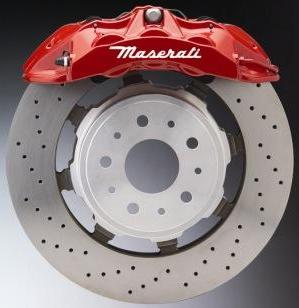
Here's some more info I found on the Brembos:
Here's some more info I found on the Brembos:
Historically, brake discs used in the great majority of braking systems have been made of cast iron, whereas more recently, racing and other high performance cars have been equipped with discs of compound design that feature a hybrid composite material (carbon-ceramic) — for the braking surface only — and a hat of cast aluminum or steel.
Brembo now presents a new kind of disc: the co-cast floating brake disc, made of two materials, cast iron and aluminum. This new disc has many advantages: reduced weight (15-20% lighter), greater driving comfort, less corrosion, less wear and better brake performance.
The co-cast floating brake disc is able to optimize the performance of brake systems for all types of vehicles, from the most basic utility to the sportiest roadster, and commercial vehicles too.
The co-cast floating brake disc has a cast-iron braking surface and an aluminum hat: ideally combining the advantages of heat-resistance provided by cast iron with the lightweight properties of aluminum. The innovation is in the way the two materials have been combined to a single component, and in the behavior of the disc during operation, functioning effectively as an integral disc at low temperatures, then as a floating disc at high temperatures, when maximum performance is needed and distortion tends to occur.
It is the dual-cast rotors that required Brembo to step outside its traditional knowledge of the permanent mold casting process to produce something unique.
To bring the aluminum and iron together in one component, Brembo’s metalcasters moved from the outside in. They began by producing the cast iron outer ring in the low pressure permanent mold process. That incomplete component was then pre-machined to prepare its mating surfaces to be paired with the aluminum ring. The inner aluminum hat then was cast in the same permanent mold procedure, but with the iron piece fitted around it on the casting die.
“The challenges were to find the optimized process parameters (for example the temperature, filling pressure and time) to guarantee that the teeth were perfectly embedded for the tangential torque transfer from the cast iron brake ring to the aluminum bell,” said a Brembo engineer.
Brembo now presents a new kind of disc: the co-cast floating brake disc, made of two materials, cast iron and aluminum. This new disc has many advantages: reduced weight (15-20% lighter), greater driving comfort, less corrosion, less wear and better brake performance.
The co-cast floating brake disc is able to optimize the performance of brake systems for all types of vehicles, from the most basic utility to the sportiest roadster, and commercial vehicles too.
The co-cast floating brake disc has a cast-iron braking surface and an aluminum hat: ideally combining the advantages of heat-resistance provided by cast iron with the lightweight properties of aluminum. The innovation is in the way the two materials have been combined to a single component, and in the behavior of the disc during operation, functioning effectively as an integral disc at low temperatures, then as a floating disc at high temperatures, when maximum performance is needed and distortion tends to occur.
It is the dual-cast rotors that required Brembo to step outside its traditional knowledge of the permanent mold casting process to produce something unique.
To bring the aluminum and iron together in one component, Brembo’s metalcasters moved from the outside in. They began by producing the cast iron outer ring in the low pressure permanent mold process. That incomplete component was then pre-machined to prepare its mating surfaces to be paired with the aluminum ring. The inner aluminum hat then was cast in the same permanent mold procedure, but with the iron piece fitted around it on the casting die.
“The challenges were to find the optimized process parameters (for example the temperature, filling pressure and time) to guarantee that the teeth were perfectly embedded for the tangential torque transfer from the cast iron brake ring to the aluminum bell,” said a Brembo engineer.

Registered User
Joined: Nov 2010
Posts: 350
From: NW England
Rep Power: 30
Was wondering how it could act as a floating disc at high temperatures if the disc was cast as a solid piece with the hat.
So, it's something like an interference fit, but with teeth that allow the steel to expand and move laterally, then when it cools it locks into the position it floated to.
Sounds good. What does that 20% weight saving translate into in kg (or pounds)
So, it's something like an interference fit, but with teeth that allow the steel to expand and move laterally, then when it cools it locks into the position it floated to.
Sounds good. What does that 20% weight saving translate into in kg (or pounds)
Thread Starter
|
Registered User
Joined: Apr 2011
Posts: 2,358
From: Melbourne
Rep Power: 214
I think your guess is probably accurate, Michael. My Aston tech described it as something similar where the disc expands and floats at high temps. This sounds like what you're saying.
I don't know what the weights savings translates to and I don't know whether I'll be able to tell the difference when I get my car. I did also order the lightweight forged 10spoke wheel option, so there's even less unsprung mass, blah, blah, blah…
I don't know what the weights savings translates to and I don't know whether I'll be able to tell the difference when I get my car. I did also order the lightweight forged 10spoke wheel option, so there's even less unsprung mass, blah, blah, blah…