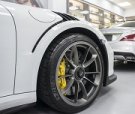
PCCB to GT3 Cup steel rotors - bitter sweet conversion



Registered User
Joined: Mar 2008
Posts: 642
From: Kansas
Rep Power: 79


changing the weight of the rotor does not change its angular velocity.
yes, but i don't see how this supports your argument.
but not on stopping distance. stopping distance is determined by a panic stop test, which is essentially a test of the tires vs the ABS tuning, given today's braking system performance.
absolutely. but you will not "feel" the difference in acceleration and there is no difference in stopping distance (i mistakenly said braking earlier).
40# difference, even in rotating unsprung weight, is probably the difference between 0-60 in 4.1 vs 4.0 seconds. there is no way you can feel that.
yes, but i don't see how this supports your argument.
but not on stopping distance. stopping distance is determined by a panic stop test, which is essentially a test of the tires vs the ABS tuning, given today's braking system performance.
absolutely. but you will not "feel" the difference in acceleration and there is no difference in stopping distance (i mistakenly said braking earlier).
40# difference, even in rotating unsprung weight, is probably the difference between 0-60 in 4.1 vs 4.0 seconds. there is no way you can feel that.
You are correct that changing the weight of the rotor does not change its velocity, but you missed my point. Kinetic energy is MASS times velocity SQUARED. So any increase in mass dramatically increases the amount of energy required to accelerate it (and vice versa). (Another important factor in rotating kinetic energy is Moment of Inertia, but it is not a variable here.)
Since energy is not created, but only converted, this energy comes from the stored chemical energy in the fuel tank. The chemical energy is then converted to heat in the engine. If you reduce the mass that must be accelerated, and keep the energy the same (i.e. horsepower) then the vehicle will accelerate more quickly.
We recently conducted a "same day-same conditions" back-to-back test in Europe with a major tuner using 30+ lb wheels in a standing mile acceleration test. When these wheels were replaced with 20 lb wheels, the ET over the mile run dropped by 2.1 seconds. Data recorders on board confirmed your argument that 0-60 times were not affected much, primarily due to the fact that the powerful 2WD vehicle was EXTREMELY traction limited. However, at higher speeds 130-190+ mph, the vehicle accelerated much more quickly, due to the lower rotating inertia (remember mass times the SQUARE of the speed).
You were also correct about deceleration being traction limited as well. This is often shown by 80-0 or 60-0 data points. However, at high speeds, traction is less a factor and braking performance is largely determined by the braking torque available and often limited by the quantity of heat that can be generated and dissipated by the braking system. The braking system has to contend with the entire kinetic energy of the moving vehicle AND the kinetic energy of the rotating mass. Reducing that mass will improve braking performance and shorten stopping distances. It is simple physics.
As to what one can or cannot "feel", I tend to avoid those arguments.
However, dramatically changing unsprung weight can make a vehicle's driving experience change significantly. A lively, nimble feel can be transformed into a heavy and ponderous feel that can lead one to make unscientific conclusions.
I enjoyed your comments and challenges. Sorry for the long post.
Last edited by Tech1_Mike; Dec 10, 2009 at 12:57 PM. Reason: clarification



Registered User
Joined: Sep 2004
Posts: 558
From: Columbia Ca. JSA
Rep Power: 48
Many of your points are accurate. I posted to remind everyone that there are laws of physics at work here.
You are correct that changing the weight of the rotor does not change its velocity, but you missed my point. Kinetic energy is MASS times velocity SQUARED. So any increase in mass dramatically increases the amount of energy required to accelerate it (and vice versa). (Another important factor in rotating kinetic energy is Moment of Inertia, but it is not a variable here.)
Since energy is not created, but only converted, this energy comes from the stored chemical energy in the fuel tank. The chemical energy is then converted to heat in the engine. If you reduce the mass that must be accelerated, and keep the energy the same (i.e. horsepower) then the vehicle will accelerate more quickly.
We recently conducted a "same day-same conditions" back-to-back test in Europe with a major tuner using 30+ lb wheels in a standing mile acceleration test. When these wheels were replaced with 20 lb wheels, the ET over the mile run dropped by 2.1 seconds. Data recorders on board confirmed your argument that 0-60 times were not affected much, primarily due to the fact that the powerful 2WD vehicle was EXTREMELY traction limited. However, at higher speeds 130-190+ mph, the vehicle accelerated much more quickly, due to the lower rotating inertia (remember mass times the SQUARE of the speed).
You were also correct about deceleration being traction limited as well. This is often shown by 80-0 or 60-0 data points. However, at high speeds, traction is less a factor and braking performance is largely determined by the braking torque available and often limited by the quantity of heat that can be generated and dissipated by the braking system. The braking system has to contend with the entire kinetic energy of the moving vehicle AND the kinetic energy of the rotating mass. Reducing that mass will improve braking performance and shorten stopping distances. It is simple physics.
As to what one can or cannot "feel", I tend to avoid those arguments.
However, dramatically changing unsprung weight can make a vehicle's driving experience change significantly. A lively, nimble feel can be transformed into a heavy and ponderous feel that can lead one to make unscientific conclusions.
I enjoyed your comments and challenges. Sorry for the long post.
You are correct that changing the weight of the rotor does not change its velocity, but you missed my point. Kinetic energy is MASS times velocity SQUARED. So any increase in mass dramatically increases the amount of energy required to accelerate it (and vice versa). (Another important factor in rotating kinetic energy is Moment of Inertia, but it is not a variable here.)
Since energy is not created, but only converted, this energy comes from the stored chemical energy in the fuel tank. The chemical energy is then converted to heat in the engine. If you reduce the mass that must be accelerated, and keep the energy the same (i.e. horsepower) then the vehicle will accelerate more quickly.
We recently conducted a "same day-same conditions" back-to-back test in Europe with a major tuner using 30+ lb wheels in a standing mile acceleration test. When these wheels were replaced with 20 lb wheels, the ET over the mile run dropped by 2.1 seconds. Data recorders on board confirmed your argument that 0-60 times were not affected much, primarily due to the fact that the powerful 2WD vehicle was EXTREMELY traction limited. However, at higher speeds 130-190+ mph, the vehicle accelerated much more quickly, due to the lower rotating inertia (remember mass times the SQUARE of the speed).
You were also correct about deceleration being traction limited as well. This is often shown by 80-0 or 60-0 data points. However, at high speeds, traction is less a factor and braking performance is largely determined by the braking torque available and often limited by the quantity of heat that can be generated and dissipated by the braking system. The braking system has to contend with the entire kinetic energy of the moving vehicle AND the kinetic energy of the rotating mass. Reducing that mass will improve braking performance and shorten stopping distances. It is simple physics.
As to what one can or cannot "feel", I tend to avoid those arguments.
However, dramatically changing unsprung weight can make a vehicle's driving experience change significantly. A lively, nimble feel can be transformed into a heavy and ponderous feel that can lead one to make unscientific conclusions.
I enjoyed your comments and challenges. Sorry for the long post.
I typically don't respond when some one argues a point that doesn't hold up. You very much feel the difference in breaking at speed as less pedal pressure is necessary before you get even close to traction limitation. To feel this you would have to drive similar cars with only the breaks being different.
I can understand how some may think this is difficult to feel; most of the driving population are very poor at peddle modulation if they even know what it is. I had a chance to dive on the oval at Milford and they use center lane with hands off to demonstrate this feature. Instructor informed me that less than one in 10 Americans get this on first try. He also stated that after about 15 minutes using this method makes all the difference in a drivers ability in many other areas.
Had another instructor tell me once that if someone gets in trouble, over 80% of the time it is caused by the feet. Threshold breaking; what the hell is that?

Last edited by Sloopy; Dec 10, 2009 at 04:47 PM.
Registered User
Joined: Mar 2008
Posts: 642
From: Kansas
Rep Power: 79
Your original post was very clear and no reason why anyone would not understand, unless their physics background is limited.
I typically don't respond when some one argues a point that doesn't hold up. You very much feel the difference in breaking at speed as less pedal pressure is necessary before you get even close to traction limitation. To feel this you would have to drive similar cars with only the breaks being different.
I can understand how some may think this is difficult to feel; most of the driving population are very poor at peddle modulation if they even know what it it. I had a chance to dive on the oval at Milford and they use center lane with hands off to demonstrate this feature. Instructor informed me that less than one in 10 Americans get this on first try. He also stated that after about 15 minutes using this method makes all the difference in a drivers ability in many other areas.
Had another instructor tell me once that if someone gets in trouble, over 80% of the time it is caused by the feet. Threshold breaking; what the hell is that?
I typically don't respond when some one argues a point that doesn't hold up. You very much feel the difference in breaking at speed as less pedal pressure is necessary before you get even close to traction limitation. To feel this you would have to drive similar cars with only the breaks being different.
I can understand how some may think this is difficult to feel; most of the driving population are very poor at peddle modulation if they even know what it it. I had a chance to dive on the oval at Milford and they use center lane with hands off to demonstrate this feature. Instructor informed me that less than one in 10 Americans get this on first try. He also stated that after about 15 minutes using this method makes all the difference in a drivers ability in many other areas.
Had another instructor tell me once that if someone gets in trouble, over 80% of the time it is caused by the feet. Threshold breaking; what the hell is that?
(Heck, I have enough trouble trying to explain physics).
But if one imagines trying to slow a 40 lb flywheel spinning at 2000 rpm, one can easily understand how eliminating that much kinetic energy will have a positive impact on brake "feel", deceleration, reduced stopping distance, driver fatigue, and the list goes on.....
Of course, one must also have an open mind.


Registered User
Joined: Jan 2008
Posts: 256
From: 123
Rep Power: 33
Kinetic energy is MASS times velocity SQUARED. So any increase in mass dramatically increases the amount of energy required to accelerate it (and vice versa). (Another important factor in rotating kinetic energy is Moment of Inertia, but it is not a variable here.)
I enjoyed your comments and challenges. Sorry for the long post.
I still stick by my original statement though that the OP could not have felt the difference in acceleration and will still put up $1000 for a blind test.
Registered User
Joined: Nov 2008
Posts: 431
From: Reno NV
Rep Power: 59
Have had approx 16+ hours track time in a stock 2009 C2S w/PDK and stock 19" wheels and stock red brakes.
My personal 2009 C4S has PCCB and Lightweight AMT Forged Alloy wheels.
The handling/braking difference between the cars is night and day.
And I would bet $10K that I could pick 10/10 tries which is which. Not sure how you would "blind" the test however
Pedal feel/modulation without doubt- PCCB superior. Driving dynamics, deceleration on initial high speed application, turn-in, steering crispness and responsiveness, ride quality, no doubt at all- lightweight wheels and PCCB's are far superior.
Side note- the wheels that Tech-1 Mike represents are in my opinion the best money can buy, bar none. Ultra-light. Tough finish. Very strong. Superb quality. Beautiful. Thanks you guys for the awesome product you make!
My personal 2009 C4S has PCCB and Lightweight AMT Forged Alloy wheels.
The handling/braking difference between the cars is night and day.
And I would bet $10K that I could pick 10/10 tries which is which. Not sure how you would "blind" the test however
Pedal feel/modulation without doubt- PCCB superior. Driving dynamics, deceleration on initial high speed application, turn-in, steering crispness and responsiveness, ride quality, no doubt at all- lightweight wheels and PCCB's are far superior.
Side note- the wheels that Tech-1 Mike represents are in my opinion the best money can buy, bar none. Ultra-light. Tough finish. Very strong. Superb quality. Beautiful. Thanks you guys for the awesome product you make!
Registered User
Joined: Jan 2008
Posts: 256
From: 123
Rep Power: 33
Have had approx 16+ hours track time in a stock 2009 C2S w/PDK and stock 19" wheels and stock red brakes.
My personal 2009 C4S has PCCB and Lightweight AMT Forged Alloy wheels.
The handling/braking difference between the cars is night and day.
And I would bet $10K that I could pick 10/10 tries which is which. Not sure how you would "blind" the test however
My personal 2009 C4S has PCCB and Lightweight AMT Forged Alloy wheels.
The handling/braking difference between the cars is night and day.
And I would bet $10K that I could pick 10/10 tries which is which. Not sure how you would "blind" the test however

Thread Starter
|
Registered User
Joined: Apr 2008
Posts: 1,120
From: Rocklin, California
Rep Power: 134
OK, it is official that PCCB/OEM pads sucks compare with Cup steel rotors with Pagid RS29. I knew the Cup steel rotors felt great at Laguna Seca but most of my PCCB/OEM pads track time were at Thunderhill. I finally had a chance to try out the Cup rotors at Thunderhill two days ago and let me tell you this, they totally ROCK!! I can accelerate all the way to the end of the brake zone before turn 10, 14 and 1 and slam on the brake with total confidence unlike the OMG experience with PCCB/OEM pads where I have to ride on the brakes way before the brake zone to prime them.
Now the only question left to answer is how well does the PCCB perform with proper track pads like the Pagid P50 and RS29 compare with Cup steel rotors? That will be my next project
Here is a video of the Thunderhill brake test day
http://www.youtube.com/watch?v=1URJcmYui9I
Now the only question left to answer is how well does the PCCB perform with proper track pads like the Pagid P50 and RS29 compare with Cup steel rotors? That will be my next project
Here is a video of the Thunderhill brake test day
http://www.youtube.com/watch?v=1URJcmYui9I

Registered User
Joined: Jan 2008
Posts: 185
From: Louisville, KY
Rep Power: 28
I wouldn't go near a track in a GT3/RS without dedicated track pads (like RS29's)...or stainless steel lines, and Motul for that matter.
There is no such thing as a "Do-it-all" brake pad. Those who market such things are irresponsible, and those who believe it are foolish.
Everyone should have 2 sets of pads...one for the street, and one for the track. It's not like it's hard to change pads in porsche calipers.
There is no such thing as a "Do-it-all" brake pad. Those who market such things are irresponsible, and those who believe it are foolish.
Everyone should have 2 sets of pads...one for the street, and one for the track. It's not like it's hard to change pads in porsche calipers.
Thread Starter
|
Registered User
Joined: Apr 2008
Posts: 1,120
From: Rocklin, California
Rep Power: 134
I wouldn't go near a track in a GT3/RS without dedicated track pads (like RS29's)...or stainless steel lines, and Motul for that matter.
There is no such thing as a "Do-it-all" brake pad. Those who market such things are irresponsible, and those who believe it are foolish.
Everyone should have 2 sets of pads...one for the street, and one for the track. It's not like it's hard to change pads in porsche calipers.
There is no such thing as a "Do-it-all" brake pad. Those who market such things are irresponsible, and those who believe it are foolish.
Everyone should have 2 sets of pads...one for the street, and one for the track. It's not like it's hard to change pads in porsche calipers.

Thread Starter
|
Registered User
Joined: Apr 2008
Posts: 1,120
From: Rocklin, California
Rep Power: 134

Registered User
Joined: Jun 2011
Posts: 150
From: SoCal
Rep Power: 23
Came across this old informative thread. Was wondering if you ever got to try out different pads (such as the P50) on the PCCB at the track?