


Has anyone thought of running forced air through the Side Inlets?

Has anyone thought of running forced air through the Side Inlets?
Well, since the Porsche uses the pressure drop from behind the rear bumper to draw the air through the intercoolers. Wouldn't it increase the effficency if the side inlets were made into "ram air" scoops to force the air into that tract? I haven't seen anything out there and I'm wondering why.





Registered User
Joined: Dec 2005
Posts: 3,282
From: Down the street on the left
Rep Power: 155

Trending Topics


Registered User
Joined: Jun 2004
Posts: 1,163
From: Earth
Rep Power: 91

On the race 993GT2 models the factory found 20-30hp by channeling fresh air to the turbo inlet from the rear GT2 wing side openings. This becomes more important as heat floods the engine bay on the track, performance drops the more hot air the turbos absorb lap after lap.
The highest pressure zone on the 996 (other than the front bumper) is on the rear engine lid as air accelerates downwards over the rear glass into it, the stock air intake box is ideally located to benefit from this, and the carefully crafted plastic ducts increase air velocity further. The GT3 scoops are very functional.
On engines with modified intake location, the best bet is to add a couple of NACA ducts on top of the rear fenders (above the wheel level) or further back and direct flow directly to the turbos or through whatever is in their way (filter, MAF, etc..). NACA ducts were specially designed to minimize drag losses while accelerating air velocity, they need to be original though, most copies are not functional unless carefully designed. NACA ducts are subtle and their design is more efficient than most scoops at high speed.
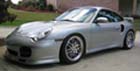
The silver car above was designed by Enco, and the scoop is very functional. Drawing fresh air into the IC is another trick, difficult on the 996 however unless you have a top mounted IC.
Those ears seem very little functional, I don't know how much space is there inside the wheel well to direct flow. However drag is not a huge handicap when compared to the benefits of fresh air intake and there are several turbo 996 race cars that do a similar setup however trhough the rear side glass instead, since they can then channel the air through the rear engine firewall to the turbos.
Check out Bello's 964 and the openings on the rear fenders, while their location is not benefitting from the highest air pressure zone (should be slightly more backwards), they are close, also a NACA duct would have been much better than those holes, but smart thinking, in a 200mph run, those turbos will be very happy!
Drive your car in the rain and observe the waterspray pattern once you park it and it dries, you will clearly see how air flows over your car.
The highest pressure zone on the 996 (other than the front bumper) is on the rear engine lid as air accelerates downwards over the rear glass into it, the stock air intake box is ideally located to benefit from this, and the carefully crafted plastic ducts increase air velocity further. The GT3 scoops are very functional.
On engines with modified intake location, the best bet is to add a couple of NACA ducts on top of the rear fenders (above the wheel level) or further back and direct flow directly to the turbos or through whatever is in their way (filter, MAF, etc..). NACA ducts were specially designed to minimize drag losses while accelerating air velocity, they need to be original though, most copies are not functional unless carefully designed. NACA ducts are subtle and their design is more efficient than most scoops at high speed.
The silver car above was designed by Enco, and the scoop is very functional. Drawing fresh air into the IC is another trick, difficult on the 996 however unless you have a top mounted IC.
Those ears seem very little functional, I don't know how much space is there inside the wheel well to direct flow. However drag is not a huge handicap when compared to the benefits of fresh air intake and there are several turbo 996 race cars that do a similar setup however trhough the rear side glass instead, since they can then channel the air through the rear engine firewall to the turbos.
Check out Bello's 964 and the openings on the rear fenders, while their location is not benefitting from the highest air pressure zone (should be slightly more backwards), they are close, also a NACA duct would have been much better than those holes, but smart thinking, in a 200mph run, those turbos will be very happy!
Drive your car in the rain and observe the waterspray pattern once you park it and it dries, you will clearly see how air flows over your car.
Last edited by Jean; Aug 25, 2008 at 10:35 PM.

Thread
Thread Starter
Forum
Replies
Last Post
eclip5e
Automobiles For Sale
6
Jul 29, 2019 11:13 AM
vividracing
991
6
Jun 10, 2017 07:45 PM
