


Introduction: AMT Tech1 Forged Monoblock Wheels

Registered User
Joined: Mar 2008
Posts: 642
From: Kansas
Rep Power: 79


Mike,
Can you please provide some further info to quantify these statements regarding mass vs strength? Anything relating to differences in forging processes, alloys used, FEA modeling techniques, load/factor of safety applied, etc, would be great for those of us looking to separate facts from marketing speak.
Thanks,
Brett
Can you please provide some further info to quantify these statements regarding mass vs strength? Anything relating to differences in forging processes, alloys used, FEA modeling techniques, load/factor of safety applied, etc, would be great for those of us looking to separate facts from marketing speak.
Thanks,
Brett
Because we have complete control of the manufacturing process, we can VERY ACCURATELY forge, spin and lathe the wheels to weight-optimize them.
For example, we hold a much tighter barrel thickness tolerance across the entire wheel width than our competitors. We commonly see variations of .020 inch or more with some wheels. This adds needless weight. (For example, we also make a 16x16 Double Beadlock wheel for a customer that we hold a .105 inch wall thickness across the entire 16 inch span. This wheel weighs 17.5 pounds and is used on a 1800 HP, 200 MPH race car). We can hold these tolerances because we own the largest, most powerful CNC spinning machine in North America. We mostly use it for military stuff, but it is very accurate, even for Porsche wheels.
Because we lathe our own parts, we can undercut the area behind the face to eliminate material that our FEA software says is unnecessary. We even remove the excess material in the barrel behind the safety bead, because it is excess and therefore unnecessary.
On the Tech1-110, we make our wheel face slightly larger than some competitors. This strengthens the wheel and slightly shortens the spokes, allowing us to make them lighter.
On the mounting pad, we remove any excess material that does not contribute to wheel strength.
We do not divulge the alloys we use, but there are many alloys that have strength-to-weight ratios far superior than 6061. We are military and aerospace certified for heat treating and therefore we hold our Brinell hardness to the very top of the performance scale. This has a big impact on strength. We even underage the heat treating prior to clearcoat so that the strength is at its peak after the clearcoat cure.
All of these little things take time and skill to perfect. Lightening a wheel is a lot like lightening a race car. You must be diligent and remove everything, even in tiny increments, that does not add to performance.
When we first STL tested the Tech1-110, it weighed 15.8 lbs.
But we decided to increase the wheel's impact strength and make it less susceptible to damage from potholes and the like. Now it weighs just shy of 17 lbs.
The wheel carries a lifetime structural warranty and a one-year road hazard warranty.

Registered User

Joined: Sep 2006
Posts: 3,028
From: Houston
Rep Power: 201
Brett,
Because we have complete control of the manufacturing process, we can VERY ACCURATELY forge, spin and lathe the wheels to weight-optimize them.
For example, we hold a much tighter barrel thickness tolerance across the entire wheel width than our competitors. We commonly see variations of .020 inch or more with some wheels. This adds needless weight. (For example, we also make a 16x16 Double Beadlock wheel for a customer that we hold a .105 inch wall thickness across the entire 16 inch span. This wheel weighs 17.5 pounds and is used on a 1800 HP, 200 MPH race car). We can hold these tolerances because we own the largest, most powerful CNC spinning machine in North America. We mostly use it for military stuff, but it is very accurate, even for Porsche wheels.
Because we lathe our own parts, we can undercut the area behind the face to eliminate material that our FEA software says is unnecessary. We even remove the excess material in the barrel behind the safety bead, because it is excess and therefore unnecessary.
On the Tech1-110, we make our wheel face slightly larger than some competitors. This strengthens the wheel and slightly shortens the spokes, allowing us to make them lighter.
On the mounting pad, we remove any excess material that does not contribute to wheel strength.
We do not divulge the alloys we use, but there are many alloys that have strength-to-weight ratios far superior than 6061. We are military and aerospace certified for heat treating and therefore we hold our Brinell hardness to the very top of the performance scale. This has a big impact on strength. We even underage the heat treating prior to clearcoat so that the strength is at its peak after the clearcoat cure.
All of these little things take time and skill to perfect. Lightening a wheel is a lot like lightening a race car. You must be diligent and remove everything, even in tiny increments, that does not add to performance.
When we first STL tested the Tech1-110, it weighed 15.8 lbs.
But we decided to increase the wheel's impact strength and make it less susceptible to damage from potholes and the like. Now it weighs just shy of 17 lbs.
The wheel carries a lifetime structural warranty and a one-year road hazard warranty.
Because we have complete control of the manufacturing process, we can VERY ACCURATELY forge, spin and lathe the wheels to weight-optimize them.
For example, we hold a much tighter barrel thickness tolerance across the entire wheel width than our competitors. We commonly see variations of .020 inch or more with some wheels. This adds needless weight. (For example, we also make a 16x16 Double Beadlock wheel for a customer that we hold a .105 inch wall thickness across the entire 16 inch span. This wheel weighs 17.5 pounds and is used on a 1800 HP, 200 MPH race car). We can hold these tolerances because we own the largest, most powerful CNC spinning machine in North America. We mostly use it for military stuff, but it is very accurate, even for Porsche wheels.
Because we lathe our own parts, we can undercut the area behind the face to eliminate material that our FEA software says is unnecessary. We even remove the excess material in the barrel behind the safety bead, because it is excess and therefore unnecessary.
On the Tech1-110, we make our wheel face slightly larger than some competitors. This strengthens the wheel and slightly shortens the spokes, allowing us to make them lighter.
On the mounting pad, we remove any excess material that does not contribute to wheel strength.
We do not divulge the alloys we use, but there are many alloys that have strength-to-weight ratios far superior than 6061. We are military and aerospace certified for heat treating and therefore we hold our Brinell hardness to the very top of the performance scale. This has a big impact on strength. We even underage the heat treating prior to clearcoat so that the strength is at its peak after the clearcoat cure.
All of these little things take time and skill to perfect. Lightening a wheel is a lot like lightening a race car. You must be diligent and remove everything, even in tiny increments, that does not add to performance.
When we first STL tested the Tech1-110, it weighed 15.8 lbs.
But we decided to increase the wheel's impact strength and make it less susceptible to damage from potholes and the like. Now it weighs just shy of 17 lbs.
The wheel carries a lifetime structural warranty and a one-year road hazard warranty.

Registered User
Joined: Jan 2007
Posts: 166
From: Ohio
Rep Power: 26
Brett,
Because we have complete control of the manufacturing process, we can VERY ACCURATELY forge, spin and lathe the wheels to weight-optimize them.
For example, we hold a much tighter barrel thickness tolerance across the entire wheel width than our competitors. We commonly see variations of .020 inch or more with some wheels. This adds needless weight. (For example, we also make a 16x16 Double Beadlock wheel for a customer that we hold a .105 inch wall thickness across the entire 16 inch span. This wheel weighs 17.5 pounds and is used on a 1800 HP, 200 MPH race car). We can hold these tolerances because we own the largest, most powerful CNC spinning machine in North America. We mostly use it for military stuff, but it is very accurate, even for Porsche wheels.
Because we lathe our own parts, we can undercut the area behind the face to eliminate material that our FEA software says is unnecessary. We even remove the excess material in the barrel behind the safety bead, because it is excess and therefore unnecessary.
On the Tech1-110, we make our wheel face slightly larger than some competitors. This strengthens the wheel and slightly shortens the spokes, allowing us to make them lighter.
On the mounting pad, we remove any excess material that does not contribute to wheel strength.
We do not divulge the alloys we use, but there are many alloys that have strength-to-weight ratios far superior than 6061. We are military and aerospace certified for heat treating and therefore we hold our Brinell hardness to the very top of the performance scale. This has a big impact on strength. We even underage the heat treating prior to clearcoat so that the strength is at its peak after the clearcoat cure.
All of these little things take time and skill to perfect. Lightening a wheel is a lot like lightening a race car. You must be diligent and remove everything, even in tiny increments, that does not add to performance.
When we first STL tested the Tech1-110, it weighed 15.8 lbs.
But we decided to increase the wheel's impact strength and make it less susceptible to damage from potholes and the like. Now it weighs just shy of 17 lbs.
The wheel carries a lifetime structural warranty and a one-year road hazard warranty.
Because we have complete control of the manufacturing process, we can VERY ACCURATELY forge, spin and lathe the wheels to weight-optimize them.
For example, we hold a much tighter barrel thickness tolerance across the entire wheel width than our competitors. We commonly see variations of .020 inch or more with some wheels. This adds needless weight. (For example, we also make a 16x16 Double Beadlock wheel for a customer that we hold a .105 inch wall thickness across the entire 16 inch span. This wheel weighs 17.5 pounds and is used on a 1800 HP, 200 MPH race car). We can hold these tolerances because we own the largest, most powerful CNC spinning machine in North America. We mostly use it for military stuff, but it is very accurate, even for Porsche wheels.
Because we lathe our own parts, we can undercut the area behind the face to eliminate material that our FEA software says is unnecessary. We even remove the excess material in the barrel behind the safety bead, because it is excess and therefore unnecessary.
On the Tech1-110, we make our wheel face slightly larger than some competitors. This strengthens the wheel and slightly shortens the spokes, allowing us to make them lighter.
On the mounting pad, we remove any excess material that does not contribute to wheel strength.
We do not divulge the alloys we use, but there are many alloys that have strength-to-weight ratios far superior than 6061. We are military and aerospace certified for heat treating and therefore we hold our Brinell hardness to the very top of the performance scale. This has a big impact on strength. We even underage the heat treating prior to clearcoat so that the strength is at its peak after the clearcoat cure.
All of these little things take time and skill to perfect. Lightening a wheel is a lot like lightening a race car. You must be diligent and remove everything, even in tiny increments, that does not add to performance.
When we first STL tested the Tech1-110, it weighed 15.8 lbs.
But we decided to increase the wheel's impact strength and make it less susceptible to damage from potholes and the like. Now it weighs just shy of 17 lbs.
The wheel carries a lifetime structural warranty and a one-year road hazard warranty.

Registered User
Joined: Mar 2008
Posts: 1,456
From: Russia
Rep Power: 81
This is very informative post...and nice wheels )))
Didnt know that Champion RG5 wheels weight that low...is those numbers in 18 or 19s wheels ??? They now also offer them in 20...
Didnt know that Champion RG5 wheels weight that low...is those numbers in 18 or 19s wheels ??? They now also offer them in 20...
Last edited by GT RUS; Nov 12, 2008 at 04:56 AM.
Registered User
Joined: Mar 2008
Posts: 642
From: Kansas
Rep Power: 79
Thanks for the kind words. BTW, we are making the 20 inch Tech1-110s and Tech1-109s this week. Wheel Experts and Wheel Enhancement can get them for you.

Registered User
Joined: Dec 2006
Posts: 3,116
From: Palos Verdes
Rep Power: 256
Hi Mike,
Thanks for the very informative post. 2 questions:
1. I have a difficult time understanding this. Wouldn't the weight saving from shortening the spokes be canceled by the weight gain from making the center disc larger?
I am asking because I think making the spokes longer is an aesthetic advantage. That is, to my eyes, longer spokes look nicer.
2. I didn't realize that there is such a difference & "trade secret" aspect to the alloys used by different companies! How could this be a secret? Isn't there a parameter that indicates best strength to weight ratio, and therefore everyone would be using the same material?
Thanks in advance and best of luck in this venture. I think you have a very nice product and it's good for consumers that another quality company has decided to join the fray.
Thanks for the very informative post. 2 questions:
1. I have a difficult time understanding this. Wouldn't the weight saving from shortening the spokes be canceled by the weight gain from making the center disc larger?
I am asking because I think making the spokes longer is an aesthetic advantage. That is, to my eyes, longer spokes look nicer.
2. I didn't realize that there is such a difference & "trade secret" aspect to the alloys used by different companies! How could this be a secret? Isn't there a parameter that indicates best strength to weight ratio, and therefore everyone would be using the same material?
Thanks in advance and best of luck in this venture. I think you have a very nice product and it's good for consumers that another quality company has decided to join the fray.
.....
1. On the Tech1-110, we make our wheel face slightly larger than some competitors. This strengthens the wheel and slightly shortens the spokes, allowing us to make them lighter.
.....
2. We do not divulge the alloys we use, but there are many alloys that have strength-to-weight ratios far superior than 6061.
.....
1. On the Tech1-110, we make our wheel face slightly larger than some competitors. This strengthens the wheel and slightly shortens the spokes, allowing us to make them lighter.
.....
2. We do not divulge the alloys we use, but there are many alloys that have strength-to-weight ratios far superior than 6061.
.....
Registered User
Joined: Mar 2008
Posts: 642
From: Kansas
Rep Power: 79
Hi Mike,
Thanks for the very informative post. 2 questions:
1. I have a difficult time understanding this. Wouldn't the weight saving from shortening the spokes be canceled by the weight gain from making the center disc larger?
I am asking because I think making the spokes longer is an aesthetic advantage. That is, to my eyes, longer spokes look nicer.
2. I didn't realize that there is such a difference & "trade secret" aspect to the alloys used by different companies! How could this be a secret? Isn't there a parameter that indicates best strength to weight ratio, and therefore everyone would be using the same material?
Thanks in advance and best of luck in this venture. I think you have a very nice product and it's good for consumers that another quality company has decided to join the fray.
Thanks for the very informative post. 2 questions:
1. I have a difficult time understanding this. Wouldn't the weight saving from shortening the spokes be canceled by the weight gain from making the center disc larger?
I am asking because I think making the spokes longer is an aesthetic advantage. That is, to my eyes, longer spokes look nicer.
2. I didn't realize that there is such a difference & "trade secret" aspect to the alloys used by different companies! How could this be a secret? Isn't there a parameter that indicates best strength to weight ratio, and therefore everyone would be using the same material?
Thanks in advance and best of luck in this venture. I think you have a very nice product and it's good for consumers that another quality company has decided to join the fray.
There are dozens of wrought alloy metals available that can be used to make wheels. 6061 is a common alloy because it has many desirable strength properties. It is also easy to form.
I am attaching a file showing the strain curves (tensile strength) of many aerospace alloys, including 6061. Each has its own formula, heat treat recipe, tensile strength, elasticity and "formability".
The more exotic alloys are more expensive, harder to form, etc. But many have tensile strength 30%, 50% or even 100% greater than 6061. Not all are suitable for wheels, and many require huge, powerful machines to form (yes, we have them).
If you study the chart, you will see that heat treating plays a critical role in alloy strength. For example, 6061/0 (no heat treat) has a tensile strength of about 18,000 psi. The identical alloy, hardened to T6, has a tensile strength of nearly 50,000 psi. Each alloy also has a "nominal" strain curve used for engineering and design purposes. However, there is also a "true" strain curve that can be used to strength advantage if one tightly controls the alloy's heat treating and resulting Brinell hardness.
We use many such alloys at AMT and have experience with their advantages and disadvantages.
I hope I answered your questions.
Registered User
Joined: Dec 2006
Posts: 3,116
From: Palos Verdes
Rep Power: 256
Mike,
Thank you. This has become a very good/informative thread & you are doing a very good job representing your company. AMT looks like a company with GREAT credentials and I hope you will do well.
Personally, I think mesh design looks best with 7 or 8 forks. Beyond that I think (just personal preference, YMMV, etc.) the wheel starts to look busy. Everyone is releasing 7-fork mesh design, Porsche uses it for their race cars and RS Spyder, any reason why AMT decides to go with 9? Structural or just aesthetic?

Thank you. This has become a very good/informative thread & you are doing a very good job representing your company. AMT looks like a company with GREAT credentials and I hope you will do well.
Personally, I think mesh design looks best with 7 or 8 forks. Beyond that I think (just personal preference, YMMV, etc.) the wheel starts to look busy. Everyone is releasing 7-fork mesh design, Porsche uses it for their race cars and RS Spyder, any reason why AMT decides to go with 9? Structural or just aesthetic?
Thanks for the great questions. Very small changes in face diameter can sometimes have a pronounced positive effect in "spreading the load" in the critical lug area. I won't pretend to know all the physics involved. If the radius where the spokes join is too close to the lug holes, then the spokes must be made considerably thicker to carry the load. Many design features are compromises. I love the look of long spokes as well, but I see how many of the Porsche faithful quickly ask the question "how much does it weigh?"
There are dozens of wrought alloy metals available that can be used to make wheels. 6061 is a common alloy because it has many desirable strength properties. It is also easy to form.
I am attaching a file showing the strain curves (tensile strength) of many aerospace alloys, including 6061. Each has its own formula, heat treat recipe, tensile strength, elasticity and "formability".
The more exotic alloys are more expensive, harder to form, etc. But many have tensile strength 30%, 50% or even 100% greater than 6061. Not all are suitable for wheels, and many require huge, powerful machines to form (yes, we have them).
If you study the chart, you will see that heat treating plays a critical role in alloy strength. For example, 6061/0 (no heat treat) has a tensile strength of about 18,000 psi. The identical alloy, hardened to T6, has a tensile strength of nearly 50,000 psi. Each alloy also has a "nominal" strain curve used for engineering and design purposes. However, there is also a "true" strain curve that can be used to strength advantage if one tightly controls the alloy's heat treating and resulting Brinell hardness.
We use many such alloys at AMT and have experience with their advantages and disadvantages.
I hope I answered your questions.
There are dozens of wrought alloy metals available that can be used to make wheels. 6061 is a common alloy because it has many desirable strength properties. It is also easy to form.
I am attaching a file showing the strain curves (tensile strength) of many aerospace alloys, including 6061. Each has its own formula, heat treat recipe, tensile strength, elasticity and "formability".
The more exotic alloys are more expensive, harder to form, etc. But many have tensile strength 30%, 50% or even 100% greater than 6061. Not all are suitable for wheels, and many require huge, powerful machines to form (yes, we have them).
If you study the chart, you will see that heat treating plays a critical role in alloy strength. For example, 6061/0 (no heat treat) has a tensile strength of about 18,000 psi. The identical alloy, hardened to T6, has a tensile strength of nearly 50,000 psi. Each alloy also has a "nominal" strain curve used for engineering and design purposes. However, there is also a "true" strain curve that can be used to strength advantage if one tightly controls the alloy's heat treating and resulting Brinell hardness.
We use many such alloys at AMT and have experience with their advantages and disadvantages.
I hope I answered your questions.
Registered User
Joined: Mar 2008
Posts: 642
From: Kansas
Rep Power: 79
Mike,
Thank you. This has become a very good/informative thread & you are doing a very good job representing your company. AMT looks like a company with GREAT credentials and I hope you will do well.
Personally, I think mesh design looks best with 7 or 8 forks. Beyond that I think (just personal preference, YMMV, etc.) the wheel starts to look busy. Everyone is releasing 7-fork mesh design, Porsche uses it for their race cars and RS Spyder, any reason why AMT decides to go with 9? Structural or just aesthetic?
Thank you. This has become a very good/informative thread & you are doing a very good job representing your company. AMT looks like a company with GREAT credentials and I hope you will do well.
Personally, I think mesh design looks best with 7 or 8 forks. Beyond that I think (just personal preference, YMMV, etc.) the wheel starts to look busy. Everyone is releasing 7-fork mesh design, Porsche uses it for their race cars and RS Spyder, any reason why AMT decides to go with 9? Structural or just aesthetic?
We plan to implement a third style soon and will be soliciting input from all of you. More later. PS: I love the car.


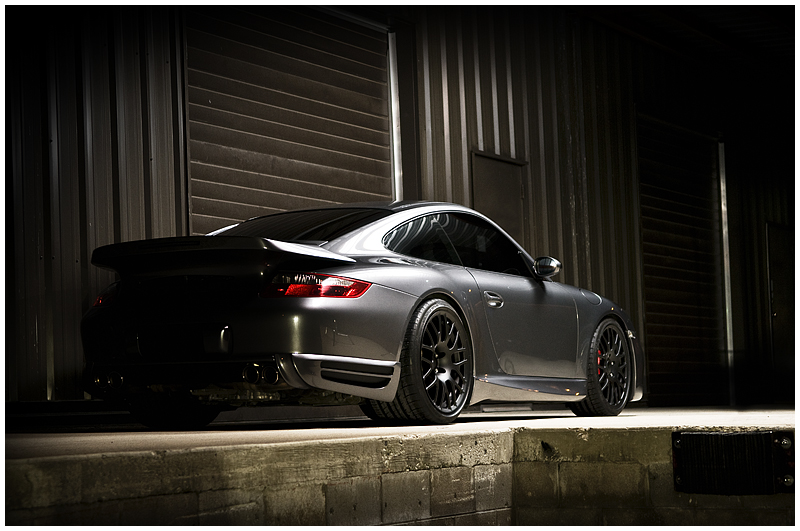
Wow this is really weird, This car actually belongs to a customer of mine. He shipped his car down to us to install Techart Front Bumper and Side Skirts, Speedart Rear Wing, Speedart Rear Diffuser, Speedart Exhaust, Bilstein Coilovers, Painted his factory brakes red with porsche logos, B&M Short Shifter, Techart shift **** and boot, techart mirror caps, we put Matte Black Vossen wheels on them at first. I believe everything took about 10 business days to complete the project.
Registered User
Joined: Mar 2008
Posts: 642
From: Kansas
Rep Power: 79
Wow this is really weird, This car actually belongs to a customer of mine. He shipped his car down to us to install Techart Front Bumper and Side Skirts, Speedart Rear Wing, Speedart Rear Diffuser, Speedart Exhaust, Bilstein Coilovers, Painted his factory brakes red with porsche logos, B&M Short Shifter, Techart shift **** and boot, techart mirror caps, we put Matte Black Vossen wheels on them at first. I believe everything took about 10 business days to complete the project.

Registered User
Joined: Sep 2008
Posts: 10
From: nyc
Rep Power: 0
JESUS CHRIST. someone needs to talk to whoever is doing wheel fitment for AMT because the offsets on everything posted so far has been absolutely perfect. Not to rag on HRE or iForged but it's very rare to see flush fitments like these. Amazing, amazing looking product guys!
Registered User
Joined: Mar 2008
Posts: 642
From: Kansas
Rep Power: 79
JESUS CHRIST. someone needs to talk to whoever is doing wheel fitment for AMT because the offsets on everything posted so far has been absolutely perfect. Not to rag on HRE or iForged but it's very rare to see flush fitments like these. Amazing, amazing looking product guys!

Registered User
Joined: Sep 2007
Posts: 650
From: california
Rep Power: 47
Peter at wheelexperts.com has helped me many times. Peter and his crew are standup people.

