


Tinting over thermal glass


Banned
Joined: Mar 2014
Posts: 129
From: LI, New York
Rep Power: 20

After about 3 weeks of tint being on my laminated windows I noticed that it takes FOREVER for some bubbles to disappear. My tint guy says that UV rays dry out the water trapped in the bubbles. Since the windows are laminated it takes extra extra long time for the bubbles to disappear because water is not drying out quick enough.
Maybe my guy just screwed up the job.
I learned one thing. You need a mole skin right away. I scratched all the windows with 1st roll down.
Does anybody know how to take out scratches from the tint? They are not very deep but maybe someone has a remedy?
Maybe my guy just screwed up the job.
I learned one thing. You need a mole skin right away. I scratched all the windows with 1st roll down.
Does anybody know how to take out scratches from the tint? They are not very deep but maybe someone has a remedy?

Registered User
Joined: Jan 2014
Posts: 629
From: SF BayArea
Rep Power: 38
Still loving my tint on my Panny by Premier. Actually reminds me to make an appointment with them to bring my Wife's Cayman R there to get the same treatment. She loves the tint on my car.
No scratches on the window when I bring it down, was able to bring the windows down the next day without scratches or issues. That felt liner they installed works.
No scratches on the window when I bring it down, was able to bring the windows down the next day without scratches or issues. That felt liner they installed works.

Registered User
Joined: Feb 2014
Posts: 28
From: los angeles
Rep Power: 14
After about 3 weeks of tint being on my laminated windows I noticed that it takes FOREVER for some bubbles to disappear. My tint guy says that UV rays dry out the water trapped in the bubbles. Since the windows are laminated it takes extra extra long time for the bubbles to disappear because water is not drying out quick enough.
Maybe my guy just screwed up the job.
Maybe my guy just screwed up the job.
Tint job was done so well, when I was pulled over for front window tint (illegal in LA) I told the officer the windows had arrived that way from the factory. He said, "really?" and tried to feel the top area with his fingernail. After a few moments of not being able to find a perforation, he said, "Oh I guess so, then."

Basic Sponsor


Joined: Feb 2009
Posts: 2,451
From: California
Rep Power: 176

Still loving my tint on my Panny by Premier. Actually reminds me to make an appointment with them to bring my Wife's Cayman R there to get the same treatment. She loves the tint on my car.
No scratches on the window when I bring it down, was able to bring the windows down the next day without scratches or issues. That felt liner they installed works.
No scratches on the window when I bring it down, was able to bring the windows down the next day without scratches or issues. That felt liner they installed works.
__________________
Premier Protective Films
ClearGuard Alpha PPF, Spectra PhotoSync Nano IR & CeraLuxe IRD Tint, Coatings
www.premiermobilegroup.com
Sharing our Passion on Youtube: https://urlgeni.us/youtube/Premier
Facebook: https://urlgeni.us/facebook/Premier
42630 Christy St, Fremont, CA. 510-623-1308 sales@premiermobilegroup.com
Premier Protective Films
ClearGuard Alpha PPF, Spectra PhotoSync Nano IR & CeraLuxe IRD Tint, Coatings
www.premiermobilegroup.com
Sharing our Passion on Youtube: https://urlgeni.us/youtube/Premier
Facebook: https://urlgeni.us/facebook/Premier
42630 Christy St, Fremont, CA. 510-623-1308 sales@premiermobilegroup.com
Basic Sponsor
Joined: Feb 2009
Posts: 2,451
From: California
Rep Power: 176
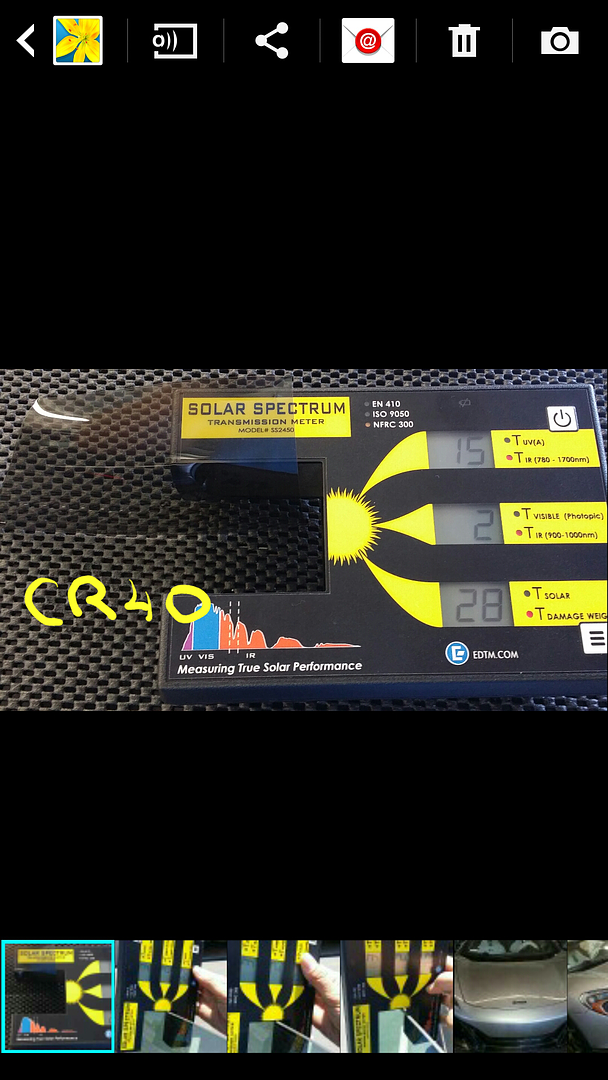
Hi all. We just wanted to share our experience and test results for PhotoSync. We used a highly sophisticated equipment to conduct our own test between PhotoSync and Crystalline. This machine is capable of reproducing the solar spectrum and can calculate a solar product performance with respect to 3 important global standards:
1. EN410 (2011)
2. ISO9050 (2003)
3. NFRC 300 (2010) - this is the most important one for us window tinters because it is a USA standard
*this equipment is patented and a very accurate measuring tool we use.
Many films on the market boast high IR rejection #s, but they usually take their highest performing #s. Typically, the easiest performance #s to gain is in the short IR between 900-1000nm. This represents a very small portion of the IR spectrum, which ranges from 780-2500. In general, these other window tints perform not as well in the higher ranges. BTU meters typically run in the range from 900-1000, so it is not representative of its true performance. On the IR scale, the range between 1100-1600 is the spot that is critical to heat transmission. With this unit, it can measure two different values:
900-1000
780-1700+
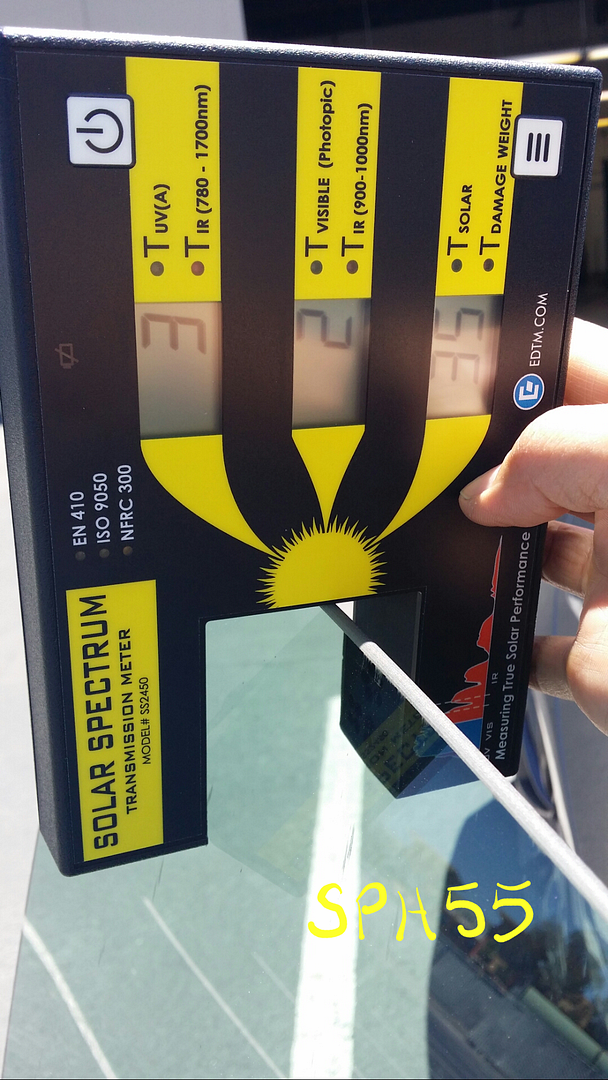
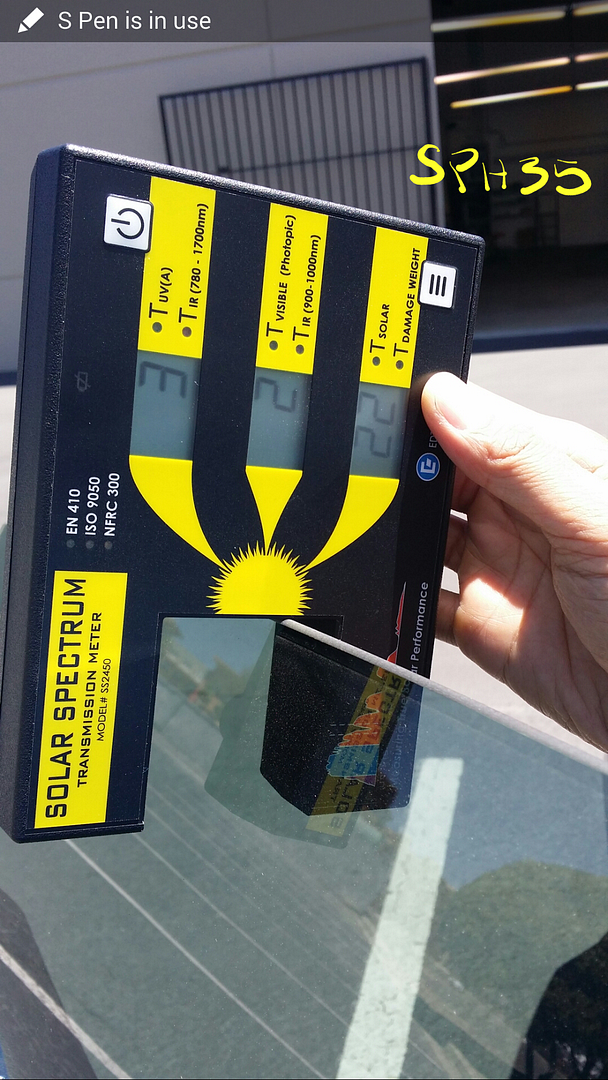
We just installed window film to this Tesla Model S with 55 on the front two and 35 on all of the back windows. As you can see SPH55 blocks out 98% of IR (allowing 2% to transmit through) on the 900-1000 scale. With the higher spectral range 780-1700, it comes through with 97% IR rejection (allowing 3% to transmit through). Simplified results:
SPH55
900-1000nm 98% IR Rejection
780-1700nm 97% IR Rejection
SPH35
900-1000nm 98% IR Rejection
780-1700nm 97% IR Rejection
**quite consistent results and only 1% variance in the higher nanometer range
Crystalline 40
900-1000nm 97% IR Rejection
780-1700nm 85% IR Rejection
**as you can see the performance drops when you are looking at the higher IR range.
Before actually conducting our own test, we were a little perplexed as to why the TSER is so different between PhotoSync and Crystalline even though their IR numbers are close. Now it is clear. It is because on Crystalline, their performance drops when you reach the higher nm of the IR Spectrum whereas PhotoSync is highly consistent with high IRR (infrared rejection)
1. EN410 (2011)
2. ISO9050 (2003)
3. NFRC 300 (2010) - this is the most important one for us window tinters because it is a USA standard
*this equipment is patented and a very accurate measuring tool we use.
Many films on the market boast high IR rejection #s, but they usually take their highest performing #s. Typically, the easiest performance #s to gain is in the short IR between 900-1000nm. This represents a very small portion of the IR spectrum, which ranges from 780-2500. In general, these other window tints perform not as well in the higher ranges. BTU meters typically run in the range from 900-1000, so it is not representative of its true performance. On the IR scale, the range between 1100-1600 is the spot that is critical to heat transmission. With this unit, it can measure two different values:
900-1000
780-1700+
We just installed window film to this Tesla Model S with 55 on the front two and 35 on all of the back windows. As you can see SPH55 blocks out 98% of IR (allowing 2% to transmit through) on the 900-1000 scale. With the higher spectral range 780-1700, it comes through with 97% IR rejection (allowing 3% to transmit through). Simplified results:
SPH55
900-1000nm 98% IR Rejection
780-1700nm 97% IR Rejection
SPH35
900-1000nm 98% IR Rejection
780-1700nm 97% IR Rejection
**quite consistent results and only 1% variance in the higher nanometer range
Crystalline 40
900-1000nm 97% IR Rejection
780-1700nm 85% IR Rejection
**as you can see the performance drops when you are looking at the higher IR range.
Before actually conducting our own test, we were a little perplexed as to why the TSER is so different between PhotoSync and Crystalline even though their IR numbers are close. Now it is clear. It is because on Crystalline, their performance drops when you reach the higher nm of the IR Spectrum whereas PhotoSync is highly consistent with high IRR (infrared rejection)


__________________
Premier Protective Films
ClearGuard Alpha PPF, Spectra PhotoSync Nano IR & CeraLuxe IRD Tint, Coatings
www.premiermobilegroup.com
Sharing our Passion on Youtube: https://urlgeni.us/youtube/Premier
Facebook: https://urlgeni.us/facebook/Premier
42630 Christy St, Fremont, CA. 510-623-1308 sales@premiermobilegroup.com
Premier Protective Films
ClearGuard Alpha PPF, Spectra PhotoSync Nano IR & CeraLuxe IRD Tint, Coatings
www.premiermobilegroup.com
Sharing our Passion on Youtube: https://urlgeni.us/youtube/Premier
Facebook: https://urlgeni.us/facebook/Premier
42630 Christy St, Fremont, CA. 510-623-1308 sales@premiermobilegroup.com
Basic Sponsor
Joined: Feb 2009
Posts: 2,451
From: California
Rep Power: 176
A very simple method to show whether or not a manufacturer's claim of "no metals" is true:
__________________
Premier Protective Films
ClearGuard Alpha PPF, Spectra PhotoSync Nano IR & CeraLuxe IRD Tint, Coatings
www.premiermobilegroup.com
Sharing our Passion on Youtube: https://urlgeni.us/youtube/Premier
Facebook: https://urlgeni.us/facebook/Premier
42630 Christy St, Fremont, CA. 510-623-1308 sales@premiermobilegroup.com
Premier Protective Films
ClearGuard Alpha PPF, Spectra PhotoSync Nano IR & CeraLuxe IRD Tint, Coatings
www.premiermobilegroup.com
Sharing our Passion on Youtube: https://urlgeni.us/youtube/Premier
Facebook: https://urlgeni.us/facebook/Premier
42630 Christy St, Fremont, CA. 510-623-1308 sales@premiermobilegroup.com

Registered User
Joined: May 2010
Posts: 98
From: Florida
Rep Power: 22
+1 Works great! Good stuff.
Basic Sponsor
Joined: Feb 2009
Posts: 2,451
From: California
Rep Power: 176
We are now carrying a new ceramic line, CeraLuxe Quantum Ceramic, made by Prestige Film Technologies - same company that manufactures Spectra PhotoSync. Performance is ahead of all ceramic tints on the market and also above ALL 3M tints, this is one spectacular film. It also does not affect radio or e-signals and does not have a reflective look. Luxury window film producing high heat rejection without compromise. On the pricing end, it does cost about 20%-25% less than Spectra PhotoSync!
Comes in the following shades: 73%, 45%, 33%, and 20% (By comparison PhotoSync comes in the following shades: 75%, 65%, 55%, 45%, 35%)
Here is our BTU (british thermal unit) video test of CeraLuxe Quantum Ceramic compared to others:
CeraLuxe labeled as "CLX"
On this BTU meter test, we put 3 different films to test against CeraLuxe 73% - which is rated at 53% Total Solar Energy Rejection + an IRR (infrared rejection) rating of 88%. In the line up of other films, we used a 3% metallic limo tint, 35% hybrid nano-carbon film, and a 50% popular ceramic. The results for CLX are impressive.
Comes in the following shades: 73%, 45%, 33%, and 20% (By comparison PhotoSync comes in the following shades: 75%, 65%, 55%, 45%, 35%)
Here is our BTU (british thermal unit) video test of CeraLuxe Quantum Ceramic compared to others:
CeraLuxe labeled as "CLX"
On this BTU meter test, we put 3 different films to test against CeraLuxe 73% - which is rated at 53% Total Solar Energy Rejection + an IRR (infrared rejection) rating of 88%. In the line up of other films, we used a 3% metallic limo tint, 35% hybrid nano-carbon film, and a 50% popular ceramic. The results for CLX are impressive.
__________________
Premier Protective Films
ClearGuard Alpha PPF, Spectra PhotoSync Nano IR & CeraLuxe IRD Tint, Coatings
www.premiermobilegroup.com
Sharing our Passion on Youtube: https://urlgeni.us/youtube/Premier
Facebook: https://urlgeni.us/facebook/Premier
42630 Christy St, Fremont, CA. 510-623-1308 sales@premiermobilegroup.com
Premier Protective Films
ClearGuard Alpha PPF, Spectra PhotoSync Nano IR & CeraLuxe IRD Tint, Coatings
www.premiermobilegroup.com
Sharing our Passion on Youtube: https://urlgeni.us/youtube/Premier
Facebook: https://urlgeni.us/facebook/Premier
42630 Christy St, Fremont, CA. 510-623-1308 sales@premiermobilegroup.com
Last edited by Premier Films; Apr 4, 2015 at 12:56 PM.



Thread
Thread Starter
Forum
Replies
Last Post