


Aero Mod Questions?

Thread Starter
|
Registered User

Joined: Jul 2003
Posts: 6,325
From: Michigan
Rep Power: 334


Aero Mod Questions?
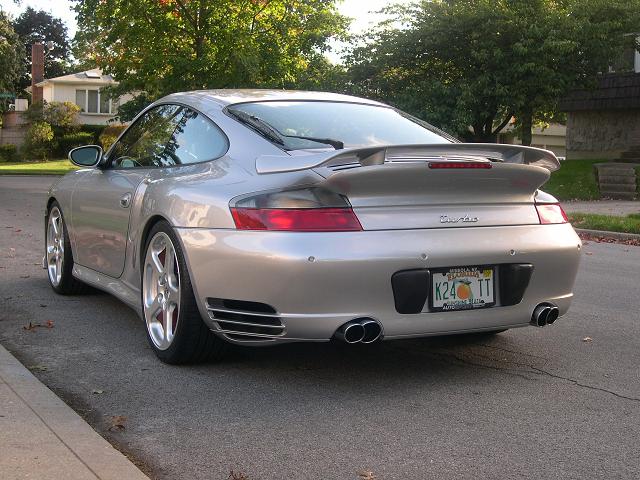
Okay, I now know what I want to do for Aero. I want the RUF front bumper with the Gemballa rear wing. The question is will mixing the different makes cause problems at 180 mph? Is there a preferred Aero package when traveling at high speeds?? Or is it just go with what looks good and don't worry about it?


Banned
Joined: Sep 2003
Posts: 480
From: Atlantic Beach to Palm Valley, FL
Rep Power: 42
I wonder how much time is spent actually testing these aero pieces produced by aftermarket tuners. No doubt that people like Ruf do some R&D but I bet most are created for cosmetics. I wonder if most of the tuners just start drawing what they think looks cool and then start cranking 'em out. None probably spend nearly the time Porsche had on testing the stock aero (kind of scary when you start thinking about swapping 'em out and doing top speed runs). I really doubt that mixing bits from each would have serious consequences on stability vs going totally Gemballa or only Techart, etc.. All of the larger rear wings probably provide increased downforce to some degree depending on the angles. I guess you then need to get some downforce up front to balance out the increased pressure in back and keep the nose down? While we're talking aero, downforce increases stability at high speeds but decreases the ultimate top speed right?
Kevin
Kevin

Banned
Joined: Sep 2003
Posts: 480
From: Atlantic Beach to Palm Valley, FL
Rep Power: 42
Originally posted by msindi
Techart actually has aa wind tunnel where they test all their products...
Techart actually has aa wind tunnel where they test all their products...
Kevin

Registered User
Joined: Jul 2003
Posts: 4,343
From: New Jersey
Rep Power: 199
Buddy,
There is no question that Porsche does wind tunnel testing. Obviously this is limited to the products they provide on factory cars. There are several variables that come into play with Posche's testing; choices of aerodynamic aids and choices of car ride heights. The aerodynamic aids are stock turbo, and turbo with aerokit. The ride heights are USA and ROW. That makes four combinations. The GT2 iteration has its own aerodynamic aids and its own ride height. Presumably, Porsche has wind tunnel tested all five iterations of the turbo in the wind tunnel.
Wind tunnel testing reveals several things:
Since many of us have lowered our cars, and due to my research among board members, usually to a height in close approximation of the GT2, it is appropriate to use the GT2 as a basis for comparison of aerodynamics. The reason for this is that the airflow under the car is going to be roughly similar. It then becomes a comparison of aerodynamics.
Before making comparisons of the available components (front spoilers and wings) it makes sense to understand the nature of airflow over and under our cars. There are two basic effects occurring. The first is global, the second is local. The global effect is that of an airplane wing. You have a basically curved upper body profile with a flat bottom. Like an airplane wing, wind must be redirected under and over the body (global wing) Since the top surface is is curved, the airflow takes a longer period of time to pass from the nose to the tail. Since the bottom of the car is flat, the airflow takes a shorter amount of time to pass from the nose to the tail. Conventional wisdom would relate this to an airplane wing and there say less pressure on top, higher pressure beneath=lift. Not exactly true. An airplane wing has a great deal of free space above and below it. In that case, the theory holds water. In the case of a car, the top has a great deal of free space above it but the bottom has a severely confined space bounded by the road surface and the bottom of the car. If anyone hasn't seen the bottom of this car, they should look. It is flat......dead flat. This affects the passage of air. There are a few effects (venturi effect, surface friction and pressure head) which I will not get into in the interest of keeping this palatable.
The local effects are simple physics. The reactions to applied wind forces. An anology is in order. Recall the days of your youth when you would stick your hand out of the car window while your parents were driving. You would angle your hand up or down and your hand would rise or fall accordingly. Basically, the forward wind force acts on your hand and your hand "reacts" with two components X and Y. X pushes your hand back from the direct force of the wind and Y pushes your hand up or down depending on which way it is oriented.
In an ideal world, you would want the car to have zero lift front and rear and the lowest drag coefficient possible. As an example, this is part of the reason RUF's Yellowbird is not a widebody car.
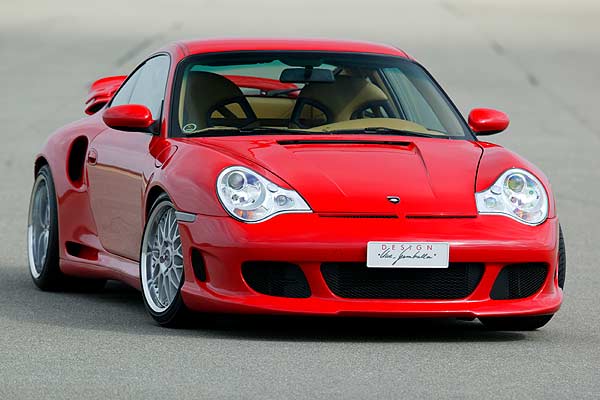
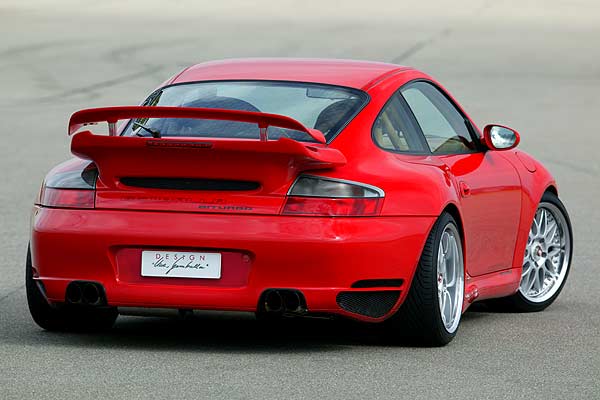
Discounting the factory components, the three major aerodynamic aids manufacturers are RUF, TechArt and Gemballa. Examples of their front and rear aids are shown below. The RUF pictures are from Andrew. The TechArt rear is courtesy of EVO's wesite.
Gemballa Front:
Ruf Front:

TechArt Front:

Gemballa Rear:
RUF Rear:
TechArt Rear:

Based upon a visual review of the nuances of each component, my opinions are as follows:
Front:
I believe the TechArt will yield both the greatest downforce and the greatest drag. I believe the Ruf will be second in both aspects and the Gemballa third.
Rear:
I believe the TechArt will yield both the greatest downforce and the greatest drag. I believe the Gemballa will be second in both aspects and the RUF third.
So, to answer your original question Buddy, I believe, on a purely relative basis, that the combination of the Gemballa rear and RUF front aids will probably be a good combination. I have also seen the RUF articulated rear wing (in lieu of the factory wing) used on the hydraulic actuators.
Disclaimer:
The aforementioned statements are only my opinions based upon many years of designing buildings and structures for wind and hurricane loads. Part of this work was the review of test results of scaled building models subjected to wind tunnels tests. Although buildings and cars differ, certain key aspects of wind effects can be carried over between the two engineering industries. Readers must draw their own conclusions.
There is no question that Porsche does wind tunnel testing. Obviously this is limited to the products they provide on factory cars. There are several variables that come into play with Posche's testing; choices of aerodynamic aids and choices of car ride heights. The aerodynamic aids are stock turbo, and turbo with aerokit. The ride heights are USA and ROW. That makes four combinations. The GT2 iteration has its own aerodynamic aids and its own ride height. Presumably, Porsche has wind tunnel tested all five iterations of the turbo in the wind tunnel.
Wind tunnel testing reveals several things:
- Lift at the front and rear axles.
- Overall coefficient of drag (Cd).
- Global and local laminar or turbulent effects.
Since many of us have lowered our cars, and due to my research among board members, usually to a height in close approximation of the GT2, it is appropriate to use the GT2 as a basis for comparison of aerodynamics. The reason for this is that the airflow under the car is going to be roughly similar. It then becomes a comparison of aerodynamics.
Before making comparisons of the available components (front spoilers and wings) it makes sense to understand the nature of airflow over and under our cars. There are two basic effects occurring. The first is global, the second is local. The global effect is that of an airplane wing. You have a basically curved upper body profile with a flat bottom. Like an airplane wing, wind must be redirected under and over the body (global wing) Since the top surface is is curved, the airflow takes a longer period of time to pass from the nose to the tail. Since the bottom of the car is flat, the airflow takes a shorter amount of time to pass from the nose to the tail. Conventional wisdom would relate this to an airplane wing and there say less pressure on top, higher pressure beneath=lift. Not exactly true. An airplane wing has a great deal of free space above and below it. In that case, the theory holds water. In the case of a car, the top has a great deal of free space above it but the bottom has a severely confined space bounded by the road surface and the bottom of the car. If anyone hasn't seen the bottom of this car, they should look. It is flat......dead flat. This affects the passage of air. There are a few effects (venturi effect, surface friction and pressure head) which I will not get into in the interest of keeping this palatable.
The local effects are simple physics. The reactions to applied wind forces. An anology is in order. Recall the days of your youth when you would stick your hand out of the car window while your parents were driving. You would angle your hand up or down and your hand would rise or fall accordingly. Basically, the forward wind force acts on your hand and your hand "reacts" with two components X and Y. X pushes your hand back from the direct force of the wind and Y pushes your hand up or down depending on which way it is oriented.
In an ideal world, you would want the car to have zero lift front and rear and the lowest drag coefficient possible. As an example, this is part of the reason RUF's Yellowbird is not a widebody car.
Discounting the factory components, the three major aerodynamic aids manufacturers are RUF, TechArt and Gemballa. Examples of their front and rear aids are shown below. The RUF pictures are from Andrew. The TechArt rear is courtesy of EVO's wesite.
Gemballa Front:
Ruf Front:
TechArt Front:
Gemballa Rear:
RUF Rear:
TechArt Rear:
Based upon a visual review of the nuances of each component, my opinions are as follows:
Front:
I believe the TechArt will yield both the greatest downforce and the greatest drag. I believe the Ruf will be second in both aspects and the Gemballa third.
Rear:
I believe the TechArt will yield both the greatest downforce and the greatest drag. I believe the Gemballa will be second in both aspects and the RUF third.
So, to answer your original question Buddy, I believe, on a purely relative basis, that the combination of the Gemballa rear and RUF front aids will probably be a good combination. I have also seen the RUF articulated rear wing (in lieu of the factory wing) used on the hydraulic actuators.
Disclaimer:
The aforementioned statements are only my opinions based upon many years of designing buildings and structures for wind and hurricane loads. Part of this work was the review of test results of scaled building models subjected to wind tunnels tests. Although buildings and cars differ, certain key aspects of wind effects can be carried over between the two engineering industries. Readers must draw their own conclusions.
Last edited by KPV; Sep 30, 2003 at 10:48 AM.

Banned
Joined: Jul 2003
Posts: 660
Rep Power: 49
Trending Topics
Registered User
Joined: Jul 2003
Posts: 4,343
From: New Jersey
Rep Power: 199
Thanks Dan. I couldn't seem to find it. A little short on time. As a sidenote, my comments were based on seeing Sean's in the flesh and not the picture I posted. I am going to edit my post and insert Andrew's pic.
Thanks again!
Thanks again!
Thread Starter
|
Registered User
Joined: Jul 2003
Posts: 6,325
From: Michigan
Rep Power: 334
Ken,
Thank goodness for engineers such as yourself because without guys like you buildings would be falling down everywhere!
Thanks for the writeup and I think I am still leaning toward the RUF front bumper and Gemballa rear wing. However I had not seen that Gemballa front that you showed me and that is also a possiblity. Very nice looking! I also like the GT2 front bumper as well. The Techart is a little too much for me. So decisions, decisions!!
Thanks Ken!

Thank goodness for engineers such as yourself because without guys like you buildings would be falling down everywhere!
Thanks for the writeup and I think I am still leaning toward the RUF front bumper and Gemballa rear wing. However I had not seen that Gemballa front that you showed me and that is also a possiblity. Very nice looking! I also like the GT2 front bumper as well. The Techart is a little too much for me. So decisions, decisions!!
Thanks Ken!
Registered User
Joined: Jul 2003
Posts: 10,837
From: New York, NY
Rep Power: 488
Buddy for your red beast I think the RUF front and the gemballa rear would look stunning but I never was a fan of mixing and matching - The RUF front/rear would look great on the red beast butr I personally am a fan of the GT2 front and rear - I had this on my TT but you run into the "wanna be" issue there - I never care what others think but some do
Banned
Joined: Sep 2003
Posts: 480
From: Atlantic Beach to Palm Valley, FL
Rep Power: 42
Ken,
Thanks for giving us the scoop on aero mods. Do you see any issues with a non-lowered 996 TT using the GT2 aero front and rear if no 150+ MPH runs will be made?
GT2 owners who've owned 'standard' 996 TTs: how bad does the front lip get scraped compared to the non-lowered 996 TTs front lip?
Kevin
Thanks for giving us the scoop on aero mods. Do you see any issues with a non-lowered 996 TT using the GT2 aero front and rear if no 150+ MPH runs will be made?
GT2 owners who've owned 'standard' 996 TTs: how bad does the front lip get scraped compared to the non-lowered 996 TTs front lip?
Kevin
Registered User
Joined: Jul 2003
Posts: 4,343
From: New Jersey
Rep Power: 199
Originally posted by Accomplice
Ken,
Thanks for giving us the scoop on aero mods. Do you see any issues with a non-lowered 996 TT using the GT2 aero front and rear if no 150+ MPH runs will be made?
GT2 owners who've owned 'standard' 996 TTs: how bad does the front lip get scraped compared to the non-lowered 996 TTs front lip?
Kevin
Ken,
Thanks for giving us the scoop on aero mods. Do you see any issues with a non-lowered 996 TT using the GT2 aero front and rear if no 150+ MPH runs will be made?
GT2 owners who've owned 'standard' 996 TTs: how bad does the front lip get scraped compared to the non-lowered 996 TTs front lip?
Kevin


Thread
Thread Starter
Forum
Replies
Last Post