


IA 690hp street warriorz challenge SA TX

Thread Starter
|
Registered User

Joined: Oct 2007
Posts: 1,094
From: San Antonio, Texas
Rep Power: 64

IA 690hp street warriorz challenge SA TX
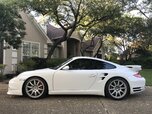
JNixon who posts in the 997tt forum wanted me to drive his car one run. Had not driven it since he had Kasper tune it to a 690hp with race fuel program. Post Jon to get the details on his car if int. Here's how I did:
5-3-08 6:30:33pm
Dial In----.oo
Reaction--.8744
60 Ft-----1.9595
330 Ft----5.1826
1/8 ET----7.7337
1/8 MPH--95.00
1000 ET--9.9979
1000 MPH-none
1/4 ET---11.7448
1/4 MPH--121.59
Finish Margin--2.3508
Winner
Accutime 11:Version 8.9.6
A few things through me a bit. First, did not know what to expect from the power increase, but found it to be extemely smooth! Second, was not used to having to go into 5th gear as in both my 996tt's I barely get into 4th. I hesitated a bit as I saw redline approaching at end of 4th and pulled back, then said what the hell slambed it back down and shifted into 5th. A week ago the car was trapping at 125mph but again I think the above mentioned hesitation caused the issue. Lots of fun though . Very tempting to get that range of hp on my stock 996tt. Sorry for the long winded dialouge, but let me know what everyone thinks?
<!-- / message --><!-- sig -->
5-3-08 6:30:33pm
Dial In----.oo
Reaction--.8744
60 Ft-----1.9595
330 Ft----5.1826
1/8 ET----7.7337
1/8 MPH--95.00
1000 ET--9.9979
1000 MPH-none
1/4 ET---11.7448
1/4 MPH--121.59
Finish Margin--2.3508
Winner
Accutime 11:Version 8.9.6
A few things through me a bit. First, did not know what to expect from the power increase, but found it to be extemely smooth! Second, was not used to having to go into 5th gear as in both my 996tt's I barely get into 4th. I hesitated a bit as I saw redline approaching at end of 4th and pulled back, then said what the hell slambed it back down and shifted into 5th. A week ago the car was trapping at 125mph but again I think the above mentioned hesitation caused the issue. Lots of fun though
. Very tempting to get that range of hp on my stock 996tt. Sorry for the long winded dialouge, but let me know what everyone thinks?<!-- / message --><!-- sig -->
Thread Starter
|
Registered User
Joined: Oct 2007
Posts: 1,094
From: San Antonio, Texas
Rep Power: 64
 .
.

Registered User
Joined: Jan 2007
Posts: 10,774
From: OR Room 5
Rep Power: 1007

Give it a rest already. Speed and power go beyond the limited universe of 0-60 and the quarter mile.


Awaiting Email Confirmation
Joined: Aug 2007
Posts: 256
From: Texas
Rep Power: 0
I saw another member post his 1/4 mile runs and he stated that he hit 121mph at the end of the run and I find that speed hard to achieve. I managed to get the car to 125mph and I believe the car could hit 128-129mph in the quarter with a good start and good shifts but that is with the 690 race turn versus a stock 997 turbo so I find it hard to believe a stock TT does 121mph. My friends 996 turbo S managed about 113mph. Maybe the track in San Antonio is slow compared to some other tracks; however, I am curious about the other times I have read about.

Registered User
Joined: Mar 2008
Posts: 1,456
From: Russia
Rep Power: 81
Yes...Good time that what is more important...
Trending Topics
Awaiting Email Confirmation
Joined: Aug 2007
Posts: 256
From: Texas
Rep Power: 0
It was a good time and my friend could have done better if he pushed it at the end of the 1/4. The biggest question I have is whether stock 997 TT could get to 121mph at the 1/4 mile mark. My car with the 690 race kit was reaching about 125 with some significant wind so I am thinking the car could reach probably 130mph but that is with the 690 kit. What is your thought GT RUS?

Registered User
Joined: Jun 2005
Posts: 8,509
From: Virginia, USA
Rep Power: 790
It was a good time and my friend could have done better if he pushed it at the end of the 1/4. The biggest question I have is whether stock 997 TT could get to 121mph at the 1/4 mile mark. My car with the 690 race kit was reaching about 125 with some significant wind so I am thinking the car could reach probably 130mph but that is with the 690 kit. What is your thought GT RUS?
Awaiting Email Confirmation
Joined: Aug 2007
Posts: 256
From: Texas
Rep Power: 0
How much power is your 996 producing? The top speed on the 1/4 run is a good indicator of the power so 126mph is very fast. Maybe the 1/4 track I am running on in San Antonio is slow. My friends 996 TT s stock could only get to 113mph and his 996 TT non-s stock could only get to 111mph. I believe my 997 TT with the 690 race tune is capable of hitting 128-130mph and that is with a stellar lauch. I also have champion wheels which are lighter and brembo brakes which are lighter than stock. I am suprised by some of the times of some of the members because of my experience on this 1/4 mile track. I have been getting better but I am not sure the car is going to do much more than 130mph. Steve Casper with Imagine Auto did my whole tune including bilsteins, clutch, intercoolers, hoses, ecm tune and brakes.
Registered User
Joined: Jun 2005
Posts: 8,509
From: Virginia, USA
Rep Power: 790
If you're intersted in learning more about 1/4 mile trap speeds relation to power and how fast some of the cars on this forum are, look here: https://www.6speedonline.com/forums/...ad.php?t=55163
Last edited by Divexxtreme; May 5, 2008 at 07:21 PM.
Awaiting Email Confirmation
Joined: Aug 2007
Posts: 256
From: Texas
Rep Power: 0
you are definetly producing some power. My goal was comparing my 1/4 mile times with other 6 speeders. I am producing 690 on race fuel with evo intercoolers, hoses, clutch, ecm tune, champion wheels and brembo brakes. I feel my car on its best day could run about 130mph in the 1/4. The top speed is an indicator of true horsepower.
Registered User
Joined: Jun 2005
Posts: 8,509
From: Virginia, USA
Rep Power: 790
I am producing 690 on race fuel with evo intercoolers, hoses, clutch, ecm tune, champion wheels and brembo brakes. I feel my car on its best day could run about 130mph in the 1/4. The top speed is an indicator of true horsepower.
Last edited by Divexxtreme; May 5, 2008 at 07:23 PM.
Awaiting Email Confirmation
Joined: Aug 2007
Posts: 256
From: Texas
Rep Power: 0
Maybe it is a weight issue but the 690 race program produces somewhere near 590 at the rear wheels. Steve Casper installed the tune and it has an Awe exhaust, evo intercoolers, boost hoses, computer tune, headers, clutch, brakes and bisteins. I believe the car could get to 130 but not 134. I am going to practice some more and I will see if I can get there. Since we are producing close to the same power I do not know why we are not hitting the same speeds. Obviously the driving is a key so I will practice. I am confident the car is producing the power but might take some time to get the car settled into the track.
Registered User
Joined: Jun 2005
Posts: 8,509
From: Virginia, USA
Rep Power: 790
Here you go. The actual threead is located here: https://www.6speedonline.com/forums/s...ad.php?t=55163
6speedonline 1/4 mile and 60-130 mph standings
<HR style="COLOR: #d1d1e1" SIZE=1><!-- / icon and title --><!-- message -->Can include any Porsche street vehicle. At the bottom of this post I also have a list of 0-100 and 60-130 times of members who've used GPS based performance computers/accelerometers to measure performance.
When comparing the below 1/4 mile numbers, please keep in mind that variances in temperature, humidity, track conditions, and especially driver ability, can have a significant impact on E.T.'s and Trap Speeds. Temperature, humidity, and user input will effect GPS based performance computer/accelerometer times as well.
For those that don't follow 1/4 mile drag racing; E.T. (Elapsed Time) is primarily a derivative of the launch, while Trap Speed (MPH achieved at the end of the run) is primarily a derivative of the amount of power being put to the ground on that specific track, that specific day. Trap Speed can be used tell you almost exactly how much hp your car is making at the wheels, assuming you use the correct calculations.
All that having been said; if you'd like a 1/4 mile run to be added to the list, please provide proof of the run. Only times from timeslips and/or video (preferably both) will be accepted for this list. No GPS based, datalogger 1/4 mile times will be accepted.
1/4 mile E.T.'s/Trap Speeds:
First, here are times for some fast production cars for comparison:
10.20 @ 142.0 - Veyron
10.80 @ 135.0 - Enzo
11.11 @ 138.0 - McLaren
11.22 @ 127.1 - C6 Z06
11.60 @ 121.1 - 997TT Tip
11.42 @ 126.5 - MB SLR McLaren
11.81 @ 124.0 - Murci LP640
996/997/CGT:
In order of E.T.:
09.67 @ 149.8 – ToddZ / RWD
09.91 @ 145.6 - Markski / RWD
10.45 @ 146.8 - Divexxtreme / RWD
10.50 @ 140.6 - Joetwint / AWD
10.62 @ 132.5 - Sharky / AWD
10.74 @ 131.7 - Hamann7 / AWD
10.77 @ 131.5 - RenntechV12 / GT2
10.82 @ 137.2 - DMK / RWD
10.83 @ 127.4 - Jamie Furman / GT2
10.84 @ 133.4 - DMaffo / AWD
10.88 @ 136.1 - Chinitowest / AWD
10.96 @ 133.2 - Cgmeredithjr / GT2
10.99 @ 127.1 – ToddZ / 997TT AWD
11.01 @ 131.7 - John D II / AWD
11.0x @ 133.9 - RUF RT-12 / RWD
11.02 @ 128.4 - Treynor / 997TT AWD
11.02 @ 127.6 – EVOMS 997TT AWD
11.03 @ 134.4 - Woodtster / AWD
11.06 @ 129.7 - 9Eleven / GT2
11.07 @ 129.2 - Gareeb / AWD
11.13 @ 124.1 – PorschePHD / AWD
11.17 @ 133.8 - sy996tt / AWD
11.1x @ 133.4 - Motor Trend / Stock Carrera GT
11.1x @ 130.1 - Roock RST AWD
11.21 @ 128.2 - Mike/A.W.E. / 997TT AWD
11.25 @ 129.8 - RennTechV12 / AWD
11.28 @ 130.7 - LuisGT3 / 997TT AWD
11.36 @ 132.0 - BuddyG / AWD
11.40 @ 125.7 - Wirx / AWD / 75 shot Nitrous
11.44 @ 124.0 - Autoaddictions / AWD (stock K16's)
11.48 @ 127.9 - AIRjordan23 / AWD
11.54 @ 123.7 - Markski / AWD
11.58 @ 122.6 - KPG / AWD
11.5x @ 126.5 - RUF R Turbo 590 HP TT (AWD)
11.60 @ 124.7 - RenntechV12 / AWD
11.64 @ 129.5 - Dr. Joe / GT2
11.64 @ 124.2 - Hartmann / AWD
11.65 @ 123.3 - Jimmer / AWD (stock K16's)
11.65 @ 126.0 - Divexxtreme / AWD (stock K16's)
11.7x @ 120.7 - Indykid / AWD
11.73 @ 124.6 - Heavychevy / AWD
11.82 @ 126.9 - TX Turbo / AWD
11.84 @ 118.7 - Powell / AWD (stock K16's)
11.86 @ 119.9 - Motor Trend / Stock 996TT X50
11.89 @ 118.8 - Cohare / AWD
11.91 @ 119.9 - Silver / AWD
11.9x @ 122.7 - RUF R Turbo 520 HP TT (RWD)
11.9x @ 116.1 - Motor Trend / Stock 996TT
12.18 @ 117.8 - Devious996TT / AWD
12.14 @ 119.3 - Rwm514 / AWD
12.1x @ 116.0 - Motor Trend / Stock 996 GT3
12.20 @ 117.3 - Sdorn / AWD
12.27 @ 115.9 - Mr.Blonde / Stock 996TT
12.32 @ 118.7 - Gtr / Stock 996TT X50
12.39 @ 114.1 - Luis95993 / Stock 996 GT3
Older model Porsches (993 and earlier):
In order of E.T.:
09.17 @ 161.x - Eddie Bello / 964C2TT
09.79 @ 146.5 - JetJox 964TT
10.5x @ 155.x - Eddie Bello / 964 C2TT
10.75 @ 135.4 - Tito / 1988 911 Carrera (Single Turbo)
11.53 @ 130.1 - AdamT / 1990 Ruf CTR Yellowbird (RWD)
11.75 @ 132.6 - Acropora / 993TT (RWD)
11.8x @ 128.2 - RUF CTR Yellow Bird 469 HP TT (RWD)
11.98 @ 122.6 - 95ONE / 944T
996/997/CGT:
In order of Trap Speed:
09.67 @ 149.8 – ToddZ / RWD
10.83 @ 148.0 - Divexxtreme / RWD
09.91 @ 145.6 - Markski / RWD
10.50 @ 140.6 - Joetwint / AWD
11.03 @ 138.4 - Chinitowest / AWD
11.10 @ 138.1 - DMK / RWD
10.76 @ 136.5 - Sharky / AWD
10.88 @ 134.7 - Joetwint / AWD
11.03 @ 134.4 - Woodtster / AWD
11.32 @ 134.3 - RennTechV12 / AWD
10.95 @ 134.x - DMaffo / AWD
10.98 @ 134.0 - Cgmeredithjr / GT2
11.0x @ 133.9 - RUF RT-12 (RWD)
11.17 @ 133.8 - sy996tt / AWD
10.92 @ 133.7 - RenntechV12 / GT2
12.00 @ 133.7 - LuisGT3 / 997TT AWD
11.1x @ 133.4 - Motor Trend / Stock Carrera GT
11.36 @ 132.0 - BuddyG / AWD
10.74 @ 131.7 - Hamann7 / AWD
11.01 @ 131.7 - John D II / AWD
11.1x @ 130.1 - Roock RST / AWD
10.88 @ 129.8 - Jamie Furman / GT2
11.06 @ 129.7 - 9Eleven / GT2
11.64 @ 129.5 - Dr. Joe / GT2
11.07 @ 129.2 - Gareeb / AWD
11.02 @ 128.4 - Treynor / 997TT AWD
11.57 @ 128.3 - AIRjordan23 / AWD
11.21 @ 128.2 - Mike/A.W.E. / 997TT AWD
11.75 @ 128.2 - KPG / AWD
11.02 @ 127.6 – EVOMS 997TT AWD
11.82 @ 126.9 - TX Turbo / AWD
11.5x @ 126.5 - RUF R Turbo 590 HP TT (AWD)
11.65 @ 126.0 - Divexxtreme / AWD (stock K16's)
11.40 @ 125.7 - Wirx / AWD / 75 shot Nitrous
11.60 @ 124.7 - RenntechV12 / AWD
11.73 @ 124.6 - Heavychevy / AWD
11.64 @ 124.2 - Hartmann / AWD
11.44 @ 124.0 - Autoaddictions / AWD (stock K16's)
11.65 @ 123.3 - Jimmer / AWD (stock K16's)
11.9x @ 122.7 - RUF R Turbo 520 HP TT (RWD)
12.22 @ 121.1 - Rwm514 / AWD
11.7x @ 120.7 - Indykid / AWD
11.91 @ 119.9 - Silver / AWD
11.86 @ 119.9 - Motor Trend / Stock 996TT X50
11.89 @ 118.8 - Cohare / AWD
11.84 @ 118.7 - Powell / AWD (stock K16's)
12.32 @ 118.7 - Gtr / Stock 996TT X50
12.3x @ 118.x - Car and Driver / Stock 996 GT3
12.18 @ 117.8 - Devious996TT / AWD
12.20 @ 117.3 - Sdorn / AWD
11.9x @ 116.1 - Motor Trend / Stock 996TT
12.27 @ 115.9 - Mr.Blonde / Stock 996TT
12.39 @ 114.1 - Luis95993 / Stock 996 GT3
Older model Porsches (993 and earlier):
In order of Trap Speed:
09.17 @ 161.x - Eddie Bello / 964C2TT
10.5x @ 155.x - Eddie Bello / 964 C2TT
09.79 @ 146.5 - JetJox 964TT
10.75 @ 135.4 - Tito / 1988 911 Carrera (Single Turbo)
11.75 @ 132.6 - Acropora / 993TT (RWD)
11.53 @ 130.1 - AdamT / 1990 Ruf CTR Yellowbird (RWD)
11.8x @ 128.2 - RUF CTR Yellow Bird 469 HP TT (RWD)
11.98 @ 122.6 - 95ONE / 944T
GPS based performance computer/accelerometer times (V-Box, Drift Box or Performance Box )
PLEASE NOTE: Only GPS based, datalogger times from V-box equipment (Driftbox, performance box, or V-box) will be accepted for this list. No extrapolated times from 1/4 mile time-slips. Also, all submitted data must be reviewed for accuracy and approved by a Subject Matter Expert (SME) before the time is posted.
Current SME's are:
Divexxtreme - Divexxtreme@hotmail.com
Accichelli - acicchelli@hotmail.com
KPG - Kpgtdg1@aol.com
*NOTE: The maximum allowed downhill slope over the course of the run is 3.0%. Any run that exceeds 3.0% will not be posted on the list.
60 -130 mph (96.5-209.2 kph):
4.74 - Divexxtreme / RWD / 2 shifts (117 octane - 1.6 BAR)
4.78 - Markski / RWD / 2 shifts
5.21 - dk996tt / 997TT AWD / 1-shift
5.52 - Divexxtreme / RWD / 2 shifts (93 octane - 1.15 BAR)
5.64 - Todd Z / RWD / 2 shifts
5.93 - OhioGT2 / GT2 / 1 shift
6.15 - DMK / RWD / 0 shifts
6.26 - Chinitowest / AWD / 1 shift
6.44 - Keithta / 997TT AWD / 1 shift
6.45 - RenntechV12 / GT2 / 0 shifts
6.68 - Dr Jitsu / GT2 / 1 shift
6.90 - Woodtster / AWD / 2 shifts
6.99 - Eclou / 997TT AWD / 1 shift
7.25 - Colorinc / AWD / 1 shift
7.83 - Torresmd / AWD / 1 shift
7.84 - 9Eleven / GT2 / 1 shift
7.89 - Pierre996TT / AWD / 0 shifts
7.93 - KPG / AWD / 1 shift
8.25 - Adam Bowles / 1 shift
8.40 - TXGold / RWD / 1 shift (stock K16's)
8.76 - Scotty slc / AWD / 1 shift
8.86 - Haudimal / 997TT AWD / Tiptronic
9.48 - Powell / AWD / 1 shift
9.53 - Woosh / AWD / 1-shift
9.54 - Roadsterdoc / AWD / 1 shift
9.56 - Topgun / AWD / 3 shifts
9.68 - Mbailey / AWD / 1 shift
10.06 - Panas001 / AWD / 1 shift
10.13 - Robertp / AWD / 2 shifts
6speed member's other cars:
4.51 - HoustonT / 880 rwhp Supra / 1 shift
5.22 - Acicchelli / 875 rwhp TT Gallardo / 1 shift
5.98 – Lil Powell / C5 Vette with big motor and NOS
7.48 - Acicchelli / Renntech SL65 AMG
7.56 - Vrybad / C5 Z06TT (APS Turbo, no cats, stock muffler, 573 rwhp @ 9.5 psi) / 1 shift
7.85 - Acicchelli / Stock LP640 / 2 shifts
7.86 - Divexxtreme / Stock C6 Z06 / 2-shifts
8.59 – Dr Jitsu / Supercharged M3 / 1 shift
12.69- Acicchelli / Cayenne Turbo S GT700
13.30- HoustonT / Stock Lexus IS-F / Sequential
For the sake of comparison, here are some 60-130 times for very fast street and production vehicles:
NOTE: Only the below runs with an asterisk (*) next to them have been verified by 6speed representive. The accuracy of the other runs can not be guaranteed.
*3.93 - 931 rwhp Supra, 88mm turbo, TH400 Auto, ET Drags
4.8 - 900 rwhp Supra (88GT47, TH400, no NOS, drag radials)
4.9 - 940 rwhp Supra (35 psi)
5.1 - 840 rwhp Supra (30 psi)
5.4 - 1,000 rwhp TT Viper
5.9 - GSXR 1000 with bolt-ons
6.1 - Saleen S7 Twin Turbo
6.9 - Mosler MT900S
7.0 - Ferrari Enzo
7.3 - Porsche Carrera GT
7.8 - Lamborghini LP640 *Acicchelli
7.8 - Chevrolet Corvette C6 Z06 *Divexxtreme
8.9 - Mercedes SLR McLaren
9.1 - Porsche 993 RUF Turbo R (100 octane)
9.4 - Lamborghini Diablo VT 6.0
9.5 - Porsche 997TT
9.5 - Ferrari F430
9.6 - Ferrari F50
*10.4 - E60 M5
10.9 - Lamborghini Murcielago
11.7 - Ferrari Challenge Stradale
12.1 - Lamborghini Gallardo
12.2 - Porsche 996TT
Here's an *excellent* post from Carver (Andrew), explaining the difference between E.T. and Trap Speed, and what they can both tell us about a car's performance capabilities and power:
Quote:
<TABLE cellSpacing=0 cellPadding=6 width="100%" border=0><TBODY><TR><TD class=alt2 style="BORDER-RIGHT: 1px inset; BORDER-TOP: 1px inset; BORDER-LEFT: 1px inset; BORDER-BOTTOM: 1px inset">Originally Posted by Carver, on 25 Oct 06
Damn, thought I'd log on and get to be a part of a good food fight......
Instead, everyone is being civil and levelheaded........
First off, I'm Andrew, the guy who was working with Scott on the formulas.
My education and background is in mechanical engineering, working in the past for Borg-Warner as an ME and currently write financial market algorithms for index mapping software on the side in addition to my day job.
Scott and I were talking about why so many of the calculators out there are wrong. After looking at the data and the formulas, I came to the conclusion that it was an issue of the formulas being written too closely to theory and without adjusting the assumptions by taking enough real world data into account. A simple way to see this is through a graphical analysis of data points.
If you look at the Hale formulas along with the graphical points shown below, you can see that a) the formula is close, but needs slope and curvature adjustments to be more accurate, and b) there aren't enough points from a variety of vehicles to represent the outcome within a reasonable statistical confidence window for most cars.
What I did was include many more data points from multiple vehicles and graph the results next to the Hale equation lines. I then rewrote the algorithms to more closely represent the real world graphical results. These formulas now work well for street vehicles in the 50-1000bhp range. Adjustments to the algorithms would have to be made for pro drag vehicles that can transfer launch energy at a statistically abnormal rate.
Regarding the trap speed vs. e.t. discussion, there are multiple ways to visualize what is happening to make it more clear. And to be fair, both sides are correct for their given questions. The problem is that the specific question in each case is not clearly defined.
Think of the difference as transferred energy to the ground in time (e.t.) and transferred energy over distance (trap speed), which are two very different ideas, as we’ll see. If it weren’t for launch energy transfer and tire capabilities ie. all of the power/energy could be transferred on the launch immediately with consistent accuracy, we wouldn’t be having this discussion as e.t. would be as representative as trap speed. But that’s not the real world.
The force available to accelerate a vehicle from a stop to the first 30-60ft. is mostly based on traction or g-force capability. That’s why a mid-hp car can have similar 60ft. times to a very high-hp car. It’s not a good indicator of hp since the max g loading of street tires is around .5-.6g no matter what you do. In first gear along with a revved engine (significant stored flywheel/crank/piston/rod/pressure plate energy) most cars have the ability to generate .5-.6+ g or break the tires loose for some distance. That’s why as one car may hook better than another, they’re still limited to approx. .5-.6g on the launch….this enables a car that has spun its tires or bogged off the line to essentially re-match the other car’s acceleration and speed, at a given distance within the .5-.6g exceedance zone, very quickly since in the lower gears it’s a traction issue and not a power issue. Notice I said speed at a distance and not speed at a time. The time already left the station, so to speak, the distance didn’t.
And here is where people get the disagreement. The time measurement is a constantly moving reference which is unaffected by the car’s performance. But distance is not ie. as you are slower than another car, you have more relative distance left but not more time left. So if you make a mistake on the launch ie. excessive spin or bog, that time measurement will be permanently changed because time marched on unaffected by your mistake. But your rate of distance coverage was changed and reduced giving you some distance to make up the mistake. And in addition, the distance where the loss took place is approx. 3% of the distance of the race, and a distance where max power could not be transferred due to the .5-.6g tire limit….as a result, speed at a snapshot time ie. 2 sec., with time continuing at the same rate, was affected but speed at a distance past the spin/slip zone, with distance traveled reduced, along with the ability to rematch .6g quickly, had little to no change. If the tire spinning/bog continued much beyond the zone where the car could no longer exceed .5-.6g acceleration, then you would start to see the reduction in trap speed in addition to the increase in e.t. as overall avg. power over distance would start being affected. But since it takes place in this “.5-.6g max zone”, the speed at time is changed but not the speed at distance. This is why e.t. is significantly affected by launch and trap speed isn’t.
Now here is where it all comes together. Both cars weight the same. Car A runs a 1.7 60ft. and turns a 12.2 @ 120mph. Car B runs a 2.0 60ft. and 12.6 @ 120mph…..what happened? Car A got a better launch enabling a .3sec better 60ft., but car B had an extra .3sec at .6g to accelerate up to car A’s speed at the 60 ft. They were both going approx. the same speed after the 60ft., although car A reached that speed in less time, but the same distance, and have the same whp because they accelerated together after that point. Car A was able to transfer more avg. power to the ground over time ie. in 12.2 sec it had traveled farther and reached 120mph quicker but at the same distance as car B (the difference in time being in the launch energy transfer) although car B was still able to reach 120mph in the ¼ mi. distance ie. the same total power transfer with respect to distance showing whp and not transferred whp over time.
So as has been stated before, if you take the .5-.6g launch window out of the equation, and compare cars from say a 3rd. gear roll, you might as well throw away the e.t. too and go by trap speed because the e.t.'s variables are no longer in play.
1-1.2g (.5-.6/tire) and in this case a total of 1.5g of thrust....and the car is still losing traction in second gear. This is what causes e.t. to be launch dependent, or responsible for a time loss, and not responsible for a trap speed loss. Consider for a second the main point that I illuded to but didn't explain well enough in my previous post. Speed curves over distance look like 1/2 parabolic curves ie. they start off steeply vertical and than begin to shallow and converge at an asymptote as distance passes, with speed on the Y axis and distance on the X axis. One more way of saying this is that the whp of a vehicle is most influential to a car's acceleration as speed increases ie. as a greater percentage of the distance of the 1/4mi. elapses, the launch becomes a smaller percentage of the performance, and drag, and as a result whp, becomes the most significant factor. This favors a confluence or matching of trap speed, or speed at a given distance, for a given wt/whp and a lessening of the effect of the launch. This effect continues to build, throughout the run, obviously, since on a percentage basis the launch distance/total distance traveled, is decreasing at an increasing rate as speed increases while time of launch/time of run is decreasing at a fixed rate as time elapse rate is constant. This causes the et differences at the launch to be maintained while the trap differences at a given point or speed at distance tend to merge. That is your key.
</TD></TR></TBODY></TABLE>
6speedonline 1/4 mile and 60-130 mph standings
<HR style="COLOR: #d1d1e1" SIZE=1><!-- / icon and title --><!-- message -->Can include any Porsche street vehicle. At the bottom of this post I also have a list of 0-100 and 60-130 times of members who've used GPS based performance computers/accelerometers to measure performance.
When comparing the below 1/4 mile numbers, please keep in mind that variances in temperature, humidity, track conditions, and especially driver ability, can have a significant impact on E.T.'s and Trap Speeds. Temperature, humidity, and user input will effect GPS based performance computer/accelerometer times as well.
For those that don't follow 1/4 mile drag racing; E.T. (Elapsed Time) is primarily a derivative of the launch, while Trap Speed (MPH achieved at the end of the run) is primarily a derivative of the amount of power being put to the ground on that specific track, that specific day. Trap Speed can be used tell you almost exactly how much hp your car is making at the wheels, assuming you use the correct calculations.
All that having been said; if you'd like a 1/4 mile run to be added to the list, please provide proof of the run. Only times from timeslips and/or video (preferably both) will be accepted for this list. No GPS based, datalogger 1/4 mile times will be accepted.
1/4 mile E.T.'s/Trap Speeds:
First, here are times for some fast production cars for comparison:
10.20 @ 142.0 - Veyron
10.80 @ 135.0 - Enzo
11.11 @ 138.0 - McLaren
11.22 @ 127.1 - C6 Z06
11.60 @ 121.1 - 997TT Tip
11.42 @ 126.5 - MB SLR McLaren
11.81 @ 124.0 - Murci LP640
996/997/CGT:
In order of E.T.:
09.67 @ 149.8 – ToddZ / RWD
09.91 @ 145.6 - Markski / RWD
10.45 @ 146.8 - Divexxtreme / RWD
10.50 @ 140.6 - Joetwint / AWD
10.62 @ 132.5 - Sharky / AWD
10.74 @ 131.7 - Hamann7 / AWD
10.77 @ 131.5 - RenntechV12 / GT2
10.82 @ 137.2 - DMK / RWD
10.83 @ 127.4 - Jamie Furman / GT2
10.84 @ 133.4 - DMaffo / AWD
10.88 @ 136.1 - Chinitowest / AWD
10.96 @ 133.2 - Cgmeredithjr / GT2
10.99 @ 127.1 – ToddZ / 997TT AWD
11.01 @ 131.7 - John D II / AWD
11.0x @ 133.9 - RUF RT-12 / RWD
11.02 @ 128.4 - Treynor / 997TT AWD
11.02 @ 127.6 – EVOMS 997TT AWD
11.03 @ 134.4 - Woodtster / AWD
11.06 @ 129.7 - 9Eleven / GT2
11.07 @ 129.2 - Gareeb / AWD
11.13 @ 124.1 – PorschePHD / AWD
11.17 @ 133.8 - sy996tt / AWD
11.1x @ 133.4 - Motor Trend / Stock Carrera GT
11.1x @ 130.1 - Roock RST AWD
11.21 @ 128.2 - Mike/A.W.E. / 997TT AWD
11.25 @ 129.8 - RennTechV12 / AWD
11.28 @ 130.7 - LuisGT3 / 997TT AWD
11.36 @ 132.0 - BuddyG / AWD
11.40 @ 125.7 - Wirx / AWD / 75 shot Nitrous
11.44 @ 124.0 - Autoaddictions / AWD (stock K16's)
11.48 @ 127.9 - AIRjordan23 / AWD
11.54 @ 123.7 - Markski / AWD
11.58 @ 122.6 - KPG / AWD
11.5x @ 126.5 - RUF R Turbo 590 HP TT (AWD)
11.60 @ 124.7 - RenntechV12 / AWD
11.64 @ 129.5 - Dr. Joe / GT2
11.64 @ 124.2 - Hartmann / AWD
11.65 @ 123.3 - Jimmer / AWD (stock K16's)
11.65 @ 126.0 - Divexxtreme / AWD (stock K16's)
11.7x @ 120.7 - Indykid / AWD
11.73 @ 124.6 - Heavychevy / AWD
11.82 @ 126.9 - TX Turbo / AWD
11.84 @ 118.7 - Powell / AWD (stock K16's)
11.86 @ 119.9 - Motor Trend / Stock 996TT X50
11.89 @ 118.8 - Cohare / AWD
11.91 @ 119.9 - Silver / AWD
11.9x @ 122.7 - RUF R Turbo 520 HP TT (RWD)
11.9x @ 116.1 - Motor Trend / Stock 996TT
12.18 @ 117.8 - Devious996TT / AWD
12.14 @ 119.3 - Rwm514 / AWD
12.1x @ 116.0 - Motor Trend / Stock 996 GT3
12.20 @ 117.3 - Sdorn / AWD
12.27 @ 115.9 - Mr.Blonde / Stock 996TT
12.32 @ 118.7 - Gtr / Stock 996TT X50
12.39 @ 114.1 - Luis95993 / Stock 996 GT3
Older model Porsches (993 and earlier):
In order of E.T.:
09.17 @ 161.x - Eddie Bello / 964C2TT
09.79 @ 146.5 - JetJox 964TT
10.5x @ 155.x - Eddie Bello / 964 C2TT
10.75 @ 135.4 - Tito / 1988 911 Carrera (Single Turbo)
11.53 @ 130.1 - AdamT / 1990 Ruf CTR Yellowbird (RWD)
11.75 @ 132.6 - Acropora / 993TT (RWD)
11.8x @ 128.2 - RUF CTR Yellow Bird 469 HP TT (RWD)
11.98 @ 122.6 - 95ONE / 944T
996/997/CGT:
In order of Trap Speed:
09.67 @ 149.8 – ToddZ / RWD
10.83 @ 148.0 - Divexxtreme / RWD
09.91 @ 145.6 - Markski / RWD
10.50 @ 140.6 - Joetwint / AWD
11.03 @ 138.4 - Chinitowest / AWD
11.10 @ 138.1 - DMK / RWD
10.76 @ 136.5 - Sharky / AWD
10.88 @ 134.7 - Joetwint / AWD
11.03 @ 134.4 - Woodtster / AWD
11.32 @ 134.3 - RennTechV12 / AWD
10.95 @ 134.x - DMaffo / AWD
10.98 @ 134.0 - Cgmeredithjr / GT2
11.0x @ 133.9 - RUF RT-12 (RWD)
11.17 @ 133.8 - sy996tt / AWD
10.92 @ 133.7 - RenntechV12 / GT2
12.00 @ 133.7 - LuisGT3 / 997TT AWD
11.1x @ 133.4 - Motor Trend / Stock Carrera GT
11.36 @ 132.0 - BuddyG / AWD
10.74 @ 131.7 - Hamann7 / AWD
11.01 @ 131.7 - John D II / AWD
11.1x @ 130.1 - Roock RST / AWD
10.88 @ 129.8 - Jamie Furman / GT2
11.06 @ 129.7 - 9Eleven / GT2
11.64 @ 129.5 - Dr. Joe / GT2
11.07 @ 129.2 - Gareeb / AWD
11.02 @ 128.4 - Treynor / 997TT AWD
11.57 @ 128.3 - AIRjordan23 / AWD
11.21 @ 128.2 - Mike/A.W.E. / 997TT AWD
11.75 @ 128.2 - KPG / AWD
11.02 @ 127.6 – EVOMS 997TT AWD
11.82 @ 126.9 - TX Turbo / AWD
11.5x @ 126.5 - RUF R Turbo 590 HP TT (AWD)
11.65 @ 126.0 - Divexxtreme / AWD (stock K16's)
11.40 @ 125.7 - Wirx / AWD / 75 shot Nitrous
11.60 @ 124.7 - RenntechV12 / AWD
11.73 @ 124.6 - Heavychevy / AWD
11.64 @ 124.2 - Hartmann / AWD
11.44 @ 124.0 - Autoaddictions / AWD (stock K16's)
11.65 @ 123.3 - Jimmer / AWD (stock K16's)
11.9x @ 122.7 - RUF R Turbo 520 HP TT (RWD)
12.22 @ 121.1 - Rwm514 / AWD
11.7x @ 120.7 - Indykid / AWD
11.91 @ 119.9 - Silver / AWD
11.86 @ 119.9 - Motor Trend / Stock 996TT X50
11.89 @ 118.8 - Cohare / AWD
11.84 @ 118.7 - Powell / AWD (stock K16's)
12.32 @ 118.7 - Gtr / Stock 996TT X50
12.3x @ 118.x - Car and Driver / Stock 996 GT3
12.18 @ 117.8 - Devious996TT / AWD
12.20 @ 117.3 - Sdorn / AWD
11.9x @ 116.1 - Motor Trend / Stock 996TT
12.27 @ 115.9 - Mr.Blonde / Stock 996TT
12.39 @ 114.1 - Luis95993 / Stock 996 GT3
Older model Porsches (993 and earlier):
In order of Trap Speed:
09.17 @ 161.x - Eddie Bello / 964C2TT
10.5x @ 155.x - Eddie Bello / 964 C2TT
09.79 @ 146.5 - JetJox 964TT
10.75 @ 135.4 - Tito / 1988 911 Carrera (Single Turbo)
11.75 @ 132.6 - Acropora / 993TT (RWD)
11.53 @ 130.1 - AdamT / 1990 Ruf CTR Yellowbird (RWD)
11.8x @ 128.2 - RUF CTR Yellow Bird 469 HP TT (RWD)
11.98 @ 122.6 - 95ONE / 944T
GPS based performance computer/accelerometer times (V-Box, Drift Box or Performance Box )
PLEASE NOTE: Only GPS based, datalogger times from V-box equipment (Driftbox, performance box, or V-box) will be accepted for this list. No extrapolated times from 1/4 mile time-slips. Also, all submitted data must be reviewed for accuracy and approved by a Subject Matter Expert (SME) before the time is posted.
Current SME's are:
Divexxtreme - Divexxtreme@hotmail.com
Accichelli - acicchelli@hotmail.com
KPG - Kpgtdg1@aol.com
*NOTE: The maximum allowed downhill slope over the course of the run is 3.0%. Any run that exceeds 3.0% will not be posted on the list.
60 -130 mph (96.5-209.2 kph):
4.74 - Divexxtreme / RWD / 2 shifts (117 octane - 1.6 BAR)
4.78 - Markski / RWD / 2 shifts
5.21 - dk996tt / 997TT AWD / 1-shift
5.52 - Divexxtreme / RWD / 2 shifts (93 octane - 1.15 BAR)
5.64 - Todd Z / RWD / 2 shifts
5.93 - OhioGT2 / GT2 / 1 shift
6.15 - DMK / RWD / 0 shifts
6.26 - Chinitowest / AWD / 1 shift
6.44 - Keithta / 997TT AWD / 1 shift
6.45 - RenntechV12 / GT2 / 0 shifts
6.68 - Dr Jitsu / GT2 / 1 shift
6.90 - Woodtster / AWD / 2 shifts
6.99 - Eclou / 997TT AWD / 1 shift
7.25 - Colorinc / AWD / 1 shift
7.83 - Torresmd / AWD / 1 shift
7.84 - 9Eleven / GT2 / 1 shift
7.89 - Pierre996TT / AWD / 0 shifts
7.93 - KPG / AWD / 1 shift
8.25 - Adam Bowles / 1 shift
8.40 - TXGold / RWD / 1 shift (stock K16's)
8.76 - Scotty slc / AWD / 1 shift
8.86 - Haudimal / 997TT AWD / Tiptronic
9.48 - Powell / AWD / 1 shift
9.53 - Woosh / AWD / 1-shift
9.54 - Roadsterdoc / AWD / 1 shift
9.56 - Topgun / AWD / 3 shifts
9.68 - Mbailey / AWD / 1 shift
10.06 - Panas001 / AWD / 1 shift
10.13 - Robertp / AWD / 2 shifts
6speed member's other cars:
4.51 - HoustonT / 880 rwhp Supra / 1 shift
5.22 - Acicchelli / 875 rwhp TT Gallardo / 1 shift
5.98 – Lil Powell / C5 Vette with big motor and NOS
7.48 - Acicchelli / Renntech SL65 AMG
7.56 - Vrybad / C5 Z06TT (APS Turbo, no cats, stock muffler, 573 rwhp @ 9.5 psi) / 1 shift
7.85 - Acicchelli / Stock LP640 / 2 shifts
7.86 - Divexxtreme / Stock C6 Z06 / 2-shifts
8.59 – Dr Jitsu / Supercharged M3 / 1 shift
12.69- Acicchelli / Cayenne Turbo S GT700
13.30- HoustonT / Stock Lexus IS-F / Sequential
For the sake of comparison, here are some 60-130 times for very fast street and production vehicles:
NOTE: Only the below runs with an asterisk (*) next to them have been verified by 6speed representive. The accuracy of the other runs can not be guaranteed.
*3.93 - 931 rwhp Supra, 88mm turbo, TH400 Auto, ET Drags
4.8 - 900 rwhp Supra (88GT47, TH400, no NOS, drag radials)
4.9 - 940 rwhp Supra (35 psi)
5.1 - 840 rwhp Supra (30 psi)
5.4 - 1,000 rwhp TT Viper
5.9 - GSXR 1000 with bolt-ons
6.1 - Saleen S7 Twin Turbo
6.9 - Mosler MT900S
7.0 - Ferrari Enzo
7.3 - Porsche Carrera GT
7.8 - Lamborghini LP640 *Acicchelli
7.8 - Chevrolet Corvette C6 Z06 *Divexxtreme
8.9 - Mercedes SLR McLaren
9.1 - Porsche 993 RUF Turbo R (100 octane)
9.4 - Lamborghini Diablo VT 6.0
9.5 - Porsche 997TT
9.5 - Ferrari F430
9.6 - Ferrari F50
*10.4 - E60 M5
10.9 - Lamborghini Murcielago
11.7 - Ferrari Challenge Stradale
12.1 - Lamborghini Gallardo
12.2 - Porsche 996TT
Here's an *excellent* post from Carver (Andrew), explaining the difference between E.T. and Trap Speed, and what they can both tell us about a car's performance capabilities and power:
Quote:
<TABLE cellSpacing=0 cellPadding=6 width="100%" border=0><TBODY><TR><TD class=alt2 style="BORDER-RIGHT: 1px inset; BORDER-TOP: 1px inset; BORDER-LEFT: 1px inset; BORDER-BOTTOM: 1px inset">Originally Posted by Carver, on 25 Oct 06
Damn, thought I'd log on and get to be a part of a good food fight......
Instead, everyone is being civil and levelheaded........
First off, I'm Andrew, the guy who was working with Scott on the formulas.
My education and background is in mechanical engineering, working in the past for Borg-Warner as an ME and currently write financial market algorithms for index mapping software on the side in addition to my day job.
Scott and I were talking about why so many of the calculators out there are wrong. After looking at the data and the formulas, I came to the conclusion that it was an issue of the formulas being written too closely to theory and without adjusting the assumptions by taking enough real world data into account. A simple way to see this is through a graphical analysis of data points.
If you look at the Hale formulas along with the graphical points shown below, you can see that a) the formula is close, but needs slope and curvature adjustments to be more accurate, and b) there aren't enough points from a variety of vehicles to represent the outcome within a reasonable statistical confidence window for most cars.
What I did was include many more data points from multiple vehicles and graph the results next to the Hale equation lines. I then rewrote the algorithms to more closely represent the real world graphical results. These formulas now work well for street vehicles in the 50-1000bhp range. Adjustments to the algorithms would have to be made for pro drag vehicles that can transfer launch energy at a statistically abnormal rate.
Regarding the trap speed vs. e.t. discussion, there are multiple ways to visualize what is happening to make it more clear. And to be fair, both sides are correct for their given questions. The problem is that the specific question in each case is not clearly defined.
Think of the difference as transferred energy to the ground in time (e.t.) and transferred energy over distance (trap speed), which are two very different ideas, as we’ll see. If it weren’t for launch energy transfer and tire capabilities ie. all of the power/energy could be transferred on the launch immediately with consistent accuracy, we wouldn’t be having this discussion as e.t. would be as representative as trap speed. But that’s not the real world.
The force available to accelerate a vehicle from a stop to the first 30-60ft. is mostly based on traction or g-force capability. That’s why a mid-hp car can have similar 60ft. times to a very high-hp car. It’s not a good indicator of hp since the max g loading of street tires is around .5-.6g no matter what you do. In first gear along with a revved engine (significant stored flywheel/crank/piston/rod/pressure plate energy) most cars have the ability to generate .5-.6+ g or break the tires loose for some distance. That’s why as one car may hook better than another, they’re still limited to approx. .5-.6g on the launch….this enables a car that has spun its tires or bogged off the line to essentially re-match the other car’s acceleration and speed, at a given distance within the .5-.6g exceedance zone, very quickly since in the lower gears it’s a traction issue and not a power issue. Notice I said speed at a distance and not speed at a time. The time already left the station, so to speak, the distance didn’t.
And here is where people get the disagreement. The time measurement is a constantly moving reference which is unaffected by the car’s performance. But distance is not ie. as you are slower than another car, you have more relative distance left but not more time left. So if you make a mistake on the launch ie. excessive spin or bog, that time measurement will be permanently changed because time marched on unaffected by your mistake. But your rate of distance coverage was changed and reduced giving you some distance to make up the mistake. And in addition, the distance where the loss took place is approx. 3% of the distance of the race, and a distance where max power could not be transferred due to the .5-.6g tire limit….as a result, speed at a snapshot time ie. 2 sec., with time continuing at the same rate, was affected but speed at a distance past the spin/slip zone, with distance traveled reduced, along with the ability to rematch .6g quickly, had little to no change. If the tire spinning/bog continued much beyond the zone where the car could no longer exceed .5-.6g acceleration, then you would start to see the reduction in trap speed in addition to the increase in e.t. as overall avg. power over distance would start being affected. But since it takes place in this “.5-.6g max zone”, the speed at time is changed but not the speed at distance. This is why e.t. is significantly affected by launch and trap speed isn’t.
Now here is where it all comes together. Both cars weight the same. Car A runs a 1.7 60ft. and turns a 12.2 @ 120mph. Car B runs a 2.0 60ft. and 12.6 @ 120mph…..what happened? Car A got a better launch enabling a .3sec better 60ft., but car B had an extra .3sec at .6g to accelerate up to car A’s speed at the 60 ft. They were both going approx. the same speed after the 60ft., although car A reached that speed in less time, but the same distance, and have the same whp because they accelerated together after that point. Car A was able to transfer more avg. power to the ground over time ie. in 12.2 sec it had traveled farther and reached 120mph quicker but at the same distance as car B (the difference in time being in the launch energy transfer) although car B was still able to reach 120mph in the ¼ mi. distance ie. the same total power transfer with respect to distance showing whp and not transferred whp over time.
So as has been stated before, if you take the .5-.6g launch window out of the equation, and compare cars from say a 3rd. gear roll, you might as well throw away the e.t. too and go by trap speed because the e.t.'s variables are no longer in play.
1-1.2g (.5-.6/tire) and in this case a total of 1.5g of thrust....and the car is still losing traction in second gear. This is what causes e.t. to be launch dependent, or responsible for a time loss, and not responsible for a trap speed loss. Consider for a second the main point that I illuded to but didn't explain well enough in my previous post. Speed curves over distance look like 1/2 parabolic curves ie. they start off steeply vertical and than begin to shallow and converge at an asymptote as distance passes, with speed on the Y axis and distance on the X axis. One more way of saying this is that the whp of a vehicle is most influential to a car's acceleration as speed increases ie. as a greater percentage of the distance of the 1/4mi. elapses, the launch becomes a smaller percentage of the performance, and drag, and as a result whp, becomes the most significant factor. This favors a confluence or matching of trap speed, or speed at a given distance, for a given wt/whp and a lessening of the effect of the launch. This effect continues to build, throughout the run, obviously, since on a percentage basis the launch distance/total distance traveled, is decreasing at an increasing rate as speed increases while time of launch/time of run is decreasing at a fixed rate as time elapse rate is constant. This causes the et differences at the launch to be maintained while the trap differences at a given point or speed at distance tend to merge. That is your key.
</TD></TR></TBODY></TABLE>