


What do you do to smoothen out the flat spot?

Thread Starter
|
Registered User
Joined: Jan 2009
Posts: 117
From: HK
Rep Power: 22

What do you do to smoothen out the flat spot?
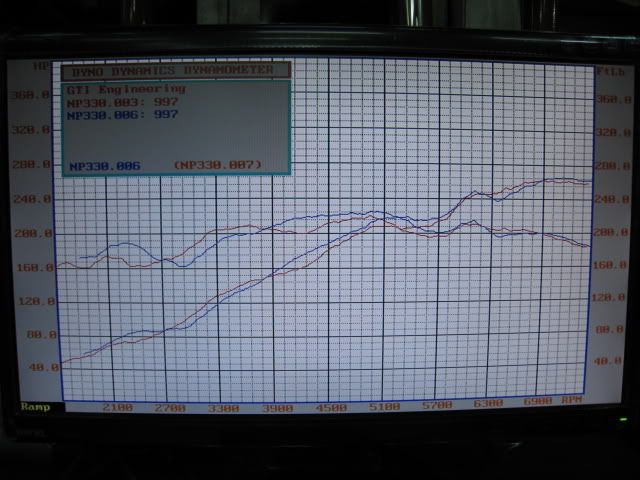
The above shows a recent dyno run I did for my 997S. As illustrated, there's a flat spot of torque delivery at around 3000rpm, which is noticeable while driving.
So what can we do to smoothen out the flat spot? Any thoughts?



Thread Starter
|
Registered User
Joined: Jan 2009
Posts: 117
From: HK
Rep Power: 22
Thanks guys for the inputs!
The car has got Europipe and that's all. There's no mod to the ECU nor air intake, just the exhaust.
For those who's not familiar with Europipe, it involves a set of X51 headers, 100-cell cats and mufflers. See below:

The dyno was done right after the exhaust installation.
For this, anything we can do about it?
The car has got Europipe and that's all. There's no mod to the ECU nor air intake, just the exhaust.
For those who's not familiar with Europipe, it involves a set of X51 headers, 100-cell cats and mufflers. See below:
The dyno was done right after the exhaust installation.
For this, anything we can do about it?
Last edited by ellistai; Jun 16, 2009 at 08:27 PM.

Registered User
Joined: Jun 2008
Posts: 110
From: LOS ANGELES
Rep Power: 23
i have the same mods on my 997s, with no mods to the intake or exhaust. i recommend a ecu flash "giac" ie. also what gear did you do the dyno pull in?
Trending Topics
Thread Starter
|
Registered User
Joined: Jan 2009
Posts: 117
From: HK
Rep Power: 22
Why GIAC? Any good?
Registered User
Joined: Jun 2008
Posts: 110
From: LOS ANGELES
Rep Power: 23
the reason i ask what gear is because, i dynoed my car in 3rd and 4th....my car made 317 rwhp on the 3rd gear pull, which was about 4 hp higher than in my 4th gear pull.
i am about to get the giac upgrade, and i to wanted to hear some more feedback from members. wanna know if its worth the upgrade.
-jason
i am about to get the giac upgrade, and i to wanted to hear some more feedback from members. wanna know if its worth the upgrade.
-jason
Registered User
Joined: Jun 2008
Posts: 110
From: LOS ANGELES
Rep Power: 23
Why GIAC? Any good?
Registered User
Joined: Jan 2008
Posts: 407
From: UK
Rep Power: 42

Having seen the full throttle mixture and timing maps for these engines, you can see where Porsche has already added a little timing and slightly enrichened the mixture at these points to try to compensate for the dips - it's already been done in other words.
This is where a single throttle plate per cylinder like the BMW 'M' motors would help. I've seen some Porsche Motorsport GT3 engines with this arrangement but don't know if a) it's ever been standard on any production Porsche engine (it certainly hasn't on the Carrera engine) or b) if anyone offers this level of tuning for a Carrera motor. Could get mightily expensive if they do......!
Thread Starter
|
Registered User
Joined: Jan 2009
Posts: 117
From: HK
Rep Power: 22
Thanks Ian.
So you are saying Porsche has done what they could cost-effectively to address the issue/characteristics of the engine? And any kind of ECU flash might shift the entire curve upward a bit but not change the curve pattern, i.e. those two dips would still be there.
Unless a custom ECU program....
So you are saying Porsche has done what they could cost-effectively to address the issue/characteristics of the engine? And any kind of ECU flash might shift the entire curve upward a bit but not change the curve pattern, i.e. those two dips would still be there.
Unless a custom ECU program....
Registered User
Joined: Aug 2004
Posts: 2,134
From: Chicagoland
Rep Power: 123
The tuning flap in the back crossover tube is controlled by the electric changeover valve which recieves it's vacuum supply from a reserve canister on top of the engine.
The tuning flap is normally open and operates as follows:
Open from 700 to 3120 rpm and from 5120 rpm .
Closed from 3120 to 5120 rpm , if the throttle is also more than 30% open at the same time.
You can modify it to stay open at all times or closed at all times or open and closed at different times. All changes will effect performance and move the power band around. In effect, you would be modifying the size of the intake.
The tuning flap is normally open and operates as follows:
Open from 700 to 3120 rpm and from 5120 rpm .
Closed from 3120 to 5120 rpm , if the throttle is also more than 30% open at the same time.
You can modify it to stay open at all times or closed at all times or open and closed at different times. All changes will effect performance and move the power band around. In effect, you would be modifying the size of the intake.
Registered User
Joined: Jan 2008
Posts: 407
From: UK
Rep Power: 42
The tuning flap in the back crossover tube is controlled by the electric changeover valve which recieves it's vacuum supply from a reserve canister on top of the engine.
The tuning flap is normally open and operates as follows:
Open from 700 to 3120 rpm and from 5120 rpm .
Closed from 3120 to 5120 rpm , if the throttle is also more than 30% open at the same time.
You can modify it to stay open at all times or closed at all times or open and closed at different times. All changes will effect performance and move the power band around. In effect, you would be modifying the size of the intake.
The tuning flap is normally open and operates as follows:
Open from 700 to 3120 rpm and from 5120 rpm .
Closed from 3120 to 5120 rpm , if the throttle is also more than 30% open at the same time.
You can modify it to stay open at all times or closed at all times or open and closed at different times. All changes will effect performance and move the power band around. In effect, you would be modifying the size of the intake.
It would be interesting to see if you could use this flap to optimise top-end power (at the expense of lower-down torque) for use on the track.
Registered User
Joined: Aug 2004
Posts: 2,134
From: Chicagoland
Rep Power: 123
Any change to the intake system will determine where PEAK torque is located. Its effect on flow due to the change in the sound waves and frequency of the air’s movement.
Most people think of an engine as an air pump, which it is, but intake air can and is FORCED past the intake valve, depending on the design of the intake system and the sound wave it produces. When the intake valve is open, this wave, traveling at the speed of sound, passes into the cylinder. When the valve closes, the wave bounces off the valve and back into the intake, again traveling at the speed of sound. When it hits the intake, the air is compressed before bouncing back towards the valve again with a different frequency and with a positive pressure.
Therefore, it is important that this positive wave to get to the intake valve at the exact time the valve is opening in order to maximize the benefits of the positive pressure. This allows for greater cylinder filling than you would otherwise have.
</SPAN>
Most people think of an engine as an air pump, which it is, but intake air can and is FORCED past the intake valve, depending on the design of the intake system and the sound wave it produces. When the intake valve is open, this wave, traveling at the speed of sound, passes into the cylinder. When the valve closes, the wave bounces off the valve and back into the intake, again traveling at the speed of sound. When it hits the intake, the air is compressed before bouncing back towards the valve again with a different frequency and with a positive pressure.
Therefore, it is important that this positive wave to get to the intake valve at the exact time the valve is opening in order to maximize the benefits of the positive pressure. This allows for greater cylinder filling than you would otherwise have.
</SPAN>

Thread
Thread Starter
Forum
Replies
Last Post
sdg1871
991 Turbo
224
Nov 22, 2015 07:27 PM
