


Vacuum Leak Fix? Bypass the Bulkhead Pipe


Thread Starter
|
Registered User
Joined: Jun 2020
Posts: 185
From: Chicago
Rep Power: 23


Vacuum Leak Fix? Bypass the Bulkhead Pipe
As per my previous thread, I have given up hope of being able to patch my vacuum lines in the bulkhead with epoxy. I am 99% sure that the leak is coming from the RH side of that hateful T connection that goes up to the center of the engine, between the LH and RH intake manifold vacuum lines. No matter how much epoxy I've lathered around the area- still smoke. Very frustrating and seems to be the main cause of vacuum leaks in these cars. The Intake lines seem to be very thick and without those nasty T connectors, and the other T connection is much closer to the wheel arch and easily accessible, if needed in the future.
So I am thinking of using @Stevieshutts method and replacing the bulkhead pipe, bypassing the very worst of the inaccessible vacuum leaks. And as per @Johnny Hotspur GT 's video, I need to make sure this line is still connected to the check valve for the intake manifolds. Here is my plan for my 2007 US Continental GT:
Cut the line at spot 1 or 4 as per Stevie's picture below.

Run new silicon vacuum tubing across the subframe.
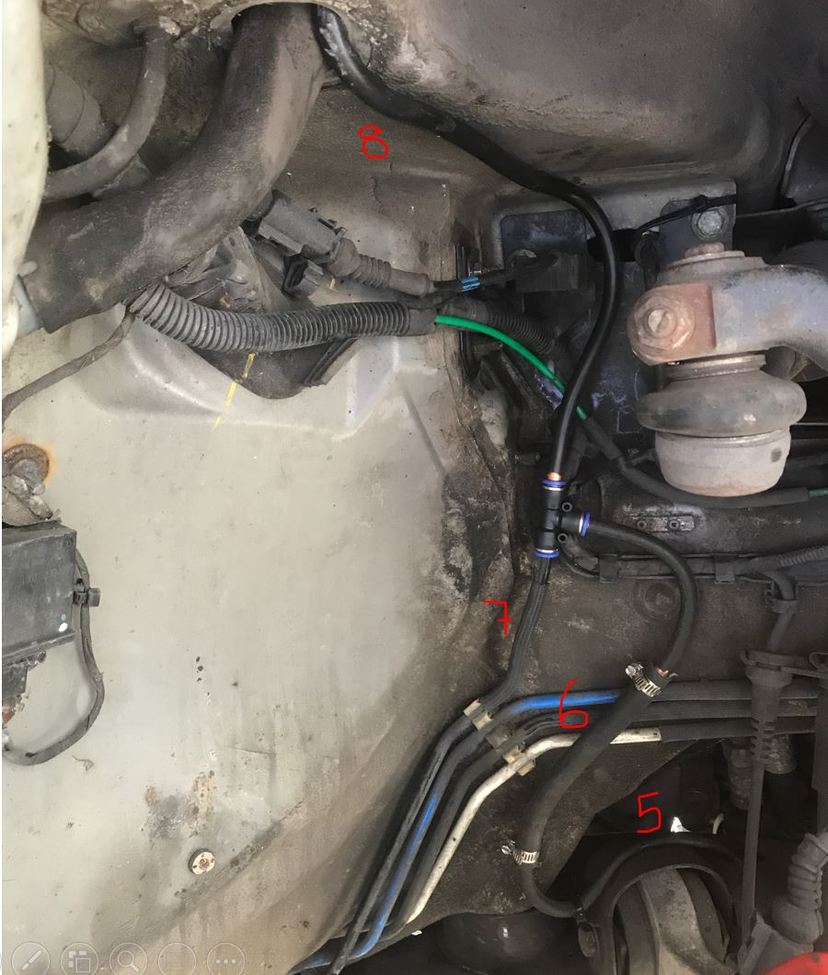
Now in the RH wheel well, cut into the vacuum line at spot 7 and install TWO T connections instead of 1, connecting the new silicon vacuum tubing to the existing vacuum line, and use the other to send the new vacuum line up through the scuttle drain valve, into the HVAC box, and up toward the engine, where I will splice in the center connection near the manifold.
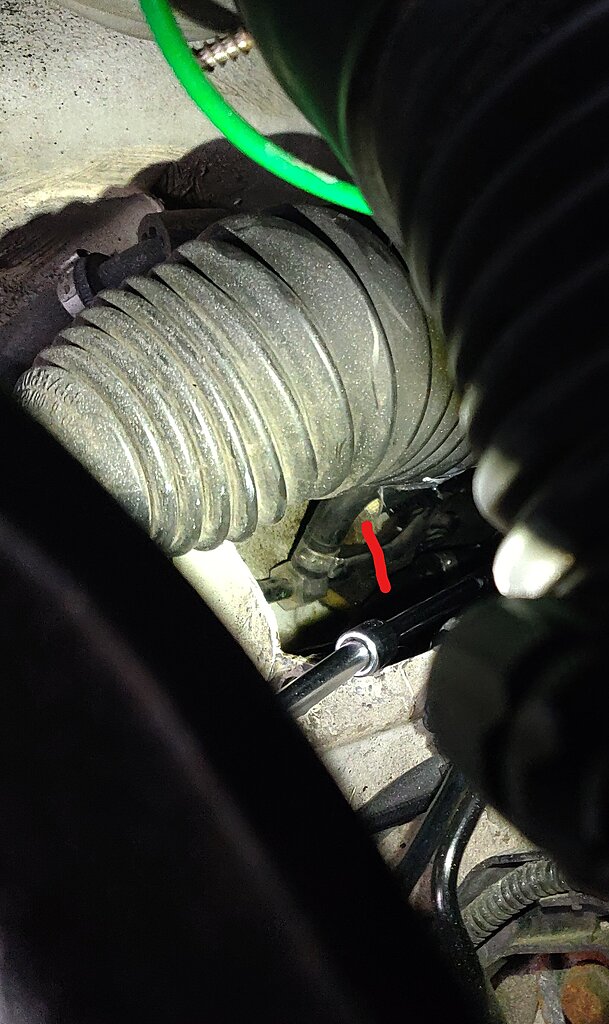
Finally, I will cut the pipe here at the red line, and cap it off. This will sever the connection with the worst of the leak culprits, yet still provide vacuum connection to the intake manifold as per @Johnny Hotspur GT 's video. Again this differs for me because Stevie has a UK spec car, and i have US, so I think his check valve to the intake manifolds are on the LH side instead of the RH side.
So I am thinking of using @Stevieshutts method and replacing the bulkhead pipe, bypassing the very worst of the inaccessible vacuum leaks. And as per @Johnny Hotspur GT 's video, I need to make sure this line is still connected to the check valve for the intake manifolds. Here is my plan for my 2007 US Continental GT:
Cut the line at spot 1 or 4 as per Stevie's picture below.
Run new silicon vacuum tubing across the subframe.
Now in the RH wheel well, cut into the vacuum line at spot 7 and install TWO T connections instead of 1, connecting the new silicon vacuum tubing to the existing vacuum line, and use the other to send the new vacuum line up through the scuttle drain valve, into the HVAC box, and up toward the engine, where I will splice in the center connection near the manifold.
Finally, I will cut the pipe here at the red line, and cap it off. This will sever the connection with the worst of the leak culprits, yet still provide vacuum connection to the intake manifold as per @Johnny Hotspur GT 's video. Again this differs for me because Stevie has a UK spec car, and i have US, so I think his check valve to the intake manifolds are on the LH side instead of the RH side.

Thread Starter
|
Registered User
Joined: Jun 2020
Posts: 185
From: Chicago
Rep Power: 23
Just fired up the car, and it works. No more leaks. No vacuum pump on brake pedal. No lumpy cold start. No engine out. Bypassed the common leak points with ~$50 in parts. An hour or two of work (not counting me dropping a screwdriver behind the engine, and messing with the hateful airboxes). Video coming soon.
Thanks to @Johnny Hotspur GT and @Stevieshutts I just saved myself seven grand.
Thanks to @Johnny Hotspur GT and @Stevieshutts I just saved myself seven grand.

Registered User


Joined: Oct 2015
Posts: 909
From: Indianapolis
Rep Power: 58
Just fired up the car, and it works. No more leaks. No vacuum pump on brake pedal. No lumpy cold start. No engine out. Bypassed the common leak points with ~$50 in parts. An hour or two of work (not counting me dropping a screwdriver behind the engine, and messing with the hateful airboxes). Video coming soon.
Thanks to @Johnny Hotspur GT and @Stevieshutts I just saved myself seven grand.
Thanks to @Johnny Hotspur GT and @Stevieshutts I just saved myself seven grand.
(I’m dead serious tho 🤣

Thread Starter
|
Registered User
Joined: Jun 2020
Posts: 185
From: Chicago
Rep Power: 23
One small issue I still need to work out.. the vacuum pump turns on for half a second when accelerating. It never did that before. It does not turn on when engine revving in park/neutral, where I assume turbo boost is not activated as the car isn't under load.
I assume that my rerouting of the line may have affected something regarding turbo boost. Certainly less annoying than having it on at all times when braking. I may do a small reroute to address, but it isn't the end of the world.
And now the engine idles lower- used to be around 650-700 and now just holds steady at exactly 500rpm. The brakes are stronger well, I know that's just perception created by the brake booster, but it is amazing how much of a difference the feel makes going from a small leak to none.
I assume that my rerouting of the line may have affected something regarding turbo boost. Certainly less annoying than having it on at all times when braking. I may do a small reroute to address, but it isn't the end of the world.
And now the engine idles lower- used to be around 650-700 and now just holds steady at exactly 500rpm. The brakes are stronger well, I know that's just perception created by the brake booster, but it is amazing how much of a difference the feel makes going from a small leak to none.
Thread Starter
|
Registered User
Joined: Jun 2020
Posts: 185
From: Chicago
Rep Power: 23
Issue fixed, I rerouted the lines again to eliminate the rearward exhaust flaps part of the line. I assume the addition of the reroute was causing just enough drop of vacuum to have the pump kick on in short bursts. After eliminating the exhaust valve line from the system (and I prefer the slightly louder tone anyway) not a single peep from that wretched pump. What a ride.
Trending Topics

Administrator
Joined: Jul 2014
Posts: 3,964
From: Montgomery NJ
Rep Power: 1002
Hi @silvertonesx24 ,
I only have one thought as to where did you plug the line that feeds vacuum to the rear of the vehicle, as, and I may be incorrect in my thinking, but, I believe that the line that runs through the front right wheel well and to the rear of the vehicle, not only supplies vacuum to the exhaust flap valves, solenoids, storage *****, etc, but it also supplies vacuum to the charcoal canister for the fuel system.
Again, I may be mistaken, but I will look tomorrow.
Johnny
I only have one thought as to where did you plug the line that feeds vacuum to the rear of the vehicle, as, and I may be incorrect in my thinking, but, I believe that the line that runs through the front right wheel well and to the rear of the vehicle, not only supplies vacuum to the exhaust flap valves, solenoids, storage *****, etc, but it also supplies vacuum to the charcoal canister for the fuel system.
Again, I may be mistaken, but I will look tomorrow.
Johnny
Thread Starter
|
Registered User
Joined: Jun 2020
Posts: 185
From: Chicago
Rep Power: 23
That's interesting.. I test drove for quite a bit, did some hard pulls, etc. I didn't notice any fuel smell yet (And I'm definitely sensitive to that after an injector nightmare on my Jaguar XJ). I wonder if it would pass emissions this way if that is indeed the case.
I followed the rearword line as far as the air suspension compressor, and it turned into two clear rubber lines that I couldn't quite trace without removing more stuff, but assumed they went to the valves from there.
It did solve my problem of the pump turning on under acceleration, but it is an easy reconnect if need be.
I followed the rearword line as far as the air suspension compressor, and it turned into two clear rubber lines that I couldn't quite trace without removing more stuff, but assumed they went to the valves from there.
It did solve my problem of the pump turning on under acceleration, but it is an easy reconnect if need be.
Thread Starter
|
Registered User
Joined: Jun 2020
Posts: 185
From: Chicago
Rep Power: 23
Hi @silvertonesx24 ,
I only have one thought as to where did you plug the line that feeds vacuum to the rear of the vehicle, as, and I may be incorrect in my thinking, but, I believe that the line that runs through the front right wheel well and to the rear of the vehicle, not only supplies vacuum to the exhaust flap valves, solenoids, storage *****, etc, but it also supplies vacuum to the charcoal canister for the fuel system.
Again, I may be mistaken, but I will look tomorrow.
Johnny
I only have one thought as to where did you plug the line that feeds vacuum to the rear of the vehicle, as, and I may be incorrect in my thinking, but, I believe that the line that runs through the front right wheel well and to the rear of the vehicle, not only supplies vacuum to the exhaust flap valves, solenoids, storage *****, etc, but it also supplies vacuum to the charcoal canister for the fuel system.
Again, I may be mistaken, but I will look tomorrow.
Johnny

Thread
Thread Starter
Forum
Replies
Last Post