


EVO Supercharger Owners' Thread


Registered User
Joined: Aug 2004
Posts: 2,134
From: Chicagoland
Rep Power: 123


Originally posted by Mother
I agree I stand corrected, I just took a look at my engine and I am always willing to learn here, I really do not see any reason for not using a vaccum line coming from the engine manifold for reading the pressure and didn't really see any adverse effect if the reading came off the vaccum line going from the manifold to the BOV and it would make for an easy install. My engine is a 3.4 and did not see any dummbie plugs however.
I agree I stand corrected, I just took a look at my engine and I am always willing to learn here, I really do not see any reason for not using a vaccum line coming from the engine manifold for reading the pressure and didn't really see any adverse effect if the reading came off the vaccum line going from the manifold to the BOV and it would make for an easy install. My engine is a 3.4 and did not see any dummbie plugs however.
Registered User
Joined: Apr 2005
Posts: 838
From: Arizona
Rep Power: 55
Had that off once and vaccum line is easier, just curious do you know if one bank runs cooler then the other bank. I was curious in regards to using one sensor or two for the average EGT readings.
Registered User
Joined: Aug 2004
Posts: 2,134
From: Chicagoland
Rep Power: 123
Originally posted by Mother
Had that off once and vaccum line is easier, just curious do you know if one bank runs cooler then the other bank. I was curious in regards to using one sensor or two for the average EGT readings.
Had that off once and vaccum line is easier, just curious do you know if one bank runs cooler then the other bank. I was curious in regards to using one sensor or two for the average EGT readings.

Thread Starter
|
Registered User
Joined: Apr 2004
Posts: 9,538
From: North Dakota
Rep Power: 504
talked to the retailer for that monitoring system. he suggested using the fuel pressure vaccum line coming off the intake manifold. much as 1999 suggested. he will supply the necessary fittings for that type of application. he also echoed what 1999 said about staying with a vacuum line after the intake manifold so that you get consistent boost readings.
the package kit comes with sensors for AF, boost, and EGT. might as well go for broke and install all three. where do you guys think would be the proper place to install the AF and EGT sensors. the retailer suggested, if i had this right, intalling the EGT sensor on the exhaust flange furthest from the TB, as that would be the hottest and worst case scenario.
the package kit comes with sensors for AF, boost, and EGT. might as well go for broke and install all three. where do you guys think would be the proper place to install the AF and EGT sensors. the retailer suggested, if i had this right, intalling the EGT sensor on the exhaust flange furthest from the TB, as that would be the hottest and worst case scenario.
Registered User
Joined: Apr 2005
Posts: 838
From: Arizona
Rep Power: 55
Sensors and Kit
Originally posted by deputydog95
talked to the retailer for that monitoring system. he suggested using the fuel pressure vaccum line coming off the intake manifold. much as 1999 suggested. he will supply the necessary fittings for that type of application. he also echoed what 1999 said about staying with a vacuum line after the intake manifold so that you get consistent boost readings.
the package kit comes with sensors for AF, boost, and EGT. might as well go for broke and install all three. where do you guys think would be the proper place to install the AF and EGT sensors. the retailer suggested, if i had this right, intalling the EGT sensor on the exhaust flange furthest from the TB, as that would be the hottest and worst case scenario.
talked to the retailer for that monitoring system. he suggested using the fuel pressure vaccum line coming off the intake manifold. much as 1999 suggested. he will supply the necessary fittings for that type of application. he also echoed what 1999 said about staying with a vacuum line after the intake manifold so that you get consistent boost readings.
the package kit comes with sensors for AF, boost, and EGT. might as well go for broke and install all three. where do you guys think would be the proper place to install the AF and EGT sensors. the retailer suggested, if i had this right, intalling the EGT sensor on the exhaust flange furthest from the TB, as that would be the hottest and worst case scenario.
Last edited by Mother; Mar 14, 2006 at 08:17 PM.
Thread Starter
|
Registered User
Joined: Apr 2004
Posts: 9,538
From: North Dakota
Rep Power: 504
They supply one, but it can be run on two. The only catch is that you can't use the display then. You would have to just use a laptop and datalog. From the way I understood it, you are just subbing one of the sensors on the sending unit for two EGT's. I'm pretty sure one EGT and one properly placed AF sensor would suffice.
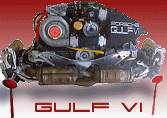
That is a nice clean motor. I like polished mufflers, but I can never understand why they make they that way for our cars as you can't see the mufflers once they're installed.
That is a nice clean motor. I like polished mufflers, but I can never understand why they make they that way for our cars as you can't see the mufflers once they're installed.

Registered User
Joined: May 2005
Posts: 252
Rep Power: 32
1999 is right on regarding the placement of the pressure reading. You definitely want a manifold source.
Personally I'm a strong proponent of A/F reading. It's important to distinguish the difference between a wideband and narrowband reading. Most naturally aspirated engined cars are supplied with narrowband sensors that are only accurate in the local region of 14.7:1 AFR. I'm not sure on Porsche, but I'd guess it's narrowband. For forced induction engines you definitely need to use a wideband sensor that can read richer conditions than stoichometric. The zeitronix setup is pretty good and I was considering them but I wasn't too hot on the display so I went a different direction.
I'm not sure where I'd put the EGT and AFR probe on the Porsche engine. Ideally you'd know which cylinders tend to run the leanest and mount it there. Perhaps someone more familiar with the engine can help you out there. I thought I recalled that most Porsche engines had fairly non-uniform flow rates to each cylinder creating some real differences but don't hold me to that.
Personally I'm a strong proponent of A/F reading. It's important to distinguish the difference between a wideband and narrowband reading. Most naturally aspirated engined cars are supplied with narrowband sensors that are only accurate in the local region of 14.7:1 AFR. I'm not sure on Porsche, but I'd guess it's narrowband. For forced induction engines you definitely need to use a wideband sensor that can read richer conditions than stoichometric. The zeitronix setup is pretty good and I was considering them but I wasn't too hot on the display so I went a different direction.
I'm not sure where I'd put the EGT and AFR probe on the Porsche engine. Ideally you'd know which cylinders tend to run the leanest and mount it there. Perhaps someone more familiar with the engine can help you out there. I thought I recalled that most Porsche engines had fairly non-uniform flow rates to each cylinder creating some real differences but don't hold me to that.
Thread Starter
|
Registered User
Joined: Apr 2004
Posts: 9,538
From: North Dakota
Rep Power: 504
I think you're correct on that Uber. The trick would be to find the worst case scenario cylinder and sensor that one. that way you'd know the other five would have to be better than that one 
Which route did you go with your gauges?
Which route did you go with your gauges?
Registered User
Joined: May 2005
Posts: 252
Rep Power: 32
I have not modified my 996 and so do not have any gauges on that car. On my turbocharged Supra I used the blitz DTT turbo timer and boost gauge plumbed to the intake manifold and the plx devices AFR reading just after the turbo (so all the cylinders had already merged). I actually have a plx devices unit with ~1000 miles on it for sale if you have any interest, but this unit only handles AFR so if you're looking for an all in one unit the zeitronix may be a better bet. PLX does make an all in once unit but I'm not hot on the packaging.
You may also want to give some thought to which AFR sensor the units use. Although the bosch sensor is much less expensive many people believe the NTK sensor is much more durable (particularly if you ever run leaded fuel). I felt okay with the bosch sensor and figured I'd replace it if necessary since it's almost a 3x price difference.
You may also want to give some thought to which AFR sensor the units use. Although the bosch sensor is much less expensive many people believe the NTK sensor is much more durable (particularly if you ever run leaded fuel). I felt okay with the bosch sensor and figured I'd replace it if necessary since it's almost a 3x price difference.
Last edited by Ubermensch; Nov 5, 2005 at 09:59 AM.
Registered User
Joined: Apr 2005
Posts: 838
From: Arizona
Rep Power: 55
It would be nice to have 1 EGT per cylinder as if you where in a test cell and place as close to the cylinder as possible, but for the sake of being practicle? I think that one per side and placing as close where all exhaust pipes on that bank come together would work. I was trying to find out also if one bank ran cooler then the other just by design. Last time I had the spark plugs out they all looked uniform to me but I was not looking that closely for color differences. The A/F using there system-- here are there ( zeitronix) instructions:
http://www.zeitronix.com/installatio...structions.pdf
http://www.zeitronix.com/installatio...structions.pdf