


Got myself an X51 air box, GT3 throttle body, plenum, before & after dynos



Thread Starter
|
Registered User
Joined: May 2011
Posts: 272
From: UK
Rep Power: 28

Guys
Here is the stock TB vs 82mm TB with X51 airbox:-
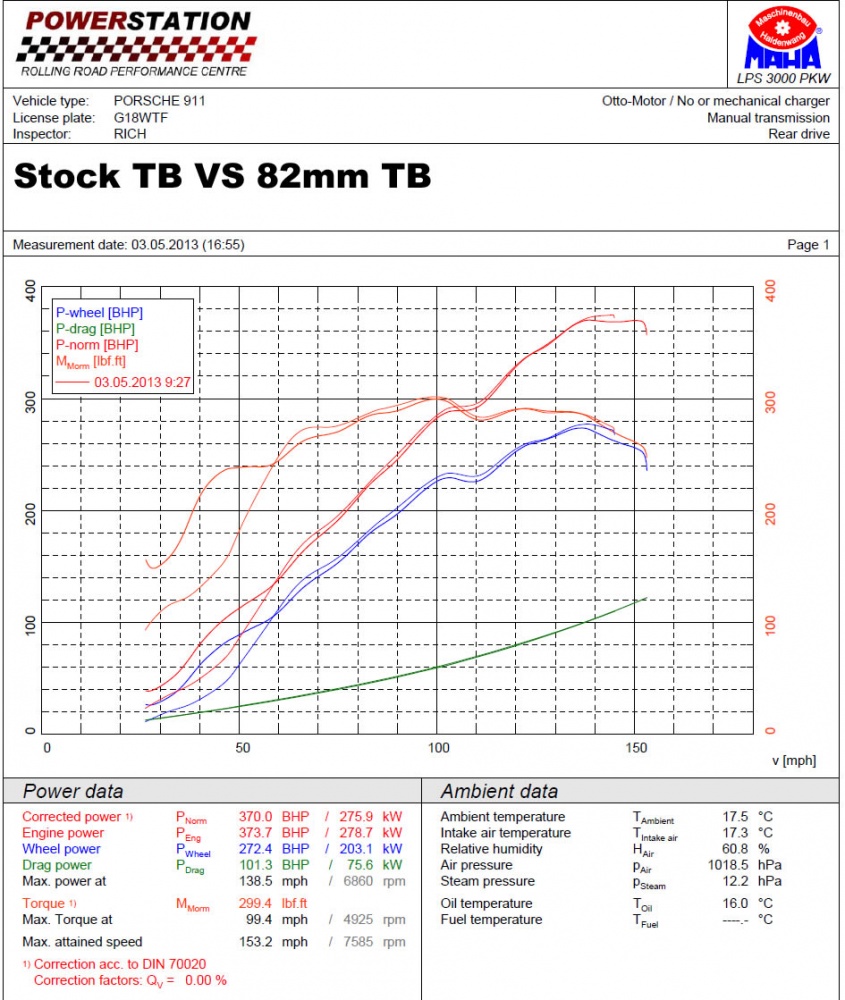
82mm makes slightly better peak power (375BHP) but looses torque/power sub 3000rpm compared to stock TB. Plenum used was EuroCup which simulates the stock T-Design, best for flat 6 engine.
Bear in mind I reckon with stock air box the 82mm would have made even better results, as it would have more fuel in the right places, so no doubt no low-down torque loss, maybe even gains.
My new tune with X51 mapping seems much better back to dyno this Friday to re-check AFR and power run.
Here is the stock TB vs 82mm TB with X51 airbox:-
82mm makes slightly better peak power (375BHP) but looses torque/power sub 3000rpm compared to stock TB. Plenum used was EuroCup which simulates the stock T-Design, best for flat 6 engine.
Bear in mind I reckon with stock air box the 82mm would have made even better results, as it would have more fuel in the right places, so no doubt no low-down torque loss, maybe even gains.
My new tune with X51 mapping seems much better back to dyno this Friday to re-check AFR and power run.
Thread Starter
|
Registered User
Joined: May 2011
Posts: 272
From: UK
Rep Power: 28
HI there
Being back to the same dyno, no graph yet, but in short the X51 map has cured the lean fuel issue.
Before WOT was 14.7 AFR upto 6000rpm with generic softronic map.
Now WOT is 12.55 AFR throughout the whole rev range with X51 softronic map.
In short now the car is running a little rich, but nothing that would cause any damage such as bore wash. But it is robbing a little power 4000rpm upwards.
Also the car gained very healthy sub 2500rpm with X51 map, no doubt because its getting fuel, hence the improves responsiveness I felt. There is a slight torque loss at 2500-3000rpm due to the flap in the vario ram being open to simulate the X51 car, for X51 map, but nothing noticeable by butt dyno.
I've emailed Scott asking if he can alter my tune to hopefully aim us towards around 13.3 - 13.5 AFR wise, this should result in best power/economy and is a safe target on an NA car.
This does however prove that those of you with X51 air boxes on stock map or regular softronic map are running very lean, which is dangerous to your engines. I'd advice you contact Scott for X51 map as it is much safer and hopefully now with a minor tweak to put a little less fuel in it shall also make more power too. Remember he does custom maps like he has for me but does charge.
My plan is when I get a tweaked map from Scott is to head back to the dyno again and do two runs:-
Run 1: Stock airbox with resonator removed and BMC filter, with regular softronic map, but with 82mm throttle body & plenum - As I believe this will make very good power in mid-range and top-end, as stock airbox flows enough and fuelling shall be spot on.
Run 2: X51 airbox with BMC filters, with Softronic X51 mapped with a little less fuel hopefully along with 82mm throttle body and plenum, so we can compare the two like for like.
I think due to how our engines flow air, that on a dyno the X51 air box probably gives no more power at all, ON A DYNO. But on the road due to having cold air rammed down two inlets, I think it does help a bit, plus it sounds amazing and looks superb!
So in short for X51 airbox owners, the softronic X51 map in its present state gives:-
- Resolves lean WOT issue, but is a little rich now at WOT.
- Improves low-down throttle response/torque
- Margin torque loss just before 3000rpm due to vario ram flap being always open to simulate X51 intake design
- Slight power loss 4000-7500rpm
Well worth it though for safety of your engine, but hopefully Scott will modify the map to take a little fuel out which should mean it makes same/more power 4000rpm upwards, making it spot on.
Being back to the same dyno, no graph yet, but in short the X51 map has cured the lean fuel issue.
Before WOT was 14.7 AFR upto 6000rpm with generic softronic map.
Now WOT is 12.55 AFR throughout the whole rev range with X51 softronic map.
In short now the car is running a little rich, but nothing that would cause any damage such as bore wash. But it is robbing a little power 4000rpm upwards.
Also the car gained very healthy sub 2500rpm with X51 map, no doubt because its getting fuel, hence the improves responsiveness I felt. There is a slight torque loss at 2500-3000rpm due to the flap in the vario ram being open to simulate the X51 car, for X51 map, but nothing noticeable by butt dyno.
I've emailed Scott asking if he can alter my tune to hopefully aim us towards around 13.3 - 13.5 AFR wise, this should result in best power/economy and is a safe target on an NA car.
This does however prove that those of you with X51 air boxes on stock map or regular softronic map are running very lean, which is dangerous to your engines. I'd advice you contact Scott for X51 map as it is much safer and hopefully now with a minor tweak to put a little less fuel in it shall also make more power too. Remember he does custom maps like he has for me but does charge.
My plan is when I get a tweaked map from Scott is to head back to the dyno again and do two runs:-
Run 1: Stock airbox with resonator removed and BMC filter, with regular softronic map, but with 82mm throttle body & plenum - As I believe this will make very good power in mid-range and top-end, as stock airbox flows enough and fuelling shall be spot on.
Run 2: X51 airbox with BMC filters, with Softronic X51 mapped with a little less fuel hopefully along with 82mm throttle body and plenum, so we can compare the two like for like.
I think due to how our engines flow air, that on a dyno the X51 air box probably gives no more power at all, ON A DYNO. But on the road due to having cold air rammed down two inlets, I think it does help a bit, plus it sounds amazing and looks superb!
So in short for X51 airbox owners, the softronic X51 map in its present state gives:-
- Resolves lean WOT issue, but is a little rich now at WOT.
- Improves low-down throttle response/torque
- Margin torque loss just before 3000rpm due to vario ram flap being always open to simulate X51 intake design
- Slight power loss 4000-7500rpm
Well worth it though for safety of your engine, but hopefully Scott will modify the map to take a little fuel out which should mean it makes same/more power 4000rpm upwards, making it spot on.
Last edited by Gibbo205; May 10, 2013 at 11:34 AM.

Registered User
Joined: Aug 2007
Posts: 1,364
From: Hawaii
Rep Power: 116

Interesting. Could you expatiate more on your thoughts as to why you think the stock T-Design plenum is better for the Flat-6 vs the IPD version?
Thread Starter
|
Registered User
Joined: May 2011
Posts: 272
From: UK
Rep Power: 28
I noticed a post on 6speed as I do not go on that forum much.* The stock design Plenum that Porsche uses is made for a very specific reason.... This being that the engine operates as two separate 3 cylinder units joined by the crank. The engine operates in pulses back and forth yet* creates a resonance that is either blocked or opened in its function. Hence why a resonance flap opens and closes at a 90 degree angle. The same wave is also generated forward to the TB section in which the waves will meet head on. This is why Porsche has used a T design for so long in the Horizontally opposed engines. Some misconceptions are in that other plenums*flow better yet keep in mind it is not an actual continual flow yet pulses back and forth from one bank to the other at a high rate of speed.
*
Another similar way to look at shock waves in relationship to the resonance generated is in the 964 or the 993. These cars have twin plug systems. These plugs both fire at opposite sides of the combustion*chamber and as a result the shock waves meet in the center and cancel each other out. Should only one plug fire at a time you get a pinging and this is the shock wave hitting the opposite side of the chamber. **
*
Now granted the intake isn't working as a combustion chamber yet the resonance and the straight or T design was for the similar reasons.
Registered User
Joined: Aug 2007
Posts: 1,364
From: Hawaii
Rep Power: 116
Thanks. Much appreciated. I wonder if that's the reason why I'm running a bit lean with my S/C. Unfortunately, I did not datalog with the stock plenum prior to changing it out for the IPD one. Well, back to the stock one for further data logging.
An explanation Scott from softronic gave me:-
I noticed a post on 6speed as I do not go on that forum much.* The stock design Plenum that Porsche uses is made for a very specific reason.... This being that the engine operates as two separate 3 cylinder units joined by the crank. The engine operates in pulses back and forth yet* creates a resonance that is either blocked or opened in its function. Hence why a resonance flap opens and closes at a 90 degree angle. The same wave is also generated forward to the TB section in which the waves will meet head on. This is why Porsche has used a T design for so long in the Horizontally opposed engines. Some misconceptions are in that other plenums*flow better yet keep in mind it is not an actual continual flow yet pulses back and forth from one bank to the other at a high rate of speed.
*
Another similar way to look at shock waves in relationship to the resonance generated is in the 964 or the 993. These cars have twin plug systems. These plugs both fire at opposite sides of the combustion*chamber and as a result the shock waves meet in the center and cancel each other out. Should only one plug fire at a time you get a pinging and this is the shock wave hitting the opposite side of the chamber. **
*
Now granted the intake isn't working as a combustion chamber yet the resonance and the straight or T design was for the similar reasons.
I noticed a post on 6speed as I do not go on that forum much.* The stock design Plenum that Porsche uses is made for a very specific reason.... This being that the engine operates as two separate 3 cylinder units joined by the crank. The engine operates in pulses back and forth yet* creates a resonance that is either blocked or opened in its function. Hence why a resonance flap opens and closes at a 90 degree angle. The same wave is also generated forward to the TB section in which the waves will meet head on. This is why Porsche has used a T design for so long in the Horizontally opposed engines. Some misconceptions are in that other plenums*flow better yet keep in mind it is not an actual continual flow yet pulses back and forth from one bank to the other at a high rate of speed.
*
Another similar way to look at shock waves in relationship to the resonance generated is in the 964 or the 993. These cars have twin plug systems. These plugs both fire at opposite sides of the combustion*chamber and as a result the shock waves meet in the center and cancel each other out. Should only one plug fire at a time you get a pinging and this is the shock wave hitting the opposite side of the chamber. **
*
Now granted the intake isn't working as a combustion chamber yet the resonance and the straight or T design was for the similar reasons.
Thread Starter
|
Registered User
Joined: May 2011
Posts: 272
From: UK
Rep Power: 28
All that effects is AFR is the tube diameter where maf inserts and the tune. So your plenum should make little/no difference to AFR.


Registered User
Joined: Dec 2007
Posts: 1,749
From: Miami
Rep Power: 125
this is the most technical x51 intake's post ever. good job!
Registered User
Joined: Mar 2011
Posts: 137
From: toronto
Rep Power: 22
good data and interesting thanks for taking the time to post up.
Just as an aside though you are not making 370+ crank hp with only 272rwhp, loss on these cars is nowhere near that high. You are closer to 330 crank with those numbers. I had mine and 3 others tested on a very high end Awd dyno 300 superflow that measures loss and we all had 50hp loss vs rwhp figures. 100hp losses happen with driven superchargers not NA motors. I know you are doing all this for data collection, tuning etc but just wanted point it out. Typical drivetain is 15-20 percent, so 272rwhp = approx 330 engine.
Just as an aside though you are not making 370+ crank hp with only 272rwhp, loss on these cars is nowhere near that high. You are closer to 330 crank with those numbers. I had mine and 3 others tested on a very high end Awd dyno 300 superflow that measures loss and we all had 50hp loss vs rwhp figures. 100hp losses happen with driven superchargers not NA motors. I know you are doing all this for data collection, tuning etc but just wanted point it out. Typical drivetain is 15-20 percent, so 272rwhp = approx 330 engine.
Thread Starter
|
Registered User
Joined: May 2011
Posts: 272
From: UK
Rep Power: 28
good data and interesting thanks for taking the time to post up.
Just as an aside though you are not making 370+ crank hp with only 272rwhp, loss on these cars is nowhere near that high. You are closer to 330 crank with those numbers. I had mine and 3 others tested on a very high end Awd dyno 300 superflow that measures loss and we all had 50hp loss vs rwhp figures. 100hp losses happen with driven superchargers not NA motors. I know you are doing all this for data collection, tuning etc but just wanted point it out. Typical drivetain is 15-20 percent, so 272rwhp = approx 330 engine.
Just as an aside though you are not making 370+ crank hp with only 272rwhp, loss on these cars is nowhere near that high. You are closer to 330 crank with those numbers. I had mine and 3 others tested on a very high end Awd dyno 300 superflow that measures loss and we all had 50hp loss vs rwhp figures. 100hp losses happen with driven superchargers not NA motors. I know you are doing all this for data collection, tuning etc but just wanted point it out. Typical drivetain is 15-20 percent, so 272rwhp = approx 330 engine.
Different dyno manufacturers work differently and I prefer a dyno which tells me my engine/flywheel power, not power at the wheels.
Registered User
Joined: Mar 2011
Posts: 137
From: toronto
Rep Power: 22
power at the wheels is all that matters as it is what drives the car. Engine hp is useless as it is computed using a set of assumptions. RWHP is what your car puts down. That said for tuning and testing your mods to see if they work either is fine as long as the variables are the same.
Last edited by hyper911; May 11, 2013 at 08:16 PM.
Thread Starter
|
Registered User
Joined: May 2011
Posts: 272
From: UK
Rep Power: 28
power at the wheels is all that matters as it is what drives the car. Engine hp is useless as it is computed using a set of assumptions. RWHP is what your car puts down. That said for tuning and testing your mods to see if they work either is fine as long as the variables are the same.
I want to know my engine power so I can see if my car is making what it made when it left the factory. You can't get this with wheel figures and a mahaa dyno does not make assumptions it calculates flywheel figure based on coast down and drag, hence it's accuracy.
Check this link:-
http://forums.vwvortex.com/showthrea...AHA-dyno-sheet
First thing we learned about using the MaHa lps 3000
Is… forgetting everything you learned about all other wheel power calculating dynos. This is what we had to do, Joe and I have been using other dynos for years to tune and test cars and we put up some resistance at first until we unlearned what we had gotten so used to.
Other dynos can only give you wheel power #s. and this is ok if all your going to do Is look for the gain from a modification compared to stock, and you don’t need or care to know what the real power is. The wheel numbers are completely arbitrary.
One of the most common miscalculations in determining horse power was guessing the drive train loss.
Most people think that there car has a certain percentage of drive train loss, in fact drive train loss is not one set percentage its multiplication, the most common example is a person that has had there car dynoed at a shop with a DynoDynamics or a Dynojet or other simalar, will say something like… my car dynoed at 280 whp and the dyno operator told me my car is approximately 25% drive train loss, so my car must have 350hp at the crank.
First question we usually ask is At what RPM. if your peak HP is at 5000 RPM then you drive train loss is much less than it is at 7000RPM so for example lets say your drive train loss is 65 hp at 5000 rpm and it is 80 at 7000RPM then you have to know what the loss is at the exact RPM that you are making your max HP, or your #s are again completely arbitrary. And with all the different wheels brakes, light weight drive lines, even tires,,.. with out the ability to dyno you driveling you have no way of knowing what your real Hp # is.
This is why we have no question about high or low reading dyno we can always throw a stock car on and compare it to the factory SAE #s
A stock e46 M3 will put between 332 and 334 crank horse power on the MaHa dyno all day, factory #s 333.0 Hp, YES its that accurate.
So sorry why do I want to use a dyno that measures wheel power for then someone to try and guess my engine power, I don't want guess work I want accuracy and the Maha dyno delivers this. It shows my car has a healthy 370BHP, somewhat better than stock and with the right AFR should be 375ish so very close to the X51 official figures.