To PCCB or not!?


Thread Starter
|
Registered User
Joined: Apr 2009
Posts: 3
From: Bucharest, Romania
Rep Power: 0

To PCCB or not!?
Hello people,
I'm looking to buy a Porsche 997 GT3 (facelift) and my biggest concern about the options is the PCCB. Now i searched the forum for my question but couldn't find a related thread!
So anyway, after i talked to my sales rep. he said that i should buy the PCCB only if i track the car and in fact buying PCCB is a bit dangerous if the car is not used on the track. I was like My obvious reaction was: What do you mean by DANGEROUS??
Then he explained that PCCB are designed to work correctly or optimal at a much higher temperature (I also knew that) and that if the brakes are not hot enough the car may very well act/brake worse than with the steel brakes! (i didn't know that). So i'm asking you is this correct? He even said that you can end up in a ditch if the brakes are not hot enough.
Also he said that if the temperature is not right for them (i assume he meant that they are not heated up at the right point) they squeal alot, which was a surprise for me.
So assuming money is not an issue (in reality it is) but for the argument's sake let's assume money is not an issue. If you would buy a 997 GT3 would you opt for PCCB if you know you're gonna track your car maximum 2-3 times per year?!
PS: Also this is new Porsche is not used as a daily driver. I have a daily driver for that matter.
PSS: Is it true that the service intervals are much longer (assuming the same abuse to steel brakes) ? What are the other advantages of PCCB (except lack of brake fade).
I'm looking to buy a Porsche 997 GT3 (facelift) and my biggest concern about the options is the PCCB. Now i searched the forum for my question but couldn't find a related thread!
So anyway, after i talked to my sales rep. he said that i should buy the PCCB only if i track the car and in fact buying PCCB is a bit dangerous if the car is not used on the track. I was like
My obvious reaction was: What do you mean by DANGEROUS??Then he explained that PCCB are designed to work correctly or optimal at a much higher temperature (I also knew that) and that if the brakes are not hot enough the car may very well act/brake worse than with the steel brakes! (i didn't know that). So i'm asking you is this correct? He even said that you can end up in a ditch if the brakes are not hot enough.
Also he said that if the temperature is not right for them (i assume he meant that they are not heated up at the right point) they squeal alot, which was a surprise for me.
So assuming money is not an issue (in reality it is) but for the argument's sake let's assume money is not an issue. If you would buy a 997 GT3 would you opt for PCCB if you know you're gonna track your car maximum 2-3 times per year?!
PS: Also this is new Porsche is not used as a daily driver. I have a daily driver for that matter.
PSS: Is it true that the service intervals are much longer (assuming the same abuse to steel brakes) ? What are the other advantages of PCCB (except lack of brake fade).

Registered User
Joined: Sep 2004
Posts: 558
From: Columbia Ca. JSA
Rep Power: 48
I don't feel PCCBs are dangerous. They are a bit sensitive and modulation may be more difficult, however I feel that they are the best breaks.
This is more for the reduction in weight which allows the suspension to work better. Mine have never made a noise and should last a long time because I don't track my car.
As far as which is better for the track; there are a lot of conflicting oppinions out there. F1 uses carbon where cost is not a factor.
There are some things about PCCBs which cant be disputed. Do to less rotational mass, acceleration would have to be better, however it may not be noticeable.
Also initial breaking will require less energy for the same reason.
Look around on those who have had both and ask them. Don't let the salesman influence your decision.
This is more for the reduction in weight which allows the suspension to work better. Mine have never made a noise and should last a long time because I don't track my car.
As far as which is better for the track; there are a lot of conflicting oppinions out there. F1 uses carbon where cost is not a factor.
There are some things about PCCBs which cant be disputed. Do to less rotational mass, acceleration would have to be better, however it may not be noticeable.
Also initial breaking will require less energy for the same reason.
Look around on those who have had both and ask them. Don't let the salesman influence your decision.
Registered User
Joined: Oct 2007
Posts: 90
From: Palos Verdes/So Cal
Rep Power: 22
Love the PCCB. Never squealed or make noises. Some said it'll last a very long (life?) time if DD with no track. Very minimum break dust accumulation on wheels, especially comparing to Bimmers. Large rotors with yellow calipers definitely have the wow factor. I have people come up to me at gas station or tire shop commenting the PCCB, but not the car.  I also believe all new Ferraris will have ceramic breaks as standard equipment?
I also believe all new Ferraris will have ceramic breaks as standard equipment?

Banned
Joined: Jan 2009
Posts: 294
From: Coral Gables
Rep Power: 32
The only drawback I've heard about PCCBs are that the rebuild costs a pretty high. If you don't plan on tracking the car often, this shouldn't be a problem. If you plan on putting a lot of track time on the car, I suggest skipping the PCCBs and going for a Brembo GT kit. Much less expensive to buy rebuild parts.

Registered User
Joined: Feb 2009
Posts: 6
From: SoCal
Rep Power: 0
Carbon-Carbon (C-C) vs. Carbon-Ceramic (CCM)
So anyway, after i talked to my sales rep. he said that i should buy the PCCB only if i track the car and in fact buying PCCB is a bit dangerous if the car is not used on the track. I was like My obvious reaction was: What do you mean by DANGEROUS??
Then he explained that PCCB are designed to work correctly or optimal at a much higher temperature (I also knew that) and that if the brakes are not hot enough the car may very well act/brake worse than with the steel brakes! (i didn't know that). So i'm asking you is this correct? He even said that you can end up in a ditch if the brakes are not hot enough.
Also he said that if the temperature is not right for them (i assume he meant that they are not heated up at the right point) they squeal alot, which was a surprise for me.
So assuming money is not an issue (in reality it is) but for the argument's sake let's assume money is not an issue. If you would buy a 997 GT3 would you opt for PCCB if you know you're gonna track your car maximum 2-3 times per year?!
PS: Also this is new Porsche is not used as a daily driver. I have a daily driver for that matter.
PSS: Is it true that the service intervals are much longer (assuming the same abuse to steel brakes) ? What are the other advantages of PCCB (except lack of brake fade).
My obvious reaction was: What do you mean by DANGEROUS??Then he explained that PCCB are designed to work correctly or optimal at a much higher temperature (I also knew that) and that if the brakes are not hot enough the car may very well act/brake worse than with the steel brakes! (i didn't know that). So i'm asking you is this correct? He even said that you can end up in a ditch if the brakes are not hot enough.
Also he said that if the temperature is not right for them (i assume he meant that they are not heated up at the right point) they squeal alot, which was a surprise for me.
So assuming money is not an issue (in reality it is) but for the argument's sake let's assume money is not an issue. If you would buy a 997 GT3 would you opt for PCCB if you know you're gonna track your car maximum 2-3 times per year?!
PS: Also this is new Porsche is not used as a daily driver. I have a daily driver for that matter.
PSS: Is it true that the service intervals are much longer (assuming the same abuse to steel brakes) ? What are the other advantages of PCCB (except lack of brake fade).

CCM's do put up with track use, but can get a bit costly if used hard for long periods of time. While they don't really wear, they will start to oxidize at extreme temperatures. The only way to check them is to put them on a scale. Once they fall below minimum weight, they must be replaced ($$$$$).
The lack of brake fade is due to the higher temperature pads that must be used in CCM systems since they force the pad and caliper to run at higher temperatures. If iron rotors are used on the track, a pad upgrade will cure brake fade. Better ducting would certainly be a good investment as well.
Service intervals will depend on driving style for the most part. With PCCB's, you can look for pad changes only (unless oxidation becomes an issue). For street driving, you may never need to replace the CCM discs.
One note: Don't ever, ever, ever let pads get down to the backing plate with CCM rotors, or you'll be replacing those very pricey discs for sure!

Registered User
Joined: Nov 2008
Posts: 253
From: Belgium
Rep Power: 28
Also don't forget the new GT3 has bigger brakes than the previous model. 380mm on the front. So it all depends on the budget. If money is not an issue, get them. If you are getting to the limit of the budget don't get them. I don't think you will miss them if you never had them. The biggest difference is the fact that the initial bite is much harder so you have push less on the pedal for the same braking, compared to steel rotors.
I didn't spec them on my GT3 on order because I find it A LOT of money and it is not as if the standard brakes won't work like they should.
I didn't spec them on my GT3 on order because I find it A LOT of money and it is not as if the standard brakes won't work like they should.
Thread Starter
|
Registered User
Joined: Apr 2009
Posts: 3
From: Bucharest, Romania
Rep Power: 0
Ok, thanks for the input so far guys. You've been really helpful and informative. I hope i'll make this forum my number one forum (coming from the bimmer world).
I wanna thanks Chris_B especially for clearing up the differences.
Till now i'm sold to the PCCB. However maybe i'm mistakes but aren't the PCCB rotors on the 997.2 GT3 the same size as the steel ones?
Any other downsides you might want to add? Like is it true that they are more prone to cracks if used intensively, not necessarily on track but let's say a lot of spirited driving on the road, if they get hot enough and a splash of water hits them?
What about the wet conditions? Do they (PCCBs) act at least at the same level as steel ones in wet conditions?
I wanna thanks Chris_B especially for clearing up the differences.
Till now i'm sold to the PCCB. However maybe i'm mistakes but aren't the PCCB rotors on the 997.2 GT3 the same size as the steel ones?
Any other downsides you might want to add? Like is it true that they are more prone to cracks if used intensively, not necessarily on track but let's say a lot of spirited driving on the road, if they get hot enough and a splash of water hits them?
What about the wet conditions? Do they (PCCBs) act at least at the same level as steel ones in wet conditions?
Trending Topics
Registered User
Joined: Sep 2004
Posts: 558
From: Columbia Ca. JSA
Rep Power: 48
First gen PCCBs were the ones that reported cracking. Second gen seems to be very good.
I was also concerned of wet performance, however I have not been able to notice and change personally. Mine has had better initial bite than standard and very easy to modulate. The biggest issue is that it’s like very light steering with good feel. You can feel what is needed and how much grip you have, however you don't dare stomp on them as stopping is still limited by traction.
I live in the mountains and did something I have never done before. I drove aggressively down hill breaking into every turn coming off of a pass on a very winding section. To my surprise the breaks had zero fade and may have even become more effective.
I was also concerned of wet performance, however I have not been able to notice and change personally. Mine has had better initial bite than standard and very easy to modulate. The biggest issue is that it’s like very light steering with good feel. You can feel what is needed and how much grip you have, however you don't dare stomp on them as stopping is still limited by traction.
I live in the mountains and did something I have never done before. I drove aggressively down hill breaking into every turn coming off of a pass on a very winding section. To my surprise the breaks had zero fade and may have even become more effective.

Registered User
Joined: Jun 2008
Posts: 166
From: Hoboken, NJ
Rep Power: 26
I'd say it is personal preference. If you've got the money go for it. But if you are going to be tracking the car a lot, I'd save the money for new pads. But i will say the lack of brake dust is really awesome.
Registered User

Joined: Apr 2008
Posts: 166
From: Covington, Louisiana
Rep Power: 39

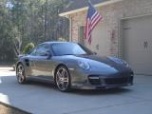
Got PCCBs on my new '08 997TT about 9 months ago. Quick summary:
- No squeal (dry or wet)
- No dust
- Excellent initial feel (dry or wet)
- Awesome stopping power - actually saved my butt recently when some idiot pulled out of a side street in front of me
- Yellow calipers (and larger front rotors) get lot's of comments
Registered User
Joined: May 2008
Posts: 111
From: NJ
Rep Power: 28
Sales rep is full of crap.
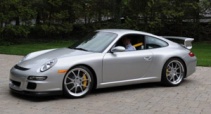
The PCCBs stop just as good as all Porsche brakes. But with great feel, and no break dust.
Mine have started to squeal. Maybe its from the 2 days of tracking I did. Not sure.
Save your money for replacements though. Or be very careful with them.
The PCCBs stop just as good as all Porsche brakes. But with great feel, and no break dust.
Mine have started to squeal. Maybe its from the 2 days of tracking I did. Not sure.
Save your money for replacements though. Or be very careful with them.

Registered User
Joined: Dec 2003
Posts: 106
From: Los Angeles. CA USA
Rep Power: 27
I've done many (~50) track days and lots of daily driving (18k) on my PCCBs. No squealing, no fade. The reduced unsprung weight is a nice advantage. I check the rotors regularly, clean out the drilled holes and change the pads as needed. I've had zero problems and recommend them highly.