


Softronic Tune for 997.2TT... First Ever PBox Run on 6Speed!

Thread Starter
|
Registered User
Joined: Apr 2010
Posts: 1,153
From: Kuwait
Rep Power: 174


 Softronic Tune for 997.2TT... First Ever PBox Run on 6Speed!
Greetings to all,
I finally flashed the car with the Softronic Tune.
I will update the tuning process thread I had started shortly.
Let me start with the before and after runs (same driver and passenger):
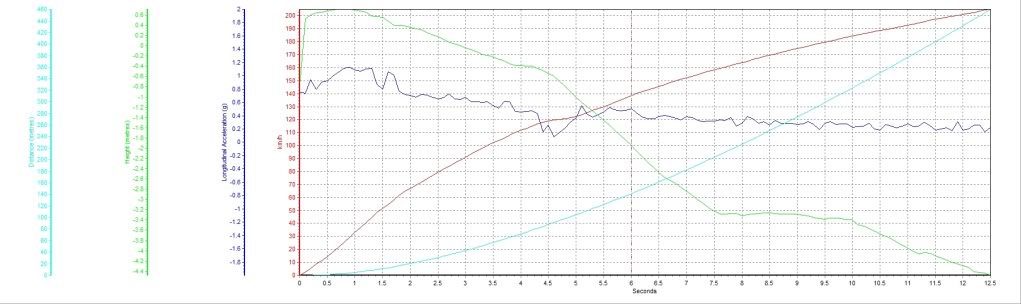
This is the run with the car still stock with only BMC Filter:
Ambients were 35*C (95*F), dry weather, 95 Octane, full tank
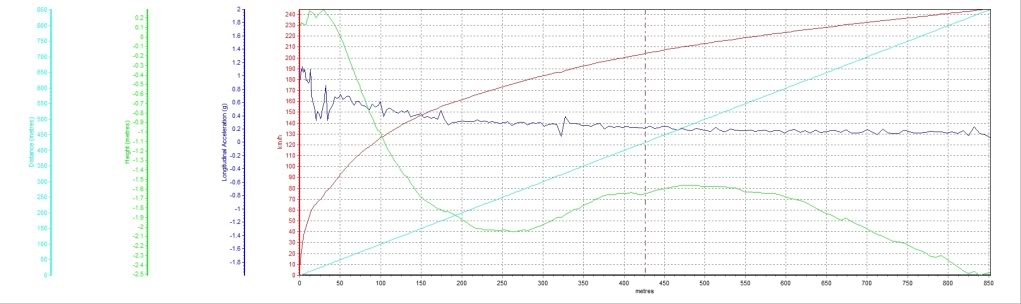
This is the run with the Softronic Flash + BMC Filter:
Ambients were 38.5*C (101.3*F), dry weather, 95 Octane, half tank
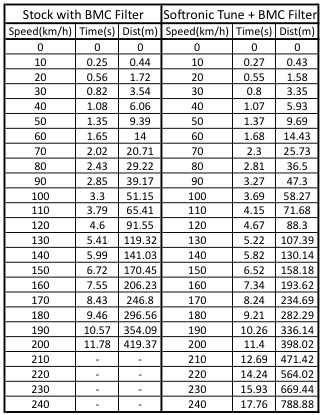
And here is the data, side-by-side:
Both runs were made as follows:
1- Sport Plus Mode
2- Gear selector in Manual
3- PSM Off
4- Air conditioning off
5- Left Foot Brake
6- WOT
7- 5k RPM
8- Launch Control lights up in steering wheel LCD
9- Side step the brake pedal
A small calculation yields the following result:
100 kph to 200 kph:
Stock + BMC = 8.48 Seconds
Tuned + BMC = 7.71 Seconds
Difference: 0.77 Seconds
0 kph to 200 kph:
Stock + BMC = 11.78 Seconds
Tuned + BMC = 11.40 Seconds
Difference: 0.38 Seconds
Frankly, I don't know what gives...
I would have thought that the 0-100 times would drop to just under 3 seconds.
The car while rolling is faster than stock. But the standing start to 100 suffered and the gain to 200 is 0.38 Seconds.
I personally feel these are modest gains...
Three questions for everyone:
1- Are these results this normal?
2- Am I mistaken that the gains are modest and my expectations are too high?
3- Am I doing something wrong?
I finally flashed the car with the Softronic Tune.
I will update the tuning process thread I had started shortly.
Let me start with the before and after runs (same driver and passenger):
This is the run with the car still stock with only BMC Filter:
Ambients were 35*C (95*F), dry weather, 95 Octane, full tank
This is the run with the Softronic Flash + BMC Filter:
Ambients were 38.5*C (101.3*F), dry weather, 95 Octane, half tank
And here is the data, side-by-side:
Both runs were made as follows:
1- Sport Plus Mode
2- Gear selector in Manual
3- PSM Off
4- Air conditioning off
5- Left Foot Brake
6- WOT
7- 5k RPM
8- Launch Control lights up in steering wheel LCD
9- Side step the brake pedal
A small calculation yields the following result:
100 kph to 200 kph:
Stock + BMC = 8.48 Seconds
Tuned + BMC = 7.71 Seconds
Difference: 0.77 Seconds
0 kph to 200 kph:
Stock + BMC = 11.78 Seconds
Tuned + BMC = 11.40 Seconds
Difference: 0.38 Seconds
Frankly, I don't know what gives...
I would have thought that the 0-100 times would drop to just under 3 seconds.
The car while rolling is faster than stock. But the standing start to 100 suffered and the gain to 200 is 0.38 Seconds.
I personally feel these are modest gains...
Three questions for everyone:
1- Are these results this normal?
2- Am I mistaken that the gains are modest and my expectations are too high?
3- Am I doing something wrong?

Thread Starter
|
Registered User
Joined: Apr 2010
Posts: 1,153
From: Kuwait
Rep Power: 174
That's possible.
The difference between the two runs is 3.5*C though. I wonder if that makes a lot of difference in performance.
It's also possible the ECU needs to be driven a bit more after the flash to fully adapt...
I only drove it for 50 Kms after the flash and then ran with the PBox.
I have to say though, other than standing start numbers, the car is noticeably faster.
Normal mode feels much quicker than before.
Boost reads 15 PSI in normal mode even in third gear and stays there until close to redline!
The car certainly feels like it is capable of delivering much better times. Hence, my confusion when I did the runs.
I will try again in a few days and with different settings...
Will post back.
The difference between the two runs is 3.5*C though. I wonder if that makes a lot of difference in performance.
It's also possible the ECU needs to be driven a bit more after the flash to fully adapt...
I only drove it for 50 Kms after the flash and then ran with the PBox.
I have to say though, other than standing start numbers, the car is noticeably faster.
Normal mode feels much quicker than before.
Boost reads 15 PSI in normal mode even in third gear and stays there until close to redline!
The car certainly feels like it is capable of delivering much better times. Hence, my confusion when I did the runs.
I will try again in a few days and with different settings...
Will post back.

Registered User
Joined: Oct 2008
Posts: 2,321
From: Fastlane USA
Rep Power: 246
Do you still have stock exhaust? If so, I think you are going to be limited in seeing any significant gains due to flow restriction which, in that heat, the ECU is likely pulling timing and boost.
Registered User
Joined: Jul 2006
Posts: 3,800
From: Tampa
Rep Power: 234
Found this thread over on rennlist.com 997 Turbo section...very interesting!
Technical data on "flashes"
Excuse the multiple posting of this:
How Porsche tuning has grown in the last 20 years is an amazing thing, I have watched it from the early days of Motronic when only a handful of people could even access the code to today when people casually talk about a “flash” as if it is something as simple as an air filter.
Those who may have read my ramblings over the years will know that I am very biased towards the tuning done by race engine builders RS Tuning who have a sophisticated, expensive engine dyno set up and many years of ongoing experience of working with that tool to produce the best performing Porsche race engines in the world. Their road engine packages benefit directly from this experience but they are hideously expensive and are only available if you buy the complete “kit” which goes against the “modular” form of tuning which has grown in this industry where for obvious reasons (which are both financial and for the fun factor) people like to bolt bits on and get a “re-flash” to suit.
We did some data logging at the airstrip a few weeks ago with some generous owners allowing me to plug the Durametrics into their cars to see what was actually happening and what exactly the “flash” was doing to their motors……
The results were quite interesting.
The ambient temperature of the day was about 17 degC
Reading the data in the pics below, unfortunately I haven’t lined up all the columns to read in the same order but you can read them if you look:
We have:
Time, this is the first column always and shows the elapsed time of when the reading is taking place, usually there is an updated reading every 10th of a second or thereabouts.
Engine speed is in RPM, sometimes you may notice that a spurious reading creeps in there – that should be considered a “spike” and not actual.
Mass air flow – this is the amount of air the engine is ingesting in kg/hr, basically the more air, the more power all else being good
IAT is intake air temperature, this is the temperature of the boosted air in the inlet tract, these cars (two 997tts and a 997GT2) work well to 55 degC which is said to be the point where timing starts to be retarded. The GT2 IAT is always higher since the GT2 runs much higher boost (1.6bar) in the inlet which is reduced by the action of the expansion intake manifold so the actual air entering the combustion chambers is not boosted so high and is cooler.
Ignition angle – this is the degree of advance which the engine is running at, basically higher advance number the better and a steady number shows a more balanced engine tune.
Vehicle speed is in KPH so for mph divide by 1.6….. so 200kph is 124mph
The lambda banks 1 & 2 are the readings from the lambda sensors and indicate the air fuel ratios. If you multiply the lambda readings by 14.7 it gives the AFR ie a 0.70 lambda is 10.29:1 AFR.
So to the data:
First up is a 997tt with sports exhaust and 200 cell cats and a “flash” from a BIG and well known German internet tuning house.
This car was fast up to 100mph setting IIRC a 3.4s 0-60mph on the way, the problem for this car was that the aggressive boost led very quickly to high IATs at 68DegC, at the gearchange 5th to 6th there is a good amount of timing advance ~14 degrees but varying quite a bit showing the ECU is working hard to keep the numbers good and AFR around 11:1 which is all good. It has a Mass air flow of 1486kg/hr peak at 6860rpm which represents the air it is using at peak power.
After the gear change the revs drop to 5521 and things start to turn nasty, the high IAT forces the ECU to take some action, the ignition advance is held way back and the mixture is richened to 10:1 to protect the motor from knock onset….. EGTs are well controlled.
This car slowed considerably over the 250kph mark in its physical acceleration and the data graphically shows us why.
Next up was a 997tt Cab with just a flash from a well know UK “flasher” who has sold a lot of his product in the UK market.
This car appeared very fast chirping its tyres as it changed 1st to second and with the owner reporting wheelspin changing 3rd to 4th gear !!! The acceleration data again showed it started to slow dramatically over 100mph.
Take a look at the data – it is not at the same speed points as the previous run because the owner was changing gear way before the red line.
So we see he changes gear 4th to 5th at 6093rpm IAT is high at 63DegC but the ECU has already been richening the mixture to cool it down with AFRs at 10:1 at the top of 4th gear.
Now checkout the chaos as 5th gear is engaged, possibly because of too high boost, the timing advance goes to pot and is all over the place even retarding the ignition for a couple of readings and the AFRs get as rich as 9.8:1 to cool things down – it appears the ECU does its job and the IAT starts falling – all this activity results in much slower acceleration.
OK so the last two were $2000 “flashes” from “tuners”. My “flash” was a program written by RS Tuning over 2 days on the engine dyno (most of which was doing part load programming so not relevant to these full load runs) specifically for the bolt on turbos, air pipes and 100 cell cats and expensive intercoolers which my GT2 engine has.
Mine is a 4th to 5th gear change. At 6902rpm you can see the Mass air my engine is ingesting is 1775kg/hr – what this data also shows is the “overboost” which RS program into their software. If you look at the data when 5th gear is engaged the Mass air for the first reading is still 1746kg/hr and then descends over the next few readings, this is the program allowing extra boost and extra torque as the next gear is engaged, this also happens if you stomp on the gas pedal in the mid range and gives extra performance in this area – non of the other flashes did this……
Next up, the IATs at 51 degC, lower than the others but remember the GT2 runs 1.6 bar in the inlet manifold so the IATs are always higher. The timing advance speaks for itself both in high degree of advance and in consistency. The AFRs are immaculately controlled with little variation at around 12.2:1 on this engine the IATs go lower as 300kph is breached and all the other numbers stay similarly constant…
I hope people find this analysis useful and please feel free to correct me on anything I may have said which is incorrect.
The second car really drove it home to me that some people will think they have really fast “tyre shredding” packages – this car was chirping its tyres as I said, but it is all just smoke screen programming to give the illusion of a fast accelerating car.
Just because the numbers are very “pretty” to my eyes below is the data trail of my GT2 up to 190mph, see the dropping IAT, the 22.5 degrees of timing advance and the steady 12.2:1 AFRs – it is poetry – right up until the rods break !
Not sure what this all really means to us enthusiasts ? Certainly modern electronics are awesome and can cope with whatever is thrown at them as long as the safety bits are left in, but to me it makes me even more cynical about "flashes" ......
__________________
997GT2 '09 RS Tuning -engine dyno tuned
993tt RS Tuning 2006 street 3.8 MAF spec
Rennlist User#386
Technical data on "flashes"
Excuse the multiple posting of this:
How Porsche tuning has grown in the last 20 years is an amazing thing, I have watched it from the early days of Motronic when only a handful of people could even access the code to today when people casually talk about a “flash” as if it is something as simple as an air filter.
Those who may have read my ramblings over the years will know that I am very biased towards the tuning done by race engine builders RS Tuning who have a sophisticated, expensive engine dyno set up and many years of ongoing experience of working with that tool to produce the best performing Porsche race engines in the world. Their road engine packages benefit directly from this experience but they are hideously expensive and are only available if you buy the complete “kit” which goes against the “modular” form of tuning which has grown in this industry where for obvious reasons (which are both financial and for the fun factor) people like to bolt bits on and get a “re-flash” to suit.
We did some data logging at the airstrip a few weeks ago with some generous owners allowing me to plug the Durametrics into their cars to see what was actually happening and what exactly the “flash” was doing to their motors……
The results were quite interesting.
The ambient temperature of the day was about 17 degC
Reading the data in the pics below, unfortunately I haven’t lined up all the columns to read in the same order but you can read them if you look:
We have:
Time, this is the first column always and shows the elapsed time of when the reading is taking place, usually there is an updated reading every 10th of a second or thereabouts.
Engine speed is in RPM, sometimes you may notice that a spurious reading creeps in there – that should be considered a “spike” and not actual.
Mass air flow – this is the amount of air the engine is ingesting in kg/hr, basically the more air, the more power all else being good
IAT is intake air temperature, this is the temperature of the boosted air in the inlet tract, these cars (two 997tts and a 997GT2) work well to 55 degC which is said to be the point where timing starts to be retarded. The GT2 IAT is always higher since the GT2 runs much higher boost (1.6bar) in the inlet which is reduced by the action of the expansion intake manifold so the actual air entering the combustion chambers is not boosted so high and is cooler.
Ignition angle – this is the degree of advance which the engine is running at, basically higher advance number the better and a steady number shows a more balanced engine tune.
Vehicle speed is in KPH so for mph divide by 1.6….. so 200kph is 124mph
The lambda banks 1 & 2 are the readings from the lambda sensors and indicate the air fuel ratios. If you multiply the lambda readings by 14.7 it gives the AFR ie a 0.70 lambda is 10.29:1 AFR.
So to the data:
First up is a 997tt with sports exhaust and 200 cell cats and a “flash” from a BIG and well known German internet tuning house.
This car was fast up to 100mph setting IIRC a 3.4s 0-60mph on the way, the problem for this car was that the aggressive boost led very quickly to high IATs at 68DegC, at the gearchange 5th to 6th there is a good amount of timing advance ~14 degrees but varying quite a bit showing the ECU is working hard to keep the numbers good and AFR around 11:1 which is all good. It has a Mass air flow of 1486kg/hr peak at 6860rpm which represents the air it is using at peak power.
After the gear change the revs drop to 5521 and things start to turn nasty, the high IAT forces the ECU to take some action, the ignition advance is held way back and the mixture is richened to 10:1 to protect the motor from knock onset….. EGTs are well controlled.
This car slowed considerably over the 250kph mark in its physical acceleration and the data graphically shows us why.
Next up was a 997tt Cab with just a flash from a well know UK “flasher” who has sold a lot of his product in the UK market.
This car appeared very fast chirping its tyres as it changed 1st to second and with the owner reporting wheelspin changing 3rd to 4th gear !!! The acceleration data again showed it started to slow dramatically over 100mph.
Take a look at the data – it is not at the same speed points as the previous run because the owner was changing gear way before the red line.
So we see he changes gear 4th to 5th at 6093rpm IAT is high at 63DegC but the ECU has already been richening the mixture to cool it down with AFRs at 10:1 at the top of 4th gear.
Now checkout the chaos as 5th gear is engaged, possibly because of too high boost, the timing advance goes to pot and is all over the place even retarding the ignition for a couple of readings and the AFRs get as rich as 9.8:1 to cool things down – it appears the ECU does its job and the IAT starts falling – all this activity results in much slower acceleration.
OK so the last two were $2000 “flashes” from “tuners”. My “flash” was a program written by RS Tuning over 2 days on the engine dyno (most of which was doing part load programming so not relevant to these full load runs) specifically for the bolt on turbos, air pipes and 100 cell cats and expensive intercoolers which my GT2 engine has.
Mine is a 4th to 5th gear change. At 6902rpm you can see the Mass air my engine is ingesting is 1775kg/hr – what this data also shows is the “overboost” which RS program into their software. If you look at the data when 5th gear is engaged the Mass air for the first reading is still 1746kg/hr and then descends over the next few readings, this is the program allowing extra boost and extra torque as the next gear is engaged, this also happens if you stomp on the gas pedal in the mid range and gives extra performance in this area – non of the other flashes did this……
Next up, the IATs at 51 degC, lower than the others but remember the GT2 runs 1.6 bar in the inlet manifold so the IATs are always higher. The timing advance speaks for itself both in high degree of advance and in consistency. The AFRs are immaculately controlled with little variation at around 12.2:1 on this engine the IATs go lower as 300kph is breached and all the other numbers stay similarly constant…
I hope people find this analysis useful and please feel free to correct me on anything I may have said which is incorrect.
The second car really drove it home to me that some people will think they have really fast “tyre shredding” packages – this car was chirping its tyres as I said, but it is all just smoke screen programming to give the illusion of a fast accelerating car.
Just because the numbers are very “pretty” to my eyes below is the data trail of my GT2 up to 190mph, see the dropping IAT, the 22.5 degrees of timing advance and the steady 12.2:1 AFRs – it is poetry – right up until the rods break !
Not sure what this all really means to us enthusiasts ? Certainly modern electronics are awesome and can cope with whatever is thrown at them as long as the safety bits are left in, but to me it makes me even more cynical about "flashes" ......
__________________
997GT2 '09 RS Tuning -engine dyno tuned
993tt RS Tuning 2006 street 3.8 MAF spec
Rennlist User#386

Registered User
Joined: Jan 2007
Posts: 10,774
From: OR Room 5
Rep Power: 1007
Forgot to mention, after logging Lambda, just multiply this with 14.7 and you'll have the correct air fuel ratio.
Trending Topics
Thread Starter
|
Registered User
Joined: Apr 2010
Posts: 1,153
From: Kuwait
Rep Power: 174
Thanks for chiming in. 
Exhaust is still stock. Both Scott Slauson of Softronic and Todd K. of Protomotive advised me not to change the exhaust at this stage.
I agree about perhaps not very significant gains. What I am wondering is I saw a drop in performance 0-100.
I agree. But the temperature difference between the pre-tune and post-tune runs is only 3.5*C. I cannot believe that makes such an big impact.
Indeed. Very interesting thread.
Thanks Bob.
I have to say, Scott Slauson has been nothing short of spectacular in his support.
I am in regular contact with him and he is asking me to do a bunch of test and looking for a lot of data which I will work towards getting him soon.
I will keep this thread updated.
Exhaust is still stock. Both Scott Slauson of Softronic and Todd K. of Protomotive advised me not to change the exhaust at this stage.
I agree. But the temperature difference between the pre-tune and post-tune runs is only 3.5*C. I cannot believe that makes such an big impact.
I have to say, Scott Slauson has been nothing short of spectacular in his support.
I am in regular contact with him and he is asking me to do a bunch of test and looking for a lot of data which I will work towards getting him soon.
I will keep this thread updated.
Registered User
Joined: Oct 2008
Posts: 2,321
From: Fastlane USA
Rep Power: 246
Another interesting post Karim. It seems your tune had some hiccups between 60-80. I guess the question is this an isolated event? I still think timing and boost are being pulled with your tuned file such that it brings it safely down to a modest level above stock, especially with stock exhaust. This is all speculation of course and your datalogging will be revealing. Keep us posted.

Banned
Joined: Jun 2010
Posts: 47
From: mississippi
Rep Power: 18
The 100-200 seems almost 10% quicker than standard-not too bad for a 10% gain in power and torque.Standing start figures in a manual car are going to be affected by gear changes/technique/surface conditions-maybe 1st to 2nd change was "slow" for the flashed run and maybe the surface was just a little less grippy...Perhaps we should compare the best of 3 runs each.TT Dude-would an exhaust lower iat's-wouldn't one need intercooler mods to achieve that?Mdrums-interesting post!
Registered User
Joined: Jul 2006
Posts: 3,800
From: Tampa
Rep Power: 234
For some reason the address for rennlist.com posts never come up in my browser...so here is all I get for a copy and paste....http://forums.rennlist.com/
The table are jpegs so here they are...or go check out the 997 Turbo forum on rennlist.com
The table are jpegs so here they are...or go check out the 997 Turbo forum on rennlist.com
Registered User
Joined: Aug 2003
Posts: 1,154
From: So. CA
Rep Power: 119
mdrums,
I saw this on Rlist too. What I found most interesting (besides the info and how well the ECU adapts) was not one tuner has chimed in on the topic to offer an explanation. So far they have RS and a UK tuner..assume Revo..german tuner, waiting on protomotive and a few $2000 flashes on the way.
I saw this on Rlist too. What I found most interesting (besides the info and how well the ECU adapts) was not one tuner has chimed in on the topic to offer an explanation. So far they have RS and a UK tuner..assume Revo..german tuner, waiting on protomotive and a few $2000 flashes on the way.
Last edited by L8Apex; Jul 4, 2010 at 09:26 AM.

Registered User
Joined: Feb 2010
Posts: 35
From: Europe
Rep Power: 19
I think you should try to avoid starting with launch control. Without it you will have better times. We have Turbo PDK with ECU tune and stock exhaust with folliwing times
0-100 3.1
0-200 10.45
1/4 mile - 10.95 at 204 kmh
We started with:
1. Sport Plus Mode "D"
2. A/C off
3. PSM off
4. Without launch control but from 2000 revs pressing brake and gas simultaneously
0-100 3.1
0-200 10.45
1/4 mile - 10.95 at 204 kmh
We started with:
1. Sport Plus Mode "D"
2. A/C off
3. PSM off
4. Without launch control but from 2000 revs pressing brake and gas simultaneously